Consider the system shown in the figure below. Block A weighs 43.2 N and block B...
Consider the system shown in the figure below. BlockA weighs 43.2 N and block B weighs 29.0 N. Once block B is set into downward motion, it descends at a constant
speed.
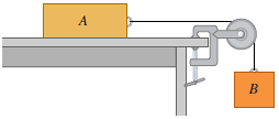
(a) Calculate the coefficient of kinetic friction between block A and the tabletop.
(b) A cat, also of weight 43.2 N, falls asleep on top of block A. If block B is now set into downward motion, what
is its acceleration?
| magnitude | m/s2 |
| direction | ---Select---upward downward |
Homework Answers
The concepts required to solve the given question are the Newton’s second law of motion and the types of forces acting on an object along an inclined plane.
Initially, find an expression for the net force acting on the system using Newton’s second law of motion. Then Substitute the values in the expression. Calculate the coefficient of kinetic friction from the expression. After that, apply Newton’s second law of motion in the case of block A. Write an expression for the net force acting on the block A. Then calculate the magnitude and direction of acceleration by solving the above expression.
Force may be defined as the sudden push or pull which is capable of changing the direction of the object.
Newton’s second law of motion: It states that the acceleration of an object produced by a net force is directly proportional to the magnitude of net force and inversely proportional to the mass of the object.
Mathematical expression for Newton’s second law is,

Here, F is the force acting on the object, m is the mass and a is the acceleration of the object.
Mass of the object is defined as the “physical property that measures an object’s resistance to acceleration”. Acceleration of the object may be defined as the “rate of change of velocity per unit time”.
Frictional force is the resistive force which tries to oppose the motion of the object. The direction of the frictional force is opposite to that of the direction of motion. Coefficient of kinetic friction becomes more pronounced in the case of surfaces in relative motion. It is the ratio of frictional force to normal force (force perpendicular to the surface).
Mathematical expression for coefficient of kinetic friction is,

Here,  is the coefficient of kinetic friction,
  is the frictional force and
  is the normal force.
Weight of the object is the mass times acceleration due to gravity of the object. The expression is given by,

Here, W is the weight of the object, m is the mass and g is the acceleration due to gravity.
(a)
Coefficient of kinetic friction:
Net horizontal force acting on A is,

 ……(1)
……(1)
Net horizontal force acting on B is,

From equation (1),

Coefficient of kinetic friction between block A and tabletop is,

Substitute 29 N for  43.2 N for
  to find
  .
.

(b)
Magnitude and direction of acceleration:
Net force acting on the block B is,
 ……(2)
……(2)
Net force acting on the block A is,

Substitute  for
for  from equation (2) in the above equation.

Substitute  for
for  and
and  ,
,  for
for  and
and  for
for  in the above equation.
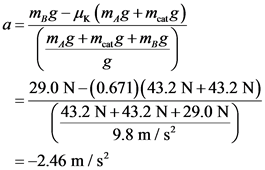
Coefficient of kinetic friction between block A and tabletop is, 0.671.
Part bMagnitude of acceleration of block B during the downward motion is,  and the direction is upwards.
Add Answer to:
Consider the system shown in the figure below. Block A weighs 43.2 N and block B...
Consider the system shown in the figure.(Figure 1) Block A has weight 5.0 N and block...
Consider the system shown in the figure.(Figure 1) Block A has weight 5.0 N and block B has weight 3.0 N . Once block B is set into downward motion, it descends at a constant speed. Assume that the mass and friction of the pulley are negligible. Calculate the coefficient of kinetic friction μ between block A and the table top.
Consider the system shown in the figure. Block A has weight 4.91 N and block B has weight 2.94 N. Once block B is set in...
Consider the system shown in the figure. Block A has weight 4.91 N and block B has weight 2.94 N. Once block B is set into downward motion, it descends at a constant speed. Assume that the mass and friction of the pulley are negligible. Calculate the coefficient of kinetic friction mu between block A and the table top. I'm not sure where to begin.
Consider the system shown in the figure.(Figure 1) Block A has weight 5.4 N and block...
 Consider the system shown in the figure.(Figure 1) Block A has
weight 5.4 N and block B has weight 3.6 N . Once block B is set
into downward motion, it descends at a constant speed. Assume that
the mass and friction of the pulley are negligible.
Calculate the coefficient of kinetic friction μ between block A
and the table top.
Express your answer numerically.
μ =
Consider the system shown in the figure.(Figure 1) Block A has
weight 5.4 N and block B has weight 3.6 N . Once block B is set
into downward motion, it descends at a constant speed. Assume that
the mass and friction of the pulley are negligible.
Calculate the coefficient of kinetic friction μ between block A
and the table top.
Express your answer numerically.
μ =
Kinetic Friction in a Block-and-Pulley System ③ 134 10 Consider the system shown in the figure...
 Kinetic Friction in a Block-and-Pulley System ③ 134 10 Consider the system shown in the figure (Figure 1) Block A has weight 5.8 N and block Bhas weight 3.2 N . Once block B is set into downward motion, it descends at a constant speed. Assume that the mass and friction of the pulley are negligible Part A between block and the table top Calculate the coefficient of kinetic friction Express your answer numerically, View Available Hints) DVD AED 0...
ReviewI ConstantsI Periodic Table Part A Consider the system shown in the figure.(Figure 1) Block A...
 ReviewI ConstantsI Periodic Table Part A Consider the system shown in the figure.(Figure 1) Block A has weight 5.0 N and block B has weight 3.6 N Once block B is set into downward motion, it descends at a constant speed. Assume that the mass and friction of the pulley are negligible Calculate the coefficient of kinetic friction between block A and the table top. Express your answer numerically View Available Hint(s) Figure 1 of 1 Submit Provide Feedback
Item 21 21 of 25 Consider the system shown in the figure.(Figure 1) Block A has...
 Item 21 21 of 25 Consider the system shown in the figure.(Figure 1) Block A has weight 5.6 N and block B has weight 3.0 N. Once block B is set into downward motion, it descends at a constant speed. Assume that the mass Part A Calculate the coefficient of kinetic friction μ between block A and the table top. Express your answer numerically. y are negligible. View Available Hint(s) μ= Submit Provide Feedback Next > Figure 1 of 1
Block A weighs 1.4 N and block B weighs 4.2 N. The coefficient of kinetic friction...
 Block A weighs 1.4 N and block B weighs 4.2 N. The
coefficient of kinetic friction between all surfaces is 0.3.
Find the magnitude of force F as shown in Fig. 1
necessary to drag block B to the
left at an acceleration of 2 m/s2 if A and B
are connected by a light flexible cord passing around
a fixed frictionless pulley.
F А 30° B Fig. 1
Block A weighs 1.4 N and block B weighs 4.2 N. The
coefficient of kinetic friction between all surfaces is 0.3.
Find the magnitude of force F as shown in Fig. 1
necessary to drag block B to the
left at an acceleration of 2 m/s2 if A and B
are connected by a light flexible cord passing around
a fixed frictionless pulley.
F А 30° B Fig. 1
Block A in the figure (Figure 1) weighs 1.22 N and block B weighs 3.69 N...
 Block A in the figure (Figure 1) weighs 1.22 N and
block B weighs 3.69 N . The coefficient of kinetic
friction between all surfaces is 0.304.
Find the magnitude of the horizontal force
F⃗ necessary to drag block B to the
left at constant speed if A rests on B and moves
with it (figure (a)).
Find the magnitude of the horizontal force
F⃗ necessary to drag block B to the
left at constant speed if A is held at rest...
Block A in the figure (Figure 1) weighs 1.22 N and
block B weighs 3.69 N . The coefficient of kinetic
friction between all surfaces is 0.304.
Find the magnitude of the horizontal force
F⃗ necessary to drag block B to the
left at constant speed if A rests on B and moves
with it (figure (a)).
Find the magnitude of the horizontal force
F⃗ necessary to drag block B to the
left at constant speed if A is held at rest...
Block A in the figure weighs 3.6 N, and block B weighs 5.4 N. Block A...
 Block A in the figure weighs 3.6 N, and block B weighs 5.4 N. Block A is attached to the wall by a string, and the coefficient of kinetic friction between all surfaces is 0.25. Calculate the force F necessary to drag block B to the left at constant speed.
17-Block A weighs 10 N and block B weighs 3 N. If B is moving downward...
 17-Block A weighs 10 N and block B weighs 3 N. If B is moving downward with a velocity (VB)3 m/s at t 0, determine the velocity of A whent-1 s. The coefficient of kinetic friction between the horizontal plane and block A is 0.15 (Use impulse and momentum concept) (vB 3 m
 Consider the system shown in the figure.(Figure 1) Block A has
weight 5.4 N and block B has weight 3.6 N . Once block B is set
into downward motion, it descends at a constant speed. Assume that
the mass and friction of the pulley are negligible.
Calculate the coefficient of kinetic friction μ between block A
and the table top.
Express your answer numerically.
μ =
Consider the system shown in the figure.(Figure 1) Block A has
weight 5.4 N and block B has weight 3.6 N . Once block B is set
into downward motion, it descends at a constant speed. Assume that
the mass and friction of the pulley are negligible.
Calculate the coefficient of kinetic friction μ between block A
and the table top.
Express your answer numerically.
μ =
 Kinetic Friction in a Block-and-Pulley System ③ 134 10 Consider the system shown in the figure (Figure 1) Block A has weight 5.8 N and block Bhas weight 3.2 N . Once block B is set into downward motion, it descends at a constant speed. Assume that the mass and friction of the pulley are negligible Part A between block and the table top Calculate the coefficient of kinetic friction Express your answer numerically, View Available Hints) DVD AED 0...
 ReviewI ConstantsI Periodic Table Part A Consider the system shown in the figure.(Figure 1) Block A has weight 5.0 N and block B has weight 3.6 N Once block B is set into downward motion, it descends at a constant speed. Assume that the mass and friction of the pulley are negligible Calculate the coefficient of kinetic friction between block A and the table top. Express your answer numerically View Available Hint(s) Figure 1 of 1 Submit Provide Feedback
 Item 21 21 of 25 Consider the system shown in the figure.(Figure 1) Block A has weight 5.6 N and block B has weight 3.0 N. Once block B is set into downward motion, it descends at a constant speed. Assume that the mass Part A Calculate the coefficient of kinetic friction μ between block A and the table top. Express your answer numerically. y are negligible. View Available Hint(s) μ= Submit Provide Feedback Next > Figure 1 of 1
 Block A weighs 1.4 N and block B weighs 4.2 N. The
coefficient of kinetic friction between all surfaces is 0.3.
Find the magnitude of force F as shown in Fig. 1
necessary to drag block B to the
left at an acceleration of 2 m/s2 if A and B
are connected by a light flexible cord passing around
a fixed frictionless pulley.
F А 30° B Fig. 1
Block A weighs 1.4 N and block B weighs 4.2 N. The
coefficient of kinetic friction between all surfaces is 0.3.
Find the magnitude of force F as shown in Fig. 1
necessary to drag block B to the
left at an acceleration of 2 m/s2 if A and B
are connected by a light flexible cord passing around
a fixed frictionless pulley.
F А 30° B Fig. 1
 Block A in the figure (Figure 1) weighs 1.22 N and
block B weighs 3.69 N . The coefficient of kinetic
friction between all surfaces is 0.304.
Find the magnitude of the horizontal force
F⃗ necessary to drag block B to the
left at constant speed if A rests on B and moves
with it (figure (a)).
Find the magnitude of the horizontal force
F⃗ necessary to drag block B to the
left at constant speed if A is held at rest...
Block A in the figure (Figure 1) weighs 1.22 N and
block B weighs 3.69 N . The coefficient of kinetic
friction between all surfaces is 0.304.
Find the magnitude of the horizontal force
F⃗ necessary to drag block B to the
left at constant speed if A rests on B and moves
with it (figure (a)).
Find the magnitude of the horizontal force
F⃗ necessary to drag block B to the
left at constant speed if A is held at rest...
 Block A in the figure weighs 3.6 N, and block B weighs 5.4 N. Block A is attached to the wall by a string, and the coefficient of kinetic friction between all surfaces is 0.25. Calculate the force F necessary to drag block B to the left at constant speed.
 17-Block A weighs 10 N and block B weighs 3 N. If B is moving downward with a velocity (VB)3 m/s at t 0, determine the velocity of A whent-1 s. The coefficient of kinetic friction between the horizontal plane and block A is 0.15 (Use impulse and momentum concept) (vB 3 m
Most questions answered within 3 hours.
-
Where is the error in this code sequence?
String s1 = "Hello";
String s2 = "ello";...
asked 10 months ago -
Financial data for Joel de Paris, Inc., for last year
follow:
Joel de Paris, Inc.
Balance...
asked 10 months ago -
Consider this reaction:
Al2(SO4)3 (aq)+ BaCl3
(aq) Al2Cl6 (aq)- +
3BaSO4(s) . What is the...
asked 10 months ago -
Suppose that Savneet is considering increasing her
recent random sample from 20 car rentals to 40...
asked 10 months ago -
Trucks arrive at an unloading terminal at an average rate of 120
per hour.
Trucks arrive...
asked 10 months ago -
Why are methanol and ethanol completely soluble in water while
octanol is not very little soluble....
asked 10 months ago -
A facilities manager at a university reads in a research report
that the mean amount of...
asked 10 months ago -
When the CuSO4 is rehydrated by adding water to the anhydrous
compound, is this an endothermic...
asked 10 months ago -
A ray of sunlight is passing from diamond into crown glass; the
angle of incidence is...
asked 10 months ago -
A block of mass 0.249 kg is placed on top of a light, vertical
spring of...
asked 10 months ago -
how do the kidneys compensate in the presences of acidosis
a) trigger hyperventilate
b) reserve acid...
asked 10 months ago -
Question 501 pts
The rental rate of capital to the firm increases. Which of the
following...
asked 10 months ago