
Homework Answers

Add Answer to:
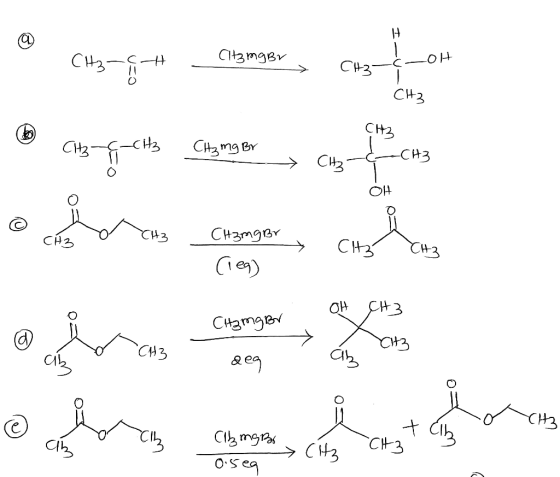
only question # 2
a. using anhydrous ether b. not rinsing glassware with acetone before the...
1)Explain using drawings why acetaldehyde reacts faster than acetone to nucleophilic acyl addition. 2) 3)What is...
 1)Explain using drawings why acetaldehyde
reacts faster than acetone to nucleophilic acyl addition.
2)
3)What is the major purpose of pyridine in nucleophile acyl
substitution reactions (for example, a reaction including an acid
chloride with pyridine)?
i. What is the purpose of the cyclic acetal in the following reaction? ii. Draw the product formed if the original starting material was treated with 1. LiAlH4 & 2. H20 (i.e. what would happen if the 1st and 3rd reactions were not performed?)...
1)Explain using drawings why acetaldehyde
reacts faster than acetone to nucleophilic acyl addition.
2)
3)What is the major purpose of pyridine in nucleophile acyl
substitution reactions (for example, a reaction including an acid
chloride with pyridine)?
i. What is the purpose of the cyclic acetal in the following reaction? ii. Draw the product formed if the original starting material was treated with 1. LiAlH4 & 2. H20 (i.e. what would happen if the 1st and 3rd reactions were not performed?)...
Grignard reagent THE GRIGNARD REAGENT-PREPARATION AND REACTION In this experiment, you will prepa...
 i need help with the prelab questions please
Grignard reagent THE GRIGNARD REAGENT-PREPARATION AND REACTION In this experiment, you will prepare a Grignard reagent, phenyl magnesium bromide, from bromobenzene and magnesium metal. The Grignard reagent will then react with methyl benzoate to form triphenylmethanol. Introduction Grignard reagents, such as organomagnesium halides, were discovered in 1910 by French chemist Victor Grignard. The Grignard reaction is one of the most general methods for carbon- carbon bond formation in all of organic chemistry....
i need help with the prelab questions please
Grignard reagent THE GRIGNARD REAGENT-PREPARATION AND REACTION In this experiment, you will prepare a Grignard reagent, phenyl magnesium bromide, from bromobenzene and magnesium metal. The Grignard reagent will then react with methyl benzoate to form triphenylmethanol. Introduction Grignard reagents, such as organomagnesium halides, were discovered in 1910 by French chemist Victor Grignard. The Grignard reaction is one of the most general methods for carbon- carbon bond formation in all of organic chemistry....
Grignard reagent THE GRIGNARD REAGENT-PREPARATION AND REACTION In this experiment, you will prepa...
 i need help with the postlab questions please
Grignard reagent THE GRIGNARD REAGENT-PREPARATION AND REACTION In this experiment, you will prepare a Grignard reagent, phenyl magnesium bromide, from bromobenzene and magnesium metal. The Grignard reagent will then react with methyl benzoate to form triphenylmethanol. Introduction Grignard reagents, such as organomagnesium halides, were discovered in 1910 by French chemist Victor Grignard. The Grignard reaction is one of the most general methods for carbon- carbon bond formation in all of organic chemistry....
i need help with the postlab questions please
Grignard reagent THE GRIGNARD REAGENT-PREPARATION AND REACTION In this experiment, you will prepare a Grignard reagent, phenyl magnesium bromide, from bromobenzene and magnesium metal. The Grignard reagent will then react with methyl benzoate to form triphenylmethanol. Introduction Grignard reagents, such as organomagnesium halides, were discovered in 1910 by French chemist Victor Grignard. The Grignard reaction is one of the most general methods for carbon- carbon bond formation in all of organic chemistry....
please answer the prelab excercise:) I tried doing it but I did not get very far Experiment 7: Grignard Reactio...
 please answer the prelab excercise:) I tried doing it but I did not
get very far
Experiment 7: Grignard Reaction. Introduction Discovered by French chemist Victor Grignard, the reaction that now bears his name is an example of the preparation of an organometallic reagent. In this lab, phenylmagnesium bromide is the Grignard of interest, and it will be added to an aldehyde to produce an alcohol. Lab Objectives 1. To study organometallic reagents in general. benzophenone. 2. To prepare phenylmagnesium...
please answer the prelab excercise:) I tried doing it but I did not
get very far
Experiment 7: Grignard Reaction. Introduction Discovered by French chemist Victor Grignard, the reaction that now bears his name is an example of the preparation of an organometallic reagent. In this lab, phenylmagnesium bromide is the Grignard of interest, and it will be added to an aldehyde to produce an alcohol. Lab Objectives 1. To study organometallic reagents in general. benzophenone. 2. To prepare phenylmagnesium...
. Grignard Reagents and As (Addition, Nucleophil ic) Additions Magnesium metal spontaneously reduces organohalides via...
 .
Grignard Reagents and As (Addition, Nucleophil ic) Additions Magnesium metal spontaneously reduces organohalides via a succession transfers. This results in the Grignard 'insertion reaction, as proposed in the 1920s single electron Procedure t was only Part A: Preparation of the Glassyware and Magnesium successful in ether solvents, and failed utterly n hydrocarbons such as benzene. 1. The Grignard reagent camot form in the presence of water, and any water that it comes Mg (solid) into contact with immed iately...
.
Grignard Reagents and As (Addition, Nucleophil ic) Additions Magnesium metal spontaneously reduces organohalides via a succession transfers. This results in the Grignard 'insertion reaction, as proposed in the 1920s single electron Procedure t was only Part A: Preparation of the Glassyware and Magnesium successful in ether solvents, and failed utterly n hydrocarbons such as benzene. 1. The Grignard reagent camot form in the presence of water, and any water that it comes Mg (solid) into contact with immed iately...
What is the theoretical yield (in grams) and percent yield of your triphenylmethanol product in this...
 What is the theoretical yield (in grams) and percent yield of your
triphenylmethanol product in this experiment? (Weight of
triphenylmethanol: 0.060g)
BACKGROUND AND THEORY The Grignard reaction was one of the first organometallic reactions discovered and is still one of the most useful synthetically. By reacting an organohalide (usually a bromide) with magnesium in ethereal solvent, carbon becomes a nucleophile. Grignard reagents are the starting points for the syntheses of many alkanes, primary, secondary, and tertiary alcohols, alkenes, and carboxylic...
What is the theoretical yield (in grams) and percent yield of your
triphenylmethanol product in this experiment? (Weight of
triphenylmethanol: 0.060g)
BACKGROUND AND THEORY The Grignard reaction was one of the first organometallic reactions discovered and is still one of the most useful synthetically. By reacting an organohalide (usually a bromide) with magnesium in ethereal solvent, carbon becomes a nucleophile. Grignard reagents are the starting points for the syntheses of many alkanes, primary, secondary, and tertiary alcohols, alkenes, and carboxylic...
please find the purpse, Discussion, conclusion un 27 Phoenix June 20 8:10 PM a 35AEXPERIMENT 35A...
 please find the purpse, Discussion, conclusion
un 27 Phoenix June 20 8:10 PM a 35AEXPERIMENT 35A Triphenylmethanol PROCEDURE ether MgBr+ C-OH + MgBr(OH) OMgBr 0 Addct Addition of Benzophenone While the phenylmagnesium bromide solution is being heated and stirred under reflux, make a solution of 1.09 g benzophenone in 2 mL of anhrudrous ether in a 5-mL conical vial. Cap the vial until the reflux period is over. Once the Grignard reagent is cooled to room temperature, draw some of...
please find the purpse, Discussion, conclusion
un 27 Phoenix June 20 8:10 PM a 35AEXPERIMENT 35A Triphenylmethanol PROCEDURE ether MgBr+ C-OH + MgBr(OH) OMgBr 0 Addct Addition of Benzophenone While the phenylmagnesium bromide solution is being heated and stirred under reflux, make a solution of 1.09 g benzophenone in 2 mL of anhrudrous ether in a 5-mL conical vial. Cap the vial until the reflux period is over. Once the Grignard reagent is cooled to room temperature, draw some of...
QUESTIONS TO ANSWER: Prepare a table of all chemicals used with the structure and purpose of...
 QUESTIONS TO ANSWER:
Prepare a table of all chemicals used with the structure and
purpose of each.
Calculate the theoretical yield by finding limiting reactant of
the experiment by converting reactants to product (remember to show
all calculations used)
Calculate the percent yield using the limiting reactant
Calculate the Rf for triphenylmethanol. If there are two dots,
determine which one is triphenylmethanol.. ( I did not provide
data. Please let me know how I Would do this if I did)...
QUESTIONS TO ANSWER:
Prepare a table of all chemicals used with the structure and
purpose of each.
Calculate the theoretical yield by finding limiting reactant of
the experiment by converting reactants to product (remember to show
all calculations used)
Calculate the percent yield using the limiting reactant
Calculate the Rf for triphenylmethanol. If there are two dots,
determine which one is triphenylmethanol.. ( I did not provide
data. Please let me know how I Would do this if I did)...
Citrate Utilization Test OBSERVATIONS AND INTERPRETATIONS 1 Using Table 5-10, page 340, as a guide, enter...
 Citrate Utilization Test OBSERVATIONS AND INTERPRETATIONS 1 Using Table 5-10, page 340, as a guide, enter your results in the table below. Organism Color Result (+ or -) Interpretation Control QUESTIONS 1 Consider the uninoculated tube. a. Is it a positive or a negative control? b. What information is provided by the uninoculated control? Rus. ay Manry bacteria that are able to metabolize citrate (as seen in the citric acid cycle) produce negative e this test. Why? Be specific. ative...
 1)Explain using drawings why acetaldehyde
reacts faster than acetone to nucleophilic acyl addition.
2)
3)What is the major purpose of pyridine in nucleophile acyl
substitution reactions (for example, a reaction including an acid
chloride with pyridine)?
i. What is the purpose of the cyclic acetal in the following reaction? ii. Draw the product formed if the original starting material was treated with 1. LiAlH4 & 2. H20 (i.e. what would happen if the 1st and 3rd reactions were not performed?)...
1)Explain using drawings why acetaldehyde
reacts faster than acetone to nucleophilic acyl addition.
2)
3)What is the major purpose of pyridine in nucleophile acyl
substitution reactions (for example, a reaction including an acid
chloride with pyridine)?
i. What is the purpose of the cyclic acetal in the following reaction? ii. Draw the product formed if the original starting material was treated with 1. LiAlH4 & 2. H20 (i.e. what would happen if the 1st and 3rd reactions were not performed?)...
 i need help with the prelab questions please
Grignard reagent THE GRIGNARD REAGENT-PREPARATION AND REACTION In this experiment, you will prepare a Grignard reagent, phenyl magnesium bromide, from bromobenzene and magnesium metal. The Grignard reagent will then react with methyl benzoate to form triphenylmethanol. Introduction Grignard reagents, such as organomagnesium halides, were discovered in 1910 by French chemist Victor Grignard. The Grignard reaction is one of the most general methods for carbon- carbon bond formation in all of organic chemistry....
i need help with the prelab questions please
Grignard reagent THE GRIGNARD REAGENT-PREPARATION AND REACTION In this experiment, you will prepare a Grignard reagent, phenyl magnesium bromide, from bromobenzene and magnesium metal. The Grignard reagent will then react with methyl benzoate to form triphenylmethanol. Introduction Grignard reagents, such as organomagnesium halides, were discovered in 1910 by French chemist Victor Grignard. The Grignard reaction is one of the most general methods for carbon- carbon bond formation in all of organic chemistry....
 i need help with the postlab questions please
Grignard reagent THE GRIGNARD REAGENT-PREPARATION AND REACTION In this experiment, you will prepare a Grignard reagent, phenyl magnesium bromide, from bromobenzene and magnesium metal. The Grignard reagent will then react with methyl benzoate to form triphenylmethanol. Introduction Grignard reagents, such as organomagnesium halides, were discovered in 1910 by French chemist Victor Grignard. The Grignard reaction is one of the most general methods for carbon- carbon bond formation in all of organic chemistry....
i need help with the postlab questions please
Grignard reagent THE GRIGNARD REAGENT-PREPARATION AND REACTION In this experiment, you will prepare a Grignard reagent, phenyl magnesium bromide, from bromobenzene and magnesium metal. The Grignard reagent will then react with methyl benzoate to form triphenylmethanol. Introduction Grignard reagents, such as organomagnesium halides, were discovered in 1910 by French chemist Victor Grignard. The Grignard reaction is one of the most general methods for carbon- carbon bond formation in all of organic chemistry....
 please answer the prelab excercise:) I tried doing it but I did not
get very far
Experiment 7: Grignard Reaction. Introduction Discovered by French chemist Victor Grignard, the reaction that now bears his name is an example of the preparation of an organometallic reagent. In this lab, phenylmagnesium bromide is the Grignard of interest, and it will be added to an aldehyde to produce an alcohol. Lab Objectives 1. To study organometallic reagents in general. benzophenone. 2. To prepare phenylmagnesium...
please answer the prelab excercise:) I tried doing it but I did not
get very far
Experiment 7: Grignard Reaction. Introduction Discovered by French chemist Victor Grignard, the reaction that now bears his name is an example of the preparation of an organometallic reagent. In this lab, phenylmagnesium bromide is the Grignard of interest, and it will be added to an aldehyde to produce an alcohol. Lab Objectives 1. To study organometallic reagents in general. benzophenone. 2. To prepare phenylmagnesium...
 .
Grignard Reagents and As (Addition, Nucleophil ic) Additions Magnesium metal spontaneously reduces organohalides via a succession transfers. This results in the Grignard 'insertion reaction, as proposed in the 1920s single electron Procedure t was only Part A: Preparation of the Glassyware and Magnesium successful in ether solvents, and failed utterly n hydrocarbons such as benzene. 1. The Grignard reagent camot form in the presence of water, and any water that it comes Mg (solid) into contact with immed iately...
.
Grignard Reagents and As (Addition, Nucleophil ic) Additions Magnesium metal spontaneously reduces organohalides via a succession transfers. This results in the Grignard 'insertion reaction, as proposed in the 1920s single electron Procedure t was only Part A: Preparation of the Glassyware and Magnesium successful in ether solvents, and failed utterly n hydrocarbons such as benzene. 1. The Grignard reagent camot form in the presence of water, and any water that it comes Mg (solid) into contact with immed iately...
 What is the theoretical yield (in grams) and percent yield of your
triphenylmethanol product in this experiment? (Weight of
triphenylmethanol: 0.060g)
BACKGROUND AND THEORY The Grignard reaction was one of the first organometallic reactions discovered and is still one of the most useful synthetically. By reacting an organohalide (usually a bromide) with magnesium in ethereal solvent, carbon becomes a nucleophile. Grignard reagents are the starting points for the syntheses of many alkanes, primary, secondary, and tertiary alcohols, alkenes, and carboxylic...
What is the theoretical yield (in grams) and percent yield of your
triphenylmethanol product in this experiment? (Weight of
triphenylmethanol: 0.060g)
BACKGROUND AND THEORY The Grignard reaction was one of the first organometallic reactions discovered and is still one of the most useful synthetically. By reacting an organohalide (usually a bromide) with magnesium in ethereal solvent, carbon becomes a nucleophile. Grignard reagents are the starting points for the syntheses of many alkanes, primary, secondary, and tertiary alcohols, alkenes, and carboxylic...
 please find the purpse, Discussion, conclusion
un 27 Phoenix June 20 8:10 PM a 35AEXPERIMENT 35A Triphenylmethanol PROCEDURE ether MgBr+ C-OH + MgBr(OH) OMgBr 0 Addct Addition of Benzophenone While the phenylmagnesium bromide solution is being heated and stirred under reflux, make a solution of 1.09 g benzophenone in 2 mL of anhrudrous ether in a 5-mL conical vial. Cap the vial until the reflux period is over. Once the Grignard reagent is cooled to room temperature, draw some of...
please find the purpse, Discussion, conclusion
un 27 Phoenix June 20 8:10 PM a 35AEXPERIMENT 35A Triphenylmethanol PROCEDURE ether MgBr+ C-OH + MgBr(OH) OMgBr 0 Addct Addition of Benzophenone While the phenylmagnesium bromide solution is being heated and stirred under reflux, make a solution of 1.09 g benzophenone in 2 mL of anhrudrous ether in a 5-mL conical vial. Cap the vial until the reflux period is over. Once the Grignard reagent is cooled to room temperature, draw some of...
 QUESTIONS TO ANSWER:
Prepare a table of all chemicals used with the structure and
purpose of each.
Calculate the theoretical yield by finding limiting reactant of
the experiment by converting reactants to product (remember to show
all calculations used)
Calculate the percent yield using the limiting reactant
Calculate the Rf for triphenylmethanol. If there are two dots,
determine which one is triphenylmethanol.. ( I did not provide
data. Please let me know how I Would do this if I did)...
QUESTIONS TO ANSWER:
Prepare a table of all chemicals used with the structure and
purpose of each.
Calculate the theoretical yield by finding limiting reactant of
the experiment by converting reactants to product (remember to show
all calculations used)
Calculate the percent yield using the limiting reactant
Calculate the Rf for triphenylmethanol. If there are two dots,
determine which one is triphenylmethanol.. ( I did not provide
data. Please let me know how I Would do this if I did)...
 Citrate Utilization Test OBSERVATIONS AND INTERPRETATIONS 1 Using Table 5-10, page 340, as a guide, enter your results in the table below. Organism Color Result (+ or -) Interpretation Control QUESTIONS 1 Consider the uninoculated tube. a. Is it a positive or a negative control? b. What information is provided by the uninoculated control? Rus. ay Manry bacteria that are able to metabolize citrate (as seen in the citric acid cycle) produce negative e this test. Why? Be specific. ative...
Most questions answered within 3 hours.
-
Where is the error in this code sequence?
String s1 = "Hello";
String s2 = "ello";...
asked 10 months ago -
Financial data for Joel de Paris, Inc., for last year
follow:
Joel de Paris, Inc.
Balance...
asked 10 months ago -
Consider this reaction:
Al2(SO4)3 (aq)+ BaCl3
(aq) Al2Cl6 (aq)- +
3BaSO4(s) . What is the...
asked 10 months ago -
Suppose that Savneet is considering increasing her
recent random sample from 20 car rentals to 40...
asked 10 months ago -
Trucks arrive at an unloading terminal at an average rate of 120
per hour.
Trucks arrive...
asked 10 months ago -
Why are methanol and ethanol completely soluble in water while
octanol is not very little soluble....
asked 10 months ago -
A facilities manager at a university reads in a research report
that the mean amount of...
asked 10 months ago -
When the CuSO4 is rehydrated by adding water to the anhydrous
compound, is this an endothermic...
asked 10 months ago -
A ray of sunlight is passing from diamond into crown glass; the
angle of incidence is...
asked 10 months ago -
A block of mass 0.249 kg is placed on top of a light, vertical
spring of...
asked 10 months ago -
how do the kidneys compensate in the presences of acidosis
a) trigger hyperventilate
b) reserve acid...
asked 10 months ago -
Question 501 pts
The rental rate of capital to the firm increases. Which of the
following...
asked 10 months ago