
Homework Answers
Add Answer to:
Calculate the probability that an electron will be found (a) between x 0.1 and 0.2 nm...
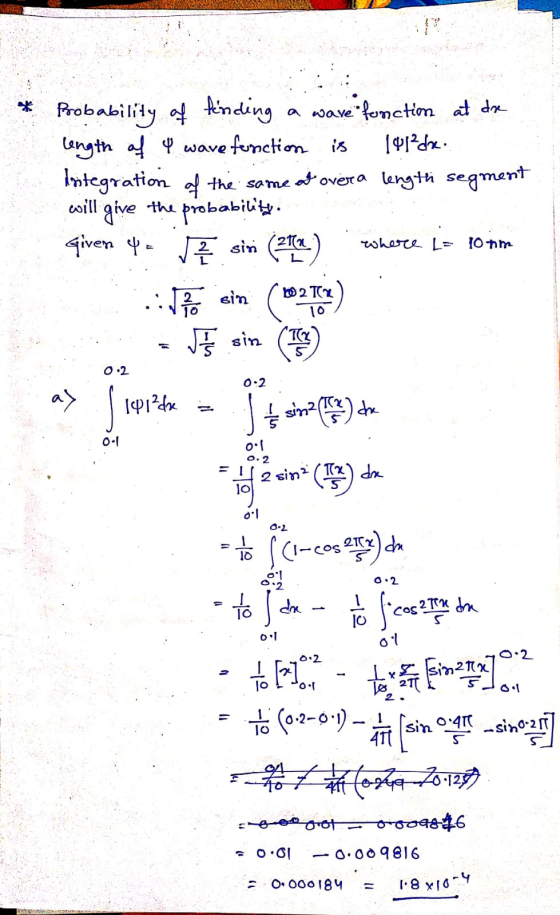
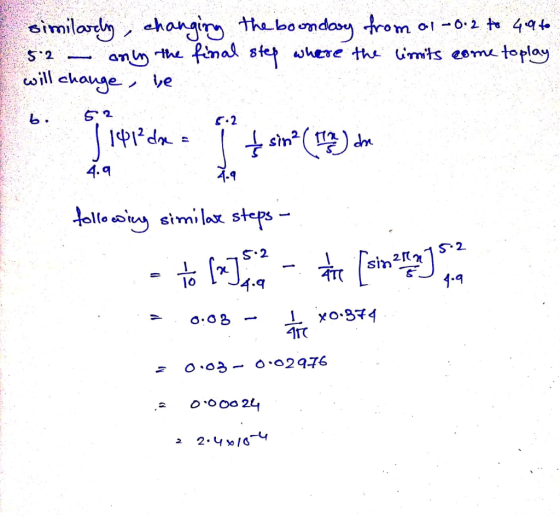
Claculate the probability that an electron will be found a) between x=0.1 and 0.2 nm b)...
Claculate the probability that an electron will be found a) between x=0.1 and 0.2 nm b) between 4.9 and 5.2 nm in a box of length L=10 nm when its wave function is y=(2/L)^1/2sin(2pix/L). Treat the wave functionas a constant in the small region of interest and interpret ?V and ?x in this one-dimensional system
9.19 Calculate the probability that an electron will be found (a) between x = 0.1 and...
9.19 Calculate the probability that an electron will be found (a) between x = 0.1 and 0.2 nm, and (b) between 4.9 and 5.2 nm in a box of length L = 10 nm when its wavefunction is y = (2/L)1/2 sin(2px/L). Hint: Treat the wavefunction as a constant in the small region of interest and interpret dV as dx. 9.20 Repeat Exercise 9.19, but allow for the variation of the wavefunction in the region of interest. What are the...
8.2(a) Calculate the probability that a particle will be found between 0.49L and 0.51L in a...
 8.2(a) Calculate the probability that a particle will be found between 0.49L and 0.51L in a box of length L when it has (a) n=1, (b) n=2. Take the wavefunction to be a constant in this range.
Calculate the probability that a particle will be found in a tiny slice of space between...
Calculate the probability that a particle will be found in a tiny slice of space between 0.49L and 0.51L in a box of length L (defined in the interval (0,L) ) when it is in quantum state n = 1. For simplicity of integration, take the wavefunction to have a constant value equal to its midpoint value in the range given.
Calculate the probability that a particle will be found in a tiny slice of space between...
 Calculate the probability that a particle will be found in a tiny slice of space between 0.69L and 0.71L in a box of length L (defined in the interval (0,1)) when it is in quantum state n = 1. For simplicity of integration, take the wavefunction to have a constant value equal to its midpoint value in the range given. .01
A particle is completely confined to one-dimensional region along the x-axis between the points x =...
 A particle is completely confined to one-dimensional region along the x-axis between the points x = ± L The wave function that describes its state is: SP 10 elsewhere where a and b are (as yet) unknown constants that can be expressed in terms of L Use the fact that the wave function must be continuous everywhere to solve for the constant b. The square of the wave function is a probability density, which means that the area under that...
5. (25 pts) An electron is trapped inside a rigid box of length L-0.250nm. a) If the electron is initially in the second excited state, what is the wavelength of the emitted photon if the electron ju...
 5. (25 pts) An electron is trapped inside a rigid box of length L-0.250nm. a) If the electron is initially in the second excited state, what is the wavelength of the emitted photon if the electron jumps to the ground state? b) The wavefunction for the electron in its first excited state is given by-(x)fsin2m excited state is given by ψ(x)--sin what is the probability of finding the electron in the middle region of the rigid box, srsc) Sketch the...
2. Electron overlap with nucleus (very important for electron capture): Since the possible positi...
 2. Electron overlap with nucleus (very important for electron capture): Since the possible position of the electron is smudged out, it even may overlap with the nucleus. a) What is the probability of an electron in the (1,0,0) state being between r-0 and ao? b) What is the probability of an electron in the (1,0,0) state being between r-0 and 1.25 fm? (remember how to solve integrals for a very small interval, see example 5.3) Example 5.3 Consider again an...
Consider an electron in a one-dimensional box of length 0.16 nm. (a) Calculate the energy difference...
Consider an electron in a one-dimensional box of length 0.16 nm. (a) Calculate the energy difference between the n = 2 and n = 1 states of the electron. (b) Calculate the energy difference for a N2 molecule in a one-dimensional box of length 11.2 cm.
I was only able to answer the first part correctly. please answer the rest correctly and clearly ...
 i was only able to answer the first part correctly. please
answer the rest correctly and clearly and show calculations. thank
you
The ground-state wave function for a particle confined to a one-dimensional box of length L is y - (2/L)1/2 sin (IX/L) Suppose the box is 10 nm long. Calculate the probability that the particle is located in the following areas. (a) between x- 4.49 nm and 5.08 nm 0.116 (b) between X-1.71 nm and 2.51 nm (c) between...
i was only able to answer the first part correctly. please
answer the rest correctly and clearly and show calculations. thank
you
The ground-state wave function for a particle confined to a one-dimensional box of length L is y - (2/L)1/2 sin (IX/L) Suppose the box is 10 nm long. Calculate the probability that the particle is located in the following areas. (a) between x- 4.49 nm and 5.08 nm 0.116 (b) between X-1.71 nm and 2.51 nm (c) between...
 8.2(a) Calculate the probability that a particle will be found between 0.49L and 0.51L in a box of length L when it has (a) n=1, (b) n=2. Take the wavefunction to be a constant in this range.
 Calculate the probability that a particle will be found in a tiny slice of space between 0.69L and 0.71L in a box of length L (defined in the interval (0,1)) when it is in quantum state n = 1. For simplicity of integration, take the wavefunction to have a constant value equal to its midpoint value in the range given. .01
 A particle is completely confined to one-dimensional region along the x-axis between the points x = ± L The wave function that describes its state is: SP 10 elsewhere where a and b are (as yet) unknown constants that can be expressed in terms of L Use the fact that the wave function must be continuous everywhere to solve for the constant b. The square of the wave function is a probability density, which means that the area under that...
 5. (25 pts) An electron is trapped inside a rigid box of length L-0.250nm. a) If the electron is initially in the second excited state, what is the wavelength of the emitted photon if the electron jumps to the ground state? b) The wavefunction for the electron in its first excited state is given by-(x)fsin2m excited state is given by ψ(x)--sin what is the probability of finding the electron in the middle region of the rigid box, srsc) Sketch the...
 2. Electron overlap with nucleus (very important for electron capture): Since the possible position of the electron is smudged out, it even may overlap with the nucleus. a) What is the probability of an electron in the (1,0,0) state being between r-0 and ao? b) What is the probability of an electron in the (1,0,0) state being between r-0 and 1.25 fm? (remember how to solve integrals for a very small interval, see example 5.3) Example 5.3 Consider again an...
 i was only able to answer the first part correctly. please
answer the rest correctly and clearly and show calculations. thank
you
The ground-state wave function for a particle confined to a one-dimensional box of length L is y - (2/L)1/2 sin (IX/L) Suppose the box is 10 nm long. Calculate the probability that the particle is located in the following areas. (a) between x- 4.49 nm and 5.08 nm 0.116 (b) between X-1.71 nm and 2.51 nm (c) between...
i was only able to answer the first part correctly. please
answer the rest correctly and clearly and show calculations. thank
you
The ground-state wave function for a particle confined to a one-dimensional box of length L is y - (2/L)1/2 sin (IX/L) Suppose the box is 10 nm long. Calculate the probability that the particle is located in the following areas. (a) between x- 4.49 nm and 5.08 nm 0.116 (b) between X-1.71 nm and 2.51 nm (c) between...
Most questions answered within 3 hours.
-
Where is the error in this code sequence?
String s1 = "Hello";
String s2 = "ello";...
asked 10 months ago -
Financial data for Joel de Paris, Inc., for last year
follow:
Joel de Paris, Inc.
Balance...
asked 10 months ago -
Consider this reaction:
Al2(SO4)3 (aq)+ BaCl3
(aq) Al2Cl6 (aq)- +
3BaSO4(s) . What is the...
asked 10 months ago -
Suppose that Savneet is considering increasing her
recent random sample from 20 car rentals to 40...
asked 10 months ago -
Trucks arrive at an unloading terminal at an average rate of 120
per hour.
Trucks arrive...
asked 10 months ago -
Why are methanol and ethanol completely soluble in water while
octanol is not very little soluble....
asked 10 months ago -
A facilities manager at a university reads in a research report
that the mean amount of...
asked 10 months ago -
When the CuSO4 is rehydrated by adding water to the anhydrous
compound, is this an endothermic...
asked 10 months ago -
A ray of sunlight is passing from diamond into crown glass; the
angle of incidence is...
asked 10 months ago -
A block of mass 0.249 kg is placed on top of a light, vertical
spring of...
asked 10 months ago -
how do the kidneys compensate in the presences of acidosis
a) trigger hyperventilate
b) reserve acid...
asked 10 months ago -
Question 501 pts
The rental rate of capital to the firm increases. Which of the
following...
asked 10 months ago