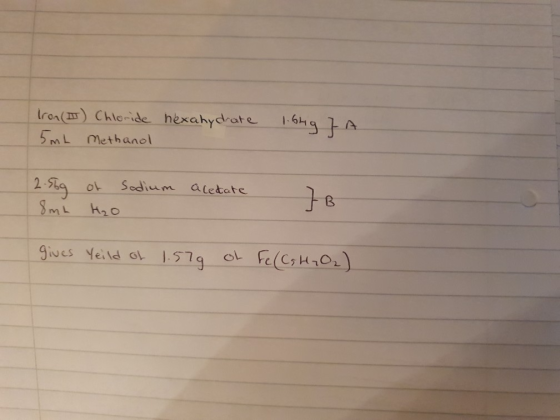
write the balanced equation for this reaction and calculate the percentage yield.

Homework Answers

Add Answer to:
write the balanced equation for this reaction and
calculate the percentage yield.
Iron (I) Chloride hexahydrate...
write a balanced equation for this reaction and calculate the percentage yield of the product. (FeCl3.6420)...
 write a balanced equation for this reaction and
calculate the percentage yield of the product.
(FeCl3.6420) tron (II) Chloride hexahydrate 1.64g } A 13 mL H2O add solution B to A Talg acetylacerone 5 mL methonal JB acetate I add to A+B mixture 2.56g of Sodium 8nh H₂O gives yeild of 157g of Fe (Cs H₂O2)
write a balanced equation for this reaction and
calculate the percentage yield of the product.
(FeCl3.6420) tron (II) Chloride hexahydrate 1.64g } A 13 mL H2O add solution B to A Talg acetylacerone 5 mL methonal JB acetate I add to A+B mixture 2.56g of Sodium 8nh H₂O gives yeild of 157g of Fe (Cs H₂O2)
c. Given an actual yield of 0.99 g iron(II) oxalate, FeC204.2H20, calculate the percentage yield SO.)...
 c. Given an actual yield of 0.99 g iron(II) oxalate, FeC204.2H20, calculate the percentage yield SO.) 6H0+ 2. H.C.O. - fear 2 C-2 - 2 16 FeC20:2H20 +_SH.C.O. + 2 FeC.0, 2H,0 + (NH) SO. + _H.SO. + H0 Fe- 1 0 =15 S=2 H2O2+ 3.KC,8. - K [Fe(COT 3H30 Transfer the balanced chemical reactions to page 6. 4. Use the first of the above balanced chemical equations to determine the following a. The reaction mixture initially contains 2.5 of...
1 U UIO 1. Write the balanced equation for the reaction of nickel(II) chloride hexahydrate when...
 1 U UIO 1. Write the balanced equation for the reaction of nickel(II) chloride hexahydrate when heated. 2. Write the balanced equation for the reaction of hydrochloric acid and sodium carbonate.
Irom metal reacts with chlorine gas giving iron(II) chloride. The balanced chemical equationfor this reaction is:...
 Irom metal reacts with chlorine gas giving iron(II) chloride. The balanced chemical equationfor this reaction is: 2 Fe(s) 3 C12(g) 2 FeCl3(s) 75.5 g FeCl, can be produced from 26.0 g of iron and excess Clh. If only 21.3 g of FeCly is obtained, what is the percent yield?
Please write out full reaction mechanism: Iron (II) chloride tetrahydrate and iron (III) chloride hexahydrate will...
Please write out full reaction mechanism: Iron (II) chloride tetrahydrate and iron (III) chloride hexahydrate will be dissolved in deionized (DI) water to form a homogeneous solution. The solution will then be heated in a water bath at 65°C for 15-20 minutes; followed by the addition of 25% sodium hydroxide. Please write full chemical formula (step by step + explanation) so that I can understand. Please write legibly if handwritten. Thank you so much!
2. (2 points) Calculate the percentage of Fe in pure iron(I) ammonium sulfate hexahydrate: (NH4)2[Fe(SO4)2]. 6...
 2. (2 points) Calculate the percentage of Fe in pure iron(I) ammonium sulfate hexahydrate: (NH4)2[Fe(SO4)2]. 6 H2O.
- Determine the theoretical yield in grams of iron(II) oxalate dihydrate, FeC204.2H20. Balance the following chemical...
 - Determine the theoretical yield in grams of iron(II) oxalate dihydrate, FeC204.2H20. Balance the following chemical equations: Feat =R2 N- Fe(NH)-(SO)2 + 6H-0+ 2.H.C0. - 2 FC 02H0+ (NH.)50. + HS0+ & HO H=22 N=2 C2 Fel 0=15 S=2 FeC204. 2H2O + H2C2O4 + H2O2 + 3 K.CO. - KiſFcc0bf-3H30 Transfer the balanced chemical reactions to page 6. 4. Use the first of the above balanced chemical equations to determine the following a. The reaction mixture initially contains 2.5 g...
51 3. Hydroxylammonium chloride reacts with iron(lIl) chloride, FeCl, in solution to produce iron(I) chloride, HCl,...
 51 3. Hydroxylammonium chloride reacts with iron(lIl) chloride, FeCl, in solution to produce iron(I) chloride, HCl, H,O, and a compound of nitrogen. It was found that 2.00g of iron(II) chioride reacted in this way with 31.0 mL of 0.200M hydroxylammonium chloride. Suggest a possible formula for the compound of nitrogen so produced. This should be a known nitrogen compound. 4. Arsenic(II) oxide, As,O3, can be titrated with potassium bromate in aqueous solution to produce potassium bromide and arsenic acid, H,AsO,....
Write a balanced molecular equation for the reaction that occurs when aqueous solutions of iron(II) chloride...
Write a balanced molecular equation for the reaction that occurs when aqueous solutions of iron(II) chloride and lithium hydroxide react to form aqueous lithium chloride and an iron(II) hydroxide precipitate. FeCl2(aq) + LiOH(aq) → Fe(OH)2(s) + LiCl(aq) You have the reactants and products correct! Great job! But the chemical equation is not balanced. FeCl2(aq) + 2 LiOH(aq) → Fe(OH)2(aq) + 2 LiCl(aq) 2 FeCl2(aq) + LiOH(aq) → 2 Fe(OH)2(s) + LiCl(aq) FeCl2(aq) + 2 LiOH(aq) →...
Iron metal reacts with chlorine gas giving iron(III)chloride. The balanced chemical equation for this reaction is:...
Iron metal reacts with chlorine gas giving iron(III)chloride. The balanced chemical equation for this reaction is: 2 Fe (s)+ 3 Cl2 (g) ---------> 2FeCl3 (s) If only 21.4 g of FeCl3 is obtained from 35.0 g of iron and excess Cl2, what is the percent yield?
 write a balanced equation for this reaction and
calculate the percentage yield of the product.
(FeCl3.6420) tron (II) Chloride hexahydrate 1.64g } A 13 mL H2O add solution B to A Talg acetylacerone 5 mL methonal JB acetate I add to A+B mixture 2.56g of Sodium 8nh H₂O gives yeild of 157g of Fe (Cs H₂O2)
write a balanced equation for this reaction and
calculate the percentage yield of the product.
(FeCl3.6420) tron (II) Chloride hexahydrate 1.64g } A 13 mL H2O add solution B to A Talg acetylacerone 5 mL methonal JB acetate I add to A+B mixture 2.56g of Sodium 8nh H₂O gives yeild of 157g of Fe (Cs H₂O2)
 c. Given an actual yield of 0.99 g iron(II) oxalate, FeC204.2H20, calculate the percentage yield SO.) 6H0+ 2. H.C.O. - fear 2 C-2 - 2 16 FeC20:2H20 +_SH.C.O. + 2 FeC.0, 2H,0 + (NH) SO. + _H.SO. + H0 Fe- 1 0 =15 S=2 H2O2+ 3.KC,8. - K [Fe(COT 3H30 Transfer the balanced chemical reactions to page 6. 4. Use the first of the above balanced chemical equations to determine the following a. The reaction mixture initially contains 2.5 of...
 1 U UIO 1. Write the balanced equation for the reaction of nickel(II) chloride hexahydrate when heated. 2. Write the balanced equation for the reaction of hydrochloric acid and sodium carbonate.
 Irom metal reacts with chlorine gas giving iron(II) chloride. The balanced chemical equationfor this reaction is: 2 Fe(s) 3 C12(g) 2 FeCl3(s) 75.5 g FeCl, can be produced from 26.0 g of iron and excess Clh. If only 21.3 g of FeCly is obtained, what is the percent yield?
 2. (2 points) Calculate the percentage of Fe in pure iron(I) ammonium sulfate hexahydrate: (NH4)2[Fe(SO4)2]. 6 H2O.
 - Determine the theoretical yield in grams of iron(II) oxalate dihydrate, FeC204.2H20. Balance the following chemical equations: Feat =R2 N- Fe(NH)-(SO)2 + 6H-0+ 2.H.C0. - 2 FC 02H0+ (NH.)50. + HS0+ & HO H=22 N=2 C2 Fel 0=15 S=2 FeC204. 2H2O + H2C2O4 + H2O2 + 3 K.CO. - KiſFcc0bf-3H30 Transfer the balanced chemical reactions to page 6. 4. Use the first of the above balanced chemical equations to determine the following a. The reaction mixture initially contains 2.5 g...
 51 3. Hydroxylammonium chloride reacts with iron(lIl) chloride, FeCl, in solution to produce iron(I) chloride, HCl, H,O, and a compound of nitrogen. It was found that 2.00g of iron(II) chioride reacted in this way with 31.0 mL of 0.200M hydroxylammonium chloride. Suggest a possible formula for the compound of nitrogen so produced. This should be a known nitrogen compound. 4. Arsenic(II) oxide, As,O3, can be titrated with potassium bromate in aqueous solution to produce potassium bromide and arsenic acid, H,AsO,....
Most questions answered within 3 hours.
-
Where is the error in this code sequence?
String s1 = "Hello";
String s2 = "ello";...
asked 10 months ago -
Financial data for Joel de Paris, Inc., for last year
follow:
Joel de Paris, Inc.
Balance...
asked 10 months ago -
Consider this reaction:
Al2(SO4)3 (aq)+ BaCl3
(aq) Al2Cl6 (aq)- +
3BaSO4(s) . What is the...
asked 10 months ago -
Suppose that Savneet is considering increasing her
recent random sample from 20 car rentals to 40...
asked 10 months ago -
Trucks arrive at an unloading terminal at an average rate of 120
per hour.
Trucks arrive...
asked 10 months ago -
Why are methanol and ethanol completely soluble in water while
octanol is not very little soluble....
asked 10 months ago -
A facilities manager at a university reads in a research report
that the mean amount of...
asked 10 months ago -
When the CuSO4 is rehydrated by adding water to the anhydrous
compound, is this an endothermic...
asked 10 months ago -
A ray of sunlight is passing from diamond into crown glass; the
angle of incidence is...
asked 10 months ago -
A block of mass 0.249 kg is placed on top of a light, vertical
spring of...
asked 10 months ago -
how do the kidneys compensate in the presences of acidosis
a) trigger hyperventilate
b) reserve acid...
asked 10 months ago -
Question 501 pts
The rental rate of capital to the firm increases. Which of the
following...
asked 10 months ago