
Homework Answers
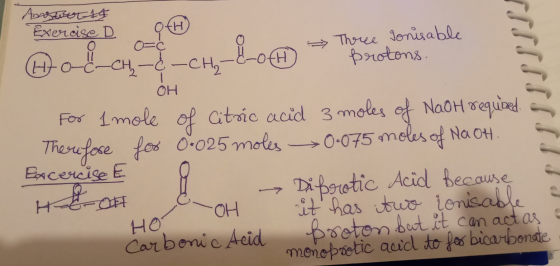
Depending on number of ionisable protons we can decide the basicity of any acid.
Add Answer to:
Pre-Lab Exercise D On the structure at the right, draw a circle around each of the...
Pre-Lab Exercise D On the structure at the right, draw a circle around each of the...
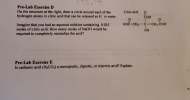 Pre-Lab Exercise D On the structure at the right, draw a circle around each of the hydrogen atoms in citric acid that can be released as H in water. Citric acid COH нос-сн- С—сн, сон Imagine that you had an aqueous solution containing 0.025 moles of citric acid. How many moles of NaOH would be required to completely neutralize the acid? Он Pre-Lab Exercise E Is carbonic acid (H2CO) a monoprotic, diprotic, or triprotic acid? Explain.
Procedure 1. Arrange the burette and other equipment as shown in Figure 1. Use a 250-ml...
 Procedure 1. Arrange the burette and other equipment as shown in Figure 1. Use a 250-ml Erlenmeyer flask for the titration 2. Fill the burette with NaOH solution using a funnel. (Wear goggles and gloves!) Record the concentration (molarity) of the base in the Data Table on the Worksheet. 3. Measure out 100 mL of flat Mountain Dew in a graduated cylinder and transfer it to the 250-ml Erlenmeyer flask. (If you will be using a magnetic stirrer, place a...
Experiment 11: Titration Pre-Lab Report Sheet Name Lab Section: Show your work for any calculations. 1....
 Experiment 11: Titration Pre-Lab Report Sheet Name Lab Section: Show your work for any calculations. 1. Consider the reaction of sulfuric acid, H,SO., with sodium hydroxide, NaOH. H2SO (aq) + 2NaOH(aq) → 2 H2O(l) + Na:SO (aq) Suppose a beaker contains 35.0 ml of 0.175 MH SO. How many moles of NaOH are needed to react completely with the sulfuric acid? 2. In the titration of total acid with sodium hydroxide, NaOH, it was determined that 36,03 mL of 0.0980...
Name Desk Date, Laboratory Instructor Titration Curves of 26 Pre-lab Polyprotic Acids Questions t...
 Name Desk Date, Laboratory Instructor Titration Curves of 26 Pre-lab Polyprotic Acids Questions tory, you should be able to answer the Before beginning this experiment in the labora following questions. 1. What is a polyprotic acid? If 10.7 mL of 0.105 M NaOH is required to reach the first equivalence point of a solution of citric acid (H,CH,O,), how many milliliters of NaOH are required to completely neutralize this solution? 2. 3. How many millimoles of NaOH will react completely...
Titration Curves of Polyprotic Acids Pre-lab Questions Before beginning this experiment in the laboratory, you should...
 Titration Curves of Polyprotic Acids Pre-lab Questions Before beginning this experiment in the laboratory, you should be able to answer the following questions. 1. What is a polyprotic acid? 2. If 10.70 mL of 0.105 M NaOH is required to reach the first equivalence point of a solution of citric acid (H,C H307), how many milliliters of NaOH are required to completely neutralize this solution? 3. How many millimoles of NaOH will react completely with 50 mL of 1.5 MH,C20,?...
LAB PARTNER Pre-Lab Questions Answer questions 1-6 after you have read the lab experiment and studied...
 LAB PARTNER Pre-Lab Questions Answer questions 1-6 after you have read the lab experiment and studied titration in your textbook (section 7.5) and/or in the lab manual (pages xxi-xxiv). Show your work fully and clearly. Calculate the molar mass of NaOH and the molar concentration of a solution containing 3.978 g of NaOH in 750.0 mL 1. Calculate the number of moles of HCl in 50.00 mL of 0.1444 M HCl. 2. Continued on the next page. 3. Calculate the...
Chemistry 326 Laboratory Manual obowy zawabnya CH, HycoF OCH Pre-Lab Assignment: Complete BEFORE Lab! (5 pts)...
 Chemistry 326 Laboratory Manual obowy zawabnya CH, HycoF OCH Pre-Lab Assignment: Complete BEFORE Lab! (5 pts) 1. Draw the ketones and aldehydes necessary to synthesize ALL compounds A-F via double Aldol condensation. 2. Determine the moles of acetone and the moles of benzaldehyde used in the sample procedure below. NOTE: you will need to find the density of acetone and benzaldehyde to do this exercise. 3. Using the same number of moles you calculated above, determine the VOLUME of each...
Titration: Acids and Bases 2. How can you determine which acid is diprotic? 3. using the...
 Titration: Acids and Bases
2. How can you determine which acid is diprotic?
3. using the answers to questions one and two, which acid is
diprotic?
4. Which base has more hydroxide ions per molecule?
Acid Volume Base Base Initial Volume (mL) Base Final Volume (mL) Volume of Base Used (mL) Acid: Base Ratio Acid 1 20 mL Base 1 50 mL 34.5 15.5 4:3 Acid 2 20 mL Base 1 Acid 1 20 mL Base 2 Acid 2 20...
Titration: Acids and Bases
2. How can you determine which acid is diprotic?
3. using the answers to questions one and two, which acid is
diprotic?
4. Which base has more hydroxide ions per molecule?
Acid Volume Base Base Initial Volume (mL) Base Final Volume (mL) Volume of Base Used (mL) Acid: Base Ratio Acid 1 20 mL Base 1 50 mL 34.5 15.5 4:3 Acid 2 20 mL Base 1 Acid 1 20 mL Base 2 Acid 2 20...
please help with my pre lab additional information Pre-Lab Questions: 1. What is the definition of...
 please help with my pre lab
additional information
Pre-Lab Questions: 1. What is the definition of an 'equivalence point' in an acid/base titration? (1 point) 2. In part one of the experiment, you will prepare the acid solutions being titrated from a stock solution. Describe how you will accurately prepare 10.00 mL of 0.100 M HCl solution using a 1.00 M HCI stock solution. In your response to this question, be very specific about the quantities of stock solution and...
please help with my pre lab
additional information
Pre-Lab Questions: 1. What is the definition of an 'equivalence point' in an acid/base titration? (1 point) 2. In part one of the experiment, you will prepare the acid solutions being titrated from a stock solution. Describe how you will accurately prepare 10.00 mL of 0.100 M HCl solution using a 1.00 M HCI stock solution. In your response to this question, be very specific about the quantities of stock solution and...
Exercise 2 Separation of a Mixture Based on Acid-Base Properties One purpose of this exercise is...
Exercise 2 Separation of a Mixture Based on Acid-Base Properties One purpose of this exercise is to learn how to use a separatory funnel to extract a single component away from other compounds in solution. To do so, we will apply the principles of solubility and acid-base behavior you’re seeing in class. One of the compounds is neutral in the acid-base sense. It has no ability to either donate or accept a proton from an aqueous solution, and will remain...
 Pre-Lab Exercise D On the structure at the right, draw a circle around each of the hydrogen atoms in citric acid that can be released as H in water. Citric acid COH нос-сн- С—сн, сон Imagine that you had an aqueous solution containing 0.025 moles of citric acid. How many moles of NaOH would be required to completely neutralize the acid? Он Pre-Lab Exercise E Is carbonic acid (H2CO) a monoprotic, diprotic, or triprotic acid? Explain.
 Procedure 1. Arrange the burette and other equipment as shown in Figure 1. Use a 250-ml Erlenmeyer flask for the titration 2. Fill the burette with NaOH solution using a funnel. (Wear goggles and gloves!) Record the concentration (molarity) of the base in the Data Table on the Worksheet. 3. Measure out 100 mL of flat Mountain Dew in a graduated cylinder and transfer it to the 250-ml Erlenmeyer flask. (If you will be using a magnetic stirrer, place a...
 Experiment 11: Titration Pre-Lab Report Sheet Name Lab Section: Show your work for any calculations. 1. Consider the reaction of sulfuric acid, H,SO., with sodium hydroxide, NaOH. H2SO (aq) + 2NaOH(aq) → 2 H2O(l) + Na:SO (aq) Suppose a beaker contains 35.0 ml of 0.175 MH SO. How many moles of NaOH are needed to react completely with the sulfuric acid? 2. In the titration of total acid with sodium hydroxide, NaOH, it was determined that 36,03 mL of 0.0980...
 Name Desk Date, Laboratory Instructor Titration Curves of 26 Pre-lab Polyprotic Acids Questions tory, you should be able to answer the Before beginning this experiment in the labora following questions. 1. What is a polyprotic acid? If 10.7 mL of 0.105 M NaOH is required to reach the first equivalence point of a solution of citric acid (H,CH,O,), how many milliliters of NaOH are required to completely neutralize this solution? 2. 3. How many millimoles of NaOH will react completely...
 Titration Curves of Polyprotic Acids Pre-lab Questions Before beginning this experiment in the laboratory, you should be able to answer the following questions. 1. What is a polyprotic acid? 2. If 10.70 mL of 0.105 M NaOH is required to reach the first equivalence point of a solution of citric acid (H,C H307), how many milliliters of NaOH are required to completely neutralize this solution? 3. How many millimoles of NaOH will react completely with 50 mL of 1.5 MH,C20,?...
 LAB PARTNER Pre-Lab Questions Answer questions 1-6 after you have read the lab experiment and studied titration in your textbook (section 7.5) and/or in the lab manual (pages xxi-xxiv). Show your work fully and clearly. Calculate the molar mass of NaOH and the molar concentration of a solution containing 3.978 g of NaOH in 750.0 mL 1. Calculate the number of moles of HCl in 50.00 mL of 0.1444 M HCl. 2. Continued on the next page. 3. Calculate the...
 Chemistry 326 Laboratory Manual obowy zawabnya CH, HycoF OCH Pre-Lab Assignment: Complete BEFORE Lab! (5 pts) 1. Draw the ketones and aldehydes necessary to synthesize ALL compounds A-F via double Aldol condensation. 2. Determine the moles of acetone and the moles of benzaldehyde used in the sample procedure below. NOTE: you will need to find the density of acetone and benzaldehyde to do this exercise. 3. Using the same number of moles you calculated above, determine the VOLUME of each...
 Titration: Acids and Bases
2. How can you determine which acid is diprotic?
3. using the answers to questions one and two, which acid is
diprotic?
4. Which base has more hydroxide ions per molecule?
Acid Volume Base Base Initial Volume (mL) Base Final Volume (mL) Volume of Base Used (mL) Acid: Base Ratio Acid 1 20 mL Base 1 50 mL 34.5 15.5 4:3 Acid 2 20 mL Base 1 Acid 1 20 mL Base 2 Acid 2 20...
Titration: Acids and Bases
2. How can you determine which acid is diprotic?
3. using the answers to questions one and two, which acid is
diprotic?
4. Which base has more hydroxide ions per molecule?
Acid Volume Base Base Initial Volume (mL) Base Final Volume (mL) Volume of Base Used (mL) Acid: Base Ratio Acid 1 20 mL Base 1 50 mL 34.5 15.5 4:3 Acid 2 20 mL Base 1 Acid 1 20 mL Base 2 Acid 2 20...
 please help with my pre lab
additional information
Pre-Lab Questions: 1. What is the definition of an 'equivalence point' in an acid/base titration? (1 point) 2. In part one of the experiment, you will prepare the acid solutions being titrated from a stock solution. Describe how you will accurately prepare 10.00 mL of 0.100 M HCl solution using a 1.00 M HCI stock solution. In your response to this question, be very specific about the quantities of stock solution and...
please help with my pre lab
additional information
Pre-Lab Questions: 1. What is the definition of an 'equivalence point' in an acid/base titration? (1 point) 2. In part one of the experiment, you will prepare the acid solutions being titrated from a stock solution. Describe how you will accurately prepare 10.00 mL of 0.100 M HCl solution using a 1.00 M HCI stock solution. In your response to this question, be very specific about the quantities of stock solution and...
Most questions answered within 3 hours.
-
Where is the error in this code sequence?
String s1 = "Hello";
String s2 = "ello";...
asked 10 months ago -
Financial data for Joel de Paris, Inc., for last year
follow:
Joel de Paris, Inc.
Balance...
asked 10 months ago -
Consider this reaction:
Al2(SO4)3 (aq)+ BaCl3
(aq) Al2Cl6 (aq)- +
3BaSO4(s) . What is the...
asked 10 months ago -
Suppose that Savneet is considering increasing her
recent random sample from 20 car rentals to 40...
asked 10 months ago -
Trucks arrive at an unloading terminal at an average rate of 120
per hour.
Trucks arrive...
asked 10 months ago -
Why are methanol and ethanol completely soluble in water while
octanol is not very little soluble....
asked 10 months ago -
A facilities manager at a university reads in a research report
that the mean amount of...
asked 10 months ago -
When the CuSO4 is rehydrated by adding water to the anhydrous
compound, is this an endothermic...
asked 10 months ago -
A ray of sunlight is passing from diamond into crown glass; the
angle of incidence is...
asked 10 months ago -
A block of mass 0.249 kg is placed on top of a light, vertical
spring of...
asked 10 months ago -
how do the kidneys compensate in the presences of acidosis
a) trigger hyperventilate
b) reserve acid...
asked 10 months ago -
Question 501 pts
The rental rate of capital to the firm increases. Which of the
following...
asked 10 months ago