![State the answer and show your work. State units in the answer. 10 points total [F = 96.485 kJ/V-mole; R = 8.314 J/mole-K] 1.](http://img.homeworklib.com/questions/fc1cc7b0-700c-11ea-b181-2ff5477bd29f.png?x-oss-process=image/resize,w_560)
Homework Answers
Add Answer to:
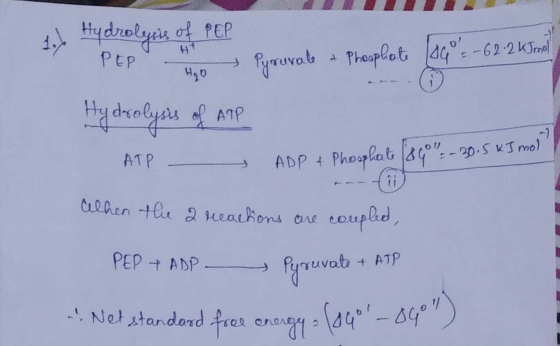
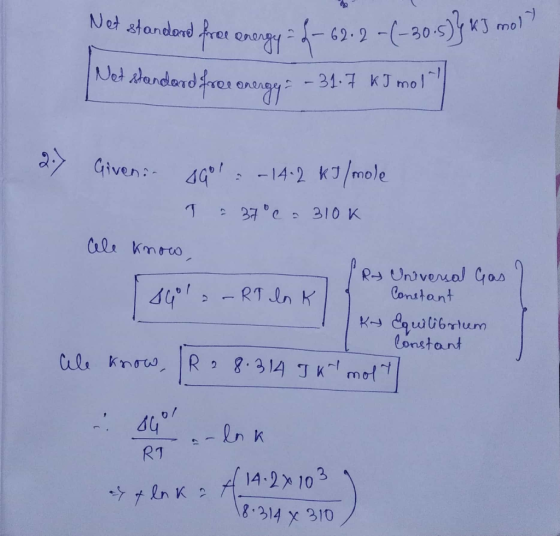
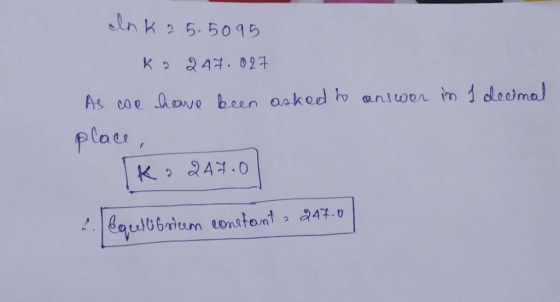
State the answer and show your work. State units in the answer. 10 points total [F...
4. Consider the following reaction: ATP + pyruvate phosphoenolpyruvate + ADP Given: Standard free energy of...
 4. Consider the following reaction: ATP + pyruvate phosphoenolpyruvate + ADP Given: Standard free energy of hydrolysis for ATP to ADP is -30.5 kJ/mol Standard free energy of hydrolysis for phosphenolpyruvate to pyruvate is -61.9 kJ/mol Calculate AGⓇ and Key for this reaction.
5.The following reaction has a ΔG°'--61.9 kJ/mol at 25°C, Phosphoenolpyruvate (PEP) +H2O Pyruvate + Inorganic Phosphate...
 5.The following reaction has a ΔG°'--61.9 kJ/mol at 25°C, Phosphoenolpyruvate (PEP) +H2O Pyruvate + Inorganic Phosphate (Pi) (a) Is the reaction favorable under standard biochemical conditions? Explain your answer. (b) What is the equilibrium constant (K) of this reaction at 25°C? In cells the direct hydrolysis of PEP rarely occurs. Rather, the hydrolysis of PEP and the reverse hydrolysis of ATP are coupled (c) w rite out the coupled reaction and determine its ΔG at 25°C The hydrolysis of ATP...
stion 8 of 25 > The table lists the standard free energies of hydrolysis (AGⓇ) of...
 stion 8 of 25 > The table lists the standard free energies of hydrolysis (AGⓇ) of some phosphorylated compounds. Compound kJ mol kcal mol-1 Phosphoenolpyruvate (PEP) -61.9 --14.8 1,3-Bisphosphoglycerate (1,3-BPG) -49.4 - 11.8 Creatine phosphate -43.1 ATP (to ADP) -30.5 -7.3 Glucose 1-phosphate -20.9 -5.0 Pyrophosphate (PP) Glucose 6-phosphate Glycerol 3-phosphate -9.2 -2.2 10.3 -4.6 -13.8 3.3 What is the direction of each of the following reactions when the reactants are initially present in equimolar amounts? The reaction ATP+H,O -...
Determine the direction the following reactions will progress. Assume that the reactants and products are present...
 Determine the direction the following reactions will progress. Assume that the reactants and products are present in equimolar amounts. Note that the standard free energy of hydrolysis of ATP is - 30.5 kJ/mol. Click each box to toggle between arrows. Fructose + ATP fructose - 6 - phosphate + ADP (The standard free energy of hydrolysis for fructose-6-phosphate is - 15.9 kJ/mol.) 3 - phosphoglycerate + ATP 1,3 - bisphosphoglycerate + ADP (The standard free energy of hydrolysis for 1,3-bisphosphoglycerate...
like me to grade. I vow did the take homeow 1. In glycolysis, the enzyme pyruvate...
 like me to grade. I vow did the take homeow 1. In glycolysis, the enzyme pyruvate the enzyme pyruvate kinase catalyzes this reaction phosphoenolpyruvate + ADP - pyruvate + ATP caction using the information provided a. What is the equilibrium constant for below? (R-8.315 J/mol K; T = 298 K) Reaction 1: ATP - ADP +P Reaction 2: phosphoenolpyruvate vale pyruvate + PAG AG"=-30.5 kJ/mol pyruvate + P AGⓇ = -61.9 kJ/mol ntrations are provided below, what is the actual...
The reaction catalysed by pyruvate kinase is: K'eg 3.63 x 10⁵ Phosphoenolpyruvate + ADP -> pyruvate ATP a) Calculate the AG°" for this reaction. Show your working. 3 marks b) The hydrolysi...
 The reaction catalysed by pyruvate kinase is: K'eg 3.63 x 10⁵ Phosphoenolpyruvate + ADP -> pyruvate ATP a) Calculate the AG°" for this reaction. Show your working. 3 marks b) The hydrolysis of ATP has following equation: ATP+H20ADP P AG-30.5 kJ/mol Calculate the AG" for the following reaction: Phosphoenolpyruvate -> pyruvate Pi Show your working. 2 marks c) At 37 °C, the steady-state concentrations of phosphoenolpyruvate, ATP, and ADP have been measured to be 23 μΜ, 1.85 mM and 140...
please explain answer Glycolysis. In the third step of glycolysis, the enzyme phosphofructokinase transfers a phosphate...
 please explain answer
Glycolysis. In the third step of glycolysis, the enzyme phosphofructokinase transfers a phosphate group from ATP to fructose-6-phophate to generate fructose- 1,6- bisphosphate. In contrast, in step 10, the enzyme pyruvate kinase transfers a phosphate group from phosphoenolpyruvate to ADP to generate ATP. Using what you know about the standard free energy change associated with phosphate bonds, (briefly) explain why we observe this difference.
please explain answer
Glycolysis. In the third step of glycolysis, the enzyme phosphofructokinase transfers a phosphate group from ATP to fructose-6-phophate to generate fructose- 1,6- bisphosphate. In contrast, in step 10, the enzyme pyruvate kinase transfers a phosphate group from phosphoenolpyruvate to ADP to generate ATP. Using what you know about the standard free energy change associated with phosphate bonds, (briefly) explain why we observe this difference.
To answer this question, please reference the Problem Solving Video: Free Energy, ATP, and Creatine in...
 To answer this question, please reference the Problem Solving Video: Free Energy, ATP, and Creatine in Resting Muscles. The standard free energy, AGⓇ', value for an enzymatic reaction with several al components is the sum of the AGⓇ values for each component. Creatine kinase catalyzes the transfer of a phosphate group from creatine phosphate to ADP to form ATP. Standard Free Energy of Hydrolysis Standard E Compound kJ.mol-1 creatine phosphate -43.1 ATP (to ADP) -30.5 creatine phosphate +H,0 creatine +...
please calculate and show work 10. Metabolism. Which of the following reactions is favorable under standard-state...
 please calculate and show work
10. Metabolism. Which of the following reactions is favorable under standard-state conditions (1 M reactants and products; pH = 7)? Calculate the value of AGⓇ for each phosphate transfer reaction. A) ATP + pyruvate ---> phosphoenolpyruvate + ADP B) 3-phosphoglycerate + ATP ---> 1,3-bisphosphoglycerate + ADP C) 1,3-bisphosphoglycerate + creatine ---> creatine phosphate + 3-phosphoglycerate D) glucose 6-phosphate --> glucose 1-phosphate not favorable noer standard
please calculate and show work
10. Metabolism. Which of the following reactions is favorable under standard-state conditions (1 M reactants and products; pH = 7)? Calculate the value of AGⓇ for each phosphate transfer reaction. A) ATP + pyruvate ---> phosphoenolpyruvate + ADP B) 3-phosphoglycerate + ATP ---> 1,3-bisphosphoglycerate + ADP C) 1,3-bisphosphoglycerate + creatine ---> creatine phosphate + 3-phosphoglycerate D) glucose 6-phosphate --> glucose 1-phosphate not favorable noer standard
please help! thanks TABLE 12-4 Standard Free Energy Change for Phosphate Hydrolysis Compound AGⓇ' (kJ. mol-')...
 please help! thanks
TABLE 12-4 Standard Free Energy Change for Phosphate Hydrolysis Compound AGⓇ' (kJ. mol-') Phosphoenolpyruvate -61.9 1,3-Bisphosphoglycerate -49.4 ATP → AMP + PP, -45.6 Phosphocreatine -43.1 ATP ADP + P -30.5 Glucose-1-phosphate -20.9 PP, 2P, -19.2 Glucose-6-phosphate -13.8 Glycerol-3-phosphate -9.2 thioester bond AGⓇ' = -31.5 kJ•mol-1 H20 O CH3 -C-s-CoA I CH3 -C-0- + COA-SH Acetyl-CoA The formation of acetyl CoA from acetate is an ATP driven reaction: Acetate + ATP + COA <--> acetyl COA + AMP...
please help! thanks
TABLE 12-4 Standard Free Energy Change for Phosphate Hydrolysis Compound AGⓇ' (kJ. mol-') Phosphoenolpyruvate -61.9 1,3-Bisphosphoglycerate -49.4 ATP → AMP + PP, -45.6 Phosphocreatine -43.1 ATP ADP + P -30.5 Glucose-1-phosphate -20.9 PP, 2P, -19.2 Glucose-6-phosphate -13.8 Glycerol-3-phosphate -9.2 thioester bond AGⓇ' = -31.5 kJ•mol-1 H20 O CH3 -C-s-CoA I CH3 -C-0- + COA-SH Acetyl-CoA The formation of acetyl CoA from acetate is an ATP driven reaction: Acetate + ATP + COA <--> acetyl COA + AMP...
 4. Consider the following reaction: ATP + pyruvate phosphoenolpyruvate + ADP Given: Standard free energy of hydrolysis for ATP to ADP is -30.5 kJ/mol Standard free energy of hydrolysis for phosphenolpyruvate to pyruvate is -61.9 kJ/mol Calculate AGⓇ and Key for this reaction.
 5.The following reaction has a ΔG°'--61.9 kJ/mol at 25°C, Phosphoenolpyruvate (PEP) +H2O Pyruvate + Inorganic Phosphate (Pi) (a) Is the reaction favorable under standard biochemical conditions? Explain your answer. (b) What is the equilibrium constant (K) of this reaction at 25°C? In cells the direct hydrolysis of PEP rarely occurs. Rather, the hydrolysis of PEP and the reverse hydrolysis of ATP are coupled (c) w rite out the coupled reaction and determine its ΔG at 25°C The hydrolysis of ATP...
 stion 8 of 25 > The table lists the standard free energies of hydrolysis (AGⓇ) of some phosphorylated compounds. Compound kJ mol kcal mol-1 Phosphoenolpyruvate (PEP) -61.9 --14.8 1,3-Bisphosphoglycerate (1,3-BPG) -49.4 - 11.8 Creatine phosphate -43.1 ATP (to ADP) -30.5 -7.3 Glucose 1-phosphate -20.9 -5.0 Pyrophosphate (PP) Glucose 6-phosphate Glycerol 3-phosphate -9.2 -2.2 10.3 -4.6 -13.8 3.3 What is the direction of each of the following reactions when the reactants are initially present in equimolar amounts? The reaction ATP+H,O -...
 Determine the direction the following reactions will progress. Assume that the reactants and products are present in equimolar amounts. Note that the standard free energy of hydrolysis of ATP is - 30.5 kJ/mol. Click each box to toggle between arrows. Fructose + ATP fructose - 6 - phosphate + ADP (The standard free energy of hydrolysis for fructose-6-phosphate is - 15.9 kJ/mol.) 3 - phosphoglycerate + ATP 1,3 - bisphosphoglycerate + ADP (The standard free energy of hydrolysis for 1,3-bisphosphoglycerate...
 like me to grade. I vow did the take homeow 1. In glycolysis, the enzyme pyruvate the enzyme pyruvate kinase catalyzes this reaction phosphoenolpyruvate + ADP - pyruvate + ATP caction using the information provided a. What is the equilibrium constant for below? (R-8.315 J/mol K; T = 298 K) Reaction 1: ATP - ADP +P Reaction 2: phosphoenolpyruvate vale pyruvate + PAG AG"=-30.5 kJ/mol pyruvate + P AGⓇ = -61.9 kJ/mol ntrations are provided below, what is the actual...
 The reaction catalysed by pyruvate kinase is: K'eg 3.63 x 10⁵ Phosphoenolpyruvate + ADP -> pyruvate ATP a) Calculate the AG°" for this reaction. Show your working. 3 marks b) The hydrolysis of ATP has following equation: ATP+H20ADP P AG-30.5 kJ/mol Calculate the AG" for the following reaction: Phosphoenolpyruvate -> pyruvate Pi Show your working. 2 marks c) At 37 °C, the steady-state concentrations of phosphoenolpyruvate, ATP, and ADP have been measured to be 23 μΜ, 1.85 mM and 140...
 please explain answer
Glycolysis. In the third step of glycolysis, the enzyme phosphofructokinase transfers a phosphate group from ATP to fructose-6-phophate to generate fructose- 1,6- bisphosphate. In contrast, in step 10, the enzyme pyruvate kinase transfers a phosphate group from phosphoenolpyruvate to ADP to generate ATP. Using what you know about the standard free energy change associated with phosphate bonds, (briefly) explain why we observe this difference.
please explain answer
Glycolysis. In the third step of glycolysis, the enzyme phosphofructokinase transfers a phosphate group from ATP to fructose-6-phophate to generate fructose- 1,6- bisphosphate. In contrast, in step 10, the enzyme pyruvate kinase transfers a phosphate group from phosphoenolpyruvate to ADP to generate ATP. Using what you know about the standard free energy change associated with phosphate bonds, (briefly) explain why we observe this difference.
 To answer this question, please reference the Problem Solving Video: Free Energy, ATP, and Creatine in Resting Muscles. The standard free energy, AGⓇ', value for an enzymatic reaction with several al components is the sum of the AGⓇ values for each component. Creatine kinase catalyzes the transfer of a phosphate group from creatine phosphate to ADP to form ATP. Standard Free Energy of Hydrolysis Standard E Compound kJ.mol-1 creatine phosphate -43.1 ATP (to ADP) -30.5 creatine phosphate +H,0 creatine +...
 please calculate and show work
10. Metabolism. Which of the following reactions is favorable under standard-state conditions (1 M reactants and products; pH = 7)? Calculate the value of AGⓇ for each phosphate transfer reaction. A) ATP + pyruvate ---> phosphoenolpyruvate + ADP B) 3-phosphoglycerate + ATP ---> 1,3-bisphosphoglycerate + ADP C) 1,3-bisphosphoglycerate + creatine ---> creatine phosphate + 3-phosphoglycerate D) glucose 6-phosphate --> glucose 1-phosphate not favorable noer standard
please calculate and show work
10. Metabolism. Which of the following reactions is favorable under standard-state conditions (1 M reactants and products; pH = 7)? Calculate the value of AGⓇ for each phosphate transfer reaction. A) ATP + pyruvate ---> phosphoenolpyruvate + ADP B) 3-phosphoglycerate + ATP ---> 1,3-bisphosphoglycerate + ADP C) 1,3-bisphosphoglycerate + creatine ---> creatine phosphate + 3-phosphoglycerate D) glucose 6-phosphate --> glucose 1-phosphate not favorable noer standard
 please help! thanks
TABLE 12-4 Standard Free Energy Change for Phosphate Hydrolysis Compound AGⓇ' (kJ. mol-') Phosphoenolpyruvate -61.9 1,3-Bisphosphoglycerate -49.4 ATP → AMP + PP, -45.6 Phosphocreatine -43.1 ATP ADP + P -30.5 Glucose-1-phosphate -20.9 PP, 2P, -19.2 Glucose-6-phosphate -13.8 Glycerol-3-phosphate -9.2 thioester bond AGⓇ' = -31.5 kJ•mol-1 H20 O CH3 -C-s-CoA I CH3 -C-0- + COA-SH Acetyl-CoA The formation of acetyl CoA from acetate is an ATP driven reaction: Acetate + ATP + COA <--> acetyl COA + AMP...
please help! thanks
TABLE 12-4 Standard Free Energy Change for Phosphate Hydrolysis Compound AGⓇ' (kJ. mol-') Phosphoenolpyruvate -61.9 1,3-Bisphosphoglycerate -49.4 ATP → AMP + PP, -45.6 Phosphocreatine -43.1 ATP ADP + P -30.5 Glucose-1-phosphate -20.9 PP, 2P, -19.2 Glucose-6-phosphate -13.8 Glycerol-3-phosphate -9.2 thioester bond AGⓇ' = -31.5 kJ•mol-1 H20 O CH3 -C-s-CoA I CH3 -C-0- + COA-SH Acetyl-CoA The formation of acetyl CoA from acetate is an ATP driven reaction: Acetate + ATP + COA <--> acetyl COA + AMP...
Most questions answered within 3 hours.
-
Where is the error in this code sequence?
String s1 = "Hello";
String s2 = "ello";...
asked 10 months ago -
Financial data for Joel de Paris, Inc., for last year
follow:
Joel de Paris, Inc.
Balance...
asked 10 months ago -
Consider this reaction:
Al2(SO4)3 (aq)+ BaCl3
(aq) Al2Cl6 (aq)- +
3BaSO4(s) . What is the...
asked 10 months ago -
Suppose that Savneet is considering increasing her
recent random sample from 20 car rentals to 40...
asked 10 months ago -
Trucks arrive at an unloading terminal at an average rate of 120
per hour.
Trucks arrive...
asked 10 months ago -
Why are methanol and ethanol completely soluble in water while
octanol is not very little soluble....
asked 10 months ago -
A facilities manager at a university reads in a research report
that the mean amount of...
asked 10 months ago -
When the CuSO4 is rehydrated by adding water to the anhydrous
compound, is this an endothermic...
asked 10 months ago -
A ray of sunlight is passing from diamond into crown glass; the
angle of incidence is...
asked 10 months ago -
A block of mass 0.249 kg is placed on top of a light, vertical
spring of...
asked 10 months ago -
how do the kidneys compensate in the presences of acidosis
a) trigger hyperventilate
b) reserve acid...
asked 10 months ago -
Question 501 pts
The rental rate of capital to the firm increases. Which of the
following...
asked 10 months ago