
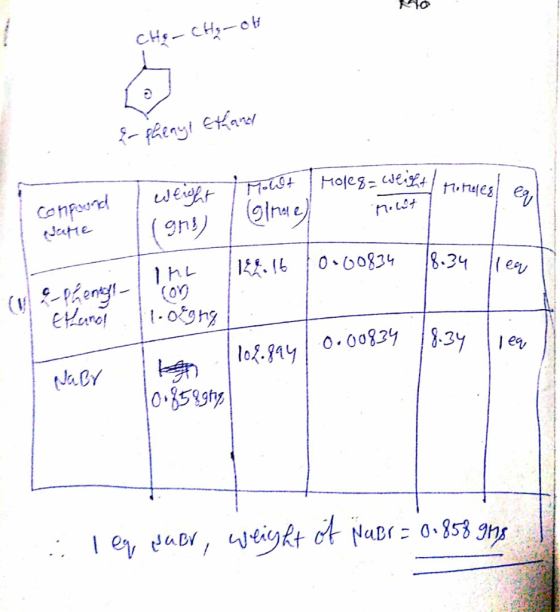
How much sodium bromide is needed for the mixture?
Homework Answers
Add Answer to:
How much sodium bromide is needed for the mixture?
Reaction Setup. Place 1.0 mL of 2-phenylethanol...
can some one help me find a limiting reagent and percent tieldncalculation for acetanilide i started...
 can some one help me find a limiting reagent and percent
tieldncalculation for acetanilide
i started with 0.090 of acetanilide and after
recryatallization i ended up with the product weigh 0.2346g. p
bromoacetanilide.
please explain and show each and every step
Dispose of the filtrate from the Hirsch funnel tiltration 8P Al container for halogenated organic solvents rude proauct into a this mixture. Place all other filtrates into the R E Running the Reaction To a tared 5-mL conical vial...
can some one help me find a limiting reagent and percent
tieldncalculation for acetanilide
i started with 0.090 of acetanilide and after
recryatallization i ended up with the product weigh 0.2346g. p
bromoacetanilide.
please explain and show each and every step
Dispose of the filtrate from the Hirsch funnel tiltration 8P Al container for halogenated organic solvents rude proauct into a this mixture. Place all other filtrates into the R E Running the Reaction To a tared 5-mL conical vial...
1. What was the sodium sulfite used for the experiment below? 2. What material could still...
1. What was the sodium sulfite used for the experiment below? 2. What material could still be in the ether layer of the experiment below? To a 3.0 mL conical vial containing a spin vane and equipped with an air condenser, add 20 uL of acetophenone and 700 uL of household bleach ( NaOCl, 5% available). Dispense both reagents in the hood! Stir the mixture at room temperature for thirty minutes. Add approximately 5.0 mg of sodium sulfite and stir...
2.95g of sodium bicarb how much water to add to make 1.0 M solution 4.25g of...
2.95g of sodium bicarb how much water to add to make 1.0 M solution 4.25g of Sodium carbonate how much water to add to make 1.0 M solution. Please show all the work very clearly even little steps to help me understand. "You need to create a 1.0 M solution of sodium bicarbonate (NaHCO3 – baking soda). Your lab kit has a bag of sodium bicarbonate to use for this portion of the experiment. Write “sodium bicarbonate” on a sample...
in FRIEDEL-CRAFTS ACYLATION AND COLUMN CHROMATOGRAPHY lab (2 pts) Amount of acetyl chloride used ____4______(drops) (each...
 in FRIEDEL-CRAFTS ACYLATION AND COLUMN CHROMATOGRAPHY lab
(2 pts) Amount of acetyl chloride used ____4______(drops) (each
drop is 0.01 mL) _____2______(equivalents) Based on the amount of
ferrocene you began the Friedel-Crafts reaction with, determine the
percent yield of acetylferrocene, diacetylferrocene, and the
percent recovery of unreacted ferrocene (show work)
react by 0.100 g of ferrocene at beginning
got 0 g of ferrocene, 0.012g of diacetylferrocene , 0.017g of
acetylferrocene
REACTION PROCEDURE: To a 5 mL conical vial, add a spin...
in FRIEDEL-CRAFTS ACYLATION AND COLUMN CHROMATOGRAPHY lab
(2 pts) Amount of acetyl chloride used ____4______(drops) (each
drop is 0.01 mL) _____2______(equivalents) Based on the amount of
ferrocene you began the Friedel-Crafts reaction with, determine the
percent yield of acetylferrocene, diacetylferrocene, and the
percent recovery of unreacted ferrocene (show work)
react by 0.100 g of ferrocene at beginning
got 0 g of ferrocene, 0.012g of diacetylferrocene , 0.017g of
acetylferrocene
REACTION PROCEDURE: To a 5 mL conical vial, add a spin...
Find %yield please the product obtained was 0.0870g In the hood, place 100 mu L of...
 Find %yield please the product obtained was 0.0870g
In the hood, place 100 mu L of aniline in a tared 10 times 75 mm (small) test tube. Place the test cube in a small beaker or Erlenmeyer flask to avoid spillage. Stopper the cube with a cork. Now, using a Pasteur pipet, add (with swirling) 0.5 mL of water, followed by three drops of concentrated HCI. Add 10 mg of decolorizing charcoal (we use the pelletized form, called Nonrit^TM) to...
Find %yield please the product obtained was 0.0870g
In the hood, place 100 mu L of aniline in a tared 10 times 75 mm (small) test tube. Place the test cube in a small beaker or Erlenmeyer flask to avoid spillage. Stopper the cube with a cork. Now, using a Pasteur pipet, add (with swirling) 0.5 mL of water, followed by three drops of concentrated HCI. Add 10 mg of decolorizing charcoal (we use the pelletized form, called Nonrit^TM) to...
question in first picture information located below mass of empty vial (979.2mg) then mass with crude...
 question in first picture
information located below
mass of empty vial (979.2mg) then mass with crude
(1769.1mg)
mass of empty vial (1769.1mg) then yield with pure
ester product(18535.6mg)
Actual ester yield (calculations in your lab notebook must be present, re-type it in the report). Theoretical yield (calculations in your lab notebook must be present, re-type it in the report). Percent yield (calculations in your lab notebook must be present, re-type it in the report). in loto in table format) drawstructure...
question in first picture
information located below
mass of empty vial (979.2mg) then mass with crude
(1769.1mg)
mass of empty vial (1769.1mg) then yield with pure
ester product(18535.6mg)
Actual ester yield (calculations in your lab notebook must be present, re-type it in the report). Theoretical yield (calculations in your lab notebook must be present, re-type it in the report). Percent yield (calculations in your lab notebook must be present, re-type it in the report). in loto in table format) drawstructure...
Grignard Reaction with a Ketone: Triphenylmethanol Introduction: The purpose of this lab is to prepare phenylmagnesium...
Grignard Reaction with a Ketone: Triphenylmethanol Introduction: The purpose of this lab is to prepare phenylmagnesium bromide, a Grignard reagent, and react it with benzophenone to give triphenylmethanol. Grignard reagents are very reactive and must be synthesized in an environment free of water or any other source of potential proton donor. Once made, the Grignard reagent will do a nucleophilic attack on the carbonyl carbon of the ketone, benzophenone. The result is an alkoxide that is then protonated to give...
i need help with post questions, thanks Product Isolation After stirring the reaction for 5 minutes...
 i need help with post questions, thanks
Product Isolation After stirring the reaction for 5 minutes and allowing the reaction mixture to cool (the reaction can be exothermic), remove the Claisen head from the conical vial. Slowly add 3 M HCl(aq) drop-wise. The solid may need to be broken up with a stirring rod or a pipet. Continue to add acid until the aqueous phase (bottom layer) tests positive with pH paper. Extractions can be done using the conical funnel...
i need help with post questions, thanks
Product Isolation After stirring the reaction for 5 minutes and allowing the reaction mixture to cool (the reaction can be exothermic), remove the Claisen head from the conical vial. Slowly add 3 M HCl(aq) drop-wise. The solid may need to be broken up with a stirring rod or a pipet. Continue to add acid until the aqueous phase (bottom layer) tests positive with pH paper. Extractions can be done using the conical funnel...
How do I find the theoretical masses of the elimination product and the addition product? The molecular weights are pro...
 How do I find the theoretical masses of the elimination
product and the addition product? The molecular weights are
provided in table
Aldol Addition and Condensation Alm. You will perform two reactions, one of which is an aldol addition and one provides the aldol condensation product. Both procedures will be performed ALDOL ADDITION conditions ALDOL CONDENSATION MSDS - ME Reactants Table Reactant(s) 2-acetylpyridine 4-nitrobenzaldehyde methanol Sodium carbonate water MW Density BPMP D 11.12 12.04 USD ROISS 0.180 MW BP MP...
How do I find the theoretical masses of the elimination
product and the addition product? The molecular weights are
provided in table
Aldol Addition and Condensation Alm. You will perform two reactions, one of which is an aldol addition and one provides the aldol condensation product. Both procedures will be performed ALDOL ADDITION conditions ALDOL CONDENSATION MSDS - ME Reactants Table Reactant(s) 2-acetylpyridine 4-nitrobenzaldehyde methanol Sodium carbonate water MW Density BPMP D 11.12 12.04 USD ROISS 0.180 MW BP MP...
Running the Reaction Add 0.100 g benzil and 0.30 mL 95% ethanol to a 3-mL conical vial. Place a s...
 Determine the theoretical yield and limiting reagent
Running the Reaction Add 0.100 g benzil and 0.30 mL 95% ethanol to a 3-mL conical vial. Place a spin vane in the vial and attach an air condenser. Heat the mixture with an aluminum block (90-100°C) while stirring until the benzil has dissolved (see inset in Tech- nique 6, Figure 6.1A). Using a 9-inch Pasteur pipette, add dropwise 0.25 mL of an aqueous potassium hydroxide solution' downward through the condenser into the...
Determine the theoretical yield and limiting reagent
Running the Reaction Add 0.100 g benzil and 0.30 mL 95% ethanol to a 3-mL conical vial. Place a spin vane in the vial and attach an air condenser. Heat the mixture with an aluminum block (90-100°C) while stirring until the benzil has dissolved (see inset in Tech- nique 6, Figure 6.1A). Using a 9-inch Pasteur pipette, add dropwise 0.25 mL of an aqueous potassium hydroxide solution' downward through the condenser into the...
 can some one help me find a limiting reagent and percent
tieldncalculation for acetanilide
i started with 0.090 of acetanilide and after
recryatallization i ended up with the product weigh 0.2346g. p
bromoacetanilide.
please explain and show each and every step
Dispose of the filtrate from the Hirsch funnel tiltration 8P Al container for halogenated organic solvents rude proauct into a this mixture. Place all other filtrates into the R E Running the Reaction To a tared 5-mL conical vial...
can some one help me find a limiting reagent and percent
tieldncalculation for acetanilide
i started with 0.090 of acetanilide and after
recryatallization i ended up with the product weigh 0.2346g. p
bromoacetanilide.
please explain and show each and every step
Dispose of the filtrate from the Hirsch funnel tiltration 8P Al container for halogenated organic solvents rude proauct into a this mixture. Place all other filtrates into the R E Running the Reaction To a tared 5-mL conical vial...
 in FRIEDEL-CRAFTS ACYLATION AND COLUMN CHROMATOGRAPHY lab
(2 pts) Amount of acetyl chloride used ____4______(drops) (each
drop is 0.01 mL) _____2______(equivalents) Based on the amount of
ferrocene you began the Friedel-Crafts reaction with, determine the
percent yield of acetylferrocene, diacetylferrocene, and the
percent recovery of unreacted ferrocene (show work)
react by 0.100 g of ferrocene at beginning
got 0 g of ferrocene, 0.012g of diacetylferrocene , 0.017g of
acetylferrocene
REACTION PROCEDURE: To a 5 mL conical vial, add a spin...
in FRIEDEL-CRAFTS ACYLATION AND COLUMN CHROMATOGRAPHY lab
(2 pts) Amount of acetyl chloride used ____4______(drops) (each
drop is 0.01 mL) _____2______(equivalents) Based on the amount of
ferrocene you began the Friedel-Crafts reaction with, determine the
percent yield of acetylferrocene, diacetylferrocene, and the
percent recovery of unreacted ferrocene (show work)
react by 0.100 g of ferrocene at beginning
got 0 g of ferrocene, 0.012g of diacetylferrocene , 0.017g of
acetylferrocene
REACTION PROCEDURE: To a 5 mL conical vial, add a spin...
 Find %yield please the product obtained was 0.0870g
In the hood, place 100 mu L of aniline in a tared 10 times 75 mm (small) test tube. Place the test cube in a small beaker or Erlenmeyer flask to avoid spillage. Stopper the cube with a cork. Now, using a Pasteur pipet, add (with swirling) 0.5 mL of water, followed by three drops of concentrated HCI. Add 10 mg of decolorizing charcoal (we use the pelletized form, called Nonrit^TM) to...
Find %yield please the product obtained was 0.0870g
In the hood, place 100 mu L of aniline in a tared 10 times 75 mm (small) test tube. Place the test cube in a small beaker or Erlenmeyer flask to avoid spillage. Stopper the cube with a cork. Now, using a Pasteur pipet, add (with swirling) 0.5 mL of water, followed by three drops of concentrated HCI. Add 10 mg of decolorizing charcoal (we use the pelletized form, called Nonrit^TM) to...
 question in first picture
information located below
mass of empty vial (979.2mg) then mass with crude
(1769.1mg)
mass of empty vial (1769.1mg) then yield with pure
ester product(18535.6mg)
Actual ester yield (calculations in your lab notebook must be present, re-type it in the report). Theoretical yield (calculations in your lab notebook must be present, re-type it in the report). Percent yield (calculations in your lab notebook must be present, re-type it in the report). in loto in table format) drawstructure...
question in first picture
information located below
mass of empty vial (979.2mg) then mass with crude
(1769.1mg)
mass of empty vial (1769.1mg) then yield with pure
ester product(18535.6mg)
Actual ester yield (calculations in your lab notebook must be present, re-type it in the report). Theoretical yield (calculations in your lab notebook must be present, re-type it in the report). Percent yield (calculations in your lab notebook must be present, re-type it in the report). in loto in table format) drawstructure...
 i need help with post questions, thanks
Product Isolation After stirring the reaction for 5 minutes and allowing the reaction mixture to cool (the reaction can be exothermic), remove the Claisen head from the conical vial. Slowly add 3 M HCl(aq) drop-wise. The solid may need to be broken up with a stirring rod or a pipet. Continue to add acid until the aqueous phase (bottom layer) tests positive with pH paper. Extractions can be done using the conical funnel...
i need help with post questions, thanks
Product Isolation After stirring the reaction for 5 minutes and allowing the reaction mixture to cool (the reaction can be exothermic), remove the Claisen head from the conical vial. Slowly add 3 M HCl(aq) drop-wise. The solid may need to be broken up with a stirring rod or a pipet. Continue to add acid until the aqueous phase (bottom layer) tests positive with pH paper. Extractions can be done using the conical funnel...
 How do I find the theoretical masses of the elimination
product and the addition product? The molecular weights are
provided in table
Aldol Addition and Condensation Alm. You will perform two reactions, one of which is an aldol addition and one provides the aldol condensation product. Both procedures will be performed ALDOL ADDITION conditions ALDOL CONDENSATION MSDS - ME Reactants Table Reactant(s) 2-acetylpyridine 4-nitrobenzaldehyde methanol Sodium carbonate water MW Density BPMP D 11.12 12.04 USD ROISS 0.180 MW BP MP...
How do I find the theoretical masses of the elimination
product and the addition product? The molecular weights are
provided in table
Aldol Addition and Condensation Alm. You will perform two reactions, one of which is an aldol addition and one provides the aldol condensation product. Both procedures will be performed ALDOL ADDITION conditions ALDOL CONDENSATION MSDS - ME Reactants Table Reactant(s) 2-acetylpyridine 4-nitrobenzaldehyde methanol Sodium carbonate water MW Density BPMP D 11.12 12.04 USD ROISS 0.180 MW BP MP...
 Determine the theoretical yield and limiting reagent
Running the Reaction Add 0.100 g benzil and 0.30 mL 95% ethanol to a 3-mL conical vial. Place a spin vane in the vial and attach an air condenser. Heat the mixture with an aluminum block (90-100°C) while stirring until the benzil has dissolved (see inset in Tech- nique 6, Figure 6.1A). Using a 9-inch Pasteur pipette, add dropwise 0.25 mL of an aqueous potassium hydroxide solution' downward through the condenser into the...
Determine the theoretical yield and limiting reagent
Running the Reaction Add 0.100 g benzil and 0.30 mL 95% ethanol to a 3-mL conical vial. Place a spin vane in the vial and attach an air condenser. Heat the mixture with an aluminum block (90-100°C) while stirring until the benzil has dissolved (see inset in Tech- nique 6, Figure 6.1A). Using a 9-inch Pasteur pipette, add dropwise 0.25 mL of an aqueous potassium hydroxide solution' downward through the condenser into the...
Most questions answered within 3 hours.
-
Where is the error in this code sequence?
String s1 = "Hello";
String s2 = "ello";...
asked 10 months ago -
Financial data for Joel de Paris, Inc., for last year
follow:
Joel de Paris, Inc.
Balance...
asked 10 months ago -
Consider this reaction:
Al2(SO4)3 (aq)+ BaCl3
(aq) Al2Cl6 (aq)- +
3BaSO4(s) . What is the...
asked 10 months ago -
Suppose that Savneet is considering increasing her
recent random sample from 20 car rentals to 40...
asked 10 months ago -
Trucks arrive at an unloading terminal at an average rate of 120
per hour.
Trucks arrive...
asked 10 months ago -
Why are methanol and ethanol completely soluble in water while
octanol is not very little soluble....
asked 10 months ago -
A facilities manager at a university reads in a research report
that the mean amount of...
asked 10 months ago -
When the CuSO4 is rehydrated by adding water to the anhydrous
compound, is this an endothermic...
asked 10 months ago -
A ray of sunlight is passing from diamond into crown glass; the
angle of incidence is...
asked 10 months ago -
A block of mass 0.249 kg is placed on top of a light, vertical
spring of...
asked 10 months ago -
how do the kidneys compensate in the presences of acidosis
a) trigger hyperventilate
b) reserve acid...
asked 10 months ago -
Question 501 pts
The rental rate of capital to the firm increases. Which of the
following...
asked 10 months ago