![05 Suppose that Mingsongs utility function for inter-temporal co is: U(CO,C1) In(C0) n(C1)/(1 +p)] where CO is his current period consumption, CI is his future period consumption and ρ is his subject rate of time preference. Let ρ be 5%. If Mingsong is endowed with $100 this period and $100 in the next period. And suppose the risk-free interest rate is 10%. What is Mingsongs optimal consumption path (i.e., the optimal level of current and future consumption) if he can only allocate wealth through lending and borrowing?](http://img.homeworklib.com/questions/e98c5c30-7053-11ea-ae50-25f84dfd70ff.png?x-oss-process=image/resize,w_560)
Homework Answers

Add Answer to:
05 Suppose that Mingsong's utility function for inter-temporal co is: U(CO,C1) In(C0) n(C1)/(1 +p)] where CO...
Question 8: Suppose that Bibi's utility function for inter-temporal consumption is: U(C0.cl)-In(C0) + [0.4 * İn(C1)]...
 Question 8: Suppose that Bibi's utility function for inter-temporal consumption is: U(C0.cl)-In(C0) + [0.4 * İn(C1)] where Cois his current period consumption, C, is his future period consumption. Bibi is endowed with mo 90,000 in this period (to) and mo -$500,000 in the next period (t1). And suppose there a perfect capital market in which Bibi can borrow and lend at 25% (risk-free). i. What is Bibi's optimal consumption bundle (i.e., the optimal level of current and future consumption) if...
1. Harvey Habit's utility function is U (C1, C2) = min {c1, c2}, where ci is...
 1. Harvey Habit's utility function is U (C1, C2) = min {c1, c2}, where ci is his consumption of bread in period 1 and ca is his consumption of bread in period 2. The price of bread is $1 per loaf in period 1. The interest rate is 21%. Harvey earns $2,000 in period 1 and he will earn $1,100 in period 2. (a) Write Harvey's budget constraint in terms of future value. (b) How much bread does Harvey consume...
3. Suppose you are given the utility function: In c' 4 U=In c +- Ci and...
 3. Suppose you are given the utility function: In c' 4 U=In c +- Ci and the budget constraint: C - 1+r 1+r where y = 100, y 120, and the interest rate r = 0.05. a) What is the optimal value of current consumption c*? b) What is the optimal value of future consumption, c*? c) Suppose the interest rate r -0.10. What is the new value of optimal current consumption c*? Suppose the new interest rate r =...
1. Suppose you are given the utility function: VC U = vc + 1.10 CI уг...
 1. Suppose you are given the utility function: VC U = vc + 1.10 CI уг and the budget constraint: c+ =yt 1+r 1+r where y = 5, y' = 10, and the interest rate r = 0.10. Now suppose that y=5 again, and there is only one consumer in the entire economy. If we add in government expenditures and taxation, the consumer's budget constraint is now: c+ y' = y + -t- +r 1+r 1+r If current and future...
1. Harvey Habit's utility function is U (C1, C2) = min {c1, c2}, where cı is his consumption of bread in period 1 and c...
 1. Harvey Habit's utility function is U (C1, C2) = min {c1, c2}, where cı is his consumption of bread in period 1 and c2 is his consumption of bread in period 2. The price of bread is $1 per loaf in period 1. The interest rate is 21%. Harvey earns $2,000 in period 1 and he will earn $1,100 in period 2. (a) Write Harvey's budget constraint in terms of future value. (b) How much bread does Harvey consume...
Question 1. (Consumption-Saving Problem): Suppose that a consumer lives for two periods. The utility function of...
 Question 1. (Consumption-Saving Problem): Suppose that a consumer lives for two periods. The utility function of the consumer is given by with u> 0 where c and c2 are consumption in period 1 and period 2 respectively. Sup- pose that consumer has income y in the first period, but has no income in the second period. Consumer has to save in the first period in order to consume in the second period. Let s be the savings in the first...
Question 1. (Consumption-Saving Problem): Suppose that a consumer lives for two periods. The utility function of...
 Question 1. (Consumption-Saving Problem): Suppose that a consumer lives for two periods. The utility function of the consumer is given by with u> 0 where c and c2 are consumption in period 1 and period 2 respectively. Sup- pose that consumer has income y in the first period, but has no income in the second period. Consumer has to save in the first period in order to consume in the second period. Let s be the savings in the first...
Question 1. (Consumption-Saving Problem): Suppose that a consumer lives for two periods. The utility function of...
 Question 1. (Consumption-Saving Problem): Suppose that a consumer lives for two periods. The utility function of the consumer is given by 1-1 1-1 with μ > 0 where c1 and c2 are consumption in period 1 and period 2 respectively (Portfolio Choice Problem) Now suppose that the consumer can save in terms of two instruments: financial savings (s) and capital investment (k). Capital investment done in period 1 yields output ka with 0 < α < 1 in period 2....
Mortimer lives for two period and has utility function U = C1*C2. He earns no income...
Mortimer lives for two period and has utility function U = C1*C2. He earns no income in period two and his income in period 1 is $80,000. The interest rate at which he can borrow and lend is 10%. Calculate his optimal consumption in each period.
1. Consumer's Consumption Decision (Chapter 2 in Fabozi, Neave and Zhou - Fi- nancial Economics) Suppose...
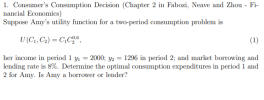 1. Consumer's Consumption Decision (Chapter 2 in Fabozi, Neave and Zhou - Fi- nancial Economics) Suppose Amy's utility function for a two-period consumption problem is U(C1, C2) = C1026, (1) her income in period 1 yı = 2000; y2 = 1296 in period 2; and market borrowing and lending rate is 8%. Determine the optimal consumption expenditures in period 1 and 2 for Amy. Is Amy a borrower or lender?
 Question 8: Suppose that Bibi's utility function for inter-temporal consumption is: U(C0.cl)-In(C0) + [0.4 * İn(C1)] where Cois his current period consumption, C, is his future period consumption. Bibi is endowed with mo 90,000 in this period (to) and mo -$500,000 in the next period (t1). And suppose there a perfect capital market in which Bibi can borrow and lend at 25% (risk-free). i. What is Bibi's optimal consumption bundle (i.e., the optimal level of current and future consumption) if...
 1. Harvey Habit's utility function is U (C1, C2) = min {c1, c2}, where ci is his consumption of bread in period 1 and ca is his consumption of bread in period 2. The price of bread is $1 per loaf in period 1. The interest rate is 21%. Harvey earns $2,000 in period 1 and he will earn $1,100 in period 2. (a) Write Harvey's budget constraint in terms of future value. (b) How much bread does Harvey consume...
 3. Suppose you are given the utility function: In c' 4 U=In c +- Ci and the budget constraint: C - 1+r 1+r where y = 100, y 120, and the interest rate r = 0.05. a) What is the optimal value of current consumption c*? b) What is the optimal value of future consumption, c*? c) Suppose the interest rate r -0.10. What is the new value of optimal current consumption c*? Suppose the new interest rate r =...
 1. Suppose you are given the utility function: VC U = vc + 1.10 CI уг and the budget constraint: c+ =yt 1+r 1+r where y = 5, y' = 10, and the interest rate r = 0.10. Now suppose that y=5 again, and there is only one consumer in the entire economy. If we add in government expenditures and taxation, the consumer's budget constraint is now: c+ y' = y + -t- +r 1+r 1+r If current and future...
 1. Harvey Habit's utility function is U (C1, C2) = min {c1, c2}, where cı is his consumption of bread in period 1 and c2 is his consumption of bread in period 2. The price of bread is $1 per loaf in period 1. The interest rate is 21%. Harvey earns $2,000 in period 1 and he will earn $1,100 in period 2. (a) Write Harvey's budget constraint in terms of future value. (b) How much bread does Harvey consume...
 Question 1. (Consumption-Saving Problem): Suppose that a consumer lives for two periods. The utility function of the consumer is given by with u> 0 where c and c2 are consumption in period 1 and period 2 respectively. Sup- pose that consumer has income y in the first period, but has no income in the second period. Consumer has to save in the first period in order to consume in the second period. Let s be the savings in the first...
 Question 1. (Consumption-Saving Problem): Suppose that a consumer lives for two periods. The utility function of the consumer is given by with u> 0 where c and c2 are consumption in period 1 and period 2 respectively. Sup- pose that consumer has income y in the first period, but has no income in the second period. Consumer has to save in the first period in order to consume in the second period. Let s be the savings in the first...
 Question 1. (Consumption-Saving Problem): Suppose that a consumer lives for two periods. The utility function of the consumer is given by 1-1 1-1 with μ > 0 where c1 and c2 are consumption in period 1 and period 2 respectively (Portfolio Choice Problem) Now suppose that the consumer can save in terms of two instruments: financial savings (s) and capital investment (k). Capital investment done in period 1 yields output ka with 0 < α < 1 in period 2....
 1. Consumer's Consumption Decision (Chapter 2 in Fabozi, Neave and Zhou - Fi- nancial Economics) Suppose Amy's utility function for a two-period consumption problem is U(C1, C2) = C1026, (1) her income in period 1 yı = 2000; y2 = 1296 in period 2; and market borrowing and lending rate is 8%. Determine the optimal consumption expenditures in period 1 and 2 for Amy. Is Amy a borrower or lender?
Most questions answered within 3 hours.
-
Where is the error in this code sequence?
String s1 = "Hello";
String s2 = "ello";...
asked 10 months ago -
Financial data for Joel de Paris, Inc., for last year
follow:
Joel de Paris, Inc.
Balance...
asked 10 months ago -
Consider this reaction:
Al2(SO4)3 (aq)+ BaCl3
(aq) Al2Cl6 (aq)- +
3BaSO4(s) . What is the...
asked 10 months ago -
Suppose that Savneet is considering increasing her
recent random sample from 20 car rentals to 40...
asked 10 months ago -
Trucks arrive at an unloading terminal at an average rate of 120
per hour.
Trucks arrive...
asked 10 months ago -
Why are methanol and ethanol completely soluble in water while
octanol is not very little soluble....
asked 10 months ago -
A facilities manager at a university reads in a research report
that the mean amount of...
asked 10 months ago -
When the CuSO4 is rehydrated by adding water to the anhydrous
compound, is this an endothermic...
asked 10 months ago -
A ray of sunlight is passing from diamond into crown glass; the
angle of incidence is...
asked 10 months ago -
A block of mass 0.249 kg is placed on top of a light, vertical
spring of...
asked 10 months ago -
how do the kidneys compensate in the presences of acidosis
a) trigger hyperventilate
b) reserve acid...
asked 10 months ago -
Question 501 pts
The rental rate of capital to the firm increases. Which of the
following...
asked 10 months ago