What is systematic risk vs. nonsystematic risk? Should both of these risks be compensated with higher...
What is systematic risk vs. nonsystematic risk? Should both of these risks be compensated with higher returns? Why or Why not?
Homework Answers
Systematic risk is the risk associated with the entire market or the segment. It is also known as non-diversifiable risk, market risk, etc. An investor cannot reduce his systematic risk by diversifying his portfolio. To see more: https://www.investopedia.com/terms/s/systematicrisk.asp
Non-systematic risk is the risk associated with a specific industry, segment or a specific company's security. It is also called diversifiable risk, residual risk, specific risk, etc. An investor can reduce the unsystematic risk of his portfolio by diversifying the portfolio. To see more: https://www.investopedia.com/terms/u/unsystematicrisk.asp
Systematic risk should not be compensated with higher returns, but Non-systematic risk should be compensated with higher returns because the investor is suffering a higher risk merely for choosing a particular security, while this is not so for Systematic risk.
Hope this helps.
Feel free to ask for clarifications.
Please leave a thumbs up.
Thank you!
Systematic risk is the risk associated with the entire market or the segment. It is also known as non-diversifiable risk, market risk, etc. An investor cannot reduce his systematic risk by diversifying his portfolio. To see more: https://www.investopedia.com/terms/s/systematicrisk.asp
Non-systematic risk is the risk associated with a specific industry, segment or a specific company's security. It is also called diversifiable risk, residual risk, specific risk, etc. An investor can reduce the unsystematic risk of his portfolio by diversifying the portfolio. To see more: https://www.investopedia.com/terms/u/unsystematicrisk.asp
Systematic risk should not be compensated with higher returns, but Non-systematic risk should be compensated with higher returns because the investor is suffering a higher risk merely for choosing a particular security, while this is not so for Systematic risk.
Hope this helps.
Feel free to ask for clarifications.
Please leave a thumbs up.
Thank you!
Add Answer to:
What is systematic
risk vs. nonsystematic risk? Should both of these risks be
compensated with higher...
Diversification cannot eliminate risk entirely because stocks (assets, projects) have: (a) nonsystematic risk (b) systematic risk...
Diversification cannot eliminate risk entirely because stocks (assets, projects) have: (a) nonsystematic risk (b) systematic risk (c) unique risk (d) diversifiable risk
john c hull risk management 1.4 What is the difference between systematic and nonsystematic risk? Which...
 john c hull risk management
1.4 What is the difference between systematic and nonsystematic risk? Which is more important to an equity investor? Which can lead to the bankruptcy of a corporation? 1.5 Outline the arguments leading to the conclusion that all investors should choose the same portfolio of risky investments. What are the key assumptions? 1.6 The expected return on the market portfolio is 12% and the risk-free rate is 6%. What is the expected return on an investment...
john c hull risk management
1.4 What is the difference between systematic and nonsystematic risk? Which is more important to an equity investor? Which can lead to the bankruptcy of a corporation? 1.5 Outline the arguments leading to the conclusion that all investors should choose the same portfolio of risky investments. What are the key assumptions? 1.6 The expected return on the market portfolio is 12% and the risk-free rate is 6%. What is the expected return on an investment...
QUESTION 24 Exposure to non-systematic risk is rewarded with higher expected return. Conversely, exposure to systematic...
 QUESTION 24 Exposure to non-systematic risk is rewarded with higher expected return. Conversely, exposure to systematic risk is not rewarded with higher expected returns. True False
1. Explain why investors require higher risk premium for a stock with higher systematic risk.
1. Explain why investors require higher risk premium for a stock with higher systematic risk.
18. Identify each of the following risks as either systematic risk or diversifiable risk: a. The...
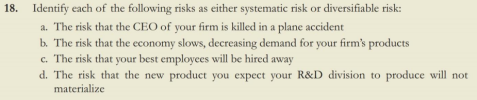 18. Identify each of the following risks as either systematic risk or diversifiable risk: a. The risk that the CEO of your firm is killed in a plane accident b. The risk that the economy slows, decreasing demand for your firm's products c. The risk that your best employees will be hired away d. The risk that the new product you expect your R&D division to produce will not materialize
Controlling risks, also referred to as “Risk Treatment”, will assist you in determining WHAT should be...
Controlling risks, also referred to as “Risk Treatment”, will assist you in determining WHAT should be done in response to the risks that have been identified, in order to improve project outcomes. Fundamentally, the concept of controlling risks emphasizes the fact that, unless action is taken, the risk identification and assessment process has been wasted. Risk treatment converts the earlier analysis into substantive actions to reduce the levels of those risks with negative consequences and exploit the risks with positive...
8. Risks of investing in bonds The higher the risk of a security, the higher its...
 8. Risks of investing in bonds The higher the risk of a security, the higher its expected return will be. A bond's risk level is reflected in its yield, but understanding the different risks involved when investing in bonds is important. The following graph shows the relationship between interest rates and maturity for three security classes: US Treasury securities (USTS), AA-rated corporate bonds, and BBB-rated corporate bonds. Use the selection dropdown lists to correctly associate each curve with its corresponding...
Which risk(s) are investors traditionally compensated for if the markets are in equilibrium, and why? If...
Which risk(s) are investors traditionally compensated for if the markets are in equilibrium, and why? If you are an undiversified investor, with a higher than average level of ris aversion, are you systematically over-paying for your investments, and why?
13. Beta is a measure of a stock's: Systematic Risk Risk relative to the market Both...
 13. Beta is a measure of a stock's: Systematic Risk Risk relative to the market Both A and B None of the above The most volatile stock would have Beta. Higher than 1.0. Lower than 1.0. Very close to 0.0. Beta is not related to volatility. Discounted cash flow techniques used in valuing common stock are based on: future value analysis. present value analysis. The CAPM. the APT. c.
What additional security risks do mobile devices pose vs. traditional PCs and laptops? What means (both...
What additional security risks do mobile devices pose vs. traditional PCs and laptops? What means (both administrative and technical) can IT departments use to mitigate these risks? What are the trade-offs for users/employees in convenience vs. security? Answer briefly in your own words.
 john c hull risk management
1.4 What is the difference between systematic and nonsystematic risk? Which is more important to an equity investor? Which can lead to the bankruptcy of a corporation? 1.5 Outline the arguments leading to the conclusion that all investors should choose the same portfolio of risky investments. What are the key assumptions? 1.6 The expected return on the market portfolio is 12% and the risk-free rate is 6%. What is the expected return on an investment...
john c hull risk management
1.4 What is the difference between systematic and nonsystematic risk? Which is more important to an equity investor? Which can lead to the bankruptcy of a corporation? 1.5 Outline the arguments leading to the conclusion that all investors should choose the same portfolio of risky investments. What are the key assumptions? 1.6 The expected return on the market portfolio is 12% and the risk-free rate is 6%. What is the expected return on an investment...
 QUESTION 24 Exposure to non-systematic risk is rewarded with higher expected return. Conversely, exposure to systematic risk is not rewarded with higher expected returns. True False
 18. Identify each of the following risks as either systematic risk or diversifiable risk: a. The risk that the CEO of your firm is killed in a plane accident b. The risk that the economy slows, decreasing demand for your firm's products c. The risk that your best employees will be hired away d. The risk that the new product you expect your R&D division to produce will not materialize
 8. Risks of investing in bonds The higher the risk of a security, the higher its expected return will be. A bond's risk level is reflected in its yield, but understanding the different risks involved when investing in bonds is important. The following graph shows the relationship between interest rates and maturity for three security classes: US Treasury securities (USTS), AA-rated corporate bonds, and BBB-rated corporate bonds. Use the selection dropdown lists to correctly associate each curve with its corresponding...
 13. Beta is a measure of a stock's: Systematic Risk Risk relative to the market Both A and B None of the above The most volatile stock would have Beta. Higher than 1.0. Lower than 1.0. Very close to 0.0. Beta is not related to volatility. Discounted cash flow techniques used in valuing common stock are based on: future value analysis. present value analysis. The CAPM. the APT. c.
Most questions answered within 3 hours.
-
Where is the error in this code sequence?
String s1 = "Hello";
String s2 = "ello";...
asked 10 months ago -
Financial data for Joel de Paris, Inc., for last year
follow:
Joel de Paris, Inc.
Balance...
asked 10 months ago -
Consider this reaction:
Al2(SO4)3 (aq)+ BaCl3
(aq) Al2Cl6 (aq)- +
3BaSO4(s) . What is the...
asked 10 months ago -
Suppose that Savneet is considering increasing her
recent random sample from 20 car rentals to 40...
asked 10 months ago -
Trucks arrive at an unloading terminal at an average rate of 120
per hour.
Trucks arrive...
asked 10 months ago -
Why are methanol and ethanol completely soluble in water while
octanol is not very little soluble....
asked 10 months ago -
A facilities manager at a university reads in a research report
that the mean amount of...
asked 10 months ago -
When the CuSO4 is rehydrated by adding water to the anhydrous
compound, is this an endothermic...
asked 10 months ago -
A ray of sunlight is passing from diamond into crown glass; the
angle of incidence is...
asked 10 months ago -
A block of mass 0.249 kg is placed on top of a light, vertical
spring of...
asked 10 months ago -
how do the kidneys compensate in the presences of acidosis
a) trigger hyperventilate
b) reserve acid...
asked 10 months ago -
Question 501 pts
The rental rate of capital to the firm increases. Which of the
following...
asked 10 months ago