Only correct answers. This is the third time posting this.
Homework Answers
Add Answer to:
Only correct answers. This is the third time posting this.
On April 5, 2018, Kinsey places...
On April 5, 2018, Kinsey places in service a new automobile that cost $70,250. He does...
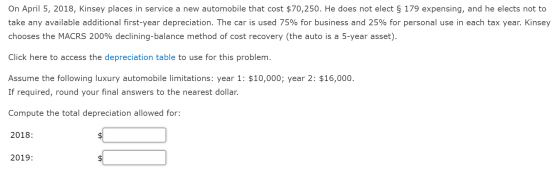
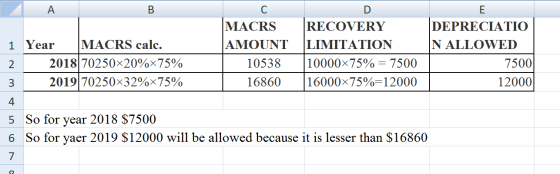
 On April 5, 2018, Kinsey places in service a new automobile that cost $70,250. He does not elect § 179 expensing, and he elects not to take any available additional first-year depreciation. The car is used 75% for business and 25% for personal use in each tax year. Kinsey chooses the MACRS 200% declining-balance method of cost recovery (the auto is a 5-year asset). Click here to access the depreciation table to use for this problem. Assume the following luxury...
On April 5, 2018, Kinsey places in service a new automobile that cost $49,250. He does...
On April 5, 2018, Kinsey places in service a new automobile that cost $49,250. He does not elect § 179 expensing, and he elects not to take any available additional first-year depreciation. The car is used 85% for business and 15% for personal use in each tax year. Kinsey chooses the MACRS 200% declining-balance method of cost recovery (the auto is a 5-year asset). Click here to access the depreciation table to use for this problem. Assume the following luxury...
Exercise 8-27 (Algorithmic) (LO. 4) On April 5, 2019, Kinsey places in service a new automobile...
 Exercise 8-27 (Algorithmic) (LO. 4) On April 5, 2019, Kinsey places in service a new automobile that cost $65,000. He does not elect § 179 expensing, and he elects not to take any available additional first-year depreciation. The car is used 60% for business and 40% for personal use in each tax year. Kinsey chooses the MACRS 200% declining-balance method of cost recovery (the auto is a 5-year asset). Click here to access the depreciation table to use for this...
Exercise 8-27 (Algorithmic) (LO. 4) On April 5, 2019, Kinsey places in service a new automobile...
 Exercise 8-27 (Algorithmic) (LO. 4) On April 5, 2019, Kinsey places in service a new automobile that cost $68,750. He does not elect § 179 expensing, and he elects not to take any available additional first-year depreciation. The car is used 95% for business and 5% for personal use in each tax year. Kinsey chooses the MACRS 200% declining-balance method of cost recovery (the auto is a 5-year asset). Click here to access the depreciation table to use for this...
Exercise 5-9 (Algorithmic) (LO. 8) On April 5, 2019, Kinsey places in service a new automobile...
 Exercise 5-9 (Algorithmic) (LO. 8) On April 5, 2019, Kinsey places in service a new automobile that cost $50,750. He does not elect g 179 expensing, and he elects not to take any available additional first-year depreciation. The car is used 70% for business and 30% for personal use in each tax year. Kinsey chooses the MACRS 200 % declining-balance method of cost recovery (the auto is a 5-year asset). Click here to access the depreciation table to use for...
For 2018 the answer is not 9835, 10538, and 21075. For 2019 the answer is not...
 For 2018 the answer is not 9835, 10538, and 21075. For 2019 the
answer is not 15736, 16860, and 10237.
On April 5, 2018, Kinsey places in service a new automobile that cost $70,250. He does not elect § 179 expensing, and he elects not to take any available additional first-year depreciation. The car is used 75% for business and 25% for personal use in each tax year. Kinsey chooses the MACRS 200% declining-balance method of cost recovery (the auto...
For 2018 the answer is not 9835, 10538, and 21075. For 2019 the
answer is not 15736, 16860, and 10237.
On April 5, 2018, Kinsey places in service a new automobile that cost $70,250. He does not elect § 179 expensing, and he elects not to take any available additional first-year depreciation. The car is used 75% for business and 25% for personal use in each tax year. Kinsey chooses the MACRS 200% declining-balance method of cost recovery (the auto...
Exercise 8-27 (Algorithmic) (LO.4) On April 5, 2019, Kinsey places in service a new automobile that...
 Exercise 8-27 (Algorithmic) (LO.4) On April 5, 2019, Kinsey places in service a new automobile that cost $45,500. He does not elect $ 179 expensing, and he elects not to take any available additional first-year depreciation. The car is used 80% for business and 209 chooses the MACRS 200% declining-balance method of cost recovery (the auto is a 5-year asset). Click here to access the depreciation table to use for this problem. Assume the following luxury automobile limitations: year 1:...
Exercise 8-27 (Algorithmic) (LO. 4) On April 5, 2019, Kinsey places in service a new automobile...
 Exercise 8-27 (Algorithmic) (LO. 4) On April 5, 2019, Kinsey places in service a new automobile that cost 576,250. He does not elect $ 179 expensing, and he elects not to take any available additional first-year depreciation. The car is used 90% for business and 10% for personal use in each tax year. Kinsey chooses the MACRS 200% declining-balance method of cost recovery (the auto is a 5-year asset). Click here to access the depreciation table to use for this...
On April 5, 2019, Kinsey places in service a new passenger automobile that cost $60,000. The...
 On April 5, 2019, Kinsey places in service a new passenger automobile that cost $60,000. The car is used 100% for business in each tax year. Kinsey uses the MACRS 200% declining-balance method of cost recovery (the auto is a 5-year asset). Assume Kinsey elects any available additional first-year depreciation. The maximum depreciation allowed for 2019 is $ 12000 X and for 2020 is $ 19200
Tax Problem On February 2, 2018, Katie purchased and placed in service a new $18,500 car....
Tax Problem On February 2, 2018, Katie purchased and placed in service a new $18,500 car. The car was used 65% for business, 5% for production of income, and 30% for personal use in 2018. In 2019, the usage changed to 40% for business, 15% for production of income, and 45% for personal use. Katie did not elect immediate expensing under § 179. She elects not to take additional first-year depreciation. If required, round your answers to the nearest dollar....
 On April 5, 2018, Kinsey places in service a new automobile that cost $70,250. He does not elect § 179 expensing, and he elects not to take any available additional first-year depreciation. The car is used 75% for business and 25% for personal use in each tax year. Kinsey chooses the MACRS 200% declining-balance method of cost recovery (the auto is a 5-year asset). Click here to access the depreciation table to use for this problem. Assume the following luxury...
 Exercise 8-27 (Algorithmic) (LO. 4) On April 5, 2019, Kinsey places in service a new automobile that cost $65,000. He does not elect § 179 expensing, and he elects not to take any available additional first-year depreciation. The car is used 60% for business and 40% for personal use in each tax year. Kinsey chooses the MACRS 200% declining-balance method of cost recovery (the auto is a 5-year asset). Click here to access the depreciation table to use for this...
 Exercise 8-27 (Algorithmic) (LO. 4) On April 5, 2019, Kinsey places in service a new automobile that cost $68,750. He does not elect § 179 expensing, and he elects not to take any available additional first-year depreciation. The car is used 95% for business and 5% for personal use in each tax year. Kinsey chooses the MACRS 200% declining-balance method of cost recovery (the auto is a 5-year asset). Click here to access the depreciation table to use for this...
 Exercise 5-9 (Algorithmic) (LO. 8) On April 5, 2019, Kinsey places in service a new automobile that cost $50,750. He does not elect g 179 expensing, and he elects not to take any available additional first-year depreciation. The car is used 70% for business and 30% for personal use in each tax year. Kinsey chooses the MACRS 200 % declining-balance method of cost recovery (the auto is a 5-year asset). Click here to access the depreciation table to use for...
 For 2018 the answer is not 9835, 10538, and 21075. For 2019 the
answer is not 15736, 16860, and 10237.
On April 5, 2018, Kinsey places in service a new automobile that cost $70,250. He does not elect § 179 expensing, and he elects not to take any available additional first-year depreciation. The car is used 75% for business and 25% for personal use in each tax year. Kinsey chooses the MACRS 200% declining-balance method of cost recovery (the auto...
For 2018 the answer is not 9835, 10538, and 21075. For 2019 the
answer is not 15736, 16860, and 10237.
On April 5, 2018, Kinsey places in service a new automobile that cost $70,250. He does not elect § 179 expensing, and he elects not to take any available additional first-year depreciation. The car is used 75% for business and 25% for personal use in each tax year. Kinsey chooses the MACRS 200% declining-balance method of cost recovery (the auto...
 Exercise 8-27 (Algorithmic) (LO.4) On April 5, 2019, Kinsey places in service a new automobile that cost $45,500. He does not elect $ 179 expensing, and he elects not to take any available additional first-year depreciation. The car is used 80% for business and 209 chooses the MACRS 200% declining-balance method of cost recovery (the auto is a 5-year asset). Click here to access the depreciation table to use for this problem. Assume the following luxury automobile limitations: year 1:...
 Exercise 8-27 (Algorithmic) (LO. 4) On April 5, 2019, Kinsey places in service a new automobile that cost 576,250. He does not elect $ 179 expensing, and he elects not to take any available additional first-year depreciation. The car is used 90% for business and 10% for personal use in each tax year. Kinsey chooses the MACRS 200% declining-balance method of cost recovery (the auto is a 5-year asset). Click here to access the depreciation table to use for this...
 On April 5, 2019, Kinsey places in service a new passenger automobile that cost $60,000. The car is used 100% for business in each tax year. Kinsey uses the MACRS 200% declining-balance method of cost recovery (the auto is a 5-year asset). Assume Kinsey elects any available additional first-year depreciation. The maximum depreciation allowed for 2019 is $ 12000 X and for 2020 is $ 19200
Most questions answered within 3 hours.
-
Where is the error in this code sequence?
String s1 = "Hello";
String s2 = "ello";...
asked 10 months ago -
Financial data for Joel de Paris, Inc., for last year
follow:
Joel de Paris, Inc.
Balance...
asked 10 months ago -
Consider this reaction:
Al2(SO4)3 (aq)+ BaCl3
(aq) Al2Cl6 (aq)- +
3BaSO4(s) . What is the...
asked 10 months ago -
Suppose that Savneet is considering increasing her
recent random sample from 20 car rentals to 40...
asked 10 months ago -
Trucks arrive at an unloading terminal at an average rate of 120
per hour.
Trucks arrive...
asked 10 months ago -
Why are methanol and ethanol completely soluble in water while
octanol is not very little soluble....
asked 10 months ago -
A facilities manager at a university reads in a research report
that the mean amount of...
asked 10 months ago -
When the CuSO4 is rehydrated by adding water to the anhydrous
compound, is this an endothermic...
asked 10 months ago -
A ray of sunlight is passing from diamond into crown glass; the
angle of incidence is...
asked 10 months ago -
A block of mass 0.249 kg is placed on top of a light, vertical
spring of...
asked 10 months ago -
how do the kidneys compensate in the presences of acidosis
a) trigger hyperventilate
b) reserve acid...
asked 10 months ago -
Question 501 pts
The rental rate of capital to the firm increases. Which of the
following...
asked 10 months ago