
Homework Answers

Add Answer to:
1. A uniform electric field is shown below. Using the information given, answer the questions shown...
A proton and an electron are separately placed at rest in the same uniform electric field....
A proton and an electron are separately placed at rest in the same uniform electric field. What can be said about the energy of each after they are released? A) Electric potential energy of both decreases, and kinetic energy of both increases. B) Electric potential energy of both increases and kinetic energy of both decreases. C) Electric potential energy and kinetic energy of both remain constant. D) Electron potential energy increases, proton potential energy decreases. E) Electron potential energy decreases,...
A proton is released from rest at point A in a constant electric field and accelerates...
 A proton is released from rest at point A in a constant electric field and accelerates to point B (see part a of the drawing). An electron is released from rest at point 8 and accelerates to point A (see part b of the drawing). How does the change in the proton's electric potential energy compare with the change in the electrons electric potential energy? O The proton experiences a greater change in electric potential energy, since it has a...
The diagrams below display two sets of charges labeled Q1 and Q2. The electric field lines...
 The diagrams below display two sets of charges labeled Q1 and
Q2. The electric field lines and equipotential surfaces are
sketched along with several labeled locations. Select either
greater than, less than or equal to for the following statements
concerning these diagrams.
Equipotential and Electric Field Diagrams The diagrams below display two sets of charges labeled Q, and Q2. The electric field lines and equipotential surfaces are sketched along with several labeled locations. Select either greater than, less than, or...
The diagrams below display two sets of charges labeled Q1 and
Q2. The electric field lines and equipotential surfaces are
sketched along with several labeled locations. Select either
greater than, less than or equal to for the following statements
concerning these diagrams.
Equipotential and Electric Field Diagrams The diagrams below display two sets of charges labeled Q, and Q2. The electric field lines and equipotential surfaces are sketched along with several labeled locations. Select either greater than, less than, or...
The following scenarios will ask you to compare the electric field at point P for four...
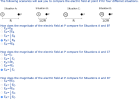 The following scenarios will ask you to compare the electric field at point P for four differnet situations. Situation B: Situation D: 20) ·P 1/2R Situation A: Situation C: 2Q 1/2R How does the magnitude of the electric field at P compare for Situations A and B? EA EB EA-2EB AEB O EA EB EA-4EB How does the magnitude of the electric field at P compare for Situations A and C? EA=Ec EA 2E EA E 4 TC How does...
Locations A, B. and c are in a regon of uniform electric field, as shown n...
 Locations A, B. and c are in a regon of uniform electric field, as shown n te diagram above. Location A is at <-03, o, o> m. Locaton cs atく0.4 electric field 1 . <-650, 350, o> NC. 0.3, 0M·In he region the For a path starting at C and endng at A, calculate: (a) The displacement vector Δ a7- (b) the change in electric potential: (e) the potential energy change for the system when a proton moves from c...
The following scenarios will ask you to compare the electric field at point P for four...
 The following scenarios will ask you to compare the electric field at point P for four differnet situations. Situation B: Situation C: Situation D: Situation A ⓞ@p 1/2R O P 2Q O P 2Q OP 1/2R How does the magnitude of the electric field at P compare for Situations A and B? EA EB EA-2Es EA-4EB EA EB How does the magnitude of the electric field at P compare for Situations A and C? EA-Ec How does the magnitude of...
please Help all questions..thanks, Electric Field een ino fen aicom is made of a single electron...
 please Help all questions..thanks,
Electric Field een ino fen aicom is made of a single electron revoling around (-5 agE-u m) a single proton as the picture below A. The electric force on the electron is given by F-qE. Explain in words what q and E represent in that equation. Determine the value of q and E. Hydrogen Atom B. The electric force on the proton is also given by F-qE Derelainin rdy what q and E represent in this...
please Help all questions..thanks,
Electric Field een ino fen aicom is made of a single electron revoling around (-5 agE-u m) a single proton as the picture below A. The electric force on the electron is given by F-qE. Explain in words what q and E represent in that equation. Determine the value of q and E. Hydrogen Atom B. The electric force on the proton is also given by F-qE Derelainin rdy what q and E represent in this...
A uniform electric field is shown below. Draw equipotential surfaces. In which direction does the voltage...
 A uniform electric field is
shown below. Draw equipotential surfaces. In which direction does
the voltage decrease? If an electron is placed in the electric
field at rest, draw the direction of the force. The electron moves
from higher potential point to lower potential point or the other
way around? If the potential difference between two locations of
the electron is 5V, what is the change in potential energy of the
electron. What is its speed at the end of...
A uniform electric field is
shown below. Draw equipotential surfaces. In which direction does
the voltage decrease? If an electron is placed in the electric
field at rest, draw the direction of the force. The electron moves
from higher potential point to lower potential point or the other
way around? If the potential difference between two locations of
the electron is 5V, what is the change in potential energy of the
electron. What is its speed at the end of...
the electric field is given bt the equation E=2axi+Aj where A=1*10^4 V/m^2 how much work does...
the electric field is given bt the equation E=2axi+Aj where A=1*10^4 V/m^2 how much work does the electric field do when a charge of 2μC is taken from point (0,0) to along the x(1,0) then parallel to the yaxis (1m,2m)? how much electrical work is done when the charge is moved along a straight line from (0,0) to (1,2m)? what is the equation for the electric potential of this field assuming the origin has a potential of zero? what is...
Q5. A uniform electric field of magnitude E 360 V/m is directed in the positive X...
 Q5. A uniform electric field of magnitude E 360 V/m is directed in the positive X direction. A proton moves from the origin to the point (x, y)-(30.0 cm, 40.0 cm). (a) Through what potential difference does the charge move? Show your work to score. (b) What is the change in the potential energy of the charge field system? Show your work to score. (c) In this uniform electric field E mentioned above, if an electron was released at rest...
 A proton is released from rest at point A in a constant electric field and accelerates to point B (see part a of the drawing). An electron is released from rest at point 8 and accelerates to point A (see part b of the drawing). How does the change in the proton's electric potential energy compare with the change in the electrons electric potential energy? O The proton experiences a greater change in electric potential energy, since it has a...
 The diagrams below display two sets of charges labeled Q1 and
Q2. The electric field lines and equipotential surfaces are
sketched along with several labeled locations. Select either
greater than, less than or equal to for the following statements
concerning these diagrams.
Equipotential and Electric Field Diagrams The diagrams below display two sets of charges labeled Q, and Q2. The electric field lines and equipotential surfaces are sketched along with several labeled locations. Select either greater than, less than, or...
The diagrams below display two sets of charges labeled Q1 and
Q2. The electric field lines and equipotential surfaces are
sketched along with several labeled locations. Select either
greater than, less than or equal to for the following statements
concerning these diagrams.
Equipotential and Electric Field Diagrams The diagrams below display two sets of charges labeled Q, and Q2. The electric field lines and equipotential surfaces are sketched along with several labeled locations. Select either greater than, less than, or...
 The following scenarios will ask you to compare the electric field at point P for four differnet situations. Situation B: Situation D: 20) ·P 1/2R Situation A: Situation C: 2Q 1/2R How does the magnitude of the electric field at P compare for Situations A and B? EA EB EA-2EB AEB O EA EB EA-4EB How does the magnitude of the electric field at P compare for Situations A and C? EA=Ec EA 2E EA E 4 TC How does...
 Locations A, B. and c are in a regon of uniform electric field, as shown n te diagram above. Location A is at <-03, o, o> m. Locaton cs atく0.4 electric field 1 . <-650, 350, o> NC. 0.3, 0M·In he region the For a path starting at C and endng at A, calculate: (a) The displacement vector Δ a7- (b) the change in electric potential: (e) the potential energy change for the system when a proton moves from c...
 The following scenarios will ask you to compare the electric field at point P for four differnet situations. Situation B: Situation C: Situation D: Situation A ⓞ@p 1/2R O P 2Q O P 2Q OP 1/2R How does the magnitude of the electric field at P compare for Situations A and B? EA EB EA-2Es EA-4EB EA EB How does the magnitude of the electric field at P compare for Situations A and C? EA-Ec How does the magnitude of...
 please Help all questions..thanks,
Electric Field een ino fen aicom is made of a single electron revoling around (-5 agE-u m) a single proton as the picture below A. The electric force on the electron is given by F-qE. Explain in words what q and E represent in that equation. Determine the value of q and E. Hydrogen Atom B. The electric force on the proton is also given by F-qE Derelainin rdy what q and E represent in this...
please Help all questions..thanks,
Electric Field een ino fen aicom is made of a single electron revoling around (-5 agE-u m) a single proton as the picture below A. The electric force on the electron is given by F-qE. Explain in words what q and E represent in that equation. Determine the value of q and E. Hydrogen Atom B. The electric force on the proton is also given by F-qE Derelainin rdy what q and E represent in this...
 A uniform electric field is
shown below. Draw equipotential surfaces. In which direction does
the voltage decrease? If an electron is placed in the electric
field at rest, draw the direction of the force. The electron moves
from higher potential point to lower potential point or the other
way around? If the potential difference between two locations of
the electron is 5V, what is the change in potential energy of the
electron. What is its speed at the end of...
A uniform electric field is
shown below. Draw equipotential surfaces. In which direction does
the voltage decrease? If an electron is placed in the electric
field at rest, draw the direction of the force. The electron moves
from higher potential point to lower potential point or the other
way around? If the potential difference between two locations of
the electron is 5V, what is the change in potential energy of the
electron. What is its speed at the end of...
 Q5. A uniform electric field of magnitude E 360 V/m is directed in the positive X direction. A proton moves from the origin to the point (x, y)-(30.0 cm, 40.0 cm). (a) Through what potential difference does the charge move? Show your work to score. (b) What is the change in the potential energy of the charge field system? Show your work to score. (c) In this uniform electric field E mentioned above, if an electron was released at rest...
Most questions answered within 3 hours.
-
Where is the error in this code sequence?
String s1 = "Hello";
String s2 = "ello";...
asked 10 months ago -
Financial data for Joel de Paris, Inc., for last year
follow:
Joel de Paris, Inc.
Balance...
asked 10 months ago -
Consider this reaction:
Al2(SO4)3 (aq)+ BaCl3
(aq) Al2Cl6 (aq)- +
3BaSO4(s) . What is the...
asked 10 months ago -
Suppose that Savneet is considering increasing her
recent random sample from 20 car rentals to 40...
asked 10 months ago -
Trucks arrive at an unloading terminal at an average rate of 120
per hour.
Trucks arrive...
asked 10 months ago -
Why are methanol and ethanol completely soluble in water while
octanol is not very little soluble....
asked 10 months ago -
A facilities manager at a university reads in a research report
that the mean amount of...
asked 10 months ago -
When the CuSO4 is rehydrated by adding water to the anhydrous
compound, is this an endothermic...
asked 10 months ago -
A ray of sunlight is passing from diamond into crown glass; the
angle of incidence is...
asked 10 months ago -
A block of mass 0.249 kg is placed on top of a light, vertical
spring of...
asked 10 months ago -
how do the kidneys compensate in the presences of acidosis
a) trigger hyperventilate
b) reserve acid...
asked 10 months ago -
Question 501 pts
The rental rate of capital to the firm increases. Which of the
following...
asked 10 months ago