
Homework Answers
eigen values is E1 /4
eigen value is
b) [H] energy is a sharp observable as
is an eigen function of the operator. The expected value is the
energy is eigen value E1 /4 nd the uncertainty is 0
c)
the eigen value is is is
sharp observable. Uncertainty is 0, expected vlue of z-component is
the eigen value
Add Answer to:
The function ψ2px-1(ψ2,1,1+ψ2,1-1) describes an electron in the 2px state of a hydrogen-like atom (with unspecified...
1. Given a state y(r) expanded on the eigenstates of the Hamiltonian for the electron, H, in a hydrogen atom: where the...
 1. Given a state y(r) expanded on the eigenstates of the Hamiltonian for the electron, H, in a hydrogen atom: where the subscript of E is n, the principal quantum number. The other two numbers are the 1 and m values, find the expectation values of H (you may use the eigenvalue equation to evaluate for H), L-(total angular momentum operator square), Lz (the z-component of the angular momentum operator) and P (parity operator). Draw schematic pictures of 1 and...
A hydrogen atom is in the n = 6 state. Determine, according to quantum mechanics, (a)...
A hydrogen atom is in the n = 6 state. Determine, according to quantum mechanics, (a) the total energy (in eV) of the atom, (b) the magnitude of the maximum angular momentum the electron can have in this state, and (c) the maximum value that the z component Lz of the angular momentum can have.
Find the expectation value and uncertainty of the z component of the angular momentum Lz for...
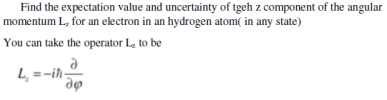 Find the expectation value and uncertainty of the z component of the angular momentum Lz for an electron in an hydrogen atom( in any state) You can take the operator Lz to be Lz = -i / psi
Consider the hydrogen atom and its eigenstates, omitting any effects of fine structure (spin- orb...
 Consider the hydrogen atom and its eigenstates, omitting any effects of fine structure (spin- orbit coupling). For the state y21-1 give the a. expectation value of the energy b. c. expectation value of the z-component of the orbital angular momentum d. expectation value of the y-component of the orbital angular momentum e. Now replace the electron with a muon which has a mass mu200 me. What is the ratio expectation value of the total orbital angular momentum of the ground...
An electron in a sodium atom is in the M shell. Determine the maximum value the...
An electron in a sodium atom is in the M shell. Determine the maximum value the z component of its angular momentum could have. (Use the following as necessary: ?.) Lz = ____?
Exercise 1: The helium atom and spin operators 26 pts (a) Show that the expectation value...
 Exercise 1: The helium atom and spin operators 26 pts (a) Show that the expectation value of the Hamiltonian in the (sa)'(2a)' excited state of helium is given by E = $42.0) (Avo ) anordes ++f63,(-) (%13-12 r) 62(e)drz + løn.(r.) per 142, (ra)]" drų dr2 - / 01.(ru) . (ra) Anemia 02.(r.)61.(r.)dr; dr2 (1) Use the approximate, antisymmetrized triplet state wave function for the (Isa)'(280)' state as discussed in class. Hint: make use of the orthonormality of the hydrogenic...
An electron in a sodium atom is in the P shell. Determine the maximum value the...
 An electron in a sodium atom is in the P shell. Determine the maximum value the z component of its angular momentum could have. (Use the following as necessary: h.) Lz
A particle on a sphere is described by the state function Ψ = N {1 +...
A particle on a sphere is described by the state function Ψ = N {1 + cos(θ)} Find a) the value of the normalization constant N b) the expectation value of the energy E c) the possible values of the z component of angular momentum (Lz) that might be measured, and which of these possibilities is most likely.
Problem 3. At some moment of time, an electron in the hydrogen atom is prepared in...
 Problem 3. At some moment of time, an electron in the hydrogen atom is prepared in the state y=1/12(R21Y1-11T>+ R32Y2011>). Determine the expectation values of (a) Î, Îz - the square of the orbital angular momentum and its projection on the z-axis, (b) Ŝ2, S2 - the square of the spin and its projection on the z-axis, (c) ſ2 = (Î + Ŝ2 - the square of the total angular momentum. Do not use calculus, use algebra in this problem.
 1. Given a state y(r) expanded on the eigenstates of the Hamiltonian for the electron, H, in a hydrogen atom: where the subscript of E is n, the principal quantum number. The other two numbers are the 1 and m values, find the expectation values of H (you may use the eigenvalue equation to evaluate for H), L-(total angular momentum operator square), Lz (the z-component of the angular momentum operator) and P (parity operator). Draw schematic pictures of 1 and...
 Find the expectation value and uncertainty of the z component of the angular momentum Lz for an electron in an hydrogen atom( in any state) You can take the operator Lz to be Lz = -i / psi
 Consider the hydrogen atom and its eigenstates, omitting any effects of fine structure (spin- orbit coupling). For the state y21-1 give the a. expectation value of the energy b. c. expectation value of the z-component of the orbital angular momentum d. expectation value of the y-component of the orbital angular momentum e. Now replace the electron with a muon which has a mass mu200 me. What is the ratio expectation value of the total orbital angular momentum of the ground...
 Exercise 1: The helium atom and spin operators 26 pts (a) Show that the expectation value of the Hamiltonian in the (sa)'(2a)' excited state of helium is given by E = $42.0) (Avo ) anordes ++f63,(-) (%13-12 r) 62(e)drz + løn.(r.) per 142, (ra)]" drų dr2 - / 01.(ru) . (ra) Anemia 02.(r.)61.(r.)dr; dr2 (1) Use the approximate, antisymmetrized triplet state wave function for the (Isa)'(280)' state as discussed in class. Hint: make use of the orthonormality of the hydrogenic...
 An electron in a sodium atom is in the P shell. Determine the maximum value the z component of its angular momentum could have. (Use the following as necessary: h.) Lz
 Problem 3. At some moment of time, an electron in the hydrogen atom is prepared in the state y=1/12(R21Y1-11T>+ R32Y2011>). Determine the expectation values of (a) Î, Îz - the square of the orbital angular momentum and its projection on the z-axis, (b) Ŝ2, S2 - the square of the spin and its projection on the z-axis, (c) ſ2 = (Î + Ŝ2 - the square of the total angular momentum. Do not use calculus, use algebra in this problem.
Most questions answered within 3 hours.
-
Where is the error in this code sequence?
String s1 = "Hello";
String s2 = "ello";...
asked 10 months ago -
Financial data for Joel de Paris, Inc., for last year
follow:
Joel de Paris, Inc.
Balance...
asked 10 months ago -
Consider this reaction:
Al2(SO4)3 (aq)+ BaCl3
(aq) Al2Cl6 (aq)- +
3BaSO4(s) . What is the...
asked 10 months ago -
Suppose that Savneet is considering increasing her
recent random sample from 20 car rentals to 40...
asked 10 months ago -
Trucks arrive at an unloading terminal at an average rate of 120
per hour.
Trucks arrive...
asked 10 months ago -
Why are methanol and ethanol completely soluble in water while
octanol is not very little soluble....
asked 10 months ago -
A facilities manager at a university reads in a research report
that the mean amount of...
asked 10 months ago -
When the CuSO4 is rehydrated by adding water to the anhydrous
compound, is this an endothermic...
asked 10 months ago -
A ray of sunlight is passing from diamond into crown glass; the
angle of incidence is...
asked 10 months ago -
A block of mass 0.249 kg is placed on top of a light, vertical
spring of...
asked 10 months ago -
how do the kidneys compensate in the presences of acidosis
a) trigger hyperventilate
b) reserve acid...
asked 10 months ago -
Question 501 pts
The rental rate of capital to the firm increases. Which of the
following...
asked 10 months ago