

Homework Answers

Add Answer to:
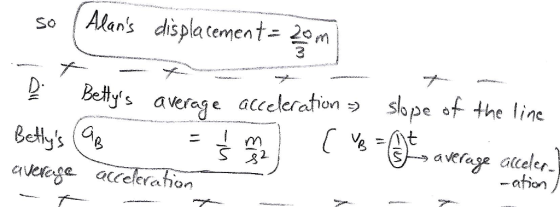
The plot below displays the velocity as a function of time for two physics students, Alan...
The plot below displays the velocity as a function of time for two physics students, Alan...
 The plot below displays the velocity as a function of time for
two physics students, Alan and Betty, for 10 seconds after a
stopwatch is started at time t = 0. Alan and Betty are both
initially standing at the same position, defined as
x = 0, and subsequently move along a straight line that we
define as our x-axis. The plot for Betty’s velocity as a function
of time vB(t) is itself a straight line while the plot for...
The plot below displays the velocity as a function of time for
two physics students, Alan and Betty, for 10 seconds after a
stopwatch is started at time t = 0. Alan and Betty are both
initially standing at the same position, defined as
x = 0, and subsequently move along a straight line that we
define as our x-axis. The plot for Betty’s velocity as a function
of time vB(t) is itself a straight line while the plot for...
Suppose that the position vector of a particle is given by the following function of time:...
Suppose that the position vector of a particle is given by the following function of time: r = (6.0 + 2.0t^2)i + (3.0 - 2.0t + 3.0t^2)j where distance is measured in meters and time in seconds. (a) What is the instantaneous velocity vector at t=2.0 s? What is the magnitude of this vector? (b) What is the instantaneous acceleration vector? What are the magnitude and direction of this vector?
An object's velocity as a function of time is shown in the plot below. The object...
 An object's velocity as a function of time is shown in the plot below. The object begins at position s = 10 m at t = 0 s. What is the object's total displacement at t = 7 s? What is the object's position at t = 7 s? What is the total distance the object Innis moved between t = 0 and t = 7 s. What is the acceleration of this object at t = 1, 3, 5...
S The function s = 12 - 91? + 27t, Osts 4, gives the position of...
 S The function s = 12 - 91? + 27t, Osts 4, gives the position of a body moving on a coordinate line, with sin meters and t in seconds. a. Find the body's displacement and average velocity for the given time interval b. Find the body's speed and acceleration at the endpoints of the interval. c. When, if ever, during the interval does the body change direction? 3.4.7 At time t, the position of a body moving along the...
The plot below shows the velocity vs. time for an object moving along the x axis....
 The plot below shows the velocity vs. time for an object moving
along the x axis. The object is initially at position x = 0 at time
t = 0. Assume two significant figures for your graph
values.
a. Find an equation for the velocity v(t)
2. The plot below shows the velocity vs. time for an object moving along the x axis. The object is initially at position x = 0 at time t = 0, Assume two significant...
The plot below shows the velocity vs. time for an object moving
along the x axis. The object is initially at position x = 0 at time
t = 0. Assume two significant figures for your graph
values.
a. Find an equation for the velocity v(t)
2. The plot below shows the velocity vs. time for an object moving along the x axis. The object is initially at position x = 0 at time t = 0, Assume two significant...
For the following velocity graph, velocity is in m/s and time is in s. For the...
 For the following velocity graph, velocity is in m/s and time is in s. For the interval t 2s to t = 5s, find (a)[4 pts] the average acceleration, and (b)4 pts] the displacement Aæ. t 5 2 4 1 For the following described motion, draw a position-time, a velocity-time, and an acceleration-time graph on the grids provided: 1. Standing still at the 0.6 meter position for 1 second. 2. Walking away from the detector speeding up slowly and steadily...
The figure shows the velocity of an object moving along a straight line as a function of time. Determine:
 The figure shows the velocity of an object moving along a straight line as a function of time. Determine: a) The displacement of the object for the first 9 secondsb) The object's average velocity from t = 0 s tot=9 s.c) The object's average acceleration from t = 0 tot = 5 seconds.c) The acceleration of the object at t =8 seconds.
.4.5 프 Assigned Media A body moves on a coordinate line such that it has a position s fon the interval 1sts2 with s in meters and t in seconds. a position s f) on the interval a Find the body...
 .4.5 프 Assigned Media A body moves on a coordinate line such that it has a position s fon the interval 1sts2 with s in meters and t in seconds. a position s f) on the interval a Find the body's displacement and average velocity for the given time interval. b. Find the body's speed and acceleration at the endpoints of the interval c. When, if ever, during the interval does the body change direction?
.4.5 프 Assigned Media A...
.4.5 프 Assigned Media A body moves on a coordinate line such that it has a position s fon the interval 1sts2 with s in meters and t in seconds. a position s f) on the interval a Find the body's displacement and average velocity for the given time interval. b. Find the body's speed and acceleration at the endpoints of the interval c. When, if ever, during the interval does the body change direction?
.4.5 프 Assigned Media A...
Find the bodys displacement and averafind the bodys displacement and average velocity for the...
a body moves on a coordinate line such that it has a position s=f(t)=t^2-8t+7 on the interval 0(greater than or equal to)t(greater than or equalto)9 with s in meters and t in secondsa)find the bodys displacement and average velocity for the given time intervalb)find the bodys speed and acceleration at the endpoints of the intervalc)when,if ever,during the interval does the body change direction?section 3.4
Please help with this Kinematics question! Position and time graphs. Velocity vs. time graph. Consider this...
 Please help with this Kinematics question! Position and time
graphs. Velocity vs. time graph.
Consider this position vs. does the corresponding velocity vs. time graph look like? 1. time graph. What (a) Sketch your prediction below * Now reproduce the position graph by walking, and see if the velocity graph comes out the way you expect. 10 t (seconds) Velocity Graph Prediction Velocity Graph Result (m/s) o (m/s) 0 10 6 10 t (seconds) t (seconds) 2. Here's a velocity...
Please help with this Kinematics question! Position and time
graphs. Velocity vs. time graph.
Consider this position vs. does the corresponding velocity vs. time graph look like? 1. time graph. What (a) Sketch your prediction below * Now reproduce the position graph by walking, and see if the velocity graph comes out the way you expect. 10 t (seconds) Velocity Graph Prediction Velocity Graph Result (m/s) o (m/s) 0 10 6 10 t (seconds) t (seconds) 2. Here's a velocity...
 The plot below displays the velocity as a function of time for
two physics students, Alan and Betty, for 10 seconds after a
stopwatch is started at time t = 0. Alan and Betty are both
initially standing at the same position, defined as
x = 0, and subsequently move along a straight line that we
define as our x-axis. The plot for Betty’s velocity as a function
of time vB(t) is itself a straight line while the plot for...
The plot below displays the velocity as a function of time for
two physics students, Alan and Betty, for 10 seconds after a
stopwatch is started at time t = 0. Alan and Betty are both
initially standing at the same position, defined as
x = 0, and subsequently move along a straight line that we
define as our x-axis. The plot for Betty’s velocity as a function
of time vB(t) is itself a straight line while the plot for...
 An object's velocity as a function of time is shown in the plot below. The object begins at position s = 10 m at t = 0 s. What is the object's total displacement at t = 7 s? What is the object's position at t = 7 s? What is the total distance the object Innis moved between t = 0 and t = 7 s. What is the acceleration of this object at t = 1, 3, 5...
 S The function s = 12 - 91? + 27t, Osts 4, gives the position of a body moving on a coordinate line, with sin meters and t in seconds. a. Find the body's displacement and average velocity for the given time interval b. Find the body's speed and acceleration at the endpoints of the interval. c. When, if ever, during the interval does the body change direction? 3.4.7 At time t, the position of a body moving along the...
 The plot below shows the velocity vs. time for an object moving
along the x axis. The object is initially at position x = 0 at time
t = 0. Assume two significant figures for your graph
values.
a. Find an equation for the velocity v(t)
2. The plot below shows the velocity vs. time for an object moving along the x axis. The object is initially at position x = 0 at time t = 0, Assume two significant...
The plot below shows the velocity vs. time for an object moving
along the x axis. The object is initially at position x = 0 at time
t = 0. Assume two significant figures for your graph
values.
a. Find an equation for the velocity v(t)
2. The plot below shows the velocity vs. time for an object moving along the x axis. The object is initially at position x = 0 at time t = 0, Assume two significant...
 For the following velocity graph, velocity is in m/s and time is in s. For the interval t 2s to t = 5s, find (a)[4 pts] the average acceleration, and (b)4 pts] the displacement Aæ. t 5 2 4 1 For the following described motion, draw a position-time, a velocity-time, and an acceleration-time graph on the grids provided: 1. Standing still at the 0.6 meter position for 1 second. 2. Walking away from the detector speeding up slowly and steadily...
 .4.5 프 Assigned Media A body moves on a coordinate line such that it has a position s fon the interval 1sts2 with s in meters and t in seconds. a position s f) on the interval a Find the body's displacement and average velocity for the given time interval. b. Find the body's speed and acceleration at the endpoints of the interval c. When, if ever, during the interval does the body change direction?
.4.5 프 Assigned Media A...
.4.5 프 Assigned Media A body moves on a coordinate line such that it has a position s fon the interval 1sts2 with s in meters and t in seconds. a position s f) on the interval a Find the body's displacement and average velocity for the given time interval. b. Find the body's speed and acceleration at the endpoints of the interval c. When, if ever, during the interval does the body change direction?
.4.5 프 Assigned Media A...
 Please help with this Kinematics question! Position and time
graphs. Velocity vs. time graph.
Consider this position vs. does the corresponding velocity vs. time graph look like? 1. time graph. What (a) Sketch your prediction below * Now reproduce the position graph by walking, and see if the velocity graph comes out the way you expect. 10 t (seconds) Velocity Graph Prediction Velocity Graph Result (m/s) o (m/s) 0 10 6 10 t (seconds) t (seconds) 2. Here's a velocity...
Please help with this Kinematics question! Position and time
graphs. Velocity vs. time graph.
Consider this position vs. does the corresponding velocity vs. time graph look like? 1. time graph. What (a) Sketch your prediction below * Now reproduce the position graph by walking, and see if the velocity graph comes out the way you expect. 10 t (seconds) Velocity Graph Prediction Velocity Graph Result (m/s) o (m/s) 0 10 6 10 t (seconds) t (seconds) 2. Here's a velocity...
Most questions answered within 3 hours.
-
Where is the error in this code sequence?
String s1 = "Hello";
String s2 = "ello";...
asked 10 months ago -
Financial data for Joel de Paris, Inc., for last year
follow:
Joel de Paris, Inc.
Balance...
asked 10 months ago -
Consider this reaction:
Al2(SO4)3 (aq)+ BaCl3
(aq) Al2Cl6 (aq)- +
3BaSO4(s) . What is the...
asked 10 months ago -
Suppose that Savneet is considering increasing her
recent random sample from 20 car rentals to 40...
asked 10 months ago -
Trucks arrive at an unloading terminal at an average rate of 120
per hour.
Trucks arrive...
asked 10 months ago -
Why are methanol and ethanol completely soluble in water while
octanol is not very little soluble....
asked 10 months ago -
A facilities manager at a university reads in a research report
that the mean amount of...
asked 10 months ago -
When the CuSO4 is rehydrated by adding water to the anhydrous
compound, is this an endothermic...
asked 10 months ago -
A ray of sunlight is passing from diamond into crown glass; the
angle of incidence is...
asked 10 months ago -
A block of mass 0.249 kg is placed on top of a light, vertical
spring of...
asked 10 months ago -
how do the kidneys compensate in the presences of acidosis
a) trigger hyperventilate
b) reserve acid...
asked 10 months ago -
Question 501 pts
The rental rate of capital to the firm increases. Which of the
following...
asked 10 months ago