
Homework Answers
Add Answer to:
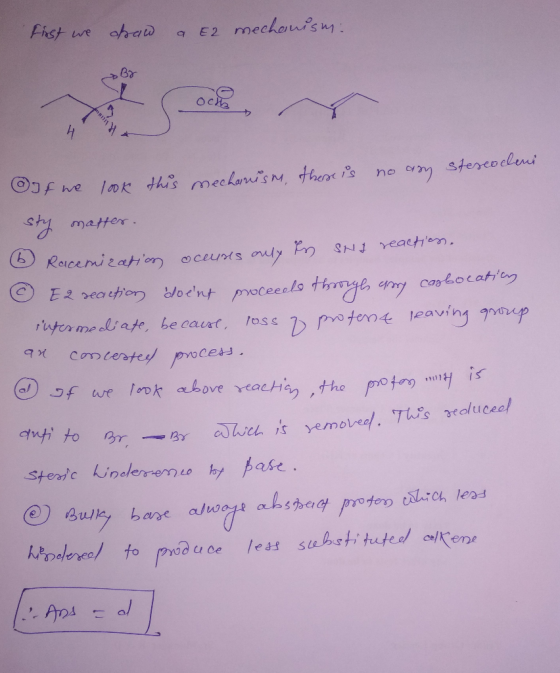
option D is correct, please explain why it is not any of the other
options.
5....
Which of the following statements applies to the E2 mechanism? A) It occurs with inversion of...
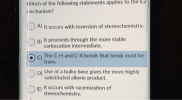 Which of the following statements applies to the E2 mechanism? A) It occurs with inversion of stereochemistry. B) It proceeds through the more stable carbocation intermediate. C) The C-H and C-X bonds that break must be trans. Use of a bulky base gives the more highly substituted alkene product. E) It occurs with racemization of stereochemistry. D)
need help with last hw problems, please explain and the answers thank you O Rank the...
 need help with last hw problems, please explain and the
answers thank you
O Rank the substituents below from hiahest priority to lowest using the Cann-ingold, Prelog sequence rules. B. -OH A. A>D>C>B B. B>D>A>C A.-CEN C. A>B>D>C D. D>B>A>C C.-CECH D. C.CH 7. The regiochemistry of hydroboration/oxidation of alkenesis A. Markovnikov. B. Anti-Markovnikov. C. Subject to solvent effects. D. Unrelated to alkene structure. 8. Assign the correct E or Z. cis or trans configuration to the following structure. OH...
need help with last hw problems, please explain and the
answers thank you
O Rank the substituents below from hiahest priority to lowest using the Cann-ingold, Prelog sequence rules. B. -OH A. A>D>C>B B. B>D>A>C A.-CEN C. A>B>D>C D. D>B>A>C C.-CECH D. C.CH 7. The regiochemistry of hydroboration/oxidation of alkenesis A. Markovnikov. B. Anti-Markovnikov. C. Subject to solvent effects. D. Unrelated to alkene structure. 8. Assign the correct E or Z. cis or trans configuration to the following structure. OH...
I need help on all of these! Please help with d-h, if possible! d. The reaction...
 I need help on all of these! Please help with d-h, if
possible!
d. The reaction of (2R)-butanol with NaBr and sulfuric acid in acetone proceeds with inversion of configuration. e. The addition reaction of HBr to 1-butene in the presence of peroxides produces the anti- Markovnikov product. (Might not be a review question, might make an appearance in early 3060.) The reaction of 2-methyl-2-butanol with HCl produces as a major product an alkyl halide. An ether and an alkene...
I need help on all of these! Please help with d-h, if
possible!
d. The reaction of (2R)-butanol with NaBr and sulfuric acid in acetone proceeds with inversion of configuration. e. The addition reaction of HBr to 1-butene in the presence of peroxides produces the anti- Markovnikov product. (Might not be a review question, might make an appearance in early 3060.) The reaction of 2-methyl-2-butanol with HCl produces as a major product an alkyl halide. An ether and an alkene...
please answer all parts, thanks! 1. More substituted alkenes are more stable than less substituted alkenes....
 please answer all parts, thanks!
1. More substituted alkenes are more stable than less substituted alkenes. Show the orbital overlap that helps to explain this observation. 2. Why is the heat of hydrogenation for an alkene exothermic? Analyze the bonds that are changing. AH = -30 kcal/mol Explain: + H2 3. Treating alkene "A" below with HBr can lead to a number of products. "A" SM + H-Br A bunch of products. For real, hella products. 3.A. Label the stereocenters...
please answer all parts, thanks!
1. More substituted alkenes are more stable than less substituted alkenes. Show the orbital overlap that helps to explain this observation. 2. Why is the heat of hydrogenation for an alkene exothermic? Analyze the bonds that are changing. AH = -30 kcal/mol Explain: + H2 3. Treating alkene "A" below with HBr can lead to a number of products. "A" SM + H-Br A bunch of products. For real, hella products. 3.A. Label the stereocenters...
Organic Chemistry: Vocabulary: i.) If we have a weakly basic nucleophile and a secondary haloalkane we’ll...
Organic Chemistry: Vocabulary: i.) If we have a weakly basic nucleophile and a secondary haloalkane we’ll generally get _ mechanism(s). a. SN1 only b. SN2 c. E2 d. E1 only e. SN1 and E1 f. no reaction This mechanism will have ____ stereochemistry, a. predictable b. random due to the ____. a. planar intermediate b. backside attack transition state c. frontside attack transition state d. anti-periplanar transition state _____________________________________________________ ii.) Carbocation rearrangements will tend to form the __ stable intermediate....
Please, make the answer clear and reable. BrEtOH a OEt Hace H2C Alkyl halides undergo nucleophilic...
 Please, make the answer clear
and reable.
BrEtOH a OEt Hace H2C Alkyl halides undergo nucleophilic substitution and elimination reactions. When the kinetics of the reaction are measured, if the rate of the reaction is found to be dependent only upon the concentration of the alkyl halide the reaction is first order. The substitution reaction is thus termed ction is termed E1. These reactions are unimolecular and occur in two steps. The first step is rate-limiting and involves the loss...
Please, make the answer clear
and reable.
BrEtOH a OEt Hace H2C Alkyl halides undergo nucleophilic substitution and elimination reactions. When the kinetics of the reaction are measured, if the rate of the reaction is found to be dependent only upon the concentration of the alkyl halide the reaction is first order. The substitution reaction is thus termed ction is termed E1. These reactions are unimolecular and occur in two steps. The first step is rate-limiting and involves the loss...
need help with 14-21 Stereochemistry of the Su2 reaction In the Sn2 reaction the tetrahedral carbon...
 need help with 14-21
Stereochemistry of the Su2 reaction In the Sn2 reaction the tetrahedral carbon center is inverted. We describe the mechanism as nudeophilic (Nuc) back side attack; the leaving group (LG) is leav ing from the front side. Generally, the LG and the Nucare electron rich so it would be unfavorable for them to react from the same side (charge repuls ion). The geometry of the carbon at the transition state is trigonal planar. 14) Label the 2-bromobuta...
need help with 14-21
Stereochemistry of the Su2 reaction In the Sn2 reaction the tetrahedral carbon center is inverted. We describe the mechanism as nudeophilic (Nuc) back side attack; the leaving group (LG) is leav ing from the front side. Generally, the LG and the Nucare electron rich so it would be unfavorable for them to react from the same side (charge repuls ion). The geometry of the carbon at the transition state is trigonal planar. 14) Label the 2-bromobuta...
need help with 1-21 1) Label the steps below as "slow" and "fast". HCH 013 10...
 need help with 1-21
1) Label the steps below as "slow" and "fast". HCH 013 10 = H. C + + H-LG H-LG 2) Why are they slow/fast? Explain using chemical terms. Stereochemistry of the Sn1 reaction 3) What type of intermediate does the Sn1 reaction proceed through? 4) What is the geometry of the carbon that the nucleophile coordinates to in the 2 step? 5) From how many directions would it be reasonable for the nucleophile to approach the...
need help with 1-21
1) Label the steps below as "slow" and "fast". HCH 013 10 = H. C + + H-LG H-LG 2) Why are they slow/fast? Explain using chemical terms. Stereochemistry of the Sn1 reaction 3) What type of intermediate does the Sn1 reaction proceed through? 4) What is the geometry of the carbon that the nucleophile coordinates to in the 2 step? 5) From how many directions would it be reasonable for the nucleophile to approach the...
Chapter 11: 1. What is a prime rule in naming alkenes? a. Find the longest carbon...
Chapter 11: 1. What is a prime rule in naming alkenes? a. Find the longest carbon chain. b.Find the longest carbon chain containing the alkene. c. Find whether the alkene has a cis- or trans- configuration. d.Find how far the alkene functionality is from either end. 2. What is the IUPAC name of the following alkene? a. cis-5-methyl-2-heptene b. trans-2-ethyl-4-hexene c. trans-5-methyl-2-heptene d. trans-3-methyl-5-heptene 3. What is the hybridization, geometry, and bond angle of the carbon marked by an asterisk?...
Please completely answer the questions, thank you! For the reactions below, 1. supply the reagents needed...
 Please completely answer the questions, thank you!
For the reactions below, 1. supply the reagents needed to carry out the reaction, by writing them above the reaction arrow. 2. Use choices 1A through 11, 2A through 24, and 3A through 3X, above to answer the questions about reaction types and mechanistic details. 3. For the reactions in column 3, that require you to diagram the mechanism, diagram the mechanism. Column 1 Column 2 Column 3 Type of Reaction The Reason...
Please completely answer the questions, thank you!
For the reactions below, 1. supply the reagents needed to carry out the reaction, by writing them above the reaction arrow. 2. Use choices 1A through 11, 2A through 24, and 3A through 3X, above to answer the questions about reaction types and mechanistic details. 3. For the reactions in column 3, that require you to diagram the mechanism, diagram the mechanism. Column 1 Column 2 Column 3 Type of Reaction The Reason...
 Which of the following statements applies to the E2 mechanism? A) It occurs with inversion of stereochemistry. B) It proceeds through the more stable carbocation intermediate. C) The C-H and C-X bonds that break must be trans. Use of a bulky base gives the more highly substituted alkene product. E) It occurs with racemization of stereochemistry. D)
 need help with last hw problems, please explain and the
answers thank you
O Rank the substituents below from hiahest priority to lowest using the Cann-ingold, Prelog sequence rules. B. -OH A. A>D>C>B B. B>D>A>C A.-CEN C. A>B>D>C D. D>B>A>C C.-CECH D. C.CH 7. The regiochemistry of hydroboration/oxidation of alkenesis A. Markovnikov. B. Anti-Markovnikov. C. Subject to solvent effects. D. Unrelated to alkene structure. 8. Assign the correct E or Z. cis or trans configuration to the following structure. OH...
need help with last hw problems, please explain and the
answers thank you
O Rank the substituents below from hiahest priority to lowest using the Cann-ingold, Prelog sequence rules. B. -OH A. A>D>C>B B. B>D>A>C A.-CEN C. A>B>D>C D. D>B>A>C C.-CECH D. C.CH 7. The regiochemistry of hydroboration/oxidation of alkenesis A. Markovnikov. B. Anti-Markovnikov. C. Subject to solvent effects. D. Unrelated to alkene structure. 8. Assign the correct E or Z. cis or trans configuration to the following structure. OH...
 I need help on all of these! Please help with d-h, if
possible!
d. The reaction of (2R)-butanol with NaBr and sulfuric acid in acetone proceeds with inversion of configuration. e. The addition reaction of HBr to 1-butene in the presence of peroxides produces the anti- Markovnikov product. (Might not be a review question, might make an appearance in early 3060.) The reaction of 2-methyl-2-butanol with HCl produces as a major product an alkyl halide. An ether and an alkene...
I need help on all of these! Please help with d-h, if
possible!
d. The reaction of (2R)-butanol with NaBr and sulfuric acid in acetone proceeds with inversion of configuration. e. The addition reaction of HBr to 1-butene in the presence of peroxides produces the anti- Markovnikov product. (Might not be a review question, might make an appearance in early 3060.) The reaction of 2-methyl-2-butanol with HCl produces as a major product an alkyl halide. An ether and an alkene...
 please answer all parts, thanks!
1. More substituted alkenes are more stable than less substituted alkenes. Show the orbital overlap that helps to explain this observation. 2. Why is the heat of hydrogenation for an alkene exothermic? Analyze the bonds that are changing. AH = -30 kcal/mol Explain: + H2 3. Treating alkene "A" below with HBr can lead to a number of products. "A" SM + H-Br A bunch of products. For real, hella products. 3.A. Label the stereocenters...
please answer all parts, thanks!
1. More substituted alkenes are more stable than less substituted alkenes. Show the orbital overlap that helps to explain this observation. 2. Why is the heat of hydrogenation for an alkene exothermic? Analyze the bonds that are changing. AH = -30 kcal/mol Explain: + H2 3. Treating alkene "A" below with HBr can lead to a number of products. "A" SM + H-Br A bunch of products. For real, hella products. 3.A. Label the stereocenters...
 Please, make the answer clear
and reable.
BrEtOH a OEt Hace H2C Alkyl halides undergo nucleophilic substitution and elimination reactions. When the kinetics of the reaction are measured, if the rate of the reaction is found to be dependent only upon the concentration of the alkyl halide the reaction is first order. The substitution reaction is thus termed ction is termed E1. These reactions are unimolecular and occur in two steps. The first step is rate-limiting and involves the loss...
Please, make the answer clear
and reable.
BrEtOH a OEt Hace H2C Alkyl halides undergo nucleophilic substitution and elimination reactions. When the kinetics of the reaction are measured, if the rate of the reaction is found to be dependent only upon the concentration of the alkyl halide the reaction is first order. The substitution reaction is thus termed ction is termed E1. These reactions are unimolecular and occur in two steps. The first step is rate-limiting and involves the loss...
 need help with 14-21
Stereochemistry of the Su2 reaction In the Sn2 reaction the tetrahedral carbon center is inverted. We describe the mechanism as nudeophilic (Nuc) back side attack; the leaving group (LG) is leav ing from the front side. Generally, the LG and the Nucare electron rich so it would be unfavorable for them to react from the same side (charge repuls ion). The geometry of the carbon at the transition state is trigonal planar. 14) Label the 2-bromobuta...
need help with 14-21
Stereochemistry of the Su2 reaction In the Sn2 reaction the tetrahedral carbon center is inverted. We describe the mechanism as nudeophilic (Nuc) back side attack; the leaving group (LG) is leav ing from the front side. Generally, the LG and the Nucare electron rich so it would be unfavorable for them to react from the same side (charge repuls ion). The geometry of the carbon at the transition state is trigonal planar. 14) Label the 2-bromobuta...
 need help with 1-21
1) Label the steps below as "slow" and "fast". HCH 013 10 = H. C + + H-LG H-LG 2) Why are they slow/fast? Explain using chemical terms. Stereochemistry of the Sn1 reaction 3) What type of intermediate does the Sn1 reaction proceed through? 4) What is the geometry of the carbon that the nucleophile coordinates to in the 2 step? 5) From how many directions would it be reasonable for the nucleophile to approach the...
need help with 1-21
1) Label the steps below as "slow" and "fast". HCH 013 10 = H. C + + H-LG H-LG 2) Why are they slow/fast? Explain using chemical terms. Stereochemistry of the Sn1 reaction 3) What type of intermediate does the Sn1 reaction proceed through? 4) What is the geometry of the carbon that the nucleophile coordinates to in the 2 step? 5) From how many directions would it be reasonable for the nucleophile to approach the...
 Please completely answer the questions, thank you!
For the reactions below, 1. supply the reagents needed to carry out the reaction, by writing them above the reaction arrow. 2. Use choices 1A through 11, 2A through 24, and 3A through 3X, above to answer the questions about reaction types and mechanistic details. 3. For the reactions in column 3, that require you to diagram the mechanism, diagram the mechanism. Column 1 Column 2 Column 3 Type of Reaction The Reason...
Please completely answer the questions, thank you!
For the reactions below, 1. supply the reagents needed to carry out the reaction, by writing them above the reaction arrow. 2. Use choices 1A through 11, 2A through 24, and 3A through 3X, above to answer the questions about reaction types and mechanistic details. 3. For the reactions in column 3, that require you to diagram the mechanism, diagram the mechanism. Column 1 Column 2 Column 3 Type of Reaction The Reason...
Most questions answered within 3 hours.
-
Where is the error in this code sequence?
String s1 = "Hello";
String s2 = "ello";...
asked 10 months ago -
Financial data for Joel de Paris, Inc., for last year
follow:
Joel de Paris, Inc.
Balance...
asked 10 months ago -
Consider this reaction:
Al2(SO4)3 (aq)+ BaCl3
(aq) Al2Cl6 (aq)- +
3BaSO4(s) . What is the...
asked 10 months ago -
Suppose that Savneet is considering increasing her
recent random sample from 20 car rentals to 40...
asked 10 months ago -
Trucks arrive at an unloading terminal at an average rate of 120
per hour.
Trucks arrive...
asked 10 months ago -
Why are methanol and ethanol completely soluble in water while
octanol is not very little soluble....
asked 10 months ago -
A facilities manager at a university reads in a research report
that the mean amount of...
asked 10 months ago -
When the CuSO4 is rehydrated by adding water to the anhydrous
compound, is this an endothermic...
asked 10 months ago -
A ray of sunlight is passing from diamond into crown glass; the
angle of incidence is...
asked 10 months ago -
A block of mass 0.249 kg is placed on top of a light, vertical
spring of...
asked 10 months ago -
how do the kidneys compensate in the presences of acidosis
a) trigger hyperventilate
b) reserve acid...
asked 10 months ago -
Question 501 pts
The rental rate of capital to the firm increases. Which of the
following...
asked 10 months ago