Naming Aromatic compounds is a challenge because of the conflicting IUPAC and Common naming rules; discuss...
Naming Aromatic compounds is a challenge because of the conflicting IUPAC and Common naming rules; discuss one situation where using O, M, P in a name would be appropriate, and one situation where you would not use O, M, P in a name.
Homework Answers
O(ortho), M(meta), P(para) nomenclature is used in naming of aromatic compounds which are disubstituted
In the case of disubstituted aromatic compounds, relative positions of non-hydrogen substituents is described by ortho, meta, para prefixes.
If the two substituents are present at adjacent carbons or 1,2 carbons of the aromatic ring then the prefix ortho(O) is used before compound name.
If the two substituents are present at alternative carbons or 1,3 carbons of the aromatic ring then the prefix meta(M) is used before compound name.
If the two substituents are present at opposite diagonal carbons or 1,4 carbons of the aromatic ring then the prefix para(P) is used before compound name.
For example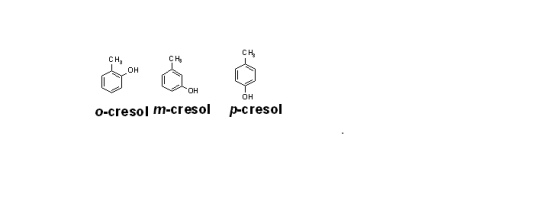
Add Answer to:
Naming Aromatic compounds is a challenge because of the
conflicting IUPAC and Common naming rules; discuss...
Megan Marsh: Attempt 1 Use IUPAC naming rules to write the name of the following molecule....
 Megan Marsh: Attempt 1 Use IUPAC naming rules to write the name of the following molecule. AV Question 4 (2 points) Hydrolysis of the following ester will produce what two compounds?
NAMING ALKENES 4.37 Give IUPAC names for the following compounds AND ALKYNES lal H20% HzCECH le)...
 NAMING ALKENES 4.37 Give IUPAC names for the following compounds AND ALKYNES lal H20% HzCECH le) 4.28 Draw structures corresponding to the following IUPAC names 3-Ethylhept-1-yne (b) 3,5-Dimethylhex-4-en-1-yne (c) Hepta-1,5-diyne (d) 1-Methyleyclopenta-1,3-diene 4.29 The following two hydrocarbons have been isolated from plants in sunflower family. Name them according to lUPAC rules. (a) CH3CH-CHC-CC-CCH-CHCH-CHCH=CH2 (all trans) Draw and name all the possible pentyne isomers, CsHs the six are conjugated dienes? 4.30 4.31 Draw and name the six possible diene isomers of...
Give the IUPAC rules to name a byciclo with one branch Give the IUPAC rules to...
Give the IUPAC rules to name a byciclo with one branch Give the IUPAC rules to name compounds with functional groups and with branches (same as 3) just the double bond changes for functional group. The double bond is a functional group. Give the names of the branches that have common names. Those names are now accepted by IUPAC since they are here to stay. e.g isopropyl Give the name of the branches in 6 using IUPAC nomenclature. e.g isopropyl...
There are several aromatic compounds with the formula C8H9Cl. Name those that have a disubstituted ring...
There are several aromatic compounds with the formula C8H9Cl. Name those that have a disubstituted ring where the chlorine is attached to the ring. If you choose to use ortho, meta, or para in your name, abbreviate these prefixes with o, m, or p. If there are not 3 isomers that fit the description, leave the appropriate number of spaces blank.
There are several aromatic compounds with the formula CgH9Cl. Name those that have a trisubstituted ring...
 There are several aromatic compounds with the formula CgH9Cl. Name those that have a trisubstituted ring where the methyl groups are oriented meta. If you choose to use ortho, meta, or para in your name, abbreviate these prefixes with o, m, or p. If there are not 3 isomers that fit the description, leave the appropriate number of spaces blank. Isomer #1: Isomer #2: Isomer #3:
1) Name the following compounds using the IUPAC rules. Use (E) and (Z) where needed. Circle your final answer. Br o...
 1) Name the following compounds using the IUPAC rules. Use (E) and (Z) where needed. Circle your final answer. Br ould dve a diftat preducte rodu SN2 feaction
Name: Naming Molecular Compounds 1. Nitrogen and oxygen combine to form many different compounds. How would you nam...
 Name: Naming Molecular Compounds 1. Nitrogen and oxygen combine to form many different compounds. How would you name find the formula each of the following according to the IUPAC rules: a. N20 (laughing gas) b. NO (a cellular signaling molecule) c. NO2 (a toxic brown gas) d. diphosphorus pentoxide (used to speed up certain chemical reactions) 4. Concept check: Each of the following compounds is incorrectly named. What is wrong with each name and what is the correct name for...
I am really confused by naming compounds. The reason I am confused is because some compounds,...
I am really confused by naming compounds. The reason I am confused is because some compounds, you would use Roman numerals and some you don’t. Example 1, NiPO4 would be nickel(III) phosphate. Example 2, Li2SO3 would be lithium sulfite. I don’t get how example 1 used Roman numerals and example 2 didn’t. How do you know when to use Roman numerals?
Give IUPAC names for the following compounds. Give IUPAC names for the following compounds ball &...
 Give IUPAC names for the following compounds.
Give IUPAC names for the following compounds ball & stick v abels ball & stick v abels (Be sure to specify stereochemistry where relevant. It is not necessary to use italics in writing compound names. Abbreviate ortho to o, meta to m, and para to p.)
Give IUPAC names for the following compounds.
Give IUPAC names for the following compounds ball & stick v abels ball & stick v abels (Be sure to specify stereochemistry where relevant. It is not necessary to use italics in writing compound names. Abbreviate ortho to o, meta to m, and para to p.)
pleasa help! i cant figure this one out 1. Using IUPAC rules (see Chapter 2.14-2.18 and...
 pleasa help! i cant figure this one out
1. Using IUPAC rules (see Chapter 2.14-2.18 and Table 2.4 and 2.5 in text) provide a name to each structure below. You may use common names for branched substituents were applicable. (2pts for each correct name provided, no partial credit)
pleasa help! i cant figure this one out
1. Using IUPAC rules (see Chapter 2.14-2.18 and Table 2.4 and 2.5 in text) provide a name to each structure below. You may use common names for branched substituents were applicable. (2pts for each correct name provided, no partial credit)
 Megan Marsh: Attempt 1 Use IUPAC naming rules to write the name of the following molecule. AV Question 4 (2 points) Hydrolysis of the following ester will produce what two compounds?
 NAMING ALKENES 4.37 Give IUPAC names for the following compounds AND ALKYNES lal H20% HzCECH le) 4.28 Draw structures corresponding to the following IUPAC names 3-Ethylhept-1-yne (b) 3,5-Dimethylhex-4-en-1-yne (c) Hepta-1,5-diyne (d) 1-Methyleyclopenta-1,3-diene 4.29 The following two hydrocarbons have been isolated from plants in sunflower family. Name them according to lUPAC rules. (a) CH3CH-CHC-CC-CCH-CHCH-CHCH=CH2 (all trans) Draw and name all the possible pentyne isomers, CsHs the six are conjugated dienes? 4.30 4.31 Draw and name the six possible diene isomers of...
 There are several aromatic compounds with the formula CgH9Cl. Name those that have a trisubstituted ring where the methyl groups are oriented meta. If you choose to use ortho, meta, or para in your name, abbreviate these prefixes with o, m, or p. If there are not 3 isomers that fit the description, leave the appropriate number of spaces blank. Isomer #1: Isomer #2: Isomer #3:
 1) Name the following compounds using the IUPAC rules. Use (E) and (Z) where needed. Circle your final answer. Br ould dve a diftat preducte rodu SN2 feaction
 Name: Naming Molecular Compounds 1. Nitrogen and oxygen combine to form many different compounds. How would you name find the formula each of the following according to the IUPAC rules: a. N20 (laughing gas) b. NO (a cellular signaling molecule) c. NO2 (a toxic brown gas) d. diphosphorus pentoxide (used to speed up certain chemical reactions) 4. Concept check: Each of the following compounds is incorrectly named. What is wrong with each name and what is the correct name for...
 Give IUPAC names for the following compounds.
Give IUPAC names for the following compounds ball & stick v abels ball & stick v abels (Be sure to specify stereochemistry where relevant. It is not necessary to use italics in writing compound names. Abbreviate ortho to o, meta to m, and para to p.)
Give IUPAC names for the following compounds.
Give IUPAC names for the following compounds ball & stick v abels ball & stick v abels (Be sure to specify stereochemistry where relevant. It is not necessary to use italics in writing compound names. Abbreviate ortho to o, meta to m, and para to p.)
 pleasa help! i cant figure this one out
1. Using IUPAC rules (see Chapter 2.14-2.18 and Table 2.4 and 2.5 in text) provide a name to each structure below. You may use common names for branched substituents were applicable. (2pts for each correct name provided, no partial credit)
pleasa help! i cant figure this one out
1. Using IUPAC rules (see Chapter 2.14-2.18 and Table 2.4 and 2.5 in text) provide a name to each structure below. You may use common names for branched substituents were applicable. (2pts for each correct name provided, no partial credit)
Most questions answered within 3 hours.
-
Where is the error in this code sequence?
String s1 = "Hello";
String s2 = "ello";...
asked 10 months ago -
Financial data for Joel de Paris, Inc., for last year
follow:
Joel de Paris, Inc.
Balance...
asked 10 months ago -
Consider this reaction:
Al2(SO4)3 (aq)+ BaCl3
(aq) Al2Cl6 (aq)- +
3BaSO4(s) . What is the...
asked 10 months ago -
Suppose that Savneet is considering increasing her
recent random sample from 20 car rentals to 40...
asked 10 months ago -
Trucks arrive at an unloading terminal at an average rate of 120
per hour.
Trucks arrive...
asked 10 months ago -
Why are methanol and ethanol completely soluble in water while
octanol is not very little soluble....
asked 10 months ago -
A facilities manager at a university reads in a research report
that the mean amount of...
asked 10 months ago -
When the CuSO4 is rehydrated by adding water to the anhydrous
compound, is this an endothermic...
asked 10 months ago -
A ray of sunlight is passing from diamond into crown glass; the
angle of incidence is...
asked 10 months ago -
A block of mass 0.249 kg is placed on top of a light, vertical
spring of...
asked 10 months ago -
how do the kidneys compensate in the presences of acidosis
a) trigger hyperventilate
b) reserve acid...
asked 10 months ago -
Question 501 pts
The rental rate of capital to the firm increases. Which of the
following...
asked 10 months ago