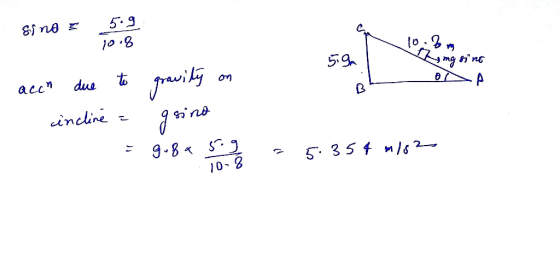
Compute the acceleration due to gravity for the ball falling down a ramp of length CA=...
Compute the acceleration due to gravity for the ball falling down a ramp of length CA= 10.8 m raised to height BC= 5.9 m above the ground on one end. Please use the international system of units.
Homework Answers
Add Answer to:
Compute the acceleration due to gravity for the ball falling
down a ramp of length CA=...
On Mars, where the acceleration due to gravity is 3.8 m/s2, a 500 gram ball is...
On Mars, where the acceleration due to gravity is 3.8 m/s2, a 500 gram ball is thrown from a cliff that is 30 m above the ground at a speed of 22 m/s. The ball lands 45 m away from the base of the cliff. What is the speed of the ball just before it hits the ground?
A box slides down a ramp with a constant acceleration of 0.300 m/s2. The ramp is...
A box slides down a ramp with a constant acceleration of 0.300 m/s2. The ramp is raised 18.0o above the horizontal. Calculate the coefficient of kinetic friction between the ramp and the box. HINT: Notice that the velocity is not constant as it was in the previous problem. However, the free body diagrams for both of these problems are the same. Use the free body diagram to write out the corresponding Newton's Law equations for x and y in the...
Projectile Motion and Motion Diagrams 3.2 A ball rolls down a long ramp to a shoot...
 Projectile Motion and Motion Diagrams 3.2 A ball rolls down a long ramp to a shoot where it is released as a projectile with an initial speed of 20 m/s at an angel of 42° above horizontal and 4.0 m above the ground. See diagram. BALL RAMP GROUND A. Draw a complete motiongrantee the motion of the ball from it leaving the shoot until reaching the ground. B What is the maximum height above pre ground reached by the ball?...
A red ball is thrown down with an initial speed of 1.3 m/s from a height...
A red ball is thrown down with an initial speed of 1.3 m/s from a height of 26 meters above the ground. Then, 0.4 seconds after the red ball is thrown, a blue ball is thrown upward with an initial speed of 23.9 m/s, from a height of 1 meters above the ground. The force of gravity due to the earth results in the balls each having a constant downward acceleration of 9.81 m/s2. What is the speed of the...
You are on a planet with an unknown acceleration due to gravity. You drop an object...
You are on a planet with an unknown acceleration due to gravity. You drop an object from rest and a height 1.1 metres, and measure the final speed 5.6 m/s as the object hits the ground. Using the Principle of Conservation of Energy, calculate the magnitude of the acceleration due to gravity. Use 2 sf in your answer.
A red ball is thrown down with an initial speed of 1.2 m/s from a height...
A red ball is thrown down with an initial speed of 1.2 m/s from a height of 25 meters above the ground. Then, 0.6 seconds after the red ball is thrown, a blue ball is thrown upward with an initial speed of 23.8 m/s, from a height of 0.8 meters above the ground. The force of gravity due to the earth results in the balls each having a constant downward acceleration of 9.81 m/s^2. 1)What is the speed of the...
A red ball is thrown down with an initial speed of 1.2 m/s from a height...
A red ball is thrown down with an initial speed of 1.2 m/s from a height of 26 meters above the ground. Then, 0.4 seconds after the red ball is thrown, a blue ball is thrown upward with an initial speed of 23.8 m/s, from a height of 1 meters above the ground. The force of gravity due to the earth results in the balls each having a constant downward acceleration of 9.81 m/s2. 1) What is the speed of...
2. An aspiring juggler realizes that the acceleration due to gravity can be measured simply by...
2. An aspiring juggler realizes that the acceleration due to gravity can be measured simply by comparing the time interval an object spends above a certain height when tossed vertically upwards to the total time it is in the air. Suppose she tosses a small ball vertically upwards and catches it a moment later (after a time ∆T elapses) at the same height it was released. In flight, the ball spends a time interval ∆t above a certain height H...
Two Thrown Balls 1 2 3 45678 A blue ball is thrown upward with an initial...
 Two Thrown Balls 1 2 3 45678 A blue ball is thrown upward with an initial speed of 19.8 m/s, from a height of 0.6 meters above the ground. 2.4 seconds after the blue ball is thrown, a red ball is thrown down with an initial speed of 8.9 m/s from a height of 22.3 meters above the ground. The force of gravity due to the earth results in the bals each having a constant downward acceleration of 9.81 m/s2....
6. An astronaut ona distant planet wants to determine its acceleration due to gravity. The astronaut...
 6. An astronaut ona distant planet wants to determine its acceleration due to gravity. The astronaut throws a rock straight up with a velocity of +15 m/s and measures a time of 20.0 s before the rock returns to his hand. What is the acceleration (magnitude and direction) due to gravity on this planet? See Diagram below: 20.0s v,15 m/s Show your work below: 7. Problem using vectors: A sailboat sails for 1 hr at 4 km/hr (relative to the...
 Projectile Motion and Motion Diagrams 3.2 A ball rolls down a long ramp to a shoot where it is released as a projectile with an initial speed of 20 m/s at an angel of 42° above horizontal and 4.0 m above the ground. See diagram. BALL RAMP GROUND A. Draw a complete motiongrantee the motion of the ball from it leaving the shoot until reaching the ground. B What is the maximum height above pre ground reached by the ball?...
 Two Thrown Balls 1 2 3 45678 A blue ball is thrown upward with an initial speed of 19.8 m/s, from a height of 0.6 meters above the ground. 2.4 seconds after the blue ball is thrown, a red ball is thrown down with an initial speed of 8.9 m/s from a height of 22.3 meters above the ground. The force of gravity due to the earth results in the bals each having a constant downward acceleration of 9.81 m/s2....
 6. An astronaut ona distant planet wants to determine its acceleration due to gravity. The astronaut throws a rock straight up with a velocity of +15 m/s and measures a time of 20.0 s before the rock returns to his hand. What is the acceleration (magnitude and direction) due to gravity on this planet? See Diagram below: 20.0s v,15 m/s Show your work below: 7. Problem using vectors: A sailboat sails for 1 hr at 4 km/hr (relative to the...
Most questions answered within 3 hours.
-
Where is the error in this code sequence?
String s1 = "Hello";
String s2 = "ello";...
asked 10 months ago -
Financial data for Joel de Paris, Inc., for last year
follow:
Joel de Paris, Inc.
Balance...
asked 10 months ago -
Consider this reaction:
Al2(SO4)3 (aq)+ BaCl3
(aq) Al2Cl6 (aq)- +
3BaSO4(s) . What is the...
asked 10 months ago -
Suppose that Savneet is considering increasing her
recent random sample from 20 car rentals to 40...
asked 10 months ago -
Trucks arrive at an unloading terminal at an average rate of 120
per hour.
Trucks arrive...
asked 10 months ago -
Why are methanol and ethanol completely soluble in water while
octanol is not very little soluble....
asked 10 months ago -
A facilities manager at a university reads in a research report
that the mean amount of...
asked 10 months ago -
When the CuSO4 is rehydrated by adding water to the anhydrous
compound, is this an endothermic...
asked 10 months ago -
A ray of sunlight is passing from diamond into crown glass; the
angle of incidence is...
asked 10 months ago -
A block of mass 0.249 kg is placed on top of a light, vertical
spring of...
asked 10 months ago -
how do the kidneys compensate in the presences of acidosis
a) trigger hyperventilate
b) reserve acid...
asked 10 months ago -
Question 501 pts
The rental rate of capital to the firm increases. Which of the
following...
asked 10 months ago