

Homework Answers
Question (1)
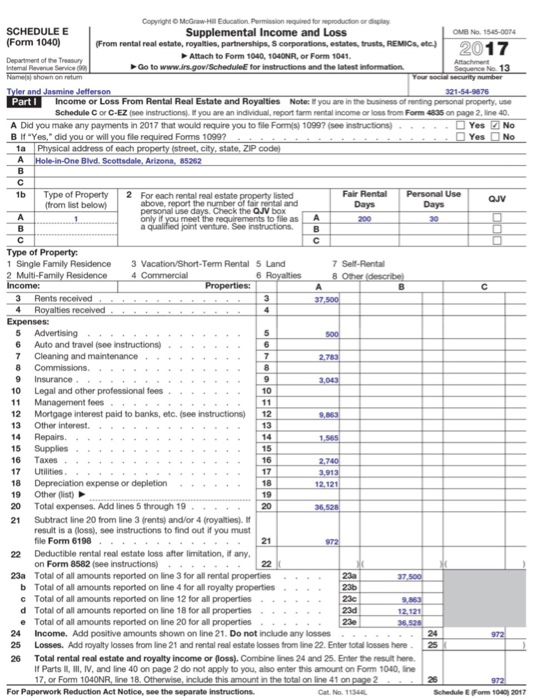
On rent = 200 days
Personal purpose = 30 days
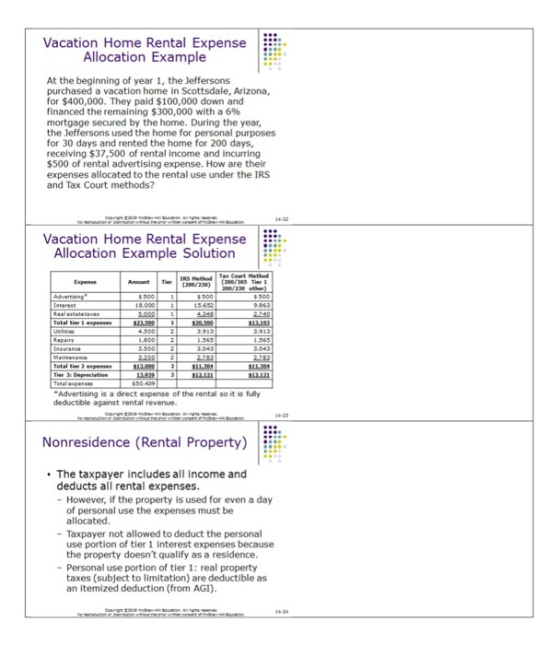
(a) Under IRS method the percentage applied will be 200 / (200 + 30) = 200 / 230 on all the expenses
(b) Under Tax court method, for
- Tier I expenses such as interest and real estate taxes, percentage applied will be rental days / 365 = 200 / 365.
- Tier II expenses such as utilities, repairs, insurance, maintenance, percentage applied will be 200 / 230
Question 2
Allocated %age is higher for tier I expenses under IRS method. Hence, allocated Tier I expenses are more in case of IRS method and hence IRS method will result into lower net rental income.
Question 3
The allocated cost is higher in case of IRS method. So the itemized deductions ( in a way the balance cost not allocated to rental revenue) will be lower. Since allocated cost is lower in case of Tax Court method, the itemized deductions will be higher.
Question 4
IRS method should be used when one is making use of standard deduction. The standard deduction limit is much more under this method and the need to itemise deductions is lower here.
Question 5
TCJA restricts the deduction of local and state taxes to a maximum of $ 10,000 a year. Hence, amount paid in excess of $ 10,000 will be lost for deduction under IRS. One should therefore opt for Tax court method.
Add Answer to:
Please answer all the following questions.
When you rent out your home for more than 14...
Spilker Chapter 14 assignment, due 1/17, 8 points When you rent out your home for more...
Spilker Chapter 14 assignment, due 1/17, 8 points When you rent out your home for more than 14 days per year, you have to declare your income and may have to pay taxes. However, it is not as bad as it sounds. This is because certain costs of running a home that would otherwise not be deductible, such as utilities and insurance, become partially deductible when the home is used to produce rental income. The textbook on page 14-18 (see...
Utilities and maintenance deductible is? Deductible depreciation is? Net income from activity? If it’s approach is...
 Utilities and maintenance deductible is? Deductible
depreciation is? Net income from activity? If it’s approach is used
for deduction, what is the net income from activity? What is the
order of deduction?
this is for the year ending in 2019. also i meant to put if the IRS
aproach is used for the deductions what would be the net income
from the activity.
2 points Saved QUESTION 49 B. During the year Martin rented his vacation home for three months...
Utilities and maintenance deductible is? Deductible
depreciation is? Net income from activity? If it’s approach is used
for deduction, what is the net income from activity? What is the
order of deduction?
this is for the year ending in 2019. also i meant to put if the IRS
aproach is used for the deductions what would be the net income
from the activity.
2 points Saved QUESTION 49 B. During the year Martin rented his vacation home for three months...
Randolph and Tammy own a second home. They spent 45 days there and rented it for...
Randolph and Tammy own a second home. They spent 45 days there and rented it for 88 days at $159 per day during the year. The total costs relating to the home include the following: (Round your intermediate computations to 5 decimal places and final answers to nearest whole dollar value). Mortgage interest $ 4,680 Property taxes 1,290 Insurance 1,935 Utilities 2,435 Repairs 1,545 Depreciation 6,680 a)What is the tax treatment of these items relating to second home under Tax...
Please help. I am not getting the correct answer even after using samples. Can you please explain...
Please help. I am not getting the correct answer even after using samples. Can you please explain how to get the answer. Alexa owns a condominium near Cocoa Beach in Florida. This year, she incurs the following expenses in connection with her condo: Insurance $ 3,750 Mortgage interest 11,400 Property taxes 4,500 Repairs & maintenance 560 Utilities 4,550 Depreciation 16,200 During the year, Alexa rented out the condo for 127 days. Alexa’s AGI from all sources other than the rental...
Janet owns a home at the lake. She incurs the following expenses: Mortgage interest Property taxes...
 Janet owns a home at the lake. She incurs the following expenses: Mortgage interest Property taxes $1,360 1,545 1.845 Repairs Depreciation 4060 Required: What is the proper treatment of the rental income and expenses in each of the following cases? Use the Tax Court allocation method, if applicable. Round your d e comutatons to 5 decimal places and final answers to nearest wole dollar value Rental Days Personal use Case income Rented Days A $ 9.150 B 12.150 55 C...
3. This question is worth 10 points During the year, Evan rented his vacation home for...
 3. This question is worth 10 points During the year, Evan rented his vacation home for 60 days and spen 90 days there. Gross rental income from the property was $3,000. Evan incurred the following expenses mortgage interest, $2,000 real estate taxes, $2,500 utilities, $1,000 maintenance, $300, and depreciation, $$,000 Identify how this vacation home is treatod the type (personal, rental. personal/rental), and how your conclusion (state the nule and apply the facts to the rule) 2 Compute Evan's allowable...
uring the year, Anna rented her vacation home for 30 days, used it personally for 20...
uring the year, Anna rented her vacation home for 30 days, used it personally for 20 days, and left it vacant for 315 days. She had the following income and expenses: Rent income $7,000 Expenses Real estate taxes 2,500 Interest on mortgage 9,000 Utilities 2,400 Repairs 1,000 Roof replacement (a capital expenditure) 12,000 Depreciation $7,500 If an answer is zero, enter "0". Assume a 365-day year. In your computations round any fractions to four decimal places. Round your final answer...
3. This question is worth 10 points During the year, Evan rented his vacation home for...
 3. This question is worth 10 points During the year, Evan rented his vacation home for 60 days and spent 90 days there. Gross rental income from the property was $3,000. Even incurred the following expenses: mortgage interest, $2,000; real estate taxes. $2,500; utilities, $1,000; maintenance, $300; and depreciation, $5,000. (a). Identify how this vacation home is treated the type (personal, rental, personal/rental), and how you came to your conclusion (state the rule and apply the facts to the rule)...
Matt and Marie own a vacation home at the beach. During the year, they rented the...
Matt and Marie own a vacation home at the beach. During the year, they rented the house for 42 days (6 weeks) at $890 per week and used it for personal use for 58 days. The total costs of maintaining the home are as follows: Mortgage interest $4,200 Property taxes 700 Insurance 1,200 Utilities 3,200 Repairs 1,900 Depreciation 5,500 What is the proper tax treatment of this information on their tax return using the Tax Court method? Are there options...
Ben owns a cozy vacation cabin in the Black Hills. During 2018, Ben rented his cabin for three months and spent one mont...
Ben owns a cozy vacation cabin in the Black Hills. During 2018, Ben rented his cabin for three months and spent one month there with her own family. Gross rental income from the property was $5,000. Ben incurred the following expenses: mortgage interest, $3,000; real estate taxes, $1,500; utilities, $800; maintenance, $500; and depreciation, $4,000. A) Is Ben’s home primarily personal, primarily rental, or personal/rental? Explain fully. B) Compute Ben’s allowable deductions for the vacation home. Use the court approach....
 Utilities and maintenance deductible is? Deductible
depreciation is? Net income from activity? If it’s approach is used
for deduction, what is the net income from activity? What is the
order of deduction?
this is for the year ending in 2019. also i meant to put if the IRS
aproach is used for the deductions what would be the net income
from the activity.
2 points Saved QUESTION 49 B. During the year Martin rented his vacation home for three months...
Utilities and maintenance deductible is? Deductible
depreciation is? Net income from activity? If it’s approach is used
for deduction, what is the net income from activity? What is the
order of deduction?
this is for the year ending in 2019. also i meant to put if the IRS
aproach is used for the deductions what would be the net income
from the activity.
2 points Saved QUESTION 49 B. During the year Martin rented his vacation home for three months...
 Janet owns a home at the lake. She incurs the following expenses: Mortgage interest Property taxes $1,360 1,545 1.845 Repairs Depreciation 4060 Required: What is the proper treatment of the rental income and expenses in each of the following cases? Use the Tax Court allocation method, if applicable. Round your d e comutatons to 5 decimal places and final answers to nearest wole dollar value Rental Days Personal use Case income Rented Days A $ 9.150 B 12.150 55 C...
 3. This question is worth 10 points During the year, Evan rented his vacation home for 60 days and spen 90 days there. Gross rental income from the property was $3,000. Evan incurred the following expenses mortgage interest, $2,000 real estate taxes, $2,500 utilities, $1,000 maintenance, $300, and depreciation, $$,000 Identify how this vacation home is treatod the type (personal, rental. personal/rental), and how your conclusion (state the nule and apply the facts to the rule) 2 Compute Evan's allowable...
 3. This question is worth 10 points During the year, Evan rented his vacation home for 60 days and spent 90 days there. Gross rental income from the property was $3,000. Even incurred the following expenses: mortgage interest, $2,000; real estate taxes. $2,500; utilities, $1,000; maintenance, $300; and depreciation, $5,000. (a). Identify how this vacation home is treated the type (personal, rental, personal/rental), and how you came to your conclusion (state the rule and apply the facts to the rule)...
Most questions answered within 3 hours.
-
Where is the error in this code sequence?
String s1 = "Hello";
String s2 = "ello";...
asked 10 months ago -
Financial data for Joel de Paris, Inc., for last year
follow:
Joel de Paris, Inc.
Balance...
asked 10 months ago -
Consider this reaction:
Al2(SO4)3 (aq)+ BaCl3
(aq) Al2Cl6 (aq)- +
3BaSO4(s) . What is the...
asked 10 months ago -
Suppose that Savneet is considering increasing her
recent random sample from 20 car rentals to 40...
asked 10 months ago -
Trucks arrive at an unloading terminal at an average rate of 120
per hour.
Trucks arrive...
asked 10 months ago -
Why are methanol and ethanol completely soluble in water while
octanol is not very little soluble....
asked 10 months ago -
A facilities manager at a university reads in a research report
that the mean amount of...
asked 10 months ago -
When the CuSO4 is rehydrated by adding water to the anhydrous
compound, is this an endothermic...
asked 10 months ago -
A ray of sunlight is passing from diamond into crown glass; the
angle of incidence is...
asked 10 months ago -
A block of mass 0.249 kg is placed on top of a light, vertical
spring of...
asked 10 months ago -
how do the kidneys compensate in the presences of acidosis
a) trigger hyperventilate
b) reserve acid...
asked 10 months ago -
Question 501 pts
The rental rate of capital to the firm increases. Which of the
following...
asked 10 months ago