
Homework Answers
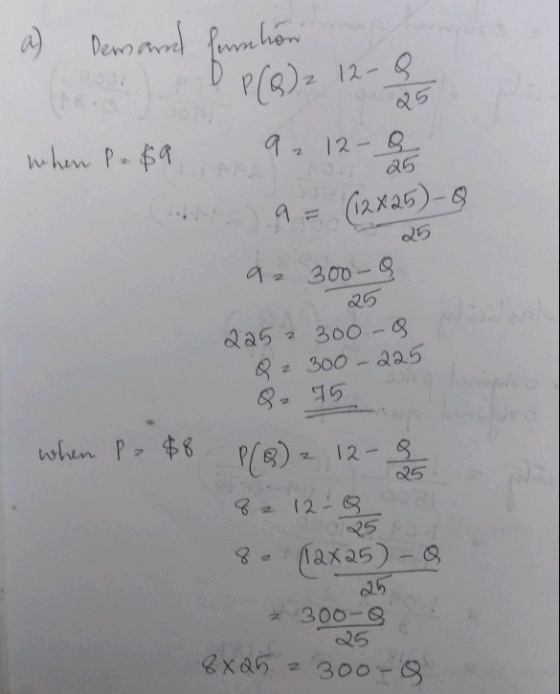
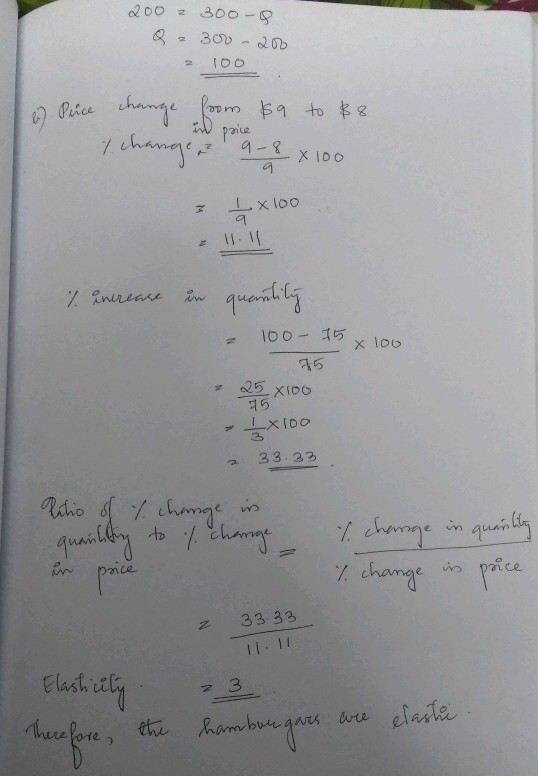
Percentage increase = New number - oringinal number ÷ Original number × 100
Percentage decrease= original number - new number ÷ original number × 100
Add Answer to:
(a) Consider the inverse demand function for hamburgers given by P(Q) 12- 25 How many burgers...
Suppose demand for hamburgers is: Q = 16 − P 2. a) How many hamburgers do...
Suppose demand for hamburgers is: Q = 16 − P 2. a) How many hamburgers do you sell if the price is P = 2? What is your total revenue? b)What is the elasticity of demand for hamburgers at P = 2? Is demand on the elastic or inelastic region of the demand curve? c) Suppose price increases by 10%. Use the elasticity of demand to show what you expect to happen to quantity (roughly). Use this to predict what...
Consider a homogeneous product industry with inverse demand function p-35 -Q a) Assume that the industry...
 Consider a homogeneous product industry with inverse demand function p-35 -Q a) Assume that the industry is initially monopolized by an incumbent firm (firm I) which has the exclusive right to use the state-of-the-art technology summarized by the total cost function C-10q. Find the initial monopoly equilibrium (price, quantity, industry profit, consumer surplus and total surplus) and the associated degrees of concentration (Herfindahl index) and market power (Lerner index) b) Assume now that a new firm (firm N) discovers and...
Consider a homogeneous product industry with inverse demand function p-35 -Q a) Assume that the industry...
 Consider a homogeneous product industry with inverse demand function p-35 -Q a) Assume that the industry is initially monopolized by an incumbent firm (firm I) which has the exclusive right to use the state-of-the-art technology summarized by the total cost function C-10q. Find the initial monopoly equilibrium (price, quantity, industry profit, consumer surplus and total surplus) and the associated degrees of concentration (Herfindahl index) and market power (Lerner index) b) Assume now that a new firm (firm N) discovers and...
Inverse demand for a good is given by the function p = 55 – 3q and...
 Inverse demand for a good is given by the function p = 55 – 3q and inverse supply is given by the function p = 10 + 2q. The resulting per-unit price is $28, and the quantity supplied and demanded is 9. The government now sets a price ceiling of $26, and for simplicity. assume that any goods produced are sold to consumers with the highest willingness to pay. What is the resulting consumer surplus? * 121.5 (Round to the...
Consider a demand curve given by Q = 10.00 - (0.20)P. What is the inverse demand...
 Consider a demand curve given by Q = 10.00 - (0.20)P. What is the inverse demand curve associated with this demand curve? Choose one: O A. P = 50.00 – 5.00Q O B. P = 0.02 – 0.20Q O C. P = 0.02 - 5.00Q O D. P = 50.00 - 0.20Q Part 2 (1 point) See Hint What is the maximum price the consumer would be willing to pay for the very first amount of the good? $ How...
Show that the demand function, Q=aP^b , a. Is a constant elasticity demand curve. b. The...
Show that the demand function, Q=aP^b , a. Is a constant elasticity demand curve. b. The vertical distance between the (inverse) demand and marginal revenue curves is a constant ratio of the price level for each value of quantity
The demand function for an oligopolistic market is given by the equation, Q = 275 – 4P, where Q is quantity demanded and P is price (Note: inverse demand for the dominant firm here is P = 50 - .2Q). T...
The demand function for an oligopolistic market is given by the equation, Q = 275 – 4P, where Q is quantity demanded and P is price (Note: inverse demand for the dominant firm here is P = 50 - .2Q). The industry has one dominant firm whose marginal cost function is: MC = 12 + 0.7QD, and many small firms, with a total supply function: QS = 25 + P. In equilibrium, the total output of all small firms is
Consider a monopolist firm facing an inverse demand curve given by P(Q) 2700-9Q. The firm's total...
 Consider a monopolist firm facing an inverse demand curve given by P(Q) 2700-9Q. The firm's total cost is given by c(Q) 11,000+900Q (a) Show your work in solving for the firm's profit-maximizing quantity and price. What is (b) Plot this firm's revenue and total cost functions. Illustrate the profit-maximizing quantity (c) Now plot this firm's inverse demand, marginal revenue, and marginal cost curves. Il- the maximized value of profit? on this graph, as well as the firm's maximized profit level....
Inverse demand function is given as P=$100,000 - 52.5Qd, where Qd is the annual quantity demanded....
Inverse demand function is given as P=$100,000 - 52.5Qd, where Qd is the annual quantity demanded. development costs were substantial and marginal costs for a treatment are "just" $750 per treatment. a) if you set a single price to maximize profits, what quantity will you supply annually? (hint: the marginal revenue function has the same y-axis intercept as the inverse demand function, but twice the slope. set MR=MC and solve for Q) b) what is the price for treatment (hint:...
Consider a monopolist firm facing an inverse demand curve given by P(Q) 2700 9Q The firm's...
 Consider a monopolist firm facing an inverse demand curve given by P(Q) 2700 9Q The firm's total cost is given by C() 11,000+9000 (a) Show your work in solving for the firm's profit-maximizing quantity and price. What is the maximized value of profit? (b) Plot this firm's revenue and total cost functions. Illustrate the profit-maximizing quantity on this graph, as well as the firm's maximized profit level (c) Now plot this firm's inverse demand, marginal revenue, and marginal cost curves....
 Consider a homogeneous product industry with inverse demand function p-35 -Q a) Assume that the industry is initially monopolized by an incumbent firm (firm I) which has the exclusive right to use the state-of-the-art technology summarized by the total cost function C-10q. Find the initial monopoly equilibrium (price, quantity, industry profit, consumer surplus and total surplus) and the associated degrees of concentration (Herfindahl index) and market power (Lerner index) b) Assume now that a new firm (firm N) discovers and...
 Consider a homogeneous product industry with inverse demand function p-35 -Q a) Assume that the industry is initially monopolized by an incumbent firm (firm I) which has the exclusive right to use the state-of-the-art technology summarized by the total cost function C-10q. Find the initial monopoly equilibrium (price, quantity, industry profit, consumer surplus and total surplus) and the associated degrees of concentration (Herfindahl index) and market power (Lerner index) b) Assume now that a new firm (firm N) discovers and...
 Inverse demand for a good is given by the function p = 55 – 3q and inverse supply is given by the function p = 10 + 2q. The resulting per-unit price is $28, and the quantity supplied and demanded is 9. The government now sets a price ceiling of $26, and for simplicity. assume that any goods produced are sold to consumers with the highest willingness to pay. What is the resulting consumer surplus? * 121.5 (Round to the...
 Consider a demand curve given by Q = 10.00 - (0.20)P. What is the inverse demand curve associated with this demand curve? Choose one: O A. P = 50.00 – 5.00Q O B. P = 0.02 – 0.20Q O C. P = 0.02 - 5.00Q O D. P = 50.00 - 0.20Q Part 2 (1 point) See Hint What is the maximum price the consumer would be willing to pay for the very first amount of the good? $ How...
 Consider a monopolist firm facing an inverse demand curve given by P(Q) 2700-9Q. The firm's total cost is given by c(Q) 11,000+900Q (a) Show your work in solving for the firm's profit-maximizing quantity and price. What is (b) Plot this firm's revenue and total cost functions. Illustrate the profit-maximizing quantity (c) Now plot this firm's inverse demand, marginal revenue, and marginal cost curves. Il- the maximized value of profit? on this graph, as well as the firm's maximized profit level....
 Consider a monopolist firm facing an inverse demand curve given by P(Q) 2700 9Q The firm's total cost is given by C() 11,000+9000 (a) Show your work in solving for the firm's profit-maximizing quantity and price. What is the maximized value of profit? (b) Plot this firm's revenue and total cost functions. Illustrate the profit-maximizing quantity on this graph, as well as the firm's maximized profit level (c) Now plot this firm's inverse demand, marginal revenue, and marginal cost curves....
Most questions answered within 3 hours.
-
Where is the error in this code sequence?
String s1 = "Hello";
String s2 = "ello";...
asked 10 months ago -
Financial data for Joel de Paris, Inc., for last year
follow:
Joel de Paris, Inc.
Balance...
asked 10 months ago -
Consider this reaction:
Al2(SO4)3 (aq)+ BaCl3
(aq) Al2Cl6 (aq)- +
3BaSO4(s) . What is the...
asked 10 months ago -
Suppose that Savneet is considering increasing her
recent random sample from 20 car rentals to 40...
asked 10 months ago -
Trucks arrive at an unloading terminal at an average rate of 120
per hour.
Trucks arrive...
asked 10 months ago -
Why are methanol and ethanol completely soluble in water while
octanol is not very little soluble....
asked 10 months ago -
A facilities manager at a university reads in a research report
that the mean amount of...
asked 10 months ago -
When the CuSO4 is rehydrated by adding water to the anhydrous
compound, is this an endothermic...
asked 10 months ago -
A ray of sunlight is passing from diamond into crown glass; the
angle of incidence is...
asked 10 months ago -
A block of mass 0.249 kg is placed on top of a light, vertical
spring of...
asked 10 months ago -
how do the kidneys compensate in the presences of acidosis
a) trigger hyperventilate
b) reserve acid...
asked 10 months ago -
Question 501 pts
The rental rate of capital to the firm increases. Which of the
following...
asked 10 months ago