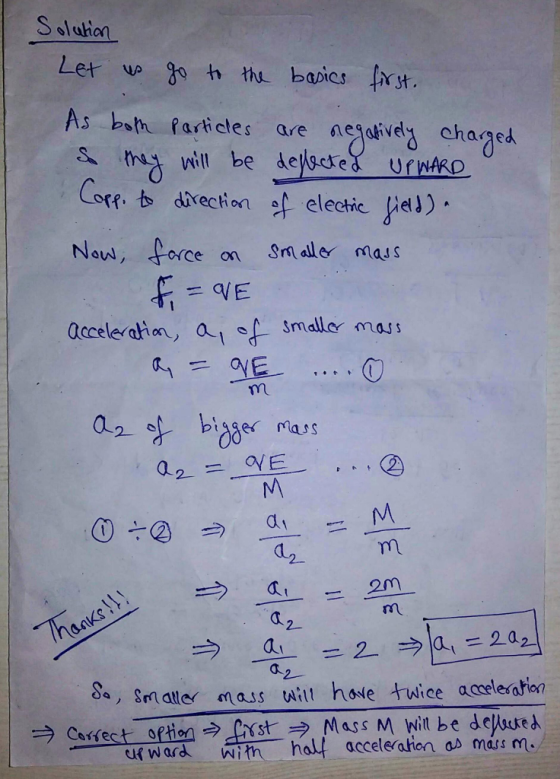
2 particles have the same net negative charge, -q but different masses, m and M. Both particles are initially moving directly toward the right along the x-axis with the same velocity as they enter the uniform electric field. If the larger mass, M, is exactly twice the smaller mass, m (i.e, M = 2m), which of the following best describes the motion of the larger mass, M

Homework Answers
Add Answer to:
2 particles have the same net negative charge, -q but different
masses, m and M. Both...
Question 21 Two particles have the same net negative charge, -q. but different masses, m and...
 Question 21 Two particles have the same net negative charge, -q. but different masses, m and M. Both particles are initially moving directly toward the right along the x-axis with the same velocity as they enter the uniform electric field. If the larger mass, M, is exactly twice the smaller mass, m (i.e, M 2m), which of the following best describes the motion of the larger mass, M. -q Select the correct answer CHECK ANSWER 2 of 3 attempts used...
Consider two boxes of masses, m and 2m, both initially at rest. You push each box...
Consider two boxes of masses, m and 2m, both initially at rest. You push each box separately with a force, F, over a distance, d, across a frictionless surface. How does the final speed of the smaller box compare to the final speed of the larger box? a. The speed of the smaller box is half that of the larger box b. The speed of the smaller box is 4 times that of the larger box c. The speed of the...
Two particles with masses m and 3m are moving toward each other along the x-axis with...
Two particles with masses m and 3m are moving toward each other along the x-axis with the same initial speeds v0. Particle m is traveling to the left and particle 3m is traveling to the right. They undergo an elastic, off-center/oblique collision such that m is moving downward after the collision at a right angle from its initial direction. Find the final speeds of the two particles, and the angle θ at which the particle 3m is scattered.
Two particles have equal masses m and electric charges of equal magnitude and opposite sign (+q...
Two particles have equal masses m and electric charges of equal magnitude and opposite sign (+q and –q). The particles are held at rest in uniform magnetic field with a magnitude of B. The direction of the field is perpendicular to the line connecting the charges. The particles are released simultaneously. What is the minimum initial separation L so that the particles do not collide after they are released? Neglect the magnetic fields produced by the particles themselves and the...
Velocity Selector-multiple choice
 The Velocity SelectorIn experiments where all the charged particles in a beam are required to have the same velocity (for example, when entering a mass spectrometer), scientists use a velocity selector. A velocity selector has a region of uniform electric and magnetic fields that are perpendicular to each other and perpendicular to the motion of the charged particles. Both the electric and magnetic fields exert a force on the charged particles. If a particle has precisely the right velocity, the...
I need answers for #5 and #7 2) m m2 ma Now, three masses (m, =...
 I need answers for #5 and #7
2) m m2 ma Now, three masses (m, = 4.4 kg, m2 = 13.2 kg and mz = 8.8) hang from three identical springs in a motionless elevator. The springs all have the same spring constant given above. What is the magnitude of the force the bottom spring exerts on the lower mass? 86.24 N Submit + 3) What is the distance the middle spring is stretched from its equilibrium length? 79.85 cm...
I need answers for #5 and #7
2) m m2 ma Now, three masses (m, = 4.4 kg, m2 = 13.2 kg and mz = 8.8) hang from three identical springs in a motionless elevator. The springs all have the same spring constant given above. What is the magnitude of the force the bottom spring exerts on the lower mass? 86.24 N Submit + 3) What is the distance the middle spring is stretched from its equilibrium length? 79.85 cm...
I need the answers for # 5 and #8 2) m m mi Now, three masses...
 I need the answers for # 5 and #8
2) m m mi Now, three masses m, = 4.8 kg, m2 = 14.4 kg and m2 = 9.6 kg hang from three identical springs in a motionless elevator. The springs all have the same spring constant that you just calculated above. What is the force the top spring exerts on the top mass? 282.64 N Submit + 3) What is the distance the lower spring is stretched from its equilibrium...
I need the answers for # 5 and #8
2) m m mi Now, three masses m, = 4.8 kg, m2 = 14.4 kg and m2 = 9.6 kg hang from three identical springs in a motionless elevator. The springs all have the same spring constant that you just calculated above. What is the force the top spring exerts on the top mass? 282.64 N Submit + 3) What is the distance the lower spring is stretched from its equilibrium...
A proton of mass mp= 1.67×10⁻²⁷ kg and a charge of qp= 1.60×10⁻¹⁹ C is moving...
A proton of mass mp= 1.67×10⁻²⁷ kg and a charge of qp= 1.60×10⁻¹⁹ C is moving through vacuum at a constant velocity of 10,000 m/s directly to the east when it enters a region of uniform electric field that points to the south with a magnitude of E =3.62e+3 N/C . The region of uniform electric field is 5 mm wide in the east-west direction. How far (in meters) will the proton have been deflected towards the south by the...
A small object with mass m, charge q, and initial speed v0 5.00x10³ m/s is projected into a uniform electric field between two parallel metal plates of length 26.0 cm (Figure 1)
 A small object with mass m, charge q, and initial speed v0 5.00x10³ m/s is projected into a uniform electric field between two parallel metal plates of length 26.0 cm (Figure 1). The electric field between the plates is directed downward and has magnitude E 800 N/C. Assume that the field is zero outside the region between the plates. The separation between the plates is large enough for the object to pass between the plates without hitting the lower plate....
1. Two particles that have the same mass m = 0.5 kg are connected by a...
 1. Two particles that have the same mass m = 0.5 kg are connected by a rotation aixs massless cord of l = 20.0 cm and rotate around O with angular speed w = 10.0 rad/s initially, as shown in figure (a). Two seconds later, two particles are mo moved toward the rotations axis, reducing their separation to l' = 15 cm, as shown in figure (b). What is the angular velocity at time t = 2 s? (hint: L...
 Question 21 Two particles have the same net negative charge, -q. but different masses, m and M. Both particles are initially moving directly toward the right along the x-axis with the same velocity as they enter the uniform electric field. If the larger mass, M, is exactly twice the smaller mass, m (i.e, M 2m), which of the following best describes the motion of the larger mass, M. -q Select the correct answer CHECK ANSWER 2 of 3 attempts used...
 I need answers for #5 and #7
2) m m2 ma Now, three masses (m, = 4.4 kg, m2 = 13.2 kg and mz = 8.8) hang from three identical springs in a motionless elevator. The springs all have the same spring constant given above. What is the magnitude of the force the bottom spring exerts on the lower mass? 86.24 N Submit + 3) What is the distance the middle spring is stretched from its equilibrium length? 79.85 cm...
I need answers for #5 and #7
2) m m2 ma Now, three masses (m, = 4.4 kg, m2 = 13.2 kg and mz = 8.8) hang from three identical springs in a motionless elevator. The springs all have the same spring constant given above. What is the magnitude of the force the bottom spring exerts on the lower mass? 86.24 N Submit + 3) What is the distance the middle spring is stretched from its equilibrium length? 79.85 cm...
 I need the answers for # 5 and #8
2) m m mi Now, three masses m, = 4.8 kg, m2 = 14.4 kg and m2 = 9.6 kg hang from three identical springs in a motionless elevator. The springs all have the same spring constant that you just calculated above. What is the force the top spring exerts on the top mass? 282.64 N Submit + 3) What is the distance the lower spring is stretched from its equilibrium...
I need the answers for # 5 and #8
2) m m mi Now, three masses m, = 4.8 kg, m2 = 14.4 kg and m2 = 9.6 kg hang from three identical springs in a motionless elevator. The springs all have the same spring constant that you just calculated above. What is the force the top spring exerts on the top mass? 282.64 N Submit + 3) What is the distance the lower spring is stretched from its equilibrium...
 1. Two particles that have the same mass m = 0.5 kg are connected by a rotation aixs massless cord of l = 20.0 cm and rotate around O with angular speed w = 10.0 rad/s initially, as shown in figure (a). Two seconds later, two particles are mo moved toward the rotations axis, reducing their separation to l' = 15 cm, as shown in figure (b). What is the angular velocity at time t = 2 s? (hint: L...
Most questions answered within 3 hours.
-
Where is the error in this code sequence?
String s1 = "Hello";
String s2 = "ello";...
asked 10 months ago -
Financial data for Joel de Paris, Inc., for last year
follow:
Joel de Paris, Inc.
Balance...
asked 10 months ago -
Consider this reaction:
Al2(SO4)3 (aq)+ BaCl3
(aq) Al2Cl6 (aq)- +
3BaSO4(s) . What is the...
asked 10 months ago -
Suppose that Savneet is considering increasing her
recent random sample from 20 car rentals to 40...
asked 10 months ago -
Trucks arrive at an unloading terminal at an average rate of 120
per hour.
Trucks arrive...
asked 10 months ago -
Why are methanol and ethanol completely soluble in water while
octanol is not very little soluble....
asked 10 months ago -
A facilities manager at a university reads in a research report
that the mean amount of...
asked 10 months ago -
When the CuSO4 is rehydrated by adding water to the anhydrous
compound, is this an endothermic...
asked 10 months ago -
A ray of sunlight is passing from diamond into crown glass; the
angle of incidence is...
asked 10 months ago -
A block of mass 0.249 kg is placed on top of a light, vertical
spring of...
asked 10 months ago -
how do the kidneys compensate in the presences of acidosis
a) trigger hyperventilate
b) reserve acid...
asked 10 months ago -
Question 501 pts
The rental rate of capital to the firm increases. Which of the
following...
asked 10 months ago