
Homework Answers
Add Answer to:
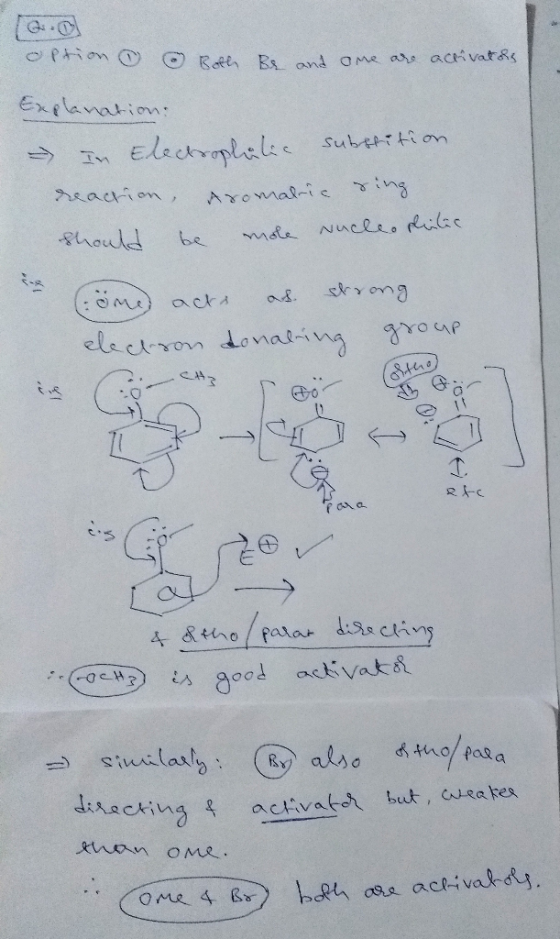
QUESTION 1 Which statement is true with respect to the effects bromine and methoxy (CH30) groups...
QUESTION 2 Which statement is true with respect to the directing effects of bromine and methoxy...
 QUESTION 2 Which statement is true with respect to the directing effects of bromine and methoxy groups in electrophilic aromatic substitution reactions? Both Brand OMe are meta directors Both Br and OMe are ortho/para directors Br is a meta director and OMe is an ortho/para director Br is an ortho/para director and OMe is a meta director
1. In electrophilic aromatic substitution reactions a bromine substituent: A) is a deactivator and a m-director....
 1. In electrophilic aromatic substitution reactions a bromine substituent: A) is a deactivator and a m-director. C) is an activator and a m-director. E) none of the above B) is a deactivator and an o,p-director. D) is an activator and an o,p-director. 2. Provide a detailed, stepwise mechanism for the reaction of benzene with Br2 and FeBr3. Make sure to include the activating reaction between Br2 and FeBr3 in your mechanism.
1) Which of the following is an intermediate in the bromination of toluene? p) Ha BrH...
 1) Which of the following is an intermediate in the bromination of toluene? p) Ha BrH 2 2) Under what reaction conditions would the electrophilic chlorination of aromatic compounds usually occur? A) Cl2, AlCl3 B) C12, CCl4 C) Cl2, H20 D) NaCl, H20 E) NaCI, CH3OH 3) 3) Which of the following is the strongest activating group in electrophilic aromatic substitution reactions? A) -CO2CH3 B)-NO2 C) -OCH3 D) -CH2CH3 E) -N(CH3)2 4) _ 4) In electrophilic aromatic substitution reactions the...
9:09 AM Mon Apr 29 ゃしダ46% ■ f) What is the major organic product obtained from the following reaction? CrOs он HSO,, H20 1-butene, CH,CH,CH CH butanal, CH CH.CH,CHO CH,CH,COCH butanoic acid, C...
 9:09 AM Mon Apr 29 ゃしダ46% ■ f) What is the major organic product obtained from the following reaction? CrOs он HSO,, H20 1-butene, CH,CH,CH CH butanal, CH CH.CH,CHO CH,CH,COCH butanoic acid, CH,CH,CH,COO g) In electrophilic aromatic substitution reactions a bromine substituent A) is a deactivator and a m-director. B) is a deactivator and an o,p-director. C) is an activator and a m-director D) is an activator and an o,p-director E) none of the above h) In electrophilic aromatic substitution...
(14) Question 1: Xylene contains which functional group attached to the benzene ring? a - methoxy...
(14) Question 1: Xylene contains which functional group attached to the benzene ring? a - methoxy b -amino c -methyl d -ester (22) Question 2: Reactions of aromatic compounds are: a- addition b- electrophilic aromatic substitution c- nucleophilic aromatic substitution d- reduction (24) Question 3: what is the percent of p character is an sp2 hybrid orbital? a- 66% b- 25% c- 33% d-75% (20) Question 4: Identify the compound below that can be drawn separately as both a cis...
1. please check what is wrong. Thank you! Determine the product formed when each compound is treated with...
 1. please check what is wrong. Thank you!
Determine the product formed when each compound is treated with Br2 and FeBr3. Drag the atom labels to their appropriate positions. CN Atom labels H H Br Br2 A. FeBr Br H OH OH Br Br. Br2 FeBr3 H H Br Br H Br2 FeBr H1 H Reset T Rank the compounds in each group in order of decreasing reactivity in electrophilic aromatic substitution. CI Decreasing reactivity Rank the compounds in each...
1. please check what is wrong. Thank you!
Determine the product formed when each compound is treated with Br2 and FeBr3. Drag the atom labels to their appropriate positions. CN Atom labels H H Br Br2 A. FeBr Br H OH OH Br Br. Br2 FeBr3 H H Br Br H Br2 FeBr H1 H Reset T Rank the compounds in each group in order of decreasing reactivity in electrophilic aromatic substitution. CI Decreasing reactivity Rank the compounds in each...
H21.18 - Level 1 Homework. Unanswered Which of the following groups is meta directing for electrophilic...
 H21.18 - Level 1 Homework. Unanswered Which of the following groups is meta directing for electrophilic aromatic substitution? O A Chlorine O B Methyl O C Miniplayer (0) Alconi O D Methoxy O E Nitrile
D Question 11 6 pts Which structure is a major organic product of the multi-step reaction...
 D Question 11 6 pts Which structure is a major organic product of the multi-step reaction shown? Recall that the numbers in front of the reagents tells the order of the addition 1) NaNHANH, 2) CH CH Br 3) HgSO4/H2SO4/H,0 // D Question 14 6 pts Which group is considered a deactivator in electrophilic aromatic substitution (EA.S.) reactions? The dashed line indicates where the group is attached to benzene. OH —ОН
D Question 1 5 pts Grignard reagents can be used to convert esters into tertiary alcohols...
 D Question 1 5 pts Grignard reagents can be used to convert esters into tertiary alcohols after an acid workup. True False Question 2 7 pts The sigma complex intermediate formed during electrophilic aromatic substitution (EAS) reactions is resonance stabilized. Electron donating groups (EDGs) typically make the intermediate more stable and electron withdrawing groups (EWGS) typically make the intermediate less stable. Using this information, which statement is correct regarding EDGs versus EWGS? The stability of the sigma complex has nothing...
MULTIPLE ANSWER CHOICES ARE POSSIBLE (more than one correct) Question 7 Which of the following statements...
 MULTIPLE ANSWER CHOICES ARE POSSIBLE (more than one correct)
Question 7 Which of the following statements are true about the deactivating nitroso substituent in electrophilic aromatic substitution reactions? NFO The nitroso group is predicted to be an ortho/para-directing group. Resonance withdrawing effects can explain why the nitroso group is deactivating. The nitroso group is predicted to be an meta-directing group. Inductive withdrawing effects can explain why the nitroso group is deactivating.
MULTIPLE ANSWER CHOICES ARE POSSIBLE (more than one correct)
Question 7 Which of the following statements are true about the deactivating nitroso substituent in electrophilic aromatic substitution reactions? NFO The nitroso group is predicted to be an ortho/para-directing group. Resonance withdrawing effects can explain why the nitroso group is deactivating. The nitroso group is predicted to be an meta-directing group. Inductive withdrawing effects can explain why the nitroso group is deactivating.
 QUESTION 2 Which statement is true with respect to the directing effects of bromine and methoxy groups in electrophilic aromatic substitution reactions? Both Brand OMe are meta directors Both Br and OMe are ortho/para directors Br is a meta director and OMe is an ortho/para director Br is an ortho/para director and OMe is a meta director
 1. In electrophilic aromatic substitution reactions a bromine substituent: A) is a deactivator and a m-director. C) is an activator and a m-director. E) none of the above B) is a deactivator and an o,p-director. D) is an activator and an o,p-director. 2. Provide a detailed, stepwise mechanism for the reaction of benzene with Br2 and FeBr3. Make sure to include the activating reaction between Br2 and FeBr3 in your mechanism.
 1) Which of the following is an intermediate in the bromination of toluene? p) Ha BrH 2 2) Under what reaction conditions would the electrophilic chlorination of aromatic compounds usually occur? A) Cl2, AlCl3 B) C12, CCl4 C) Cl2, H20 D) NaCl, H20 E) NaCI, CH3OH 3) 3) Which of the following is the strongest activating group in electrophilic aromatic substitution reactions? A) -CO2CH3 B)-NO2 C) -OCH3 D) -CH2CH3 E) -N(CH3)2 4) _ 4) In electrophilic aromatic substitution reactions the...
 9:09 AM Mon Apr 29 ゃしダ46% ■ f) What is the major organic product obtained from the following reaction? CrOs он HSO,, H20 1-butene, CH,CH,CH CH butanal, CH CH.CH,CHO CH,CH,COCH butanoic acid, CH,CH,CH,COO g) In electrophilic aromatic substitution reactions a bromine substituent A) is a deactivator and a m-director. B) is a deactivator and an o,p-director. C) is an activator and a m-director D) is an activator and an o,p-director E) none of the above h) In electrophilic aromatic substitution...
 1. please check what is wrong. Thank you!
Determine the product formed when each compound is treated with Br2 and FeBr3. Drag the atom labels to their appropriate positions. CN Atom labels H H Br Br2 A. FeBr Br H OH OH Br Br. Br2 FeBr3 H H Br Br H Br2 FeBr H1 H Reset T Rank the compounds in each group in order of decreasing reactivity in electrophilic aromatic substitution. CI Decreasing reactivity Rank the compounds in each...
1. please check what is wrong. Thank you!
Determine the product formed when each compound is treated with Br2 and FeBr3. Drag the atom labels to their appropriate positions. CN Atom labels H H Br Br2 A. FeBr Br H OH OH Br Br. Br2 FeBr3 H H Br Br H Br2 FeBr H1 H Reset T Rank the compounds in each group in order of decreasing reactivity in electrophilic aromatic substitution. CI Decreasing reactivity Rank the compounds in each...
 H21.18 - Level 1 Homework. Unanswered Which of the following groups is meta directing for electrophilic aromatic substitution? O A Chlorine O B Methyl O C Miniplayer (0) Alconi O D Methoxy O E Nitrile
 D Question 11 6 pts Which structure is a major organic product of the multi-step reaction shown? Recall that the numbers in front of the reagents tells the order of the addition 1) NaNHANH, 2) CH CH Br 3) HgSO4/H2SO4/H,0 // D Question 14 6 pts Which group is considered a deactivator in electrophilic aromatic substitution (EA.S.) reactions? The dashed line indicates where the group is attached to benzene. OH —ОН
 D Question 1 5 pts Grignard reagents can be used to convert esters into tertiary alcohols after an acid workup. True False Question 2 7 pts The sigma complex intermediate formed during electrophilic aromatic substitution (EAS) reactions is resonance stabilized. Electron donating groups (EDGs) typically make the intermediate more stable and electron withdrawing groups (EWGS) typically make the intermediate less stable. Using this information, which statement is correct regarding EDGs versus EWGS? The stability of the sigma complex has nothing...
 MULTIPLE ANSWER CHOICES ARE POSSIBLE (more than one correct)
Question 7 Which of the following statements are true about the deactivating nitroso substituent in electrophilic aromatic substitution reactions? NFO The nitroso group is predicted to be an ortho/para-directing group. Resonance withdrawing effects can explain why the nitroso group is deactivating. The nitroso group is predicted to be an meta-directing group. Inductive withdrawing effects can explain why the nitroso group is deactivating.
MULTIPLE ANSWER CHOICES ARE POSSIBLE (more than one correct)
Question 7 Which of the following statements are true about the deactivating nitroso substituent in electrophilic aromatic substitution reactions? NFO The nitroso group is predicted to be an ortho/para-directing group. Resonance withdrawing effects can explain why the nitroso group is deactivating. The nitroso group is predicted to be an meta-directing group. Inductive withdrawing effects can explain why the nitroso group is deactivating.
Most questions answered within 3 hours.
-
Where is the error in this code sequence?
String s1 = "Hello";
String s2 = "ello";...
asked 10 months ago -
Financial data for Joel de Paris, Inc., for last year
follow:
Joel de Paris, Inc.
Balance...
asked 10 months ago -
Consider this reaction:
Al2(SO4)3 (aq)+ BaCl3
(aq) Al2Cl6 (aq)- +
3BaSO4(s) . What is the...
asked 10 months ago -
Suppose that Savneet is considering increasing her
recent random sample from 20 car rentals to 40...
asked 10 months ago -
Trucks arrive at an unloading terminal at an average rate of 120
per hour.
Trucks arrive...
asked 10 months ago -
Why are methanol and ethanol completely soluble in water while
octanol is not very little soluble....
asked 10 months ago -
A facilities manager at a university reads in a research report
that the mean amount of...
asked 10 months ago -
When the CuSO4 is rehydrated by adding water to the anhydrous
compound, is this an endothermic...
asked 10 months ago -
A ray of sunlight is passing from diamond into crown glass; the
angle of incidence is...
asked 10 months ago -
A block of mass 0.249 kg is placed on top of a light, vertical
spring of...
asked 10 months ago -
how do the kidneys compensate in the presences of acidosis
a) trigger hyperventilate
b) reserve acid...
asked 10 months ago -
Question 501 pts
The rental rate of capital to the firm increases. Which of the
following...
asked 10 months ago