Show graphically and explain why a government is more likely to place an excise (per unit)...
Show graphically and explain why a government is more likely to place an excise (per unit) tax on a good with inelastic demand than it is to put an excise tax on a good with elastic demand
Homework Answers
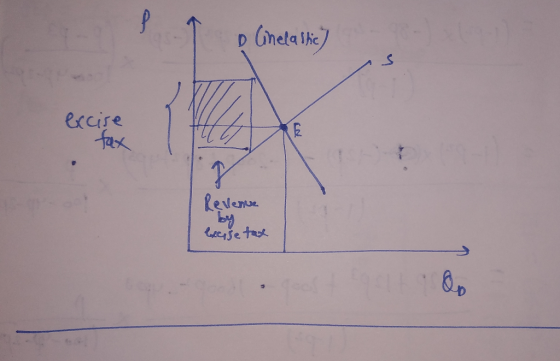
Inelastic demand is a type of demand in which even there is a very high change in the price but quantity demanded change is very less
elastic demand is a type of demand in which there is a little change in the price but causes every change in the quantity demanded
So if a demand is inelastic demand then the government knows that their quantity demanded will be always high whether price high or low
For taking benefit t,government mostly put excise taxes on it because they are the basic needs which will always be demanded
The best example of this is gasoline
But if a demand is elastic demand then it is very price sensitive which means a consumer may demand it very less if price goes heights or excise taxes are high so government do not put very high taxes on elastic goods
Add Answer to:
Show graphically and explain why a government is more likely to
place an excise (per unit)...
From a revenue-maximizing viewpoint, explain why the government would be more likely to impose excise taxes...
From a revenue-maximizing viewpoint, explain why the government would be more likely to impose excise taxes on cigarettes and beer rather than on mangoes and mineral water?
The graph below shows the market for office rental space. A $400 per month excise tax...
 The graph below shows the market for office rental space. A $400
per month excise tax is imposed on firms selling office space. D is
the demand curve, S1 is the supply curve in the absence of the tax,
and S2 represents the supply curve that includes the tax.
The graph below shows the market for office rental space. A $400 per month excise tax is imposed on firms selling office space. D is the demand curve, S1 is the...
The graph below shows the market for office rental space. A $400
per month excise tax is imposed on firms selling office space. D is
the demand curve, S1 is the supply curve in the absence of the tax,
and S2 represents the supply curve that includes the tax.
The graph below shows the market for office rental space. A $400 per month excise tax is imposed on firms selling office space. D is the demand curve, S1 is the...
Suppose the Canadian government has decided to place an excise (or sales) tax of $20 per...
 Suppose the Canadian government has decided to place an excise
(or sales) tax of $20 per tire on producers of automobile tires.
Previously, there was no excise tax on automobile tires. As a
result of the excise tax, producers of tires, such as Bridgestone
and Michelin, are going to alter their tire prices. The graph
illustrates the demand and supply curves for automobile tires
before the excise tax. 1. Please shift the appropriate curve(s) on
the graph to demonstrate the...
Suppose the Canadian government has decided to place an excise
(or sales) tax of $20 per tire on producers of automobile tires.
Previously, there was no excise tax on automobile tires. As a
result of the excise tax, producers of tires, such as Bridgestone
and Michelin, are going to alter their tire prices. The graph
illustrates the demand and supply curves for automobile tires
before the excise tax. 1. Please shift the appropriate curve(s) on
the graph to demonstrate the...
12. Government pays attention to the elasticity of demand when selecting foods and services upon which...
12. Government pays attention to the elasticity of demand when selecting foods and services upon which to levy excise taxes. Assume a $1.00 tax is levied on some good and 10,000 units are sold. What is the tax revenue collected? Now, assume the government raises the tax to $1.50. This causes sales to decline to 5,000 units. Calculate the price (tax) elasticity of demand. Is it elastic, inelastic, or unit elastic? What happens to total tax revenue? Based on your...
21. Suppose the government imposes a S9 per unit tax on the production of Good Z....
 21. Suppose the government imposes a S9 per unit tax on the production of Good Z. If the demand curve for Good Z is perfectly inelastic and the supply curve is upward-sloping, the price that consumers pay for the good will: A) increase by S9. B) increase by S4.50. C) increase by more than S9.
1-3 please Feel free to use any spaces for scratch work. 1) Consider the excise tax lectured in class. For a given e...
 1-3
please
Feel free to use any spaces for scratch work. 1) Consider the excise tax lectured in class. For a given excise tax, we can correctly predict that consumer tax incidence will be less than producer tax incidence when: a) Both the demand and the supply curves are more inelastic. b) The demand curve is inelastic and the supply curve is elastie. c) The demand curve is elastic and the supply curve is inelastic. d) Both the demand and...
1-3
please
Feel free to use any spaces for scratch work. 1) Consider the excise tax lectured in class. For a given excise tax, we can correctly predict that consumer tax incidence will be less than producer tax incidence when: a) Both the demand and the supply curves are more inelastic. b) The demand curve is inelastic and the supply curve is elastie. c) The demand curve is elastic and the supply curve is inelastic. d) Both the demand and...
Good X costs $12 and Good Y costs $8. The government places an excise (per unit)...
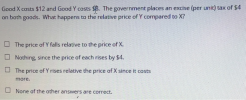 Good X costs $12 and Good Y costs $8. The government places an excise (per unit) tax of $4 on both goods. What happens to the relative price of Y compared to X? The price of Y falls relative to the price of X. Nothing, since the price of each rises by $4. The price of Y rises relative the price of X since it costs more. None of the other answers are correct.
Graphically show and explain how each of the conditions below will affect the market for a...
Graphically show and explain how each of the conditions below will affect the market for a generic manufactured good: a) The excise tax for the product is increased. b) The firm spends more on advertising its product. c) Consumers expect the economy to go into a recession in the near future. d) The population increases.
When the government decides to impose a tax on sellers of a good or service, sellers...
When the government decides to impose a tax on sellers of a good or service, sellers try to pass the tax on to consumers by raising the price of the good being sold. Assume the government decides to place a $1 tax on each unit of a good sold, e.g., tires. Using the simple model of supply and demand, describe what would happen to the price and quantity of tires sold. Would the amount of tax paid by the consumer...
The graph below shows a hypothetical market for salt. Suppose that an excise or commodity tax...
 The graph below shows a hypothetical market for salt. Suppose that an excise or commodity tax is levied on consumers in an attempt to curb blood pressure problems. Show the effect of the tax by shifting the appropriate curve(s). Who has the larger tax burden? Producers (suppliers) Consumers (buyers) The tax burdens are equal Why is the tax burden as you described in in the question above? Supply is less elastic than demand. Demand is more elastic than supply. Both...
 The graph below shows the market for office rental space. A $400
per month excise tax is imposed on firms selling office space. D is
the demand curve, S1 is the supply curve in the absence of the tax,
and S2 represents the supply curve that includes the tax.
The graph below shows the market for office rental space. A $400 per month excise tax is imposed on firms selling office space. D is the demand curve, S1 is the...
The graph below shows the market for office rental space. A $400
per month excise tax is imposed on firms selling office space. D is
the demand curve, S1 is the supply curve in the absence of the tax,
and S2 represents the supply curve that includes the tax.
The graph below shows the market for office rental space. A $400 per month excise tax is imposed on firms selling office space. D is the demand curve, S1 is the...
 Suppose the Canadian government has decided to place an excise
(or sales) tax of $20 per tire on producers of automobile tires.
Previously, there was no excise tax on automobile tires. As a
result of the excise tax, producers of tires, such as Bridgestone
and Michelin, are going to alter their tire prices. The graph
illustrates the demand and supply curves for automobile tires
before the excise tax. 1. Please shift the appropriate curve(s) on
the graph to demonstrate the...
Suppose the Canadian government has decided to place an excise
(or sales) tax of $20 per tire on producers of automobile tires.
Previously, there was no excise tax on automobile tires. As a
result of the excise tax, producers of tires, such as Bridgestone
and Michelin, are going to alter their tire prices. The graph
illustrates the demand and supply curves for automobile tires
before the excise tax. 1. Please shift the appropriate curve(s) on
the graph to demonstrate the...
 21. Suppose the government imposes a S9 per unit tax on the production of Good Z. If the demand curve for Good Z is perfectly inelastic and the supply curve is upward-sloping, the price that consumers pay for the good will: A) increase by S9. B) increase by S4.50. C) increase by more than S9.
 1-3
please
Feel free to use any spaces for scratch work. 1) Consider the excise tax lectured in class. For a given excise tax, we can correctly predict that consumer tax incidence will be less than producer tax incidence when: a) Both the demand and the supply curves are more inelastic. b) The demand curve is inelastic and the supply curve is elastie. c) The demand curve is elastic and the supply curve is inelastic. d) Both the demand and...
1-3
please
Feel free to use any spaces for scratch work. 1) Consider the excise tax lectured in class. For a given excise tax, we can correctly predict that consumer tax incidence will be less than producer tax incidence when: a) Both the demand and the supply curves are more inelastic. b) The demand curve is inelastic and the supply curve is elastie. c) The demand curve is elastic and the supply curve is inelastic. d) Both the demand and...
 Good X costs $12 and Good Y costs $8. The government places an excise (per unit) tax of $4 on both goods. What happens to the relative price of Y compared to X? The price of Y falls relative to the price of X. Nothing, since the price of each rises by $4. The price of Y rises relative the price of X since it costs more. None of the other answers are correct.
 The graph below shows a hypothetical market for salt. Suppose that an excise or commodity tax is levied on consumers in an attempt to curb blood pressure problems. Show the effect of the tax by shifting the appropriate curve(s). Who has the larger tax burden? Producers (suppliers) Consumers (buyers) The tax burdens are equal Why is the tax burden as you described in in the question above? Supply is less elastic than demand. Demand is more elastic than supply. Both...
Most questions answered within 3 hours.
-
Where is the error in this code sequence?
String s1 = "Hello";
String s2 = "ello";...
asked 10 months ago -
Financial data for Joel de Paris, Inc., for last year
follow:
Joel de Paris, Inc.
Balance...
asked 10 months ago -
Consider this reaction:
Al2(SO4)3 (aq)+ BaCl3
(aq) Al2Cl6 (aq)- +
3BaSO4(s) . What is the...
asked 10 months ago -
Suppose that Savneet is considering increasing her
recent random sample from 20 car rentals to 40...
asked 10 months ago -
Trucks arrive at an unloading terminal at an average rate of 120
per hour.
Trucks arrive...
asked 10 months ago -
Why are methanol and ethanol completely soluble in water while
octanol is not very little soluble....
asked 10 months ago -
A facilities manager at a university reads in a research report
that the mean amount of...
asked 10 months ago -
When the CuSO4 is rehydrated by adding water to the anhydrous
compound, is this an endothermic...
asked 10 months ago -
A ray of sunlight is passing from diamond into crown glass; the
angle of incidence is...
asked 10 months ago -
A block of mass 0.249 kg is placed on top of a light, vertical
spring of...
asked 10 months ago -
how do the kidneys compensate in the presences of acidosis
a) trigger hyperventilate
b) reserve acid...
asked 10 months ago -
Question 501 pts
The rental rate of capital to the firm increases. Which of the
following...
asked 10 months ago