Non linear Differential equation
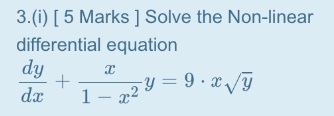
Homework Answers
Request Answer!
We need at least 10 more requests to produce the answer.
0 / 10 have requested this problem solution
The more requests, the faster the answer.
Q1 State a first order non-linear and non-homogeneous differential equation. Solve using - Exact Equation Approach Q2 State a second order linear and non-homogeneous differential equation. Solve using...
Q1 State a first order non-linear and non-homogeneous differential equation. Solve using - Exact Equation Approach Q2 State a second order linear and non-homogeneous differential equation. Solve using - Undetermined Coefficient Approach Please state the DE and solve it , as I want to know how you answer it , then i can practice with the real DE given by the question
Q1 State a first order non-linear and non-homogeneous differential equation. Solve using - Exact Equation Approach...
Q1 State a first order non-linear and non-homogeneous differential equation. Solve using - Exact Equation Approach Q2 State a second order linear and non-homogeneous differential equation. Solve using - Undetermined Coefficient Approach Please state the DE and solve it , as I want to know how you answer it , then i can practice with the real DE given by the question
1. The Duffing equation is a non-linear second-order differential equation used to model certain damped and...
 1. The Duffing equation is a non-linear second-order differential equation used to model certain damped and driven oscillators. The equation is given by -ax+3x3 = cos(wt) at medt dr. where function r = r(t) is the displacement at timet, is the velocity, and is the acceleration. The parameter 8 controls the amount of damping, a controls the linear stiffness, B controls the amount of non-linearity in the restoring force, and 7 and w are the amplitude and angular frequency of...
The general solution of the first order non-homogeneous linear differential equation with variable coefficients
 The general solution of the first order non-homogeneous linear differential equation with variable coefficients \((x+1) \frac{d y}{d x}+x y=e^{-x}, \quad x>-1 \quad\) equalsQ \(y=e^{-x}\left[C\left(x^{2}-1\right)+1\right]\), where \(C\) is an arbitrary constant.None of themQ \(y=e^{x}\left[C\left(x^{2}-1\right)+1\right]\), where \(C\) is an arbitrary constant.\(y=e^{-x}[C(x+1)-1]\), where \(C\) is an arbitrary constant.\(y=e^{x}[C(x-1)+1]\), where \(C\) is an arbitrary constant.
Determine the appropriate form of the particular solution for the following non-homogeneous linear differential equation with...
 Determine the appropriate form of the particular solution for
the following non-homogeneous linear differential equation with
constant coefficients.
J.(4) +9y" = 5 + e' (x – 3) + 4sin(3x). Ax + B + C sin(3x) + D cos(3x) + Exer Ax? + Bxe - 3x + Cxe3x + Det + Exet A + Bxe-3x + Cxe3x + Det + Exet none of these A+B sin(3x) + Cx sin(3x) + Det + Exel Ax2 + Bx cos (3x) + Cxsin (3x)...
Determine the appropriate form of the particular solution for
the following non-homogeneous linear differential equation with
constant coefficients.
J.(4) +9y" = 5 + e' (x – 3) + 4sin(3x). Ax + B + C sin(3x) + D cos(3x) + Exer Ax? + Bxe - 3x + Cxe3x + Det + Exet A + Bxe-3x + Cxe3x + Det + Exet none of these A+B sin(3x) + Cx sin(3x) + Det + Exel Ax2 + Bx cos (3x) + Cxsin (3x)...
how to solve the non-linear differential equation implicitly. y' = x + 2y / 2x +...
how to solve the non-linear differential equation implicitly. y' = x + 2y / 2x + y Please show your work step by step. Thanks.
8. Determine the appropriate form of the particular solution for the following non-homogeneous linear differential equation...
 8. Determine the appropriate form of the particular solution for the following non-homogeneous linear differential equation with constant coefficients. (8 Puan y(4) +9y" = 5+ &'(x-3) + 4sin (3x). none of these O Ar? + Bx cos(3x) + Cx sin(3x) + De' + Exet Ar + B + C sin(3x) + D cos(3x) + Exe" A + Bre-3x + Crer + De + Exet O Ar? + Bxe- + Crex + Det + Exe! A + B sin(3x) + Cxsin(3x)...
8. Determine the appropriate form of the particular solution for the following non-homogeneous linear differential equation...
 8. Determine the appropriate form of the particular solution for the following non-homogeneous linear differential equation with constant coefficients. * (8 Puan) y (4) +9y" = 5+ (x-3) + 4sin(3x). A + B sin(3x) + Cx sin(3r) + Det + Exer A + Bxe-3x + Cxex + De' + Exet Ax? + Bxe-3x + Cxe3x + Det + Exel none of these Ax? + Bx cos(3x) + Cx sin(3x) + Del + Exe" Ax+ B + C sin(3x) + D...
The general solution of the first order non homogeneous linear differential equation with variable dy coefficients...
 The general solution of the first order non homogeneous linear differential equation with variable dy coefficients (x+1)+zy=e" => -1 equals None of them Oy =é (C(x - 1) + 1), where is an arbitrary constant. Oy=é (C(ZP – 1) + 1). where is an arbitrary constant. Oy=e*10*? - 1) + 1]. where is an arbitrary constart Oy=-*|C(2+1) – 1), where is an arbitrary constant
Solve 1st order non-linear differential equation by Bernoulli's equation x2 dy/dx + y2 = xy Kindly...
Solve 1st order non-linear differential equation by Bernoulli's equation x2 dy/dx + y2 = xy Kindly simplify every step, thanks!
 1. The Duffing equation is a non-linear second-order differential equation used to model certain damped and driven oscillators. The equation is given by -ax+3x3 = cos(wt) at medt dr. where function r = r(t) is the displacement at timet, is the velocity, and is the acceleration. The parameter 8 controls the amount of damping, a controls the linear stiffness, B controls the amount of non-linearity in the restoring force, and 7 and w are the amplitude and angular frequency of...
 The general solution of the first order non-homogeneous linear differential equation with variable coefficients \((x+1) \frac{d y}{d x}+x y=e^{-x}, \quad x>-1 \quad\) equalsQ \(y=e^{-x}\left[C\left(x^{2}-1\right)+1\right]\), where \(C\) is an arbitrary constant.None of themQ \(y=e^{x}\left[C\left(x^{2}-1\right)+1\right]\), where \(C\) is an arbitrary constant.\(y=e^{-x}[C(x+1)-1]\), where \(C\) is an arbitrary constant.\(y=e^{x}[C(x-1)+1]\), where \(C\) is an arbitrary constant.
 Determine the appropriate form of the particular solution for
the following non-homogeneous linear differential equation with
constant coefficients.
J.(4) +9y" = 5 + e' (x – 3) + 4sin(3x). Ax + B + C sin(3x) + D cos(3x) + Exer Ax? + Bxe - 3x + Cxe3x + Det + Exet A + Bxe-3x + Cxe3x + Det + Exet none of these A+B sin(3x) + Cx sin(3x) + Det + Exel Ax2 + Bx cos (3x) + Cxsin (3x)...
Determine the appropriate form of the particular solution for
the following non-homogeneous linear differential equation with
constant coefficients.
J.(4) +9y" = 5 + e' (x – 3) + 4sin(3x). Ax + B + C sin(3x) + D cos(3x) + Exer Ax? + Bxe - 3x + Cxe3x + Det + Exet A + Bxe-3x + Cxe3x + Det + Exet none of these A+B sin(3x) + Cx sin(3x) + Det + Exel Ax2 + Bx cos (3x) + Cxsin (3x)...
 8. Determine the appropriate form of the particular solution for the following non-homogeneous linear differential equation with constant coefficients. (8 Puan y(4) +9y" = 5+ &'(x-3) + 4sin (3x). none of these O Ar? + Bx cos(3x) + Cx sin(3x) + De' + Exet Ar + B + C sin(3x) + D cos(3x) + Exe" A + Bre-3x + Crer + De + Exet O Ar? + Bxe- + Crex + Det + Exe! A + B sin(3x) + Cxsin(3x)...
 8. Determine the appropriate form of the particular solution for the following non-homogeneous linear differential equation with constant coefficients. * (8 Puan) y (4) +9y" = 5+ (x-3) + 4sin(3x). A + B sin(3x) + Cx sin(3r) + Det + Exer A + Bxe-3x + Cxex + De' + Exet Ax? + Bxe-3x + Cxe3x + Det + Exel none of these Ax? + Bx cos(3x) + Cx sin(3x) + Del + Exe" Ax+ B + C sin(3x) + D...
 The general solution of the first order non homogeneous linear differential equation with variable dy coefficients (x+1)+zy=e" => -1 equals None of them Oy =é (C(x - 1) + 1), where is an arbitrary constant. Oy=é (C(ZP – 1) + 1). where is an arbitrary constant. Oy=e*10*? - 1) + 1]. where is an arbitrary constart Oy=-*|C(2+1) – 1), where is an arbitrary constant
Most questions answered within 3 hours.
-
Where is the error in this code sequence?
String s1 = "Hello";
String s2 = "ello";...
asked 10 months ago -
Financial data for Joel de Paris, Inc., for last year
follow:
Joel de Paris, Inc.
Balance...
asked 10 months ago -
Consider this reaction:
Al2(SO4)3 (aq)+ BaCl3
(aq) Al2Cl6 (aq)- +
3BaSO4(s) . What is the...
asked 10 months ago -
Suppose that Savneet is considering increasing her
recent random sample from 20 car rentals to 40...
asked 10 months ago -
Trucks arrive at an unloading terminal at an average rate of 120
per hour.
Trucks arrive...
asked 10 months ago -
Why are methanol and ethanol completely soluble in water while
octanol is not very little soluble....
asked 10 months ago -
A facilities manager at a university reads in a research report
that the mean amount of...
asked 10 months ago -
When the CuSO4 is rehydrated by adding water to the anhydrous
compound, is this an endothermic...
asked 10 months ago -
A ray of sunlight is passing from diamond into crown glass; the
angle of incidence is...
asked 10 months ago -
A block of mass 0.249 kg is placed on top of a light, vertical
spring of...
asked 10 months ago -
how do the kidneys compensate in the presences of acidosis
a) trigger hyperventilate
b) reserve acid...
asked 10 months ago -
Question 501 pts
The rental rate of capital to the firm increases. Which of the
following...
asked 10 months ago