
Homework Answers

Add Answer to:
In the figure, a conducting rectangular body of dimensions d - 5.05 m, dy - 3,42...
Chapter 28, Problem 015 Your answer is partially correct. Try again. In the figure, a conducting...
 Chapter 28, Problem 015 Your answer is partially correct. Try again. In the figure, a conducting rectangular body of dimensions dr-5.48 m, dy-4.09 m, and dr·1.98 m moves at constant velocity - (12.2 m/s) through a uniform magnetic field 8 (40.8 mT) . (a) What is the resulting electric field within the body, in unit-vector notation? (b) What is the resulting potential difference across the body? k ) Units (a) Number N/C-m Units (b) Number Click if you would like...
1.82 m moves at constant velocty V (23.8 m/s) through a uniform magnetic field 8 (34.9...
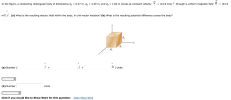 1.82 m moves at constant velocty V (23.8 m/s) through a uniform magnetic field 8 (34.9 In the figure, a conducting rectangular body of dimensions d,- 6.47 m, dy - 4.29 m, and d mT) . (a) What is the resulting electric field within the body, in unit-vector notation? (b) What is the resulting potential difference across the body? dx K ) Units (a) Number ( Units (b) Number Open Show Work Click if you would like to Show Work...
(10) A rectangular conducting slab with dimensions dx = 7.00 m, dy = 3.00 m, and...
 (10) A rectangular conducting slab with dimensions dx = 7.00 m, dy = 3.00 m, and dz = 2.00 m (not drawn to scale in the Figure), is moving through a uniform magnetic field B = 40.0 I mt with a velocity v = 20.0 i m/s in the x direction. What is the hall potential difference (in Volts)? 00 m (not drawn to scale in the Figures, 1. 2.4 2. 00 3. O 1.6 4. O 16.2 5. 0.027...
3) The next figure shows a rectangular 20-turn coil of wire, of dimensions 10 cm by...
 3) The next figure shows a rectangular 20-turn coil of wire, of dimensions 10 cm by 5.0 cm. It carries a current of 0.10 A and is hinged along one long side. It is mounted in the xy plane, at angle of 30° to the direction of a uniform magnetic field of magnitude 0.50 T. In unit-vector notation, a) what is the magnetic force on each side? B) What is the torque acting on the coil? Hinge line
A rectangular conducting loop of dimensions L = 3.55 m and d = 2.11 mis pulled...
 A rectangular conducting loop of dimensions L = 3.55 m and d = 2.11 mis pulled to the right at a speed of v = 5.46 m/s out of a magnetic field of magnitude B = 0.766 T which points into the page, as shown. The loop is made of cylindrical copper wire, whose radius is r=0.444 mm. The resistivity of copper is p= 1.68 x 10⁻⁸ 22.m. What thermal power is dissipated in the loop? REK ELE WIN *...
Problem 9. (4 points) Fall of a rectangular loop. A conducting rectangular loop of mass M,...
 Problem 9. (4 points) Fall of a rectangular loop. A conducting rectangular loop of mass M, resistance R, and dimensions a × b as shown in Fig. 8 is allowed to fall from rest through a uniform magnetic field which is perpendicular to the plane of the loop. The loop accelerates until it reaches a terminal speed(before the upper end enters the magnetic field). If a 2.0 m, B 6.0 T, R-130 and M= 0.60 kg, what is the terminal...
Why is the following situation impossible? A conducting rectangular loop of mass M = 0.100 kg,...
 Why is the following situation impossible? A conducting
rectangular loop of mass M = 0.100 kg, resistance R = 1.00 ?, and
dimensions w = 50.0 cm by ? = 90.0 cm is held with its lower edge
just above a region with a uniform magnetic field of magnitude B =
1.00 T as shown in the figure below. The loop is released from
rest. Just as the top edge of the loop reaches the region
containing the field, the...
Why is the following situation impossible? A conducting
rectangular loop of mass M = 0.100 kg, resistance R = 1.00 ?, and
dimensions w = 50.0 cm by ? = 90.0 cm is held with its lower edge
just above a region with a uniform magnetic field of magnitude B =
1.00 T as shown in the figure below. The loop is released from
rest. Just as the top edge of the loop reaches the region
containing the field, the...
A rectangular conducting loop of dimensions L = 3.55 m and d = 2.11 m is...
 A rectangular conducting loop of dimensions L = 3.55 m and d = 2.11 m is pulled to the right at a speed of v = 5.46 m/s out of a magnetic field of magnitude B = 0.766 T which points into the page, as shown. The loop is made of cylindrical copper wire, whose radius is r = 0.444 mm. The resistivity of copper is p= 1.68 x 10⁻⁸ 1.m. What thermal power is dissipated in the loop? x...
Part of a single rectangular loop of wire with dimensions shown in the figure (Figure 1)...
Part of a single rectangular loop of wire with dimensions shown in the figure (Figure 1) is situated inside a region of uniform magnetic field of 0.336 T . The total resistance of the loop is 0.532 Ω . Calculate the force required to pull the loop from the field (to the right) at a constant velocity of 1.59 m/s . Neglect gravity.
Part of a single rectangular loop of wire with dimensions shown in the (Figure 1) is...
Part of a single rectangular loop of wire with dimensions shown in the (Figure 1) is situated inside a region of uniform magnetic field of 0.740 T . The total resistance of the loop is 0.780 Ω . Calculate the force required to pull the loop from the field (to the right) at a constant velocity of 5.20 m/s . Neglect gravity.
 Chapter 28, Problem 015 Your answer is partially correct. Try again. In the figure, a conducting rectangular body of dimensions dr-5.48 m, dy-4.09 m, and dr·1.98 m moves at constant velocity - (12.2 m/s) through a uniform magnetic field 8 (40.8 mT) . (a) What is the resulting electric field within the body, in unit-vector notation? (b) What is the resulting potential difference across the body? k ) Units (a) Number N/C-m Units (b) Number Click if you would like...
 1.82 m moves at constant velocty V (23.8 m/s) through a uniform magnetic field 8 (34.9 In the figure, a conducting rectangular body of dimensions d,- 6.47 m, dy - 4.29 m, and d mT) . (a) What is the resulting electric field within the body, in unit-vector notation? (b) What is the resulting potential difference across the body? dx K ) Units (a) Number ( Units (b) Number Open Show Work Click if you would like to Show Work...
 (10) A rectangular conducting slab with dimensions dx = 7.00 m, dy = 3.00 m, and dz = 2.00 m (not drawn to scale in the Figure), is moving through a uniform magnetic field B = 40.0 I mt with a velocity v = 20.0 i m/s in the x direction. What is the hall potential difference (in Volts)? 00 m (not drawn to scale in the Figures, 1. 2.4 2. 00 3. O 1.6 4. O 16.2 5. 0.027...
 3) The next figure shows a rectangular 20-turn coil of wire, of dimensions 10 cm by 5.0 cm. It carries a current of 0.10 A and is hinged along one long side. It is mounted in the xy plane, at angle of 30° to the direction of a uniform magnetic field of magnitude 0.50 T. In unit-vector notation, a) what is the magnetic force on each side? B) What is the torque acting on the coil? Hinge line
 A rectangular conducting loop of dimensions L = 3.55 m and d = 2.11 mis pulled to the right at a speed of v = 5.46 m/s out of a magnetic field of magnitude B = 0.766 T which points into the page, as shown. The loop is made of cylindrical copper wire, whose radius is r=0.444 mm. The resistivity of copper is p= 1.68 x 10⁻⁸ 22.m. What thermal power is dissipated in the loop? REK ELE WIN *...
 Problem 9. (4 points) Fall of a rectangular loop. A conducting rectangular loop of mass M, resistance R, and dimensions a × b as shown in Fig. 8 is allowed to fall from rest through a uniform magnetic field which is perpendicular to the plane of the loop. The loop accelerates until it reaches a terminal speed(before the upper end enters the magnetic field). If a 2.0 m, B 6.0 T, R-130 and M= 0.60 kg, what is the terminal...
 Why is the following situation impossible? A conducting
rectangular loop of mass M = 0.100 kg, resistance R = 1.00 ?, and
dimensions w = 50.0 cm by ? = 90.0 cm is held with its lower edge
just above a region with a uniform magnetic field of magnitude B =
1.00 T as shown in the figure below. The loop is released from
rest. Just as the top edge of the loop reaches the region
containing the field, the...
Why is the following situation impossible? A conducting
rectangular loop of mass M = 0.100 kg, resistance R = 1.00 ?, and
dimensions w = 50.0 cm by ? = 90.0 cm is held with its lower edge
just above a region with a uniform magnetic field of magnitude B =
1.00 T as shown in the figure below. The loop is released from
rest. Just as the top edge of the loop reaches the region
containing the field, the...
 A rectangular conducting loop of dimensions L = 3.55 m and d = 2.11 m is pulled to the right at a speed of v = 5.46 m/s out of a magnetic field of magnitude B = 0.766 T which points into the page, as shown. The loop is made of cylindrical copper wire, whose radius is r = 0.444 mm. The resistivity of copper is p= 1.68 x 10⁻⁸ 1.m. What thermal power is dissipated in the loop? x...
Most questions answered within 3 hours.
-
Where is the error in this code sequence?
String s1 = "Hello";
String s2 = "ello";...
asked 10 months ago -
Financial data for Joel de Paris, Inc., for last year
follow:
Joel de Paris, Inc.
Balance...
asked 10 months ago -
Consider this reaction:
Al2(SO4)3 (aq)+ BaCl3
(aq) Al2Cl6 (aq)- +
3BaSO4(s) . What is the...
asked 10 months ago -
Suppose that Savneet is considering increasing her
recent random sample from 20 car rentals to 40...
asked 10 months ago -
Trucks arrive at an unloading terminal at an average rate of 120
per hour.
Trucks arrive...
asked 10 months ago -
Why are methanol and ethanol completely soluble in water while
octanol is not very little soluble....
asked 10 months ago -
A facilities manager at a university reads in a research report
that the mean amount of...
asked 10 months ago -
When the CuSO4 is rehydrated by adding water to the anhydrous
compound, is this an endothermic...
asked 10 months ago -
A ray of sunlight is passing from diamond into crown glass; the
angle of incidence is...
asked 10 months ago -
A block of mass 0.249 kg is placed on top of a light, vertical
spring of...
asked 10 months ago -
how do the kidneys compensate in the presences of acidosis
a) trigger hyperventilate
b) reserve acid...
asked 10 months ago -
Question 501 pts
The rental rate of capital to the firm increases. Which of the
following...
asked 10 months ago