
Homework Answers
To find the kth largest element from the heap of n elements, an additional heap data structure will be required.
Algorithm:
Step 1: Using the first k elements of the given heap, build a min-heap M. The time complexity of this step is O(k).
Step 2: After the above step, each of the next elements of the given heap is compared with the root of the min-heap M. If the element is greater than the root of the min-heap M, then make it root and call min-heapify function for M. Otherwise (if element is less than root of M), just ignore it. The time complexity of this step is O((n-k)*logk)
Step 3: After performing all the above steps, the root of the min-heap M is the kth largest element.
Time Complexity: O((n-k)*logk) = O(klogk)
For the given example:
1. The heap from the first seven elements is:

2. Min-heapify this heap.

3. Compare the root of this heap with remaining elements. 20, 40, 10 and 30 are smaller than the root 40, so nothing is done. But 45 is greater than 40, so 40 is replaced with 45. Thus, the 7th largest element is 45.

CODE:
The language used is C++.
In the code given below, an array data structure is given to represent the given heap. If the given heap is in tree form, store it into array using level order traversal and use the same code given below to find kth largest element. Note that level order traversal of a tree can be done using queue data structure.
In this code, priority_queue of Standard Template Library is used to represent min heap.
#include<bits/stdc++.h>
using namespace std;
int kthLargest(int arr[], int n, int k)
{
//Min heap
priority_queue<int, vector<int>, greater<int> >
Q;
//Push first k elements into the priority_queue.
//The top or root of the priority_queue is the minimum
element.
for(int i=0;i<k;i++)
Q.push(arr[i]);
//Compare remaining elements with top or root of the
priority_queue.
//Top of the priority_queue Q can be obtained by Q.top().
for(int i=k;i<n;i++){
if(arr[i] > Q.top()){
Q.pop(); //Used to remove top of the priority_queue.
Q.push(arr[i]);
//When arr[i] is pushed, Q is automatically arranged so that
minimum is at the root or top.
}
}
//Return root or top of the priority_queue.
return Q.top();
}
int main()
{
int arr[] = {100, 80, 70, 40, 50, 65, 60, 20, 40, 10, 30,
45};
int n = sizeof(arr)/sizeof(arr[0]);
cout<<kthLargest(arr, n, 7);
}
Code Snippets:

![27 int main) 28 29 30 31 int arr(100, 80, 70, 40, 50, 65, 60, 20, 40, 10, 30,45) int n sizeof (arr) /sizeof (arr [0]); cout<<](http://img.homeworklib.com/questions/9421ac00-c190-11ea-a14c-cb013e0f684d.png?x-oss-process=image/resize,w_560)
Sample Output:

Add Answer to:
Provide an O(k log k) algorithm that uses a heap data structure to find the kth...
please justify. A Fibonacci heap is a fancy priority queue data structure. For a heap of...
 please justify.
A Fibonacci heap is a fancy priority queue data structure. For a heap of size n, it takes O(log n) time to do an extractMin() operation but only O(1) time to do an insert or decrease operation. Suppose we replace the binary heap used in Dijkstra's algorithm by a Fibonacci heap. 6. If the graph is dense, what is the asymptotic complexity of Dijkstra's algorithm using a Fibonacci heap, in terms of V|? 7. If the graph is...
please justify.
A Fibonacci heap is a fancy priority queue data structure. For a heap of size n, it takes O(log n) time to do an extractMin() operation but only O(1) time to do an insert or decrease operation. Suppose we replace the binary heap used in Dijkstra's algorithm by a Fibonacci heap. 6. If the graph is dense, what is the asymptotic complexity of Dijkstra's algorithm using a Fibonacci heap, in terms of V|? 7. If the graph is...
Suppose you have two data sets, each of which contain n comparable elements. As an basic...
Suppose you have two data sets, each of which contain n comparable elements. As an basic operation, you may ask one set to tell you the kth largest element of that set, for a value k you choose. Give an algorithm that, with O(log n) queries, determines the median value of the union of the two sets.
Discrete Mathematics Time Complexity Analysis Due: May 9th, 2019 Math 4 6026 Heap Sort Another algorithm for sorting uses a specialized tree structure called a "heap." Specifically, we wi...
 Discrete Mathematics
Time Complexity Analysis Due: May 9th, 2019 Math 4 6026 Heap Sort Another algorithm for sorting uses a specialized tree structure called a "heap." Specifically, we will use a binary heap, which is like a binary tree with hierarchy. Here is an example of a binary heap structure 1. 2. There is a top vertex, called the parent vertex (aka node). The top parent vertex connects to two vertices a level below. These vertices are the "left child"...
Discrete Mathematics
Time Complexity Analysis Due: May 9th, 2019 Math 4 6026 Heap Sort Another algorithm for sorting uses a specialized tree structure called a "heap." Specifically, we will use a binary heap, which is like a binary tree with hierarchy. Here is an example of a binary heap structure 1. 2. There is a top vertex, called the parent vertex (aka node). The top parent vertex connects to two vertices a level below. These vertices are the "left child"...
A deterministic heuristic for NUMBER PARTITION is the Karmarkar-Karp algorithm. This KK algorithm uses differencing: repeatedly...
A deterministic heuristic for NUMBER PARTITION is the Karmarkar-Karp algorithm. This KK algorithm uses differencing: repeatedly take the two largest elements from A, call them ai and aj , and replace the larger by |ai − aj | while replacing the smaller by zero, until there is only one non-zero element left. This final non-zero element corresponds to an achievable residue, but it may not be the best possible residue, that is why we refer to this as a heuristic....
8. Provide an O(n log n) time divide-and-conquer algorithm to find the area of the largest...
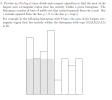 8. Provide an O(n log n) time divide-and-conquer algorithm to find the area of the largest area rectangular region that lies entirely within a given histogram. The histogram consists of bars of width one that extend upwards from the x-axis. Bar i extends upward from the line y 0 to the line y topi) For example in the following histogram with 8 bars, the area of the largest rect- angular region that lies entirely within the histogram with tops (8,5,6,9,2,5,4,5)...
Write a program in Java to implement the max-priority queue using max-heap data structure. Implement the...
Write a program in Java to implement the max-priority queue using max-heap data structure. Implement the max-heap data structure using an integer array of 10 cells. (Do not use Java in-built PriorityQueue class.) [In a max-heap, the root node and the intermediate node vales are always greater than their children.] First, take 10 integer values from the user and insert them in the max-priority queue. Then print the elements of the queue. After that, delete two elements from the queue...
need solution plz Question 1 (CLO-4, PLo-3) Figure 1 show an input tree T. 1. Analyze the tree and mention weather the tree is a heap or not by checking heap's property. If yes, justify your a...
 need solution plz
Question 1 (CLO-4, PLo-3) Figure 1 show an input tree T. 1. Analyze the tree and mention weather the tree is a heap or not by checking heap's property. If yes, justify your answer. If no, make it a heap by adjusting the node's location 2. Alter the value of T[l1] to 100 using alter-heap algorithm. Analyze the tree again and state whether i. The tree is still a heap or not? ii. If not, which one...
need solution plz
Question 1 (CLO-4, PLo-3) Figure 1 show an input tree T. 1. Analyze the tree and mention weather the tree is a heap or not by checking heap's property. If yes, justify your answer. If no, make it a heap by adjusting the node's location 2. Alter the value of T[l1] to 100 using alter-heap algorithm. Analyze the tree again and state whether i. The tree is still a heap or not? ii. If not, which one...
need full solution of this question plz help me Question 1 (CLO-4, PLo-3) Figure 1 show an input tree T. 1. Analyze the tree and mention weather the tree is a heap or not by checking heap's pr...
 need full solution of this question plz help me
Question 1 (CLO-4, PLo-3) Figure 1 show an input tree T. 1. Analyze the tree and mention weather the tree is a heap or not by checking heap's property. If yes, justify your answer. If no, make it a heap by adjusting the node's location 2. Alter the value of T[l1] to 100 using alter-heap algorithm. Analyze the tree again and state whether i. The tree is still a heap or...
need full solution of this question plz help me
Question 1 (CLO-4, PLo-3) Figure 1 show an input tree T. 1. Analyze the tree and mention weather the tree is a heap or not by checking heap's property. If yes, justify your answer. If no, make it a heap by adjusting the node's location 2. Alter the value of T[l1] to 100 using alter-heap algorithm. Analyze the tree again and state whether i. The tree is still a heap or...
Data Structures using C BuildHeap and Heap Sort In preparation: If you have not done so...
 Data Structures using C
BuildHeap and Heap Sort In preparation: If you have not done so already, you should complete Worksheet 33 to leam more about the heap data structure. In some applications it is useful to void buildHeap (struct dyArray heap) { initialize a Heap with an existing vector int max = dy Array Size(heap); int i; of values. The values are not assumed for (i = max/2-1; i >= 0; i--) to be organized into a heap, and...
Data Structures using C
BuildHeap and Heap Sort In preparation: If you have not done so already, you should complete Worksheet 33 to leam more about the heap data structure. In some applications it is useful to void buildHeap (struct dyArray heap) { initialize a Heap with an existing vector int max = dy Array Size(heap); int i; of values. The values are not assumed for (i = max/2-1; i >= 0; i--) to be organized into a heap, and...
problem 2 can use Det-Selection(A, p, q, r) as a sub-routine (i.e, you don't need to...
 problem 2
can use Det-Selection(A, p, q, r) as a sub-routine (i.e, you don't need to write its pseudo-code). To sort an array A, you will then call Det-QuickSort(A, 1, n). You also need to provide the worst case time complexity analysis of your algorithm. 2. (20 points) Given a set of n distinct numbers, we wish to find the k largest in sorted order using a comparison-based algorithm. Give an algorithm that implements each of the following methods, and...
problem 2
can use Det-Selection(A, p, q, r) as a sub-routine (i.e, you don't need to write its pseudo-code). To sort an array A, you will then call Det-QuickSort(A, 1, n). You also need to provide the worst case time complexity analysis of your algorithm. 2. (20 points) Given a set of n distinct numbers, we wish to find the k largest in sorted order using a comparison-based algorithm. Give an algorithm that implements each of the following methods, and...
 please justify.
A Fibonacci heap is a fancy priority queue data structure. For a heap of size n, it takes O(log n) time to do an extractMin() operation but only O(1) time to do an insert or decrease operation. Suppose we replace the binary heap used in Dijkstra's algorithm by a Fibonacci heap. 6. If the graph is dense, what is the asymptotic complexity of Dijkstra's algorithm using a Fibonacci heap, in terms of V|? 7. If the graph is...
please justify.
A Fibonacci heap is a fancy priority queue data structure. For a heap of size n, it takes O(log n) time to do an extractMin() operation but only O(1) time to do an insert or decrease operation. Suppose we replace the binary heap used in Dijkstra's algorithm by a Fibonacci heap. 6. If the graph is dense, what is the asymptotic complexity of Dijkstra's algorithm using a Fibonacci heap, in terms of V|? 7. If the graph is...
 Discrete Mathematics
Time Complexity Analysis Due: May 9th, 2019 Math 4 6026 Heap Sort Another algorithm for sorting uses a specialized tree structure called a "heap." Specifically, we will use a binary heap, which is like a binary tree with hierarchy. Here is an example of a binary heap structure 1. 2. There is a top vertex, called the parent vertex (aka node). The top parent vertex connects to two vertices a level below. These vertices are the "left child"...
Discrete Mathematics
Time Complexity Analysis Due: May 9th, 2019 Math 4 6026 Heap Sort Another algorithm for sorting uses a specialized tree structure called a "heap." Specifically, we will use a binary heap, which is like a binary tree with hierarchy. Here is an example of a binary heap structure 1. 2. There is a top vertex, called the parent vertex (aka node). The top parent vertex connects to two vertices a level below. These vertices are the "left child"...
 8. Provide an O(n log n) time divide-and-conquer algorithm to find the area of the largest area rectangular region that lies entirely within a given histogram. The histogram consists of bars of width one that extend upwards from the x-axis. Bar i extends upward from the line y 0 to the line y topi) For example in the following histogram with 8 bars, the area of the largest rect- angular region that lies entirely within the histogram with tops (8,5,6,9,2,5,4,5)...
 need solution plz
Question 1 (CLO-4, PLo-3) Figure 1 show an input tree T. 1. Analyze the tree and mention weather the tree is a heap or not by checking heap's property. If yes, justify your answer. If no, make it a heap by adjusting the node's location 2. Alter the value of T[l1] to 100 using alter-heap algorithm. Analyze the tree again and state whether i. The tree is still a heap or not? ii. If not, which one...
need solution plz
Question 1 (CLO-4, PLo-3) Figure 1 show an input tree T. 1. Analyze the tree and mention weather the tree is a heap or not by checking heap's property. If yes, justify your answer. If no, make it a heap by adjusting the node's location 2. Alter the value of T[l1] to 100 using alter-heap algorithm. Analyze the tree again and state whether i. The tree is still a heap or not? ii. If not, which one...
 need full solution of this question plz help me
Question 1 (CLO-4, PLo-3) Figure 1 show an input tree T. 1. Analyze the tree and mention weather the tree is a heap or not by checking heap's property. If yes, justify your answer. If no, make it a heap by adjusting the node's location 2. Alter the value of T[l1] to 100 using alter-heap algorithm. Analyze the tree again and state whether i. The tree is still a heap or...
need full solution of this question plz help me
Question 1 (CLO-4, PLo-3) Figure 1 show an input tree T. 1. Analyze the tree and mention weather the tree is a heap or not by checking heap's property. If yes, justify your answer. If no, make it a heap by adjusting the node's location 2. Alter the value of T[l1] to 100 using alter-heap algorithm. Analyze the tree again and state whether i. The tree is still a heap or...
 Data Structures using C
BuildHeap and Heap Sort In preparation: If you have not done so already, you should complete Worksheet 33 to leam more about the heap data structure. In some applications it is useful to void buildHeap (struct dyArray heap) { initialize a Heap with an existing vector int max = dy Array Size(heap); int i; of values. The values are not assumed for (i = max/2-1; i >= 0; i--) to be organized into a heap, and...
Data Structures using C
BuildHeap and Heap Sort In preparation: If you have not done so already, you should complete Worksheet 33 to leam more about the heap data structure. In some applications it is useful to void buildHeap (struct dyArray heap) { initialize a Heap with an existing vector int max = dy Array Size(heap); int i; of values. The values are not assumed for (i = max/2-1; i >= 0; i--) to be organized into a heap, and...
 problem 2
can use Det-Selection(A, p, q, r) as a sub-routine (i.e, you don't need to write its pseudo-code). To sort an array A, you will then call Det-QuickSort(A, 1, n). You also need to provide the worst case time complexity analysis of your algorithm. 2. (20 points) Given a set of n distinct numbers, we wish to find the k largest in sorted order using a comparison-based algorithm. Give an algorithm that implements each of the following methods, and...
problem 2
can use Det-Selection(A, p, q, r) as a sub-routine (i.e, you don't need to write its pseudo-code). To sort an array A, you will then call Det-QuickSort(A, 1, n). You also need to provide the worst case time complexity analysis of your algorithm. 2. (20 points) Given a set of n distinct numbers, we wish to find the k largest in sorted order using a comparison-based algorithm. Give an algorithm that implements each of the following methods, and...
Most questions answered within 3 hours.
-
Where is the error in this code sequence?
String s1 = "Hello";
String s2 = "ello";...
asked 10 months ago -
Financial data for Joel de Paris, Inc., for last year
follow:
Joel de Paris, Inc.
Balance...
asked 10 months ago -
Consider this reaction:
Al2(SO4)3 (aq)+ BaCl3
(aq) Al2Cl6 (aq)- +
3BaSO4(s) . What is the...
asked 10 months ago -
Suppose that Savneet is considering increasing her
recent random sample from 20 car rentals to 40...
asked 10 months ago -
Trucks arrive at an unloading terminal at an average rate of 120
per hour.
Trucks arrive...
asked 10 months ago -
Why are methanol and ethanol completely soluble in water while
octanol is not very little soluble....
asked 10 months ago -
A facilities manager at a university reads in a research report
that the mean amount of...
asked 10 months ago -
When the CuSO4 is rehydrated by adding water to the anhydrous
compound, is this an endothermic...
asked 10 months ago -
A ray of sunlight is passing from diamond into crown glass; the
angle of incidence is...
asked 10 months ago -
A block of mass 0.249 kg is placed on top of a light, vertical
spring of...
asked 10 months ago -
how do the kidneys compensate in the presences of acidosis
a) trigger hyperventilate
b) reserve acid...
asked 10 months ago -
Question 501 pts
The rental rate of capital to the firm increases. Which of the
following...
asked 10 months ago