Please provide me a correct and clear answer for this question
Thanks

Homework Answers


Add Answer to:
Please provide me a correct and clear answer for this
question
Thanks
QUESTION 1 125 MARKS...
Question 1 A piston-cylinder assembly contains 3.2 kg of water at 211.9oC and 3 bar. The...
Question 1 A piston-cylinder assembly contains 3.2 kg of water at 211.9oC and 3 bar. The water is compressed to a saturated vapor state where the pressure is 51.5 bar. During compression, there is a heat transfer of energy from the water to its surroundings having a magnitude of 230 kJ. Neglecting changes in kinetic energy and potential energy, determine the work, in kJ, for the process of the water. Question 2 Water, initially saturated vapor at 10.2 bar, fills...
QUESTION 2 [ 10 MARKS) A vessel having a volume of 3 m' initially contains a...
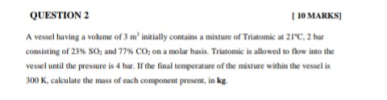 QUESTION 2 [ 10 MARKS) A vessel having a volume of 3 m' initially contains a mixture of Triatomic at 21°C, 2 bar consisting of 23% SO, and 77% CO on a molar basis. Triatomic is allowed to flow into the vessel until the pressure is 4 bar. If the final temperature of the mixture within the vessel is 300 K, calculate the mass of each component present, in kg
Can you please help me with these 5 problems!!! please and thank you Question 1 A...
Can you please help me with these 5 problems!!! please and thank you Question 1 A mass of 5 kilograms of carbon dioxide (CO2) in a piston-cylinder assembly undergoes two processes in series from an initial state where p1 = 2.4 MPa, T1 = 260°C: Process 1–2: Constant-temperature expansion until the volume is twice the initial volume. Process 2–3: Constant-volume heating until the pressure is again 2.4 MPa. Assuming ideal gas behavior, determine the overall work, in kJ. ____________________________________________________________ Nitrogen...
Please give me the correct answer. Thanks. Question 2 (25 marks) a. Design a ladder diagram...
 Please give me the correct answer.
Thanks.
Question 2 (25 marks) a. Design a ladder diagram to implement the control function based on following truth table 1. SW1 SW2Light OFF OFF OFF OFF ON OFF ON OFFOFF ON | ON | ON [5 marks] SW1 SW2Light OFF OFF OFF OFF ON ON ON OFF ON ON | ON | ON [5 marks]
Please give me the correct answer.
Thanks.
Question 2 (25 marks) a. Design a ladder diagram to implement the control function based on following truth table 1. SW1 SW2Light OFF OFF OFF OFF ON OFF ON OFFOFF ON | ON | ON [5 marks] SW1 SW2Light OFF OFF OFF OFF ON ON ON OFF ON ON | ON | ON [5 marks]
Chlorine gas is to be heated from 125 °C and 1 atm to 175 °c. (a)...
 Chlorine gas is to be heated from 125 °C and 1 atm to 175 °c. (a) Calculate the heat input ( W) required to heat a stream of the gas flowing at 5.0 kg's (b) Calculate the heat input (kJ) required to raise the temperature of 5.0 kg of chlorine in at constant pressure. a closed rigid vessel from 125 °C and 1 atm to 175 °C. (Suggestion: Evaluate the change in specific internal energy directly from the result of...
Question Number 1 (25 Marks) A mass of 0.5 kg of ammonia is contained in a...
 Question Number 1 (25 Marks) A mass of 0.5 kg of ammonia is contained in a piston-cylinder assembly, initially at T1 = -20°C and U1 = 391.11 kJ/kg. The ammonia is slowly heated to state 2, where T2 = 20°C and P2 = 0.6 MPa, and the pressure varies linearly with specific volume during this process. From state 2, the system isºcompressed at constant pressure until the ammonia becomes a fully saturated vapor. Assume that there are no significant change...
can some one please explain me the question. the correct answer is A. thanks 6. What...
 can some one please explain me the question. the
correct answer is A.
thanks
6. What is the concentration of Co(aq) ions in the solution made by adding water to cobalt(IT) nitrate (0.50 mol) and ethylenediamine (3.0 mol) so that the final volume of solution is 3.0L? The Khof (Coſen)]" is 10 x 10 a) 1.3 x 10 M b) 1.5 x 10M c) 2.9 x 10-"M d) 3.3 X 10M e) 8.7 10M
can some one please explain me the question. the
correct answer is A.
thanks
6. What is the concentration of Co(aq) ions in the solution made by adding water to cobalt(IT) nitrate (0.50 mol) and ethylenediamine (3.0 mol) so that the final volume of solution is 3.0L? The Khof (Coſen)]" is 10 x 10 a) 1.3 x 10 M b) 1.5 x 10M c) 2.9 x 10-"M d) 3.3 X 10M e) 8.7 10M
QUESTION 1 [ 10 MARKS] The gravimetric analysis of a gas mixture is 50% N2, 40%...
 QUESTION 1 [ 10 MARKS] The gravimetric analysis of a gas mixture is 50% N2, 40% CO2 and 10% CH4 with a temperature of 40°C and pressure of 1 bar. Calculate, 1.1 the partial pressure of each component, in bar. 1.2 the molar mass for the gas mixture, in kg/kmol. 1.3 the mass by 4 m of mixture, in kg. QUESTION 2 [ 10 MARKS A vessel having a volume of 3 m’initially contains a mixture of Triatomic at 21°C,...
QUESTION 1 [ 10 MARKS) The gravimetric analysis of a gas mixture is 50% N, 40%...
 QUESTION 1 [ 10 MARKS) The gravimetric analysis of a gas mixture is 50% N, 40% CO2 and 10% CH4 with a temperature of 407C and pressure of 1 bar. Calculate, 1.1 the partial pressure of each component, in bar. 1.2 the molar mass for the gas mixture, in kg/kmol. 1.3 the mass by 4 m of mixture, in kg. QUESTION 2 [ 10 MARKS) A vessel having a volume of 3 m'initially contains a mixture of Triatomic at 21°C,...
Please provide a detailed, clear answer to this question. Thanks! Initial Final 6. In the above...
 Please provide a detailed, clear answer to this question.
Thanks!
Initial Final 6. In the above figure is an Atwood machine: a machine composed of two blocks, one of mass m 250g and one of mass m2 100g, a massless rope and a massless pulley. If the two masses are released from rest as shown in the figure, at what speed does m hit the ground after falling some h 12cm?
Please provide a detailed, clear answer to this question.
Thanks!
Initial Final 6. In the above figure is an Atwood machine: a machine composed of two blocks, one of mass m 250g and one of mass m2 100g, a massless rope and a massless pulley. If the two masses are released from rest as shown in the figure, at what speed does m hit the ground after falling some h 12cm?
 QUESTION 2 [ 10 MARKS) A vessel having a volume of 3 m' initially contains a mixture of Triatomic at 21°C, 2 bar consisting of 23% SO, and 77% CO on a molar basis. Triatomic is allowed to flow into the vessel until the pressure is 4 bar. If the final temperature of the mixture within the vessel is 300 K, calculate the mass of each component present, in kg
 Please give me the correct answer.
Thanks.
Question 2 (25 marks) a. Design a ladder diagram to implement the control function based on following truth table 1. SW1 SW2Light OFF OFF OFF OFF ON OFF ON OFFOFF ON | ON | ON [5 marks] SW1 SW2Light OFF OFF OFF OFF ON ON ON OFF ON ON | ON | ON [5 marks]
Please give me the correct answer.
Thanks.
Question 2 (25 marks) a. Design a ladder diagram to implement the control function based on following truth table 1. SW1 SW2Light OFF OFF OFF OFF ON OFF ON OFFOFF ON | ON | ON [5 marks] SW1 SW2Light OFF OFF OFF OFF ON ON ON OFF ON ON | ON | ON [5 marks]
 Chlorine gas is to be heated from 125 °C and 1 atm to 175 °c. (a) Calculate the heat input ( W) required to heat a stream of the gas flowing at 5.0 kg's (b) Calculate the heat input (kJ) required to raise the temperature of 5.0 kg of chlorine in at constant pressure. a closed rigid vessel from 125 °C and 1 atm to 175 °C. (Suggestion: Evaluate the change in specific internal energy directly from the result of...
 Question Number 1 (25 Marks) A mass of 0.5 kg of ammonia is contained in a piston-cylinder assembly, initially at T1 = -20°C and U1 = 391.11 kJ/kg. The ammonia is slowly heated to state 2, where T2 = 20°C and P2 = 0.6 MPa, and the pressure varies linearly with specific volume during this process. From state 2, the system isºcompressed at constant pressure until the ammonia becomes a fully saturated vapor. Assume that there are no significant change...
 can some one please explain me the question. the
correct answer is A.
thanks
6. What is the concentration of Co(aq) ions in the solution made by adding water to cobalt(IT) nitrate (0.50 mol) and ethylenediamine (3.0 mol) so that the final volume of solution is 3.0L? The Khof (Coſen)]" is 10 x 10 a) 1.3 x 10 M b) 1.5 x 10M c) 2.9 x 10-"M d) 3.3 X 10M e) 8.7 10M
can some one please explain me the question. the
correct answer is A.
thanks
6. What is the concentration of Co(aq) ions in the solution made by adding water to cobalt(IT) nitrate (0.50 mol) and ethylenediamine (3.0 mol) so that the final volume of solution is 3.0L? The Khof (Coſen)]" is 10 x 10 a) 1.3 x 10 M b) 1.5 x 10M c) 2.9 x 10-"M d) 3.3 X 10M e) 8.7 10M
 QUESTION 1 [ 10 MARKS] The gravimetric analysis of a gas mixture is 50% N2, 40% CO2 and 10% CH4 with a temperature of 40°C and pressure of 1 bar. Calculate, 1.1 the partial pressure of each component, in bar. 1.2 the molar mass for the gas mixture, in kg/kmol. 1.3 the mass by 4 m of mixture, in kg. QUESTION 2 [ 10 MARKS A vessel having a volume of 3 m’initially contains a mixture of Triatomic at 21°C,...
 QUESTION 1 [ 10 MARKS) The gravimetric analysis of a gas mixture is 50% N, 40% CO2 and 10% CH4 with a temperature of 407C and pressure of 1 bar. Calculate, 1.1 the partial pressure of each component, in bar. 1.2 the molar mass for the gas mixture, in kg/kmol. 1.3 the mass by 4 m of mixture, in kg. QUESTION 2 [ 10 MARKS) A vessel having a volume of 3 m'initially contains a mixture of Triatomic at 21°C,...
 Please provide a detailed, clear answer to this question.
Thanks!
Initial Final 6. In the above figure is an Atwood machine: a machine composed of two blocks, one of mass m 250g and one of mass m2 100g, a massless rope and a massless pulley. If the two masses are released from rest as shown in the figure, at what speed does m hit the ground after falling some h 12cm?
Please provide a detailed, clear answer to this question.
Thanks!
Initial Final 6. In the above figure is an Atwood machine: a machine composed of two blocks, one of mass m 250g and one of mass m2 100g, a massless rope and a massless pulley. If the two masses are released from rest as shown in the figure, at what speed does m hit the ground after falling some h 12cm?
Most questions answered within 3 hours.
-
Where is the error in this code sequence?
String s1 = "Hello";
String s2 = "ello";...
asked 10 months ago -
Financial data for Joel de Paris, Inc., for last year
follow:
Joel de Paris, Inc.
Balance...
asked 10 months ago -
Consider this reaction:
Al2(SO4)3 (aq)+ BaCl3
(aq) Al2Cl6 (aq)- +
3BaSO4(s) . What is the...
asked 10 months ago -
Suppose that Savneet is considering increasing her
recent random sample from 20 car rentals to 40...
asked 10 months ago -
Trucks arrive at an unloading terminal at an average rate of 120
per hour.
Trucks arrive...
asked 10 months ago -
Why are methanol and ethanol completely soluble in water while
octanol is not very little soluble....
asked 10 months ago -
A facilities manager at a university reads in a research report
that the mean amount of...
asked 10 months ago -
When the CuSO4 is rehydrated by adding water to the anhydrous
compound, is this an endothermic...
asked 10 months ago -
A ray of sunlight is passing from diamond into crown glass; the
angle of incidence is...
asked 10 months ago -
A block of mass 0.249 kg is placed on top of a light, vertical
spring of...
asked 10 months ago -
how do the kidneys compensate in the presences of acidosis
a) trigger hyperventilate
b) reserve acid...
asked 10 months ago -
Question 501 pts
The rental rate of capital to the firm increases. Which of the
following...
asked 10 months ago