
Homework Answers
Request Answer!
We need at least 10 more requests to produce the answer.
0 / 10 have requested this problem solution
The more requests, the faster the answer.
Add Answer to:
EE2002-ANALOG ELECTRONICS (TEL) (Part 1: P02E_Diode-Easy) 4 P02E Q10 The voltage across RL is V in...
QUESTION 13 Calculate the voltage across RL in the series_parallel network below. Vs = 20 V,...
 QUESTION 13 Calculate the voltage across RL in the series_parallel network below. Vs = 20 V, RL = 3.6 KN Enter your results in Volts - V. Do not type the unit. Tko 33.3kg TR2 SRL QUESTION 14 Calculate the current through RL in the series parallel network below. Vs = 18 V, RL = 2.8 KN Enter your results in mA. Do not type the unit. 1kg PR1 RL 33.3kg R2 QUESTION 15 Calculate the voltage measured by the...
The Natural Response of an RL Circuit In summary, to find the time constant of an...
 The Natural Response of an RL Circuit In summary, to find the time constant of an RL circuit, find the Thevenin equivalent resistance se Learning Goal: To analyze an RL circuit to determine the initial current through an inductor, the time constant, and the expression for the natural response of the inductor current, and to use the expression for the inductor current to find other circuit quantities, such as current, voltage, power, or energy. The natural response of an RL...
For the circuit in Figure 1, assme that the voltage drop across the infrared emitter is 1.3 V. De...
 R1= 12 K ohm
R2= 12 K ohm
rout= 1.2 K ohm
For the circuit in Figure 1, assme that the voltage drop across the infrared emitter is 1.3 V. Determine the value of RE that will set the current through the emitter to a value within the range of 50 mA to 80 mA. For the circuit in Figure 1, assume Rx 10 kQ and Vs 5 V. Using the equation given in the introduction section, determine the value...
R1= 12 K ohm
R2= 12 K ohm
rout= 1.2 K ohm
For the circuit in Figure 1, assme that the voltage drop across the infrared emitter is 1.3 V. Determine the value of RE that will set the current through the emitter to a value within the range of 50 mA to 80 mA. For the circuit in Figure 1, assume Rx 10 kQ and Vs 5 V. Using the equation given in the introduction section, determine the value...
Part The voltage across R, in the crout from Part A is to be measured using...
 Part The voltage across R, in the crout from Part A is to be measured using an analog voltmeter. The votimete has a 150 mV,50 A movement and Miscale reading of 10 V. What is the reading on the volumelor? Recall that R. - 20 kn. R10 kl.and t = 12 V Express your answer in V to five significant figures View Available Hits) IVO AX 1 veo ? V 3.8905 X Incorrect: Try Again 18 apto remaining An analog...
1.(TCO 2) For the circuit in the following figure (Chapter 3, Figure 3-29, on page 135),...
 1.(TCO 2) For the circuit in the following figure (Chapter 3,
Figure 3-29, on page 135), VCC=18
V, R1=10 K?, R2=2.2
K?, RC=1
k?, RE1=220
?,RE2=220 ?, RL=10
K?, Rs=1 K?VCC=18 V,
R1=10 K?, R2=2.2 K?, RC=1 k?, RE1=220
?,RE2=220 ?, RL=10 K?, Rs=1 K? . Determine
the AC voltage gain.
2.(TCO 2) For the circuit in the following figure (Chapter 3,
Figure 3-29, on page 135), VCC=18
V, R1=10 K?, R2=2.2
K?, RC=3
k?, RE1=220
?,RE2=220 ?, RL=5
K?, Rs=1 K?VCC=18 V,
R1=10 K?, R2=2.2 K?, RC=3 k?, RE1=220
?,RE2=220 ?, RL=5 K?, Rs=1 K?...
1.(TCO 2) For the circuit in the following figure (Chapter 3,
Figure 3-29, on page 135), VCC=18
V, R1=10 K?, R2=2.2
K?, RC=1
k?, RE1=220
?,RE2=220 ?, RL=10
K?, Rs=1 K?VCC=18 V,
R1=10 K?, R2=2.2 K?, RC=1 k?, RE1=220
?,RE2=220 ?, RL=10 K?, Rs=1 K? . Determine
the AC voltage gain.
2.(TCO 2) For the circuit in the following figure (Chapter 3,
Figure 3-29, on page 135), VCC=18
V, R1=10 K?, R2=2.2
K?, RC=3
k?, RE1=220
?,RE2=220 ?, RL=5
K?, Rs=1 K?VCC=18 V,
R1=10 K?, R2=2.2 K?, RC=3 k?, RE1=220
?,RE2=220 ?, RL=5 K?, Rs=1 K?...
Part 3 - Voltage doubler 9. What is the maximum DC voltage expected across Rl in...
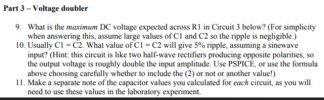 Part 3 - Voltage doubler 9. What is the maximum DC voltage expected across Rl in Circuit 3 below? (For simplicity when answering this, assume large values of Cl and C2 so the ripple is negligible.) 10. Usually C1-C2. What value of C1 = C2 will give 5% ripple, assuming a sinewave input? (Hint: this circuit is like two half-wave rectifiers producing opposite polarities, so the output voltage is roughly double the input amplitude. Use PSPICE, or use the formula...
QUESTION 1 5 points Save Answer A resistor R = 2k Ohms has a voltage V...
 QUESTION 1 5 points Save Answer A resistor R = 2k Ohms has a voltage V = 15 Volts. What is the current I through the resistor? Express your answer in mA. QUESTION 2 5 points Save Answer Three resistors are connected in series: R1 10k Ohms, R2 = 17k Ohms, R3 = 32k Ohms. A DC voltage source ( Volts) is connected across the three resistors. Determine the current I in mA. 7 QUESTION 3 5 points Save Answer...
The silicon diode shown in the given figure is described by ip = I. (ed/- 1)...
 The silicon diode shown in the given figure is described by ip = I. (ed/- 1) where at T = 300 K, 1. = 250 x 10-12 A, VT = KT 26 mV, vs = Vs + V3 = 4.2V + 110 cos(wt) mV,w = 377 rad/s, and R = 10 ko. The DC operating (quiescent) point Q and the AC small-signal equivalent resistance at Q are as follows: IDQ = 0.548 mA, VDQ = 0.365 V, and ra =...
R1 R2 AAA 4700 1000 12 LED1 R4 2200 Figure 1 Part 4 Application of Thevenin's...
 R1 R2 AAA 4700 1000 12 LED1 R4 2200 Figure 1 Part 4 Application of Thevenin's Equivalent Circuit The LED in Figure 1 is replaced with a resistor RL Predict the voltage across Rl and the current in RL for RL = 4.7k12, 10k12, and 47 12 respectively. Enter your values in Table 4. Measure Rx and the voltage across and current in it for the three values of RL, and enter your results in Table 4. Workings: Table 4...
Learning Goal: To analyze an RC circuit to determine the initial voltage across a capacitor, the...
 Learning Goal: To analyze an RC circuit to determine the initial voltage across a capacitor, the time constant, and the expression for the natural response of the capacitor voltage, and then to find other circuit quantities such as current,voltage, power, or energy. The natural response of an RC circuit is the response of the capacitor voltage to the sudden removal of a DC source. When this occurs, the capacitor releases its stored energy Figure < 10121〉 t 0 V. Figure...
 QUESTION 13 Calculate the voltage across RL in the series_parallel network below. Vs = 20 V, RL = 3.6 KN Enter your results in Volts - V. Do not type the unit. Tko 33.3kg TR2 SRL QUESTION 14 Calculate the current through RL in the series parallel network below. Vs = 18 V, RL = 2.8 KN Enter your results in mA. Do not type the unit. 1kg PR1 RL 33.3kg R2 QUESTION 15 Calculate the voltage measured by the...
 The Natural Response of an RL Circuit In summary, to find the time constant of an RL circuit, find the Thevenin equivalent resistance se Learning Goal: To analyze an RL circuit to determine the initial current through an inductor, the time constant, and the expression for the natural response of the inductor current, and to use the expression for the inductor current to find other circuit quantities, such as current, voltage, power, or energy. The natural response of an RL...
 R1= 12 K ohm
R2= 12 K ohm
rout= 1.2 K ohm
For the circuit in Figure 1, assme that the voltage drop across the infrared emitter is 1.3 V. Determine the value of RE that will set the current through the emitter to a value within the range of 50 mA to 80 mA. For the circuit in Figure 1, assume Rx 10 kQ and Vs 5 V. Using the equation given in the introduction section, determine the value...
R1= 12 K ohm
R2= 12 K ohm
rout= 1.2 K ohm
For the circuit in Figure 1, assme that the voltage drop across the infrared emitter is 1.3 V. Determine the value of RE that will set the current through the emitter to a value within the range of 50 mA to 80 mA. For the circuit in Figure 1, assume Rx 10 kQ and Vs 5 V. Using the equation given in the introduction section, determine the value...
 Part The voltage across R, in the crout from Part A is to be measured using an analog voltmeter. The votimete has a 150 mV,50 A movement and Miscale reading of 10 V. What is the reading on the volumelor? Recall that R. - 20 kn. R10 kl.and t = 12 V Express your answer in V to five significant figures View Available Hits) IVO AX 1 veo ? V 3.8905 X Incorrect: Try Again 18 apto remaining An analog...
 1.(TCO 2) For the circuit in the following figure (Chapter 3,
Figure 3-29, on page 135), VCC=18
V, R1=10 K?, R2=2.2
K?, RC=1
k?, RE1=220
?,RE2=220 ?, RL=10
K?, Rs=1 K?VCC=18 V,
R1=10 K?, R2=2.2 K?, RC=1 k?, RE1=220
?,RE2=220 ?, RL=10 K?, Rs=1 K? . Determine
the AC voltage gain.
2.(TCO 2) For the circuit in the following figure (Chapter 3,
Figure 3-29, on page 135), VCC=18
V, R1=10 K?, R2=2.2
K?, RC=3
k?, RE1=220
?,RE2=220 ?, RL=5
K?, Rs=1 K?VCC=18 V,
R1=10 K?, R2=2.2 K?, RC=3 k?, RE1=220
?,RE2=220 ?, RL=5 K?, Rs=1 K?...
1.(TCO 2) For the circuit in the following figure (Chapter 3,
Figure 3-29, on page 135), VCC=18
V, R1=10 K?, R2=2.2
K?, RC=1
k?, RE1=220
?,RE2=220 ?, RL=10
K?, Rs=1 K?VCC=18 V,
R1=10 K?, R2=2.2 K?, RC=1 k?, RE1=220
?,RE2=220 ?, RL=10 K?, Rs=1 K? . Determine
the AC voltage gain.
2.(TCO 2) For the circuit in the following figure (Chapter 3,
Figure 3-29, on page 135), VCC=18
V, R1=10 K?, R2=2.2
K?, RC=3
k?, RE1=220
?,RE2=220 ?, RL=5
K?, Rs=1 K?VCC=18 V,
R1=10 K?, R2=2.2 K?, RC=3 k?, RE1=220
?,RE2=220 ?, RL=5 K?, Rs=1 K?...
 Part 3 - Voltage doubler 9. What is the maximum DC voltage expected across Rl in Circuit 3 below? (For simplicity when answering this, assume large values of Cl and C2 so the ripple is negligible.) 10. Usually C1-C2. What value of C1 = C2 will give 5% ripple, assuming a sinewave input? (Hint: this circuit is like two half-wave rectifiers producing opposite polarities, so the output voltage is roughly double the input amplitude. Use PSPICE, or use the formula...
 QUESTION 1 5 points Save Answer A resistor R = 2k Ohms has a voltage V = 15 Volts. What is the current I through the resistor? Express your answer in mA. QUESTION 2 5 points Save Answer Three resistors are connected in series: R1 10k Ohms, R2 = 17k Ohms, R3 = 32k Ohms. A DC voltage source ( Volts) is connected across the three resistors. Determine the current I in mA. 7 QUESTION 3 5 points Save Answer...
 The silicon diode shown in the given figure is described by ip = I. (ed/- 1) where at T = 300 K, 1. = 250 x 10-12 A, VT = KT 26 mV, vs = Vs + V3 = 4.2V + 110 cos(wt) mV,w = 377 rad/s, and R = 10 ko. The DC operating (quiescent) point Q and the AC small-signal equivalent resistance at Q are as follows: IDQ = 0.548 mA, VDQ = 0.365 V, and ra =...
 R1 R2 AAA 4700 1000 12 LED1 R4 2200 Figure 1 Part 4 Application of Thevenin's Equivalent Circuit The LED in Figure 1 is replaced with a resistor RL Predict the voltage across Rl and the current in RL for RL = 4.7k12, 10k12, and 47 12 respectively. Enter your values in Table 4. Measure Rx and the voltage across and current in it for the three values of RL, and enter your results in Table 4. Workings: Table 4...
 Learning Goal: To analyze an RC circuit to determine the initial voltage across a capacitor, the time constant, and the expression for the natural response of the capacitor voltage, and then to find other circuit quantities such as current,voltage, power, or energy. The natural response of an RC circuit is the response of the capacitor voltage to the sudden removal of a DC source. When this occurs, the capacitor releases its stored energy Figure < 10121〉 t 0 V. Figure...
Most questions answered within 3 hours.
-
Where is the error in this code sequence?
String s1 = "Hello";
String s2 = "ello";...
asked 10 months ago -
Financial data for Joel de Paris, Inc., for last year
follow:
Joel de Paris, Inc.
Balance...
asked 10 months ago -
Consider this reaction:
Al2(SO4)3 (aq)+ BaCl3
(aq) Al2Cl6 (aq)- +
3BaSO4(s) . What is the...
asked 10 months ago -
Suppose that Savneet is considering increasing her
recent random sample from 20 car rentals to 40...
asked 10 months ago -
Trucks arrive at an unloading terminal at an average rate of 120
per hour.
Trucks arrive...
asked 10 months ago -
Why are methanol and ethanol completely soluble in water while
octanol is not very little soluble....
asked 10 months ago -
A facilities manager at a university reads in a research report
that the mean amount of...
asked 10 months ago -
When the CuSO4 is rehydrated by adding water to the anhydrous
compound, is this an endothermic...
asked 10 months ago -
A ray of sunlight is passing from diamond into crown glass; the
angle of incidence is...
asked 10 months ago -
A block of mass 0.249 kg is placed on top of a light, vertical
spring of...
asked 10 months ago -
how do the kidneys compensate in the presences of acidosis
a) trigger hyperventilate
b) reserve acid...
asked 10 months ago -
Question 501 pts
The rental rate of capital to the firm increases. Which of the
following...
asked 10 months ago