
Homework Answers
Add Answer to:
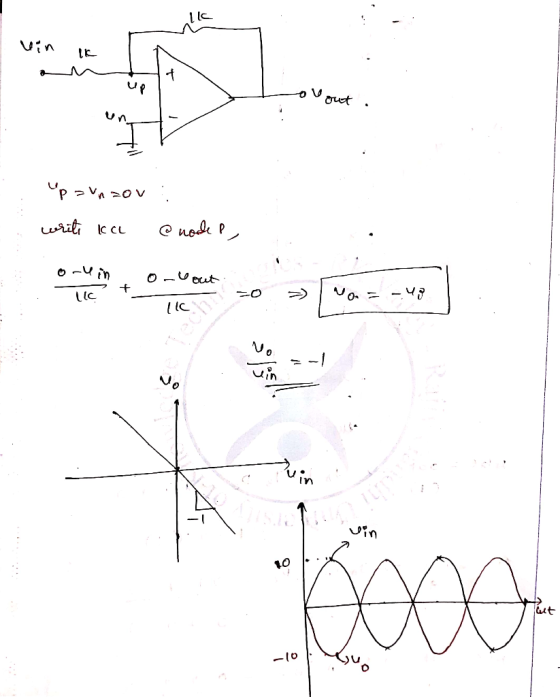
6) Consider the comparator circuit below. Given a 20Vp-p sinewave as the input. a) Draw the...
Question 13 The input Vs to the comparator circuit below is a 10 V Triangle Wave....
 Question 13 The input Vs to the comparator circuit below is a 10 V Triangle Wave. Determine the voltage Vs when the output of the comparator will become maximum positive VCC = 12 V, R1 10 k2, R2 = 3.1 k Enter your results in volts. Do not type the units Vcc R1 Vout R2 AN Vs ww
Question 13 The input Vs to the comparator circuit below is a 10 V Triangle Wave. Determine the voltage Vs when the...
Question 13 The input Vs to the comparator circuit below is a 10 V Triangle Wave. Determine the voltage Vs when the output of the comparator will become maximum positive VCC = 12 V, R1 10 k2, R2 = 3.1 k Enter your results in volts. Do not type the units Vcc R1 Vout R2 AN Vs ww
Question 13 The input Vs to the comparator circuit below is a 10 V Triangle Wave. Determine the voltage Vs when the...
Problem # 3 For the summing opamp circuit, assume that the opamp is powered with +15V and-15V. Th...
 Problem # 3 For the summing opamp circuit, assume that the opamp is powered with +15V and-15V. The input voltages are VI and V2 and the output voltage is Vout. Rf 15 V U1 R1 R2 Vout 741 V2 (A -15 V 1. Find the relation between the output Vout and the inputs VI and V2 2. Assume that RI-2kS2, R2-3 ㏀ and Rf-6kS2, Vin is a sinewave with viinpp-2V, V2DC- IV, plot Vin() and Vout(0) 3. Assume that you...
In Figure 6, what is the output reference voltage (in V) of the given circuit when...
 In Figure 6, what is the output reference voltage (in V) of the given circuit when R1=2kohms, R2=9kohms and V+=7V. Do not include unit. Use 2 decimal places. +A R1 It U1 Vout Vin R2
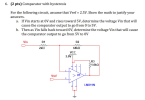
Trying to check answer 6. (2 pts) Comparator with hysteresis For the following circuit, assume that...
 Trying to check answer
6. (2 pts) Comparator with hysteresis For the following circuit, assume that Vref answers 2.5V. Show the math to justify your If Vin starts at 0V and rises toward 5V, determine the voltage Vin that will cause the comparator output to go from 0 to 5V. Then as Vin falls back toward 0V, determine the voltage Vin that will cause the comparator output to go from 5V to 0V a. b. Vin R1 R2 VCC 5.0V...
Trying to check answer
6. (2 pts) Comparator with hysteresis For the following circuit, assume that Vref answers 2.5V. Show the math to justify your If Vin starts at 0V and rises toward 5V, determine the voltage Vin that will cause the comparator output to go from 0 to 5V. Then as Vin falls back toward 0V, determine the voltage Vin that will cause the comparator output to go from 5V to 0V a. b. Vin R1 R2 VCC 5.0V...
2. Construct the non-inverting amplifier circuit below. Then, obtain input-output transfer function for R1=1K and R2=2.2K,...
 2. Construct the non-inverting amplifier circuit below. Then, obtain input-output transfer function for R1=1K and R2=2.2K, E= 9V. Use a variable de voltage (5V de source and a variable 1k potentiometer) source as the input and measure the output voltage for different inputs. Draw the input-output transfer function from the measured input-output voltages. Proteus Table Vin Vout Measured Table Vin Vout Q2) Determine the voltage gain VO / Vin of the non-inverting amplifier. What is the output voltage range over...
Given the circuit below: R3 C1 Vout C2 R1 R3 Vin R2 ts 1 a) derive the transfer function between ...
 Given the circuit below: R3 C1 Vout C2 R1 R3 Vin R2 ts 1 a) derive the transfer function between the input and the output in terms of R1,C1,R2,C2 b) For this and all other parts below, assume Izl<Ipl, i..e that D(s) is a lead-type compensator. The transfer function is written in the following format ts 1 Express quantities K, z, p using R1,C1,R2,C2 Also, express Κα, α, τ using K,z, p c) Observe the values of s-jw on the...
1) An input step voltage Vin(t)=10 u(t) Volt is applied to the circuit shown below. The...
 1) An input step voltage Vin(t)=10 u(t) Volt is applied to the circuit shown below. The initial voltage on the capacitor is zero. Using Laplace transform techniques, calculate the resulting output voltage Vout(t). R1 R2 Vout 2000 Vin c1 1000 1uF R3 1000
Following the circuit specification below: Comparator: A 3-bit comparator has six inputs A= A2A1A0 and B=...
Following the circuit specification below: Comparator: A 3-bit comparator has six inputs A= A2A1A0 and B= B2B1B0, and one output: L. The comparator is a ‘less than’, meaning the output is ‘1’ is A<B. Using your method of choice, find the Boolean expression for the output of the comparator; Draw the logic circuit of the 3-bit comparator Available gates (no other gates can be used than the 5 listed below): 2-input NAND 2-input NOR 2-input AND 2-input OR Inverter
(25 pts)For the circuit below assuming an ideal diode with a 0.7 V drop (You must...
 (25 pts)For the circuit below assuming an ideal diode with a 0.7 V drop (You must fill in the information in the boxes below): a. Sketch Vout VS. Vin- b. When Vin -5V: Determine which diode leg is conducting, the current flowing through the diode, and Vout? c. Find the values in part b when Vin 0.3V? d. Find the values in part b when Vin 3V? R 1-2k, R2 = 6k. R1 R2 D2 Vout DI R2
Use the circuit diagram as shown in Figure A below to conduct the experiment and answer...
 Use the circuit diagram as shown in Figure A below to conduct the experiment and answer the questions 1 to 6. VCC VCC 15V 15V U2 U1 + R3 + 741 Voutt Vouth 6 R1 741 1.0kΩ 2.2k VEE VEE -15V Vin= 0.75 VIP-pl @ 2 kHz -15V R2 R4 TH 4.7ΚΩ 10kΩ Figure A Question 3 3 pts Focus on Op-amp U1 ("Both op-amps have to be completely connected as shown in Figure A) • Use myDAQ's oscilloscope to...
 Question 13 The input Vs to the comparator circuit below is a 10 V Triangle Wave. Determine the voltage Vs when the output of the comparator will become maximum positive VCC = 12 V, R1 10 k2, R2 = 3.1 k Enter your results in volts. Do not type the units Vcc R1 Vout R2 AN Vs ww
Question 13 The input Vs to the comparator circuit below is a 10 V Triangle Wave. Determine the voltage Vs when the...
Question 13 The input Vs to the comparator circuit below is a 10 V Triangle Wave. Determine the voltage Vs when the output of the comparator will become maximum positive VCC = 12 V, R1 10 k2, R2 = 3.1 k Enter your results in volts. Do not type the units Vcc R1 Vout R2 AN Vs ww
Question 13 The input Vs to the comparator circuit below is a 10 V Triangle Wave. Determine the voltage Vs when the...
 Problem # 3 For the summing opamp circuit, assume that the opamp is powered with +15V and-15V. The input voltages are VI and V2 and the output voltage is Vout. Rf 15 V U1 R1 R2 Vout 741 V2 (A -15 V 1. Find the relation between the output Vout and the inputs VI and V2 2. Assume that RI-2kS2, R2-3 ㏀ and Rf-6kS2, Vin is a sinewave with viinpp-2V, V2DC- IV, plot Vin() and Vout(0) 3. Assume that you...
 In Figure 6, what is the output reference voltage (in V) of the given circuit when R1=2kohms, R2=9kohms and V+=7V. Do not include unit. Use 2 decimal places. +A R1 It U1 Vout Vin R2
 Trying to check answer
6. (2 pts) Comparator with hysteresis For the following circuit, assume that Vref answers 2.5V. Show the math to justify your If Vin starts at 0V and rises toward 5V, determine the voltage Vin that will cause the comparator output to go from 0 to 5V. Then as Vin falls back toward 0V, determine the voltage Vin that will cause the comparator output to go from 5V to 0V a. b. Vin R1 R2 VCC 5.0V...
Trying to check answer
6. (2 pts) Comparator with hysteresis For the following circuit, assume that Vref answers 2.5V. Show the math to justify your If Vin starts at 0V and rises toward 5V, determine the voltage Vin that will cause the comparator output to go from 0 to 5V. Then as Vin falls back toward 0V, determine the voltage Vin that will cause the comparator output to go from 5V to 0V a. b. Vin R1 R2 VCC 5.0V...
 2. Construct the non-inverting amplifier circuit below. Then, obtain input-output transfer function for R1=1K and R2=2.2K, E= 9V. Use a variable de voltage (5V de source and a variable 1k potentiometer) source as the input and measure the output voltage for different inputs. Draw the input-output transfer function from the measured input-output voltages. Proteus Table Vin Vout Measured Table Vin Vout Q2) Determine the voltage gain VO / Vin of the non-inverting amplifier. What is the output voltage range over...
 Given the circuit below: R3 C1 Vout C2 R1 R3 Vin R2 ts 1 a) derive the transfer function between the input and the output in terms of R1,C1,R2,C2 b) For this and all other parts below, assume Izl<Ipl, i..e that D(s) is a lead-type compensator. The transfer function is written in the following format ts 1 Express quantities K, z, p using R1,C1,R2,C2 Also, express Κα, α, τ using K,z, p c) Observe the values of s-jw on the...
 1) An input step voltage Vin(t)=10 u(t) Volt is applied to the circuit shown below. The initial voltage on the capacitor is zero. Using Laplace transform techniques, calculate the resulting output voltage Vout(t). R1 R2 Vout 2000 Vin c1 1000 1uF R3 1000
 (25 pts)For the circuit below assuming an ideal diode with a 0.7 V drop (You must fill in the information in the boxes below): a. Sketch Vout VS. Vin- b. When Vin -5V: Determine which diode leg is conducting, the current flowing through the diode, and Vout? c. Find the values in part b when Vin 0.3V? d. Find the values in part b when Vin 3V? R 1-2k, R2 = 6k. R1 R2 D2 Vout DI R2
 Use the circuit diagram as shown in Figure A below to conduct the experiment and answer the questions 1 to 6. VCC VCC 15V 15V U2 U1 + R3 + 741 Voutt Vouth 6 R1 741 1.0kΩ 2.2k VEE VEE -15V Vin= 0.75 VIP-pl @ 2 kHz -15V R2 R4 TH 4.7ΚΩ 10kΩ Figure A Question 3 3 pts Focus on Op-amp U1 ("Both op-amps have to be completely connected as shown in Figure A) • Use myDAQ's oscilloscope to...
Most questions answered within 3 hours.
-
Where is the error in this code sequence?
String s1 = "Hello";
String s2 = "ello";...
asked 10 months ago -
Financial data for Joel de Paris, Inc., for last year
follow:
Joel de Paris, Inc.
Balance...
asked 10 months ago -
Consider this reaction:
Al2(SO4)3 (aq)+ BaCl3
(aq) Al2Cl6 (aq)- +
3BaSO4(s) . What is the...
asked 10 months ago -
Suppose that Savneet is considering increasing her
recent random sample from 20 car rentals to 40...
asked 10 months ago -
Trucks arrive at an unloading terminal at an average rate of 120
per hour.
Trucks arrive...
asked 10 months ago -
Why are methanol and ethanol completely soluble in water while
octanol is not very little soluble....
asked 10 months ago -
A facilities manager at a university reads in a research report
that the mean amount of...
asked 10 months ago -
When the CuSO4 is rehydrated by adding water to the anhydrous
compound, is this an endothermic...
asked 10 months ago -
A ray of sunlight is passing from diamond into crown glass; the
angle of incidence is...
asked 10 months ago -
A block of mass 0.249 kg is placed on top of a light, vertical
spring of...
asked 10 months ago -
how do the kidneys compensate in the presences of acidosis
a) trigger hyperventilate
b) reserve acid...
asked 10 months ago -
Question 501 pts
The rental rate of capital to the firm increases. Which of the
following...
asked 10 months ago