
Homework Answers
Question 1: acidic dyes are referred to as the dyes that would be having a negative charge such that these would be able to bind to the positive structures present in the cell. These re used less often intne microbiology lab. An example of an acidic stain is the capsule staining, which would be staining the background. Examples of stain are India ink, acid fuschin, picnic acid as well as nigrosine.
Basic dyes are the ones that would be having a positive charge and would be binding to molecules that are negatively charged. These molecules would be nucleus acids. These are used more commonly since, the bacterial surfaces are negatively charged, due to the presence of teichoic acid. These are used more commonly. Examples are safranin, methylene blue, crystal violet or basic fuschin.
Add Answer to:
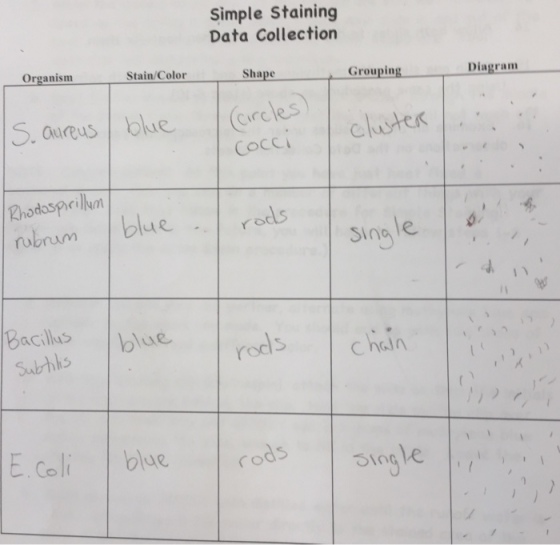
Simple Staining Data Interpretation Please type the answers to the following questions below (double spaced) and...
all questions ASSESSMENT Critical Thinking and Learning Outcomes Review 1. What are the two purposes of...
 all questions
ASSESSMENT Critical Thinking and Learning Outcomes Review 1. What are the two purposes of heat fixation? 2. What is the purpose of simple staining? 3. Why are basic dyes more successful in staining bacteria than acidic dyes? 4. Name three basic stains 5. Why is time an important factor in simple staining? 6. How would you define a properly prepared bacterial smear? 7. Why should you use an inoculating needle when making smears from solid media? An inoculating...
all questions
ASSESSMENT Critical Thinking and Learning Outcomes Review 1. What are the two purposes of heat fixation? 2. What is the purpose of simple staining? 3. Why are basic dyes more successful in staining bacteria than acidic dyes? 4. Name three basic stains 5. Why is time an important factor in simple staining? 6. How would you define a properly prepared bacterial smear? 7. Why should you use an inoculating needle when making smears from solid media? An inoculating...
Effectiveness of Disinfectants Data Interpretation Please type the answers to the following questions below (double spaced)...
 Effectiveness of Disinfectants Data Interpretation Please type the answers to the following questions below (double spaced) and attach the data collection sheets when you hand in this lab report. Answer the first 9 questions True or False 1. Disinfectants always remove all bacteria and fungal spores from an object. Antiseptic is another term for disinfectant. The presence of blood serum, skin tissue and other body fluids would interfere with the antimicrobial action of disinfectants. The use of carbolic acid as...
Differential Tests Data Interpretation Please type the answers to the following questions below (double spaced) and...
 Differential Tests Data Interpretation Please type the answers to the following questions below (double spaced) and attach the data collection sheets when you hand in this lab report. 1. What is the color of phenoi red at an acid pH? Yellow Cola 2. What is the function of a Durham tube? 3. Name one indole positive organism. E.coli 4. Name two methods for determining bacterial motility. 5. Why is it essential to have pure cultures for biochemical tests? 6. Could...
5. Why are simple stains able to "stick” to bacteria? Explain the chemical properties of the...
 5. Why are simple stains able to "stick” to bacteria? Explain the chemical properties of the stain and bacteria surface. 3-Preparation of Bacterial Smears and Simple Stains Introduction Microbial cultures are handled using aseptic technique. Aseptie technique is a set of procedures used to minimize contamination of materials by microorganisms from the environment, and to minimize the spread of cultures around the laboratory. In this experiment, you will be using an inoculating loop to transfer bacteria from a culture tube...
A sentence or two stating the hypothesis or hypotheses made. A sentence or two describing what...
 A sentence or two stating the hypothesis or hypotheses
made.
A sentence or two describing what was done
A summary of the most important results
A sentence stating the major conclusion
EXPERIMENT 2: CHARACTERIZING BACTERIA ISOLATED FROM SOIL Data Tables Table 1: Gram Staining Observations Sample Colony 1 Colony 2 Colony 3 + "Normal" + "Heated" Table 2: Experiment 2b Catalase Assay Results Colony Catalase Assay Results ("Normal") Catalase Assay Results ("Heated') 1 2 3 + Characterizing Bacteria Isolated from...
A sentence or two stating the hypothesis or hypotheses
made.
A sentence or two describing what was done
A summary of the most important results
A sentence stating the major conclusion
EXPERIMENT 2: CHARACTERIZING BACTERIA ISOLATED FROM SOIL Data Tables Table 1: Gram Staining Observations Sample Colony 1 Colony 2 Colony 3 + "Normal" + "Heated" Table 2: Experiment 2b Catalase Assay Results Colony Catalase Assay Results ("Normal") Catalase Assay Results ("Heated') 1 2 3 + Characterizing Bacteria Isolated from...
69. THE ENDOSPORE itself is might to stain_?_ color in an ACID FAST stain. (a) HOT...
69. THE ENDOSPORE itself is might to stain_?_ color in an ACID FAST stain. (a) HOT pink (c) purple (d) green (e) baby-blue 70. All STAINS begin with a properly prepared _?_ . (a) dye (b) slide (c) smear (d) dog (e) cat 71. Which of the following is an ENDOTOXIN found in some microbes? This is results in fever, blood vessel dilation and possibly SHOCK when it is released into the human blood stream? (a) the plasma membrane (b)...
100. Flare is: (a) the widest frequency of light that can enter an objective (b) the...
100. Flare is: (a) the widest frequency of light that can enter an objective (b) the bending of light as it passes through different substances (c) wavelength/2NA (d) when the beam of light "spreads" wider than the objective's "hole" (e) wavelengths of light too short to enter the objective 101. Coccobacillus shaped bacteria are considered to be_?_ (a) cocci (b) bacilli (c) diplobacilli (d) diplococci (e)answers a and b only 102. This microscope is used for cheap and quick "'diagnosis"...
ARE MY ANSWERS CORRECT? 25 questions 1. what an A/R aging analysis is, its purpose, and...
ARE MY ANSWERS CORRECT? 25 questions 1. what an A/R aging analysis is, its purpose, and how it is created. Used to estimate amount needed in Allowance for Bad Debts Account (a contra account) A/R Days Outstanding 0-30 31-60 61-90 Over 90 Under each term list all A/Rs that are not paid by date Use historical experience to estimate the percentage of A/R for each date period to determine allowance for Bad Debts What the three major cost components are...
10. Write a one-page summary of the attached paper? INTRODUCTION Many problems can develop in activated...
10. Write a one-page summary of the attached paper? INTRODUCTION Many problems can develop in activated sludge operation that adversely affect effluent quality with origins in the engineering, hydraulic and microbiological components of the process. The real "heart" of the activated sludge system is the development and maintenance of a mixed microbial culture (activated sludge) that treats wastewater and which can be managed. One definition of a wastewater treatment plant operator is a "bug farmer", one who controls the aeration...
 all questions
ASSESSMENT Critical Thinking and Learning Outcomes Review 1. What are the two purposes of heat fixation? 2. What is the purpose of simple staining? 3. Why are basic dyes more successful in staining bacteria than acidic dyes? 4. Name three basic stains 5. Why is time an important factor in simple staining? 6. How would you define a properly prepared bacterial smear? 7. Why should you use an inoculating needle when making smears from solid media? An inoculating...
all questions
ASSESSMENT Critical Thinking and Learning Outcomes Review 1. What are the two purposes of heat fixation? 2. What is the purpose of simple staining? 3. Why are basic dyes more successful in staining bacteria than acidic dyes? 4. Name three basic stains 5. Why is time an important factor in simple staining? 6. How would you define a properly prepared bacterial smear? 7. Why should you use an inoculating needle when making smears from solid media? An inoculating...
 Effectiveness of Disinfectants Data Interpretation Please type the answers to the following questions below (double spaced) and attach the data collection sheets when you hand in this lab report. Answer the first 9 questions True or False 1. Disinfectants always remove all bacteria and fungal spores from an object. Antiseptic is another term for disinfectant. The presence of blood serum, skin tissue and other body fluids would interfere with the antimicrobial action of disinfectants. The use of carbolic acid as...
 Differential Tests Data Interpretation Please type the answers to the following questions below (double spaced) and attach the data collection sheets when you hand in this lab report. 1. What is the color of phenoi red at an acid pH? Yellow Cola 2. What is the function of a Durham tube? 3. Name one indole positive organism. E.coli 4. Name two methods for determining bacterial motility. 5. Why is it essential to have pure cultures for biochemical tests? 6. Could...
 5. Why are simple stains able to "stick” to bacteria? Explain the chemical properties of the stain and bacteria surface. 3-Preparation of Bacterial Smears and Simple Stains Introduction Microbial cultures are handled using aseptic technique. Aseptie technique is a set of procedures used to minimize contamination of materials by microorganisms from the environment, and to minimize the spread of cultures around the laboratory. In this experiment, you will be using an inoculating loop to transfer bacteria from a culture tube...
 A sentence or two stating the hypothesis or hypotheses
made.
A sentence or two describing what was done
A summary of the most important results
A sentence stating the major conclusion
EXPERIMENT 2: CHARACTERIZING BACTERIA ISOLATED FROM SOIL Data Tables Table 1: Gram Staining Observations Sample Colony 1 Colony 2 Colony 3 + "Normal" + "Heated" Table 2: Experiment 2b Catalase Assay Results Colony Catalase Assay Results ("Normal") Catalase Assay Results ("Heated') 1 2 3 + Characterizing Bacteria Isolated from...
A sentence or two stating the hypothesis or hypotheses
made.
A sentence or two describing what was done
A summary of the most important results
A sentence stating the major conclusion
EXPERIMENT 2: CHARACTERIZING BACTERIA ISOLATED FROM SOIL Data Tables Table 1: Gram Staining Observations Sample Colony 1 Colony 2 Colony 3 + "Normal" + "Heated" Table 2: Experiment 2b Catalase Assay Results Colony Catalase Assay Results ("Normal") Catalase Assay Results ("Heated') 1 2 3 + Characterizing Bacteria Isolated from...
Most questions answered within 3 hours.
-
Where is the error in this code sequence?
String s1 = "Hello";
String s2 = "ello";...
asked 10 months ago -
Financial data for Joel de Paris, Inc., for last year
follow:
Joel de Paris, Inc.
Balance...
asked 10 months ago -
Consider this reaction:
Al2(SO4)3 (aq)+ BaCl3
(aq) Al2Cl6 (aq)- +
3BaSO4(s) . What is the...
asked 10 months ago -
Suppose that Savneet is considering increasing her
recent random sample from 20 car rentals to 40...
asked 10 months ago -
Trucks arrive at an unloading terminal at an average rate of 120
per hour.
Trucks arrive...
asked 10 months ago -
Why are methanol and ethanol completely soluble in water while
octanol is not very little soluble....
asked 10 months ago -
A facilities manager at a university reads in a research report
that the mean amount of...
asked 10 months ago -
When the CuSO4 is rehydrated by adding water to the anhydrous
compound, is this an endothermic...
asked 10 months ago -
A ray of sunlight is passing from diamond into crown glass; the
angle of incidence is...
asked 10 months ago -
A block of mass 0.249 kg is placed on top of a light, vertical
spring of...
asked 10 months ago -
how do the kidneys compensate in the presences of acidosis
a) trigger hyperventilate
b) reserve acid...
asked 10 months ago -
Question 501 pts
The rental rate of capital to the firm increases. Which of the
following...
asked 10 months ago