
Homework Answers
Having any doubts please comment below. Thank you.

Add Answer to:
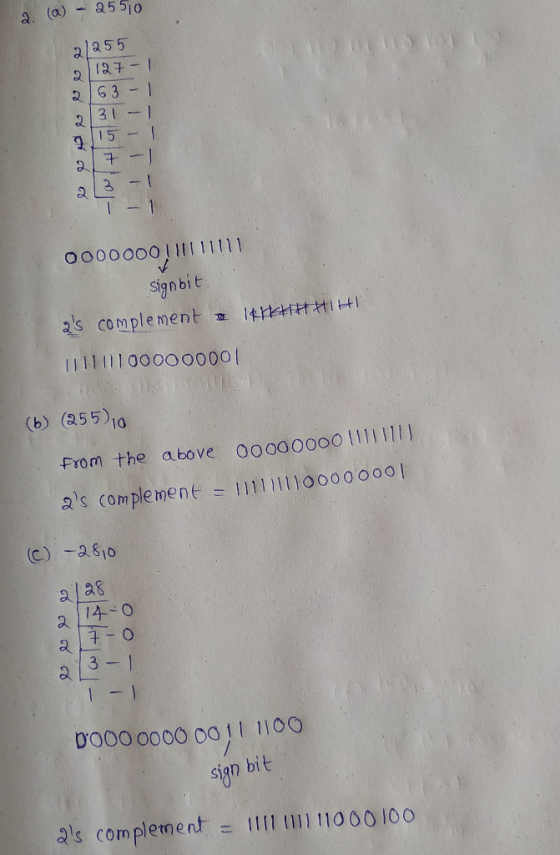
(12 marks) Perform the following conversions. (Note: for part (c), the "base 32" digits are 0,...
ord Paragrapth Styles 1 Perform the following conversions Convert 51 (decimal) to binary and to hex...
 ord Paragrapth Styles 1 Perform the following conversions Convert 51 (decimal) to binary and to hex a b. Convert 0xDI (hexadecimal) to binary and to decimal c. Convert Ob11001001 (binary) to hex and to decimal 2. Find the 2's complement of the following 4 bit numbers a 1101 b 0101 3. Perform the following 4 bit unsigned operations. For each, indicate the 4-bet result and the carry bit, and indicate if the answer is correct or not a. 5+8 b....
4-6 with explained work 4. Solve the following conversions: a. (0126F9D4)16 ? in base 8 b.(11100010)2...
 4-6 with explained work
4. Solve the following conversions: a. (0126F9D4)16 ? in base 8 b.(11100010)2 ? in base 16 5. Show the 1's complement representation on 1 Byte for the following signed decimal numbers: b.57 a.-100 6. Show the 2's complement representation on 1 Byte for the following signed decimal numbers: b. 57 a.-100
4-6 with explained work
4. Solve the following conversions: a. (0126F9D4)16 ? in base 8 b.(11100010)2 ? in base 16 5. Show the 1's complement representation on 1 Byte for the following signed decimal numbers: b.57 a.-100 6. Show the 2's complement representation on 1 Byte for the following signed decimal numbers: b. 57 a.-100
11. Perform the following hexadecimal additions and subtractions. Assume the numbers are stored in 32-bit 2’s...
11. Perform the following hexadecimal additions and subtractions. Assume the numbers are stored in 32-bit 2’s complement binary numbers. Indicate the sign of the answer and whether overflow occurs. a. BBCA270C + AE223464 b. E3BA265F + E045B9A9 c. E9B20F5D – FE605C8D d. 5FCA5243 – AE223464
(ii) The following two numbers are represented in unsigned binary: A = (10001)2 B=(100102 Represent these...
 (ii) The following two numbers are represented in unsigned binary: A = (10001)2 B=(100102 Represent these two numbers in signed l's complement form and perform the following binary arithmetic operations using the l's complement method. Use the necessary number of bits to represent both numbers and results including the sign bit. C= A +B; D=A-B.
1. (10 points) Answer the following question. #1. Perform the following base conversions using subtraction or...
 1. (10 points) Answer the following question. #1. Perform the following base conversions using subtraction or division-remainder: a) 13710 b) 248,0 = c) 38710 = d) 63310= #2. Perform the following base conversions. a) 20012, = b) 4103, = c) 3236, = d) 1378, = #3. Convert the following decimal fractions to binary with a maximum of six places to the right of the binary point: a) 25.84375 b) 57.55 #4. Convert the hexadecimal number DECAF 16 to binary.
(a) Hexadecimal numbers are numbers in base 16. They use the following sixteen digits: 0, 1,...
(a) Hexadecimal numbers are numbers in base 16. They use the following sixteen digits: 0, 1, 2, 3, 4, 5, 6, 7, 8, 9, A, B, C, D, E, F. They are widely used in com- puting, for example, to represent colors or network addresses of computers. i. Convert A2F1316 to decimal. Show your work. ii. Convert 456710 into hexadecimal. Show your work. iii. Convert 00010101100011002 to hexadecimal. Explain how can you use the fact that 16 = 24 ?...
For the following decimal numbers, convert to 8-bit binary numbers and perform addition. Use 2's complement...
 For the following decimal numbers, convert to 8-bit binary numbers and perform addition. Use 2's complement signed numbers when subtraction is indicated. (a) 2710+ 3410 (b) 520-1810 (c) 3110 - 6310
1. Perform the following base conversions using subtraction or division-remainder: a) 58810 = _________ 3 b)...
1. Perform the following base conversions using subtraction or division-remainder: a) 58810 = _________ 3 b) 225410 = _________ 5 c) 65210 = _________ 7 d) 310410 = _________ 9 e) 13710 = _________ 3 2. Perform the following base conversions: a) 201013 = _________ 10 b) 23025 = _________ 10 c) 16057 = _________10 d) 6879 = _________ 10 3. Convert the following decimal fractions to binary with a maximum of six places to the right of the binary...
Please answer all the questions! Thank you. For the following C statement, what would be the corresponding MIPS assembly...
 Please answer all the questions! Thank you.
For the following C statement, what would be the corresponding MIPS assembly code? Assume that the variables a, b, c, and d are given and were declared as 32-bit integers a - b - (c + 7)+ d; 1. 2. Show how the value 0xB47CA034 would be arranged in a little-endian and big-endian machine Assume the data is being stored starting with address 0 3. Convert the following base-16 numbers to base-2 a....
Please answer all the questions! Thank you.
For the following C statement, what would be the corresponding MIPS assembly code? Assume that the variables a, b, c, and d are given and were declared as 32-bit integers a - b - (c + 7)+ d; 1. 2. Show how the value 0xB47CA034 would be arranged in a little-endian and big-endian machine Assume the data is being stored starting with address 0 3. Convert the following base-16 numbers to base-2 a....
1 please IEEE-754 Floating point conversions problems (assume 32 bit machine): 1. For IEEE 754 single-precision...
 1 please
IEEE-754 Floating point conversions problems (assume 32 bit machine): 1. For IEEE 754 single-precision floating point, write the hexadecimal representation for the following decimal values: a. 27.1015625 b.-1 2. For IEEE 754 single-precision floating point, what is the decimal number, whose hexadecimal representation is the following? a. 4280 0000 b. 7FE4 0000 c. 0061 0000 3. For IEEE-754 single-precision floating point practice the following problem: Suppose X and Y are representing single precision numbers as follows: X 0100...
1 please
IEEE-754 Floating point conversions problems (assume 32 bit machine): 1. For IEEE 754 single-precision floating point, write the hexadecimal representation for the following decimal values: a. 27.1015625 b.-1 2. For IEEE 754 single-precision floating point, what is the decimal number, whose hexadecimal representation is the following? a. 4280 0000 b. 7FE4 0000 c. 0061 0000 3. For IEEE-754 single-precision floating point practice the following problem: Suppose X and Y are representing single precision numbers as follows: X 0100...
 ord Paragrapth Styles 1 Perform the following conversions Convert 51 (decimal) to binary and to hex a b. Convert 0xDI (hexadecimal) to binary and to decimal c. Convert Ob11001001 (binary) to hex and to decimal 2. Find the 2's complement of the following 4 bit numbers a 1101 b 0101 3. Perform the following 4 bit unsigned operations. For each, indicate the 4-bet result and the carry bit, and indicate if the answer is correct or not a. 5+8 b....
 4-6 with explained work
4. Solve the following conversions: a. (0126F9D4)16 ? in base 8 b.(11100010)2 ? in base 16 5. Show the 1's complement representation on 1 Byte for the following signed decimal numbers: b.57 a.-100 6. Show the 2's complement representation on 1 Byte for the following signed decimal numbers: b. 57 a.-100
4-6 with explained work
4. Solve the following conversions: a. (0126F9D4)16 ? in base 8 b.(11100010)2 ? in base 16 5. Show the 1's complement representation on 1 Byte for the following signed decimal numbers: b.57 a.-100 6. Show the 2's complement representation on 1 Byte for the following signed decimal numbers: b. 57 a.-100
 (ii) The following two numbers are represented in unsigned binary: A = (10001)2 B=(100102 Represent these two numbers in signed l's complement form and perform the following binary arithmetic operations using the l's complement method. Use the necessary number of bits to represent both numbers and results including the sign bit. C= A +B; D=A-B.
 1. (10 points) Answer the following question. #1. Perform the following base conversions using subtraction or division-remainder: a) 13710 b) 248,0 = c) 38710 = d) 63310= #2. Perform the following base conversions. a) 20012, = b) 4103, = c) 3236, = d) 1378, = #3. Convert the following decimal fractions to binary with a maximum of six places to the right of the binary point: a) 25.84375 b) 57.55 #4. Convert the hexadecimal number DECAF 16 to binary.
 For the following decimal numbers, convert to 8-bit binary numbers and perform addition. Use 2's complement signed numbers when subtraction is indicated. (a) 2710+ 3410 (b) 520-1810 (c) 3110 - 6310
 Please answer all the questions! Thank you.
For the following C statement, what would be the corresponding MIPS assembly code? Assume that the variables a, b, c, and d are given and were declared as 32-bit integers a - b - (c + 7)+ d; 1. 2. Show how the value 0xB47CA034 would be arranged in a little-endian and big-endian machine Assume the data is being stored starting with address 0 3. Convert the following base-16 numbers to base-2 a....
Please answer all the questions! Thank you.
For the following C statement, what would be the corresponding MIPS assembly code? Assume that the variables a, b, c, and d are given and were declared as 32-bit integers a - b - (c + 7)+ d; 1. 2. Show how the value 0xB47CA034 would be arranged in a little-endian and big-endian machine Assume the data is being stored starting with address 0 3. Convert the following base-16 numbers to base-2 a....
 1 please
IEEE-754 Floating point conversions problems (assume 32 bit machine): 1. For IEEE 754 single-precision floating point, write the hexadecimal representation for the following decimal values: a. 27.1015625 b.-1 2. For IEEE 754 single-precision floating point, what is the decimal number, whose hexadecimal representation is the following? a. 4280 0000 b. 7FE4 0000 c. 0061 0000 3. For IEEE-754 single-precision floating point practice the following problem: Suppose X and Y are representing single precision numbers as follows: X 0100...
1 please
IEEE-754 Floating point conversions problems (assume 32 bit machine): 1. For IEEE 754 single-precision floating point, write the hexadecimal representation for the following decimal values: a. 27.1015625 b.-1 2. For IEEE 754 single-precision floating point, what is the decimal number, whose hexadecimal representation is the following? a. 4280 0000 b. 7FE4 0000 c. 0061 0000 3. For IEEE-754 single-precision floating point practice the following problem: Suppose X and Y are representing single precision numbers as follows: X 0100...
Most questions answered within 3 hours.
-
Where is the error in this code sequence?
String s1 = "Hello";
String s2 = "ello";...
asked 10 months ago -
Financial data for Joel de Paris, Inc., for last year
follow:
Joel de Paris, Inc.
Balance...
asked 10 months ago -
Consider this reaction:
Al2(SO4)3 (aq)+ BaCl3
(aq) Al2Cl6 (aq)- +
3BaSO4(s) . What is the...
asked 10 months ago -
Suppose that Savneet is considering increasing her
recent random sample from 20 car rentals to 40...
asked 10 months ago -
Trucks arrive at an unloading terminal at an average rate of 120
per hour.
Trucks arrive...
asked 10 months ago -
Why are methanol and ethanol completely soluble in water while
octanol is not very little soluble....
asked 10 months ago -
A facilities manager at a university reads in a research report
that the mean amount of...
asked 10 months ago -
When the CuSO4 is rehydrated by adding water to the anhydrous
compound, is this an endothermic...
asked 10 months ago -
A ray of sunlight is passing from diamond into crown glass; the
angle of incidence is...
asked 10 months ago -
A block of mass 0.249 kg is placed on top of a light, vertical
spring of...
asked 10 months ago -
how do the kidneys compensate in the presences of acidosis
a) trigger hyperventilate
b) reserve acid...
asked 10 months ago -
Question 501 pts
The rental rate of capital to the firm increases. Which of the
following...
asked 10 months ago