Discrete mathematics question
Can you please answe the following question?
Please show your answer clearly.
Homework Answers
Master Theorem
T(n) = aT(n/b) + f(n)
If f(n) = Θ(n^c) where c < Logb(a) then T(n) = Θ(n^Logb(a))
If f(n) = Θ(n^c) where c = Logb(a) then T(n) = Θ((n^c)(Log(n)))
If f(n) = Θ(n^c) where c > Logb(a) then T(n) = Θ(f(n))

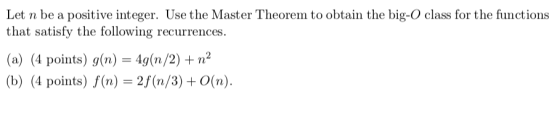
a)
g(n) = 4g(n/2)+n^2
So, from the definition of masters theorem
a=4, b=2 and f(n)=n^2 then c=2
Logb(a)=Log2(4)=2
Where Logb(a)=c
So From the above values we can say that,
So, T(n) = Θ((n^c)(Log(n)))
T(n) = Θ((n^2)(Log(n)))

b)
f(n) = 2g(n/3)+O(n)
So, from the definition of masters theorem
a=2, b=3 and f(n)=O(n) then c=1
Logb(a)=Log3(2)=0.63092975357146
where c > Logb(a)
So From the above values we can say that,
So, T(n) = Θ(f(n))
T(n) = Θ(n)

Add Answer to:
Discrete mathematics question
Can you please answe the following
question?
Please show your answer clearly.
et...
discrete mathematics structure clear answer please thank you read the problem the question is there and...
 discrete mathematics structure
clear answer please
thank you
read the problem
the question is there and asking to use the chinese remaider
theorem
discrete mathematics structure
clear answer please
thank you
read the problem
the question is there and asking to use the chinese remaider
theorem
Discrete Math Give a big-Theta estimate for the number of additions in the following algorithm a)...
 Discrete Math
Give a big-Theta estimate for the number of additions in the following algorithm a) procedure f (n: integer) bar = 0; for i = 1 to n^3 for j = 1 to n^2 bar = bar + i + j return bar b) Consider the procedure T given below. procedure T (n: positive integer) if n = 1 return 2 for i = 1 to n^3 x = x + x + x return T(/4) + T(/4) +...
Discrete Math
Give a big-Theta estimate for the number of additions in the following algorithm a) procedure f (n: integer) bar = 0; for i = 1 to n^3 for j = 1 to n^2 bar = bar + i + j return bar b) Consider the procedure T given below. procedure T (n: positive integer) if n = 1 return 2 for i = 1 to n^3 x = x + x + x return T(/4) + T(/4) +...
Discrete mathematics and cryptography: specifically graph theory. Please show working 4. The following graph is called...
 Discrete mathematics and cryptography: specifically graph
theory.
Please show working
4. The following graph is called the Hajós graph. What is its chromatic number?
Discrete mathematics and cryptography: specifically graph
theory.
Please show working
4. The following graph is called the Hajós graph. What is its chromatic number?
This is discrete mathematics. Please solve it step by step. Thank you so much. Solve the...
 This is discrete mathematics.
Please solve it step by step. Thank you so much.
Solve the following problems, showing any necessary work. 1. Use Mathematical Induction to prove the following. a. 5 points Prove that a 5 × (6n) board can be tiled using 2 x 3 rectangles, for all positive integers n. b. [5 points] Let the Lucas sequence be defined recursively by Lo-2 Ln = Ln-ı + Ln-2, n > 2 TL Prove that 〉·L2i L2n+1 + 1...
This is discrete mathematics.
Please solve it step by step. Thank you so much.
Solve the following problems, showing any necessary work. 1. Use Mathematical Induction to prove the following. a. 5 points Prove that a 5 × (6n) board can be tiled using 2 x 3 rectangles, for all positive integers n. b. [5 points] Let the Lucas sequence be defined recursively by Lo-2 Ln = Ln-ı + Ln-2, n > 2 TL Prove that 〉·L2i L2n+1 + 1...
This problem is dealing with Discrete Math. Please answer fully and clearly, and show/explain all...
 This problem is dealing with Discrete Math. Please answer fully
and clearly, and show/explain all steps or proofs that you state in
the answer.
4. Let (G, w) be a connected graph with weights on edges so that all weights are distinct positive real numbers. Suppose we find a MST (minimum spanning trees ) in G by using Prim's algorithm. Prove that no matter what vertex we begin with in Prim algorithm, the set of all weights on edges in...
This problem is dealing with Discrete Math. Please answer fully
and clearly, and show/explain all steps or proofs that you state in
the answer.
4. Let (G, w) be a connected graph with weights on edges so that all weights are distinct positive real numbers. Suppose we find a MST (minimum spanning trees ) in G by using Prim's algorithm. Prove that no matter what vertex we begin with in Prim algorithm, the set of all weights on edges in...
A Discrete mathematics question shows on the image, could you please show the detailed procedures, thank...
 A Discrete mathematics question shows on the image, could you
please show the detailed procedures, thank you!
Given the following deterministic FSM M over the alphabet Σ- (0,13: 1 S1 S2 1 1 S3 (a) Give an English language description of L(M), the language recognised by M. (b) Add an error state (labelled X) to the diagram, and draw all transitions to it (c) Describe how to derive an FSM that accepts the complement of L(M) over the set ....
A Discrete mathematics question shows on the image, could you
please show the detailed procedures, thank you!
Given the following deterministic FSM M over the alphabet Σ- (0,13: 1 S1 S2 1 1 S3 (a) Give an English language description of L(M), the language recognised by M. (b) Add an error state (labelled X) to the diagram, and draw all transitions to it (c) Describe how to derive an FSM that accepts the complement of L(M) over the set ....
***Please answer all the following (Computer science) Discrete math question completely.*** Q2. Growth of functions. In...
 ***Please answer all the following (Computer science)
Discrete math question completely.***
Q2. Growth of functions. In each of the following cases, either construct a function /(/n) that satisfies the specified constraints or state that no such function exists. (2pt each) b, (n)-Ω(n2) and/(n)-O (n + n') In the following two questions, arrange the functions in a list so that each function is a big-O of the next function. (2pt each) d. nlog n, V', log n, (log2n+log n+n), 12 n,...
***Please answer all the following (Computer science)
Discrete math question completely.***
Q2. Growth of functions. In each of the following cases, either construct a function /(/n) that satisfies the specified constraints or state that no such function exists. (2pt each) b, (n)-Ω(n2) and/(n)-O (n + n') In the following two questions, arrange the functions in a list so that each function is a big-O of the next function. (2pt each) d. nlog n, V', log n, (log2n+log n+n), 12 n,...
please answer question #42 41. We have encountered the gamma function f(a) in our study of...
 please answer question #42
41. We have encountered the gamma function f(a) in our study of Bessel functions in Section 6.4 (page 263). One definition of this function is given by the improper integral (a) = ar-le'dt, a > 0. Use this definition to show that I'(a + 1) = al(a). When a = n is a positive integer the last property can be used to show that T(n + 1) = n!. See Appendix A. 42. Use Problem 41...
please answer question #42
41. We have encountered the gamma function f(a) in our study of Bessel functions in Section 6.4 (page 263). One definition of this function is given by the improper integral (a) = ar-le'dt, a > 0. Use this definition to show that I'(a + 1) = al(a). When a = n is a positive integer the last property can be used to show that T(n + 1) = n!. See Appendix A. 42. Use Problem 41...
Please help me solve these discrete math problems. Please show work so that i may follow...
 Please help me solve these discrete math problems. Please show
work so that i may follow and understand.
Problem 4. Let r, y be nonzero integers and let n be a positive integer. Prove the following by induction Hint: Consider problem (1d) where r = . y
Please help me solve these discrete math problems. Please show
work so that i may follow and understand.
Problem 4. Let r, y be nonzero integers and let n be a positive integer. Prove the following by induction Hint: Consider problem (1d) where r = . y
Please solve Q1, this is a discrete math question. "O" represents Oh notation, f=O(g) if there...
 Please solve Q1, this is a discrete math
question. "O" represents Oh notation, f=O(g) if there are positive
constants c and n0 such that for any n≥ n0,
f(n) ≤ c·g(n). Please include all your explanations.
Problem 1 (3 points) Find the least integer t such that (n° + n2 log(n)) (log(n) + 1) + (8 log(n) +6) (n3 + 4) is 0 (nt). Briefly justify your answer (i.e., why it is o (nt) and why it is not 0...
Please solve Q1, this is a discrete math
question. "O" represents Oh notation, f=O(g) if there are positive
constants c and n0 such that for any n≥ n0,
f(n) ≤ c·g(n). Please include all your explanations.
Problem 1 (3 points) Find the least integer t such that (n° + n2 log(n)) (log(n) + 1) + (8 log(n) +6) (n3 + 4) is 0 (nt). Briefly justify your answer (i.e., why it is o (nt) and why it is not 0...
 discrete mathematics structure
clear answer please
thank you
read the problem
the question is there and asking to use the chinese remaider
theorem
discrete mathematics structure
clear answer please
thank you
read the problem
the question is there and asking to use the chinese remaider
theorem
 Discrete Math
Give a big-Theta estimate for the number of additions in the following algorithm a) procedure f (n: integer) bar = 0; for i = 1 to n^3 for j = 1 to n^2 bar = bar + i + j return bar b) Consider the procedure T given below. procedure T (n: positive integer) if n = 1 return 2 for i = 1 to n^3 x = x + x + x return T(/4) + T(/4) +...
Discrete Math
Give a big-Theta estimate for the number of additions in the following algorithm a) procedure f (n: integer) bar = 0; for i = 1 to n^3 for j = 1 to n^2 bar = bar + i + j return bar b) Consider the procedure T given below. procedure T (n: positive integer) if n = 1 return 2 for i = 1 to n^3 x = x + x + x return T(/4) + T(/4) +...
 Discrete mathematics and cryptography: specifically graph
theory.
Please show working
4. The following graph is called the Hajós graph. What is its chromatic number?
Discrete mathematics and cryptography: specifically graph
theory.
Please show working
4. The following graph is called the Hajós graph. What is its chromatic number?
 This is discrete mathematics.
Please solve it step by step. Thank you so much.
Solve the following problems, showing any necessary work. 1. Use Mathematical Induction to prove the following. a. 5 points Prove that a 5 × (6n) board can be tiled using 2 x 3 rectangles, for all positive integers n. b. [5 points] Let the Lucas sequence be defined recursively by Lo-2 Ln = Ln-ı + Ln-2, n > 2 TL Prove that 〉·L2i L2n+1 + 1...
This is discrete mathematics.
Please solve it step by step. Thank you so much.
Solve the following problems, showing any necessary work. 1. Use Mathematical Induction to prove the following. a. 5 points Prove that a 5 × (6n) board can be tiled using 2 x 3 rectangles, for all positive integers n. b. [5 points] Let the Lucas sequence be defined recursively by Lo-2 Ln = Ln-ı + Ln-2, n > 2 TL Prove that 〉·L2i L2n+1 + 1...
 This problem is dealing with Discrete Math. Please answer fully
and clearly, and show/explain all steps or proofs that you state in
the answer.
4. Let (G, w) be a connected graph with weights on edges so that all weights are distinct positive real numbers. Suppose we find a MST (minimum spanning trees ) in G by using Prim's algorithm. Prove that no matter what vertex we begin with in Prim algorithm, the set of all weights on edges in...
This problem is dealing with Discrete Math. Please answer fully
and clearly, and show/explain all steps or proofs that you state in
the answer.
4. Let (G, w) be a connected graph with weights on edges so that all weights are distinct positive real numbers. Suppose we find a MST (minimum spanning trees ) in G by using Prim's algorithm. Prove that no matter what vertex we begin with in Prim algorithm, the set of all weights on edges in...
 A Discrete mathematics question shows on the image, could you
please show the detailed procedures, thank you!
Given the following deterministic FSM M over the alphabet Σ- (0,13: 1 S1 S2 1 1 S3 (a) Give an English language description of L(M), the language recognised by M. (b) Add an error state (labelled X) to the diagram, and draw all transitions to it (c) Describe how to derive an FSM that accepts the complement of L(M) over the set ....
A Discrete mathematics question shows on the image, could you
please show the detailed procedures, thank you!
Given the following deterministic FSM M over the alphabet Σ- (0,13: 1 S1 S2 1 1 S3 (a) Give an English language description of L(M), the language recognised by M. (b) Add an error state (labelled X) to the diagram, and draw all transitions to it (c) Describe how to derive an FSM that accepts the complement of L(M) over the set ....
 ***Please answer all the following (Computer science)
Discrete math question completely.***
Q2. Growth of functions. In each of the following cases, either construct a function /(/n) that satisfies the specified constraints or state that no such function exists. (2pt each) b, (n)-Ω(n2) and/(n)-O (n + n') In the following two questions, arrange the functions in a list so that each function is a big-O of the next function. (2pt each) d. nlog n, V', log n, (log2n+log n+n), 12 n,...
***Please answer all the following (Computer science)
Discrete math question completely.***
Q2. Growth of functions. In each of the following cases, either construct a function /(/n) that satisfies the specified constraints or state that no such function exists. (2pt each) b, (n)-Ω(n2) and/(n)-O (n + n') In the following two questions, arrange the functions in a list so that each function is a big-O of the next function. (2pt each) d. nlog n, V', log n, (log2n+log n+n), 12 n,...
 please answer question #42
41. We have encountered the gamma function f(a) in our study of Bessel functions in Section 6.4 (page 263). One definition of this function is given by the improper integral (a) = ar-le'dt, a > 0. Use this definition to show that I'(a + 1) = al(a). When a = n is a positive integer the last property can be used to show that T(n + 1) = n!. See Appendix A. 42. Use Problem 41...
please answer question #42
41. We have encountered the gamma function f(a) in our study of Bessel functions in Section 6.4 (page 263). One definition of this function is given by the improper integral (a) = ar-le'dt, a > 0. Use this definition to show that I'(a + 1) = al(a). When a = n is a positive integer the last property can be used to show that T(n + 1) = n!. See Appendix A. 42. Use Problem 41...
 Please help me solve these discrete math problems. Please show
work so that i may follow and understand.
Problem 4. Let r, y be nonzero integers and let n be a positive integer. Prove the following by induction Hint: Consider problem (1d) where r = . y
Please help me solve these discrete math problems. Please show
work so that i may follow and understand.
Problem 4. Let r, y be nonzero integers and let n be a positive integer. Prove the following by induction Hint: Consider problem (1d) where r = . y
 Please solve Q1, this is a discrete math
question. "O" represents Oh notation, f=O(g) if there are positive
constants c and n0 such that for any n≥ n0,
f(n) ≤ c·g(n). Please include all your explanations.
Problem 1 (3 points) Find the least integer t such that (n° + n2 log(n)) (log(n) + 1) + (8 log(n) +6) (n3 + 4) is 0 (nt). Briefly justify your answer (i.e., why it is o (nt) and why it is not 0...
Please solve Q1, this is a discrete math
question. "O" represents Oh notation, f=O(g) if there are positive
constants c and n0 such that for any n≥ n0,
f(n) ≤ c·g(n). Please include all your explanations.
Problem 1 (3 points) Find the least integer t such that (n° + n2 log(n)) (log(n) + 1) + (8 log(n) +6) (n3 + 4) is 0 (nt). Briefly justify your answer (i.e., why it is o (nt) and why it is not 0...
Most questions answered within 3 hours.
-
Where is the error in this code sequence?
String s1 = "Hello";
String s2 = "ello";...
asked 10 months ago -
Financial data for Joel de Paris, Inc., for last year
follow:
Joel de Paris, Inc.
Balance...
asked 10 months ago -
Consider this reaction:
Al2(SO4)3 (aq)+ BaCl3
(aq) Al2Cl6 (aq)- +
3BaSO4(s) . What is the...
asked 10 months ago -
Suppose that Savneet is considering increasing her
recent random sample from 20 car rentals to 40...
asked 10 months ago -
Trucks arrive at an unloading terminal at an average rate of 120
per hour.
Trucks arrive...
asked 10 months ago -
Why are methanol and ethanol completely soluble in water while
octanol is not very little soluble....
asked 10 months ago -
A facilities manager at a university reads in a research report
that the mean amount of...
asked 10 months ago -
When the CuSO4 is rehydrated by adding water to the anhydrous
compound, is this an endothermic...
asked 10 months ago -
A ray of sunlight is passing from diamond into crown glass; the
angle of incidence is...
asked 10 months ago -
A block of mass 0.249 kg is placed on top of a light, vertical
spring of...
asked 10 months ago -
how do the kidneys compensate in the presences of acidosis
a) trigger hyperventilate
b) reserve acid...
asked 10 months ago -
Question 501 pts
The rental rate of capital to the firm increases. Which of the
following...
asked 10 months ago