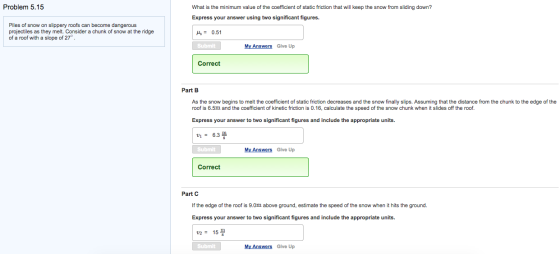
Can someone please explain what the question is asking and what each part entails? The answers are above!
Any advice will be greatly appreciated!
Homework Answers
m*g*sintheta = us*m*g*costheta
us = tantheta = tan27 = 0.51
---------------
m*g*d*sin27 - uk*m*g*d*cos27 = 0.5*m*v1^2
v1 = sqrt(2*g*d*(sin27 - uk*cos27))
v1 = 6.29 = 6.3 m/s
--------------------
energy conservation
0.5*m*v1^2 + m*g*h = 0.5*m*v2^2
v2 = sqrt(v1^2 +2*g*h)
v2 = sqrt((6.3*6.3)+(2*9.8*9)) 14.7 m/s = 15 m/s
Add Answer to:
Can someone please explain what the question is asking and what
each part entails? The answers...
PHY116 S2019 CHO5: Chapter 4-Dynamics: Newton's Laws of Motion (Part 2) Item 7 - Part A undergo i...
 PHY116 S2019 CHO5: Chapter 4-Dynamics: Newton's Laws of Motion (Part 2) Item 7 - Part A undergo if the coefficient of static friction between the tires and the ground is 0.887 What is the maximum acceleration a car can Express your answer using two significant figures empBes Symbols aso jedo relat keyboard shortcuts geilp Submit Request Answer Provide Feedback Pom Fle Eit View History Bookmarks People Window Help a session.masteringphysics.comc PHY116 52019 HOS:Chapher 4-Dynamics: Newton's Laws of Motion (Part 2)...
Part A With what minimum speed must you toss a 200 g ball straight up to...
Part A With what minimum speed must you toss a 200 g ball straight up to hit the 15-m-high roof of the gymnasium if you release the ball 1.5 m above the ground? Solve this problem using energy. Express your answer using two significant figures. (answer v_min = m/s) Part B With what speed does the ball hit the ground? Express your answer using two significant figures. (answer v = m/s)
B 30 Part C Determine the maximum force P that can be applied without causing the...
 B 30 Part C Determine the maximum force P that can be applied without causing the two 51-kg crates to move. The coefficient of static friction between each crate and the ground is his = 0.33 Express your answer to three significant figures and include the appropriate units. μΑ ? P= Value Units Submit Request Answer
Problem 5.08 Part A How large must the coefficient of static friction be between the tires...
 Problem 5.08 Part A How large must the coefficient of static friction be between the tires and the road if a car is to round a level curve of radius 110 m at a speed of 100 km/h? Express your answer using two significant figures.
Constants Part A In the (Figure 1) the coefficient of static friction between mass mA and...
 Constants Part A In the (Figure 1) the coefficient of static friction between mass mA and the table is 0.45, whereas the coefficient of kinetic friction is 0.11. Ignore masses of the cord and the (frictionless) pulley What minimum value of mA will keep the system from starting to move? Express your answer to two significant figures and include the appropriate units. mA-Value Units Submit Request Answer Part B Figure What value of mA will keep the system moving at...
Can someone please help with this problem? Thanks! What propulsion torce is needed to keep the...
 Can someone please help with this problem? Thanks!
What propulsion torce is needed to keep the car moving forward at a constant speed? Express your answer to two significant fiqures and include the appropriate units Review Constants Periodic Table Driving on asphalt roads entails very litle rolling resistance, so most riving skwly in ry ad isangler story If a 170 kr rar is driven n sand at 5.0 m/s, the coeticient of rolling friction is DO5, In this Value Units...
Can someone please help with this problem? Thanks!
What propulsion torce is needed to keep the car moving forward at a constant speed? Express your answer to two significant fiqures and include the appropriate units Review Constants Periodic Table Driving on asphalt roads entails very litle rolling resistance, so most riving skwly in ry ad isangler story If a 170 kr rar is driven n sand at 5.0 m/s, the coeticient of rolling friction is DO5, In this Value Units...
Part A With what minimum speed must you toss a 190 g ball straight up to...
 Part A With what minimum speed must you toss a 190 g ball straight up to just touch the 11-m-high roof of the gymnasium if you release the ball 1.6 m above the ground? Solve this problem using energy. Express your answer to two significant figures and include the appropriate units. CHÅR O ? Value Units Vmin = Submit Request Answer Part B With what speed does the ball hit the ground? Express your answer to two significant figures and...
Part A How large must the coefficient of static friction be between the tires and the...
 Part A How large must the coefficient of static friction be between the tires and the road if a car is to round a level curve of radius 140 m at a speed of 120 km/h? Express your answer using two significant figures. | ΑΣφ ? Submit Request Answer Provide Feedback
Constants A curve of radius 73 mis banked for a design speed of 90 km/h Part...
 Constants A curve of radius 73 mis banked for a design speed of 90 km/h Part A If the coefficient of static friction is 0.30 (wet pavement), at what range of speeds can a car safely make the curve? (Hint: Consider the direction of the friction force when the car goes too slow or too fast.] Express your answers using two significant figures separated by a comma. EVO ALO ? Umin, Vmax= km/h Submit Request Answer < Return to Assignment...
Part C Review A 4.5 kg box slides down a 5.2-m -high frictionless hill starting from rest, across a 2.3-m -wide horizontal surface then hits a horizontal spring with spring constant 470 N/m How far i...
 Part C Review A 4.5 kg box slides down a 5.2-m -high frictionless hill starting from rest, across a 2.3-m -wide horizontal surface then hits a horizontal spring with spring constant 470 N/m How far is the spring compressed? Express your answer using two significant figures The other end of the spring is anchored against a wall The ground under the spring is frictionless, but the 2.3-m- long horizontal surface is rough. The coefficient of kinetic friction of the box...
 PHY116 S2019 CHO5: Chapter 4-Dynamics: Newton's Laws of Motion (Part 2) Item 7 - Part A undergo if the coefficient of static friction between the tires and the ground is 0.887 What is the maximum acceleration a car can Express your answer using two significant figures empBes Symbols aso jedo relat keyboard shortcuts geilp Submit Request Answer Provide Feedback Pom Fle Eit View History Bookmarks People Window Help a session.masteringphysics.comc PHY116 52019 HOS:Chapher 4-Dynamics: Newton's Laws of Motion (Part 2)...
 B 30 Part C Determine the maximum force P that can be applied without causing the two 51-kg crates to move. The coefficient of static friction between each crate and the ground is his = 0.33 Express your answer to three significant figures and include the appropriate units. μΑ ? P= Value Units Submit Request Answer
 Problem 5.08 Part A How large must the coefficient of static friction be between the tires and the road if a car is to round a level curve of radius 110 m at a speed of 100 km/h? Express your answer using two significant figures.
 Constants Part A In the (Figure 1) the coefficient of static friction between mass mA and the table is 0.45, whereas the coefficient of kinetic friction is 0.11. Ignore masses of the cord and the (frictionless) pulley What minimum value of mA will keep the system from starting to move? Express your answer to two significant figures and include the appropriate units. mA-Value Units Submit Request Answer Part B Figure What value of mA will keep the system moving at...
 Can someone please help with this problem? Thanks!
What propulsion torce is needed to keep the car moving forward at a constant speed? Express your answer to two significant fiqures and include the appropriate units Review Constants Periodic Table Driving on asphalt roads entails very litle rolling resistance, so most riving skwly in ry ad isangler story If a 170 kr rar is driven n sand at 5.0 m/s, the coeticient of rolling friction is DO5, In this Value Units...
Can someone please help with this problem? Thanks!
What propulsion torce is needed to keep the car moving forward at a constant speed? Express your answer to two significant fiqures and include the appropriate units Review Constants Periodic Table Driving on asphalt roads entails very litle rolling resistance, so most riving skwly in ry ad isangler story If a 170 kr rar is driven n sand at 5.0 m/s, the coeticient of rolling friction is DO5, In this Value Units...
 Part A With what minimum speed must you toss a 190 g ball straight up to just touch the 11-m-high roof of the gymnasium if you release the ball 1.6 m above the ground? Solve this problem using energy. Express your answer to two significant figures and include the appropriate units. CHÅR O ? Value Units Vmin = Submit Request Answer Part B With what speed does the ball hit the ground? Express your answer to two significant figures and...
 Part A How large must the coefficient of static friction be between the tires and the road if a car is to round a level curve of radius 140 m at a speed of 120 km/h? Express your answer using two significant figures. | ΑΣφ ? Submit Request Answer Provide Feedback
 Constants A curve of radius 73 mis banked for a design speed of 90 km/h Part A If the coefficient of static friction is 0.30 (wet pavement), at what range of speeds can a car safely make the curve? (Hint: Consider the direction of the friction force when the car goes too slow or too fast.] Express your answers using two significant figures separated by a comma. EVO ALO ? Umin, Vmax= km/h Submit Request Answer < Return to Assignment...
 Part C Review A 4.5 kg box slides down a 5.2-m -high frictionless hill starting from rest, across a 2.3-m -wide horizontal surface then hits a horizontal spring with spring constant 470 N/m How far is the spring compressed? Express your answer using two significant figures The other end of the spring is anchored against a wall The ground under the spring is frictionless, but the 2.3-m- long horizontal surface is rough. The coefficient of kinetic friction of the box...
Most questions answered within 3 hours.
-
Where is the error in this code sequence?
String s1 = "Hello";
String s2 = "ello";...
asked 10 months ago -
Financial data for Joel de Paris, Inc., for last year
follow:
Joel de Paris, Inc.
Balance...
asked 10 months ago -
Consider this reaction:
Al2(SO4)3 (aq)+ BaCl3
(aq) Al2Cl6 (aq)- +
3BaSO4(s) . What is the...
asked 10 months ago -
Suppose that Savneet is considering increasing her
recent random sample from 20 car rentals to 40...
asked 10 months ago -
Trucks arrive at an unloading terminal at an average rate of 120
per hour.
Trucks arrive...
asked 10 months ago -
Why are methanol and ethanol completely soluble in water while
octanol is not very little soluble....
asked 10 months ago -
A facilities manager at a university reads in a research report
that the mean amount of...
asked 10 months ago -
When the CuSO4 is rehydrated by adding water to the anhydrous
compound, is this an endothermic...
asked 10 months ago -
A ray of sunlight is passing from diamond into crown glass; the
angle of incidence is...
asked 10 months ago -
A block of mass 0.249 kg is placed on top of a light, vertical
spring of...
asked 10 months ago -
how do the kidneys compensate in the presences of acidosis
a) trigger hyperventilate
b) reserve acid...
asked 10 months ago -
Question 501 pts
The rental rate of capital to the firm increases. Which of the
following...
asked 10 months ago