
Homework Answers

Add Answer to:
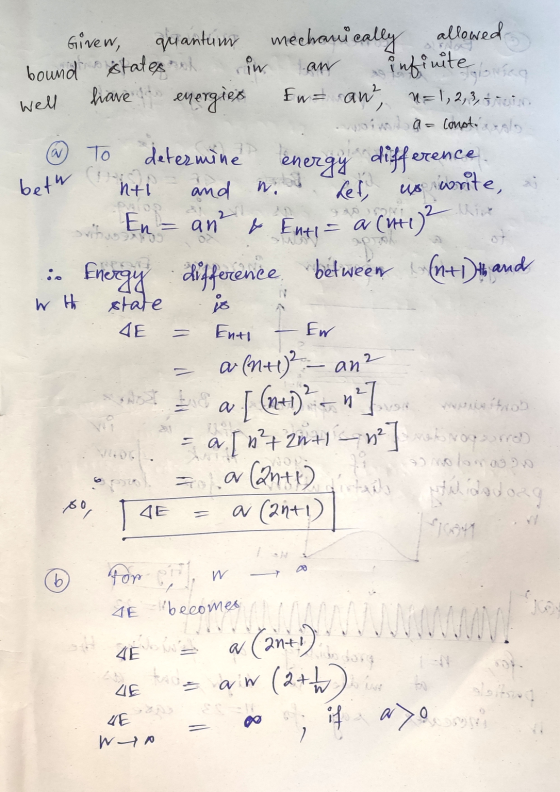
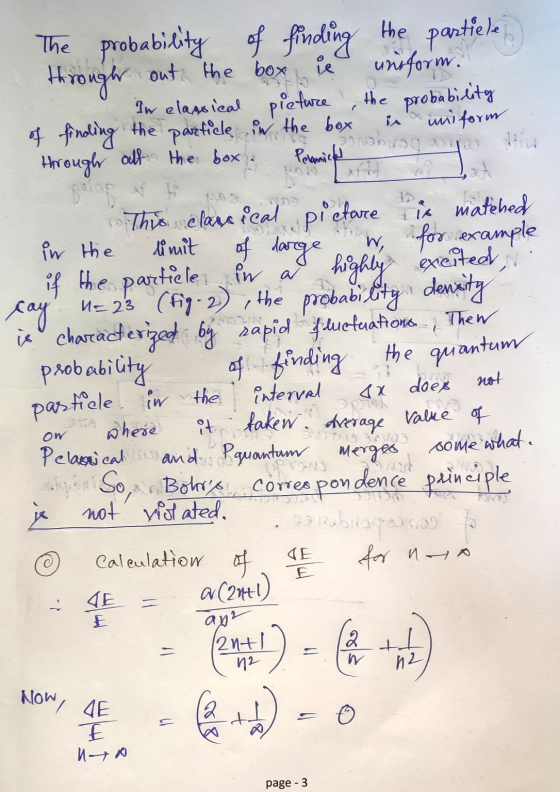
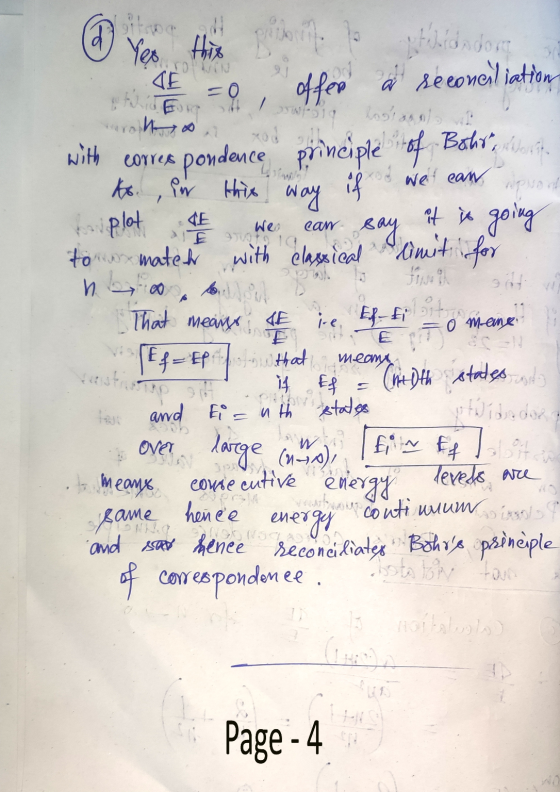
4. Infinite well The quantin-mechanically allowed bound states in an infinite well have energies E =an...
Introduction to Quantum Mechanics problem: 3. Find the normalized stationary states and allowed bound state energies...
 Introduction to Quantum Mechanics
problem:
3. Find the normalized stationary states and allowed bound state energies of the Schrodinger equation for a particle of mass m and energy E < Vo in the semi-infinite potential well Vo 0.
Introduction to Quantum Mechanics
problem:
3. Find the normalized stationary states and allowed bound state energies of the Schrodinger equation for a particle of mass m and energy E < Vo in the semi-infinite potential well Vo 0.
4. 3D Infinite Square Well Perturbation (20 pts) Consider the three-dimensional infinite cubic well: otherwise The stationary states are where n, ny, and n, are integers. The corresponding allowed en...
 4. 3D Infinite Square Well Perturbation (20 pts) Consider the three-dimensional infinite cubic well: otherwise The stationary states are where n, ny, and n, are integers. The corresponding allowed energies are Now let us introduce the perturbation otherwise a) Find the first-order correction to the ground state energy b) Find the first-order correction to the first excited state
4. 3D Infinite Square Well Perturbation (20 pts) Consider the three-dimensional infinite cubic well: otherwise The stationary states are where n, ny,...
4. 3D Infinite Square Well Perturbation (20 pts) Consider the three-dimensional infinite cubic well: otherwise The stationary states are where n, ny, and n, are integers. The corresponding allowed energies are Now let us introduce the perturbation otherwise a) Find the first-order correction to the ground state energy b) Find the first-order correction to the first excited state
4. 3D Infinite Square Well Perturbation (20 pts) Consider the three-dimensional infinite cubic well: otherwise The stationary states are where n, ny,...
A NON stationary state A particle of mass m is in an infinite square well potential of width L, a...
 A NON stationary state A particle of mass m is in an infinite square well potential of width L, as in McIntyre's section 5.4. Suppose we have an initial state vector lv(t -0) results from Mclntrye without re-deriving them, and you may use a computer for your math as long as you include your code in your solution A(3E1) 4iE2)). You may use E. (4 pts) Use a computer to plot this probability density at 4 times: t 0, t2...
Quantum Mechanics Problem 1. (25) Consider an infinite potential well with the following shape: 0 a/4...
 Quantum Mechanics Problem
1. (25) Consider an infinite potential well with the following shape: 0 a/4 3al4 a h2 where 4 Using the ground state wavefunction of the original infinite potential well as a trial function, 2πχ trial = 1-sin- find the approximation of the ground state energy for this system with the variational method. (Note, this question is simplified by considering the two components of the Hamiltonian, and V, on their own) b) If we had used the 1st...
Quantum Mechanics Problem
1. (25) Consider an infinite potential well with the following shape: 0 a/4 3al4 a h2 where 4 Using the ground state wavefunction of the original infinite potential well as a trial function, 2πχ trial = 1-sin- find the approximation of the ground state energy for this system with the variational method. (Note, this question is simplified by considering the two components of the Hamiltonian, and V, on their own) b) If we had used the 1st...
3 Casimir effect c. All vacuum energies considered so far are infinite. In reality, the metal wal...
 3 Casimir effect c. All vacuum energies considered so far are infinite. In reality, the metal walls are conduc tors only at finite frequencies, and thus do not impose boundary conditions at infinite frqu cies. (The cutoff is given roughly by the plasma frequencywp Thus, we need (and should) not consider infinite frequencies in our equations. To remove We will derive the Casimir effect in thee d sions, making use of the Euler-Maclaurin formula imen- them, we introduce a cutoff...
Quantum Mechanics Thank you! 2 Casimir effect We will derive the Casimir effect in three dimensions,...
 Quantum Mechanics
Thank you!
2 Casimir effect We will derive the Casimir effect in three dimensions, making use of the Euler- Maclaurin formula Ž 0,F(n) – [F(n)dn = 67\2F'O) + 30 x , F"(0) -... (1) JO n=0 where On = 1 for n > 0, 0 = 1/2, and on = 0 for n < 0. (You don't need to prove this formula.) Let us consider a square box with conducting walls of length L. Let El be the...
Quantum Mechanics
Thank you!
2 Casimir effect We will derive the Casimir effect in three dimensions, making use of the Euler- Maclaurin formula Ž 0,F(n) – [F(n)dn = 67\2F'O) + 30 x , F"(0) -... (1) JO n=0 where On = 1 for n > 0, 0 = 1/2, and on = 0 for n < 0. (You don't need to prove this formula.) Let us consider a square box with conducting walls of length L. Let El be the...
 Introduction to Quantum Mechanics
problem:
3. Find the normalized stationary states and allowed bound state energies of the Schrodinger equation for a particle of mass m and energy E < Vo in the semi-infinite potential well Vo 0.
Introduction to Quantum Mechanics
problem:
3. Find the normalized stationary states and allowed bound state energies of the Schrodinger equation for a particle of mass m and energy E < Vo in the semi-infinite potential well Vo 0.
 4. 3D Infinite Square Well Perturbation (20 pts) Consider the three-dimensional infinite cubic well: otherwise The stationary states are where n, ny, and n, are integers. The corresponding allowed energies are Now let us introduce the perturbation otherwise a) Find the first-order correction to the ground state energy b) Find the first-order correction to the first excited state
4. 3D Infinite Square Well Perturbation (20 pts) Consider the three-dimensional infinite cubic well: otherwise The stationary states are where n, ny,...
4. 3D Infinite Square Well Perturbation (20 pts) Consider the three-dimensional infinite cubic well: otherwise The stationary states are where n, ny, and n, are integers. The corresponding allowed energies are Now let us introduce the perturbation otherwise a) Find the first-order correction to the ground state energy b) Find the first-order correction to the first excited state
4. 3D Infinite Square Well Perturbation (20 pts) Consider the three-dimensional infinite cubic well: otherwise The stationary states are where n, ny,...
 A NON stationary state A particle of mass m is in an infinite square well potential of width L, as in McIntyre's section 5.4. Suppose we have an initial state vector lv(t -0) results from Mclntrye without re-deriving them, and you may use a computer for your math as long as you include your code in your solution A(3E1) 4iE2)). You may use E. (4 pts) Use a computer to plot this probability density at 4 times: t 0, t2...
 Quantum Mechanics Problem
1. (25) Consider an infinite potential well with the following shape: 0 a/4 3al4 a h2 where 4 Using the ground state wavefunction of the original infinite potential well as a trial function, 2πχ trial = 1-sin- find the approximation of the ground state energy for this system with the variational method. (Note, this question is simplified by considering the two components of the Hamiltonian, and V, on their own) b) If we had used the 1st...
Quantum Mechanics Problem
1. (25) Consider an infinite potential well with the following shape: 0 a/4 3al4 a h2 where 4 Using the ground state wavefunction of the original infinite potential well as a trial function, 2πχ trial = 1-sin- find the approximation of the ground state energy for this system with the variational method. (Note, this question is simplified by considering the two components of the Hamiltonian, and V, on their own) b) If we had used the 1st...
 3 Casimir effect c. All vacuum energies considered so far are infinite. In reality, the metal walls are conduc tors only at finite frequencies, and thus do not impose boundary conditions at infinite frqu cies. (The cutoff is given roughly by the plasma frequencywp Thus, we need (and should) not consider infinite frequencies in our equations. To remove We will derive the Casimir effect in thee d sions, making use of the Euler-Maclaurin formula imen- them, we introduce a cutoff...
 Quantum Mechanics
Thank you!
2 Casimir effect We will derive the Casimir effect in three dimensions, making use of the Euler- Maclaurin formula Ž 0,F(n) – [F(n)dn = 67\2F'O) + 30 x , F"(0) -... (1) JO n=0 where On = 1 for n > 0, 0 = 1/2, and on = 0 for n < 0. (You don't need to prove this formula.) Let us consider a square box with conducting walls of length L. Let El be the...
Quantum Mechanics
Thank you!
2 Casimir effect We will derive the Casimir effect in three dimensions, making use of the Euler- Maclaurin formula Ž 0,F(n) – [F(n)dn = 67\2F'O) + 30 x , F"(0) -... (1) JO n=0 where On = 1 for n > 0, 0 = 1/2, and on = 0 for n < 0. (You don't need to prove this formula.) Let us consider a square box with conducting walls of length L. Let El be the...
Most questions answered within 3 hours.
-
Where is the error in this code sequence?
String s1 = "Hello";
String s2 = "ello";...
asked 10 months ago -
Financial data for Joel de Paris, Inc., for last year
follow:
Joel de Paris, Inc.
Balance...
asked 10 months ago -
Consider this reaction:
Al2(SO4)3 (aq)+ BaCl3
(aq) Al2Cl6 (aq)- +
3BaSO4(s) . What is the...
asked 10 months ago -
Suppose that Savneet is considering increasing her
recent random sample from 20 car rentals to 40...
asked 10 months ago -
Trucks arrive at an unloading terminal at an average rate of 120
per hour.
Trucks arrive...
asked 10 months ago -
Why are methanol and ethanol completely soluble in water while
octanol is not very little soluble....
asked 10 months ago -
A facilities manager at a university reads in a research report
that the mean amount of...
asked 10 months ago -
When the CuSO4 is rehydrated by adding water to the anhydrous
compound, is this an endothermic...
asked 10 months ago -
A ray of sunlight is passing from diamond into crown glass; the
angle of incidence is...
asked 10 months ago -
A block of mass 0.249 kg is placed on top of a light, vertical
spring of...
asked 10 months ago -
how do the kidneys compensate in the presences of acidosis
a) trigger hyperventilate
b) reserve acid...
asked 10 months ago -
Question 501 pts
The rental rate of capital to the firm increases. Which of the
following...
asked 10 months ago