

Homework Answers
Circular Flow of Income
Circular Flow of income is a graphical representation of the movement of money in the economy. It demonstrates the equivalence between the “Money Withdrawal” and “Money Injections” in the economy.
o Money is injected in an economy in the form of Investment (I), Government Spending (G) and Exports (X)
o Money is withdrawn in an economy in the form of leakages such as Savings(S), Taxation (T) and Imports (M)
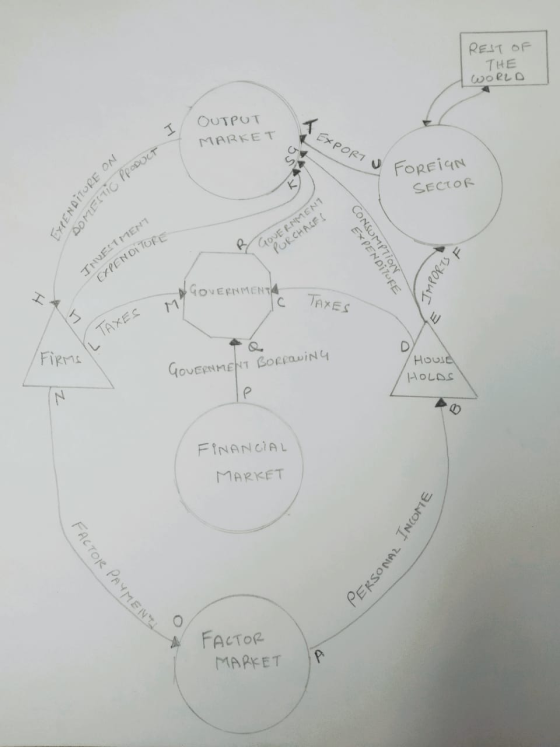
The below diagram shows a circular flow of income in case of a four sector economy or an open economy.
1. The House-hold sector supplies factor of production to the factor market and in return it receives personal income as a part of factor payments from the firms. Thus, arrow AB goes into the Households.
Arrow AB – Personal Income
The 3 primary expenditures by households shown in the model are:
(a) Taxes : Household pays taxes to the government shown by Arrow - CD
(b) Consumption Expenditure – With disposable income i.e. personal income after paying taxes, the HH spend on purchasing domestically produced goods and services from the output market, which is shown by Arrow - EG
(c) Imports – Under a 4 sector model, the households purchases goods and services from abroad in the form of Imports, which is shown by arrow EF
2. Firms make investment expenditure in the output market. The revenue earned in the product market (by sales of goods and services) flows into the Firms as “Expenditure on Domestic Product”. Thus, arrow HI goes in to the Firms/Business Sector.
Arrow HI – Personal Income
The 3 primary expenditures by Firms shown in the model are:
(a) Investment Expenditure: The amount which firm invest to produce goods and services that are sold in the output market, which is shown by arrow JK
(b) Taxes : Firms too pay taxes to the government shown by Arrow - LM
(c) Factor Payments : Firms hire factor of production from households in the form of labor, land, capital, etc, in return of which it pays them factor payments, which is shown by arrow NO
3. Government receives taxes from both Firms and Households which are represented by the arrows LM and CD respectively. The government also borrows from the financial market, lets say in order finance the deficit or to invest on public goods projects such as infrastructure, telecommunication, railways, etc. This is shown by arrow PQ.
The only expenditure made by the government are the government purchases from the output market, which is shown by the arrows RS.
4. The four arrows going into the output market are the 4 types of expenditure made by the four sectors in the economy:
Arrow JK – Investment Expenditure by Firms
Arrow RS – Government Purchases by the Government Sector
Arrow EG – Consumption Expenditure by the Households
Arrow TU – Expenditure on domestically produced goods by the foreign sector, which are the exports.
Add Answer to:
GRAPH MAP Please complete and label this circular flow model. Do your best not to refer...
1. The economy's income and expenditure The following diagram presents a circular-flow model of a simple...
 1. The economy's income and expenditure The following diagram presents a circular-flow model of a simple economy. The outer set of arrows (shown in green) shows the flow of dollars, and the nner set of arrows (shown in red) shows the corresponding flow of inputs and outputs Markets for Goods and Services Firms Households Markets for^ Factors of Production Based on this model, households earn income when ms purchase a or and ca tal ▼ n markets for actors of...
Homework (Ch 02) Attempts: Average: 73 2. The circular-flow model The following diagram presents a circular-flow...
 Homework (Ch 02) Attempts: Average: 73 2. The circular-flow model The following diagram presents a circular-flow model of a simple economy. The outer set of arrows (shown in green) shows the flow of dollars, and the Inner set of arrows (shown in red) shows the corresponding flow of inputs and outputs. Markets for Goods and Services Firms Households Markets for Factors of Production Based on this model, households earn income when firms purchase factors in factor markets. Suppose Rosa earns...
The circular-flow model The following diagram presents a circular-flow model of a simple economy. The outer...
 The circular-flow model
The following diagram presents a circular-flow model of a simple
economy. The outer set of arrows (shown in green) shows the flow of
dollars, and the inner set of arrows (shown in red) shows the
corresponding flow of inputs and outputs.
Based on this model, households earn income when
________________ purchase ___________ in factor markets.
Suppose Latasha earns $650 per week working as a programmer for
PC Pros. She uses $9 to order a mojito cocktail at...
The circular-flow model
The following diagram presents a circular-flow model of a simple
economy. The outer set of arrows (shown in green) shows the flow of
dollars, and the inner set of arrows (shown in red) shows the
corresponding flow of inputs and outputs.
Based on this model, households earn income when
________________ purchase ___________ in factor markets.
Suppose Latasha earns $650 per week working as a programmer for
PC Pros. She uses $9 to order a mojito cocktail at...
2. The circular-flow model The following diagram presents a circular-flow model of a simple economy. The...
 2. The circular-flow model The following diagram presents a circular-flow model of a simple economy. The outer set of arrows (shown in green) shows the flow of dollars, and the inner set of arrows (shown in red) shows the corresponding flow of inputs and outputs. Markets for Goods and Services Firms Households Markets for Factors of Production Based on this model, firms earn revenue when purchase in product markets. ー Suppose Kyoko earns $650 per week working as jewelry appraiser...
3. The circular flow model The following diagram presents a circular flow model of a simple...
 3. The circular flow model The following diagram presents a circular flow model of a simple economy. The outer set of arrows (shown in green) shows the flow of dollars, and the inner set of arrows (shown in red) shows the corresponding flow of inputs and outputs. Markets for Outputs Sales receipts Goods and services Expenditures Goods and services Households Businesses Labor, capital, etc. Incomes Labor, capital, etc. Markets for Inputs Wages, interest, etc. Based on this model, households earn...
The following diagram presents a circular-flow model of a simple economy. The outer set of arrows...
 The following diagram presents
a circular-flow model of a simple economy. The outer set of arrows
(shown in green) shows the flow of dollars, and the inner set of
arrows (shown in red) shows the corresponding flow of inputs and
outputs.
Which of the following is true regarding this economic
model?
A) While simple, the circular-flow diagram can still be useful
for the purposes of modeling how dollars and resources move
throughout an economy.
B) Because it does not take...
The following diagram presents
a circular-flow model of a simple economy. The outer set of arrows
(shown in green) shows the flow of dollars, and the inner set of
arrows (shown in red) shows the corresponding flow of inputs and
outputs.
Which of the following is true regarding this economic
model?
A) While simple, the circular-flow diagram can still be useful
for the purposes of modeling how dollars and resources move
throughout an economy.
B) Because it does not take...
2. The circular-flow model The following diagram presents a circular-flow model of a simple economy. The...
 2. The circular-flow model The following diagram presents a circular-flow model of a simple economy. The outer set of arrows (shown in green) shows the flow of do inner set of arrows (shown in red) shows the corresponding flow of inputs and outputs. Markets for Goods and Services Firms Households Markets for Factors of Production Based on this model, households earn income whenfirms purchase in factor markets Suppose Poornima earns $800 per week working as a corporate attorney for Rowan...
1. Economic models The following diagram presents a circular-flow model of a simple economy. The outer...
 1. Economic models The following diagram presents a circular-flow model of a simple economy. The outer set of arrows (shown in green) shows the flow of dollars, and the Inner set of arrows (shown in red) shows the corresponding flow of inputs and outputs. Markets for Goods and Services Firms Households Markets for Factors of Production Which of the following is true regarding this economic model? While simple, the circular-flow diagram can still be useful for the purposes of modeling...
1. The economy's income and expenditure The following diagram presents a circular-flow model of a simple...
 1. The economy's income and expenditure The following diagram presents a circular-flow model of a simple economy. The outer set of arrows (shown in green) shows the flow of dollars, and the inner set of arrows (shown in red) shows the corresponding flow of inputs and outputs. Markets for Goods and Services Firms Households Markets for Factors of Production Based on this model, households earn income when _purchase in markets for factors of production. Suppose Becky earns $625 per week...
1. The economy's income and expenditure The following diagram presents a circular-flow model of a simple...
 1. The economy's income and expenditure The following diagram presents a circular-flow model of a simple economy. The outer set of arrows (shown in green) shows the flow of dollars, and the inner set of arrows (shown in red) shows the corresponding flow of inputs and outputs. Markets for Goods and Services Firms Households Markets for Factors of Production Based on this model, households earn income when purchase in markets for factors of production. Suppose Yvette earns $600 per week...
 1. The economy's income and expenditure The following diagram presents a circular-flow model of a simple economy. The outer set of arrows (shown in green) shows the flow of dollars, and the nner set of arrows (shown in red) shows the corresponding flow of inputs and outputs Markets for Goods and Services Firms Households Markets for^ Factors of Production Based on this model, households earn income when ms purchase a or and ca tal ▼ n markets for actors of...
 Homework (Ch 02) Attempts: Average: 73 2. The circular-flow model The following diagram presents a circular-flow model of a simple economy. The outer set of arrows (shown in green) shows the flow of dollars, and the Inner set of arrows (shown in red) shows the corresponding flow of inputs and outputs. Markets for Goods and Services Firms Households Markets for Factors of Production Based on this model, households earn income when firms purchase factors in factor markets. Suppose Rosa earns...
 The circular-flow model
The following diagram presents a circular-flow model of a simple
economy. The outer set of arrows (shown in green) shows the flow of
dollars, and the inner set of arrows (shown in red) shows the
corresponding flow of inputs and outputs.
Based on this model, households earn income when
________________ purchase ___________ in factor markets.
Suppose Latasha earns $650 per week working as a programmer for
PC Pros. She uses $9 to order a mojito cocktail at...
The circular-flow model
The following diagram presents a circular-flow model of a simple
economy. The outer set of arrows (shown in green) shows the flow of
dollars, and the inner set of arrows (shown in red) shows the
corresponding flow of inputs and outputs.
Based on this model, households earn income when
________________ purchase ___________ in factor markets.
Suppose Latasha earns $650 per week working as a programmer for
PC Pros. She uses $9 to order a mojito cocktail at...
 2. The circular-flow model The following diagram presents a circular-flow model of a simple economy. The outer set of arrows (shown in green) shows the flow of dollars, and the inner set of arrows (shown in red) shows the corresponding flow of inputs and outputs. Markets for Goods and Services Firms Households Markets for Factors of Production Based on this model, firms earn revenue when purchase in product markets. ー Suppose Kyoko earns $650 per week working as jewelry appraiser...
 3. The circular flow model The following diagram presents a circular flow model of a simple economy. The outer set of arrows (shown in green) shows the flow of dollars, and the inner set of arrows (shown in red) shows the corresponding flow of inputs and outputs. Markets for Outputs Sales receipts Goods and services Expenditures Goods and services Households Businesses Labor, capital, etc. Incomes Labor, capital, etc. Markets for Inputs Wages, interest, etc. Based on this model, households earn...
 The following diagram presents
a circular-flow model of a simple economy. The outer set of arrows
(shown in green) shows the flow of dollars, and the inner set of
arrows (shown in red) shows the corresponding flow of inputs and
outputs.
Which of the following is true regarding this economic
model?
A) While simple, the circular-flow diagram can still be useful
for the purposes of modeling how dollars and resources move
throughout an economy.
B) Because it does not take...
The following diagram presents
a circular-flow model of a simple economy. The outer set of arrows
(shown in green) shows the flow of dollars, and the inner set of
arrows (shown in red) shows the corresponding flow of inputs and
outputs.
Which of the following is true regarding this economic
model?
A) While simple, the circular-flow diagram can still be useful
for the purposes of modeling how dollars and resources move
throughout an economy.
B) Because it does not take...
 2. The circular-flow model The following diagram presents a circular-flow model of a simple economy. The outer set of arrows (shown in green) shows the flow of do inner set of arrows (shown in red) shows the corresponding flow of inputs and outputs. Markets for Goods and Services Firms Households Markets for Factors of Production Based on this model, households earn income whenfirms purchase in factor markets Suppose Poornima earns $800 per week working as a corporate attorney for Rowan...
 1. Economic models The following diagram presents a circular-flow model of a simple economy. The outer set of arrows (shown in green) shows the flow of dollars, and the Inner set of arrows (shown in red) shows the corresponding flow of inputs and outputs. Markets for Goods and Services Firms Households Markets for Factors of Production Which of the following is true regarding this economic model? While simple, the circular-flow diagram can still be useful for the purposes of modeling...
 1. The economy's income and expenditure The following diagram presents a circular-flow model of a simple economy. The outer set of arrows (shown in green) shows the flow of dollars, and the inner set of arrows (shown in red) shows the corresponding flow of inputs and outputs. Markets for Goods and Services Firms Households Markets for Factors of Production Based on this model, households earn income when _purchase in markets for factors of production. Suppose Becky earns $625 per week...
 1. The economy's income and expenditure The following diagram presents a circular-flow model of a simple economy. The outer set of arrows (shown in green) shows the flow of dollars, and the inner set of arrows (shown in red) shows the corresponding flow of inputs and outputs. Markets for Goods and Services Firms Households Markets for Factors of Production Based on this model, households earn income when purchase in markets for factors of production. Suppose Yvette earns $600 per week...
Most questions answered within 3 hours.
-
Where is the error in this code sequence?
String s1 = "Hello";
String s2 = "ello";...
asked 10 months ago -
Financial data for Joel de Paris, Inc., for last year
follow:
Joel de Paris, Inc.
Balance...
asked 10 months ago -
Consider this reaction:
Al2(SO4)3 (aq)+ BaCl3
(aq) Al2Cl6 (aq)- +
3BaSO4(s) . What is the...
asked 10 months ago -
Suppose that Savneet is considering increasing her
recent random sample from 20 car rentals to 40...
asked 10 months ago -
Trucks arrive at an unloading terminal at an average rate of 120
per hour.
Trucks arrive...
asked 10 months ago -
Why are methanol and ethanol completely soluble in water while
octanol is not very little soluble....
asked 10 months ago -
A facilities manager at a university reads in a research report
that the mean amount of...
asked 10 months ago -
When the CuSO4 is rehydrated by adding water to the anhydrous
compound, is this an endothermic...
asked 10 months ago -
A ray of sunlight is passing from diamond into crown glass; the
angle of incidence is...
asked 10 months ago -
A block of mass 0.249 kg is placed on top of a light, vertical
spring of...
asked 10 months ago -
how do the kidneys compensate in the presences of acidosis
a) trigger hyperventilate
b) reserve acid...
asked 10 months ago -
Question 501 pts
The rental rate of capital to the firm increases. Which of the
following...
asked 10 months ago