A copper rod is 0.825 m long with a rectangular cross section of dimensions 0.0463 m...
A copper rod is 0.825 m long with a rectangular cross section of dimensions 0.0463 m by 0.0829 m . The ends of the rod are held at 52.7 ∘C and 91.5 ∘C , but the rod is otherwise insulated from its environment. Find the heat current (the amount of heat that flows per unit time) through the rod. The thermal conductivity of copper is 385 W/(m⋅K) .
Please show work
Homework Answers

Add Answer to:
A copper rod is 0.825 m long with a rectangular cross section of
dimensions 0.0463 m...
copper rod is 0.791 m long with a rectangular cross section of dimensions 0.0451 m by...
 copper rod is 0.791 m long with a rectangular cross section of dimensions 0.0451 m by 0.0751 m. The ends of the rod are held at 55.1 'C and 99.1 'C, but the rod is otherwise insulated from its environment. Find the heat current (the amount of heat that flows per unit time) through the rod. The thermal conductivity of copper is 385 W/(m K). heat current
A copper rod is 0.815 m0.815 m long with a rectangular cross section of dimensions 0.0543...
A copper rod is 0.815 m0.815 m long with a rectangular cross section of dimensions 0.0543 m0.0543 m by 0.0781 m0.0781 m. The ends of the rod are held at 51.5 ∘C51.5 ∘C and 89.9 ∘C89.9 ∘C, but the rod is otherwise insulated from its environment. Find the heat current (the amount of heat that flows per unit time) through the rod. The thermal conductivity of copper is 385 W/(m⋅K)385 W/(m⋅K).
u have a 0.883-m-long copper rod with a rectangular cross section of dimensions 0.0563 m by...
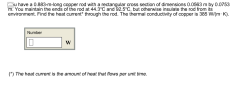 u have a 0.883-m-long copper rod with a rectangular cross section of dimensions 0.0563 m by 0.0753 m. You maintain the ends of the rod at 44.3°C and 92.5°C, but otherwise insulate the rod from its environment. Find the heat current* through the rod. The thermal conductivity of copper is 385 W/(m K) Number ) The heat current is the amount of heat that flows per unit time.
A heat conducting rod, is made of an aluminum section that is 0.10 m long, and...
A heat conducting rod, is made of an aluminum section that is 0.10 m long, and a copper section that is 0.80 m long. Both sections have cross-sectional areas of 0,0004 m2. The aluminum end is maintained at a temperature of 20°C and the copper end is at 121°C. The thermal conductivity of aluminum is 205 W/m∙K and of copper is 385 W/m∙K. Steady state has been reached, and no heat is lost through the well-insulated sides of the rod....
A long rectangular copper bar of a cross section of 2cm by 3cm and a long...
 A long rectangular copper bar of a cross section of 2cm by 3cm and a long cylindrical copper rod of 2.2 cm in diameter are initially at a uniform temperature of 120 °C. They are then exposed to a cooling air stream at 22 °C with a heat transfer coefficient of 180 W/m-K. Taking the properties of the copper to be k = 400 W/m-K and p-8930 kg/m', and C -0.385 kJ/kg-K, determine: a How long would it take for...
QUESTION 4 The temperature distribution for a long fin with uniform cross section is cosh[m(L -...
 QUESTION 4 The temperature distribution for a long fin with uniform cross section is cosh[m(L - x)] cosh(ml) where b means base, O = T - To, m= rand A and P are the area and perimeter of the cross- section. K is in air at A long copper rod of diameter D = 1.5 cm, L = 20 cm, and thermal conductivity 380 W/ m 20°C. The temperature at the base is 150°C. If m = 6 m-7, the...
The coefficient of linear expansion for some common materials are listed in the table to the...
 The coefficient of linear expansion for some common materials are listed in the table to the right. You would like to design an emergency overheating alarm using one of these materials. In your design, at room temperature (23.0°C), a 7.51 cm long cylinder of the material will sit with one end against a wall and the other just barely touching a button. Once the heat causes the cylinder to lengthen by 0.0258 cm, the button will be activated, turning on...
Heat Flowing through a Sectioned Rod
 A long rod, insulated to prevent heat loss along its sides, is in perfect thermal contact with boiling water (at atmospheric pressure) at one end and with an ice-water mixture at the other. The rod consists of a 1.00 m section of copper (with one end in the boiling water) joined end-to-end to a length L2 of steel (with one end in the ice water). Both sections of the rod have cross-sectional areas of 4.00 cm2. The temperature of the copper-steel junction...
Consider a rectangular bar of thermal conductivity k W/m-K and total length 2L, as shown in...
 Consider a rectangular bar of thermal conductivity k W/m-K and
total length 2L, as shown in the figure, is connected to a hot
surface that is at a temperature T1. The connection between the bar
and the surface is imperfect and results in a thermal contact
resistance of R’’ m2-K/W. The width of the rod into the depth of
the paper is W meters and the thickness of the rod is t meters. The
first section of the rod of...
Consider a rectangular bar of thermal conductivity k W/m-K and
total length 2L, as shown in the figure, is connected to a hot
surface that is at a temperature T1. The connection between the bar
and the surface is imperfect and results in a thermal contact
resistance of R’’ m2-K/W. The width of the rod into the depth of
the paper is W meters and the thickness of the rod is t meters. The
first section of the rod of...
A copper rod and an aluminum rod of the same length and cross-sectional area are attached...
A copper rod and an aluminum rod of the same length and cross-sectional area are attached end to end. The copper end is placed in a furnace which is maintained at a constant temperature of 292∘C. The aluminum end is placed in an ice bath held at constant temperature of 0.0∘C. Calculate the temperature (in degrees Celsius) at the point where the two rods are joined. The thermal conductivity of copper is 380 J/(s⋅m⋅C∘) and that of aluminum is 200...
 copper rod is 0.791 m long with a rectangular cross section of dimensions 0.0451 m by 0.0751 m. The ends of the rod are held at 55.1 'C and 99.1 'C, but the rod is otherwise insulated from its environment. Find the heat current (the amount of heat that flows per unit time) through the rod. The thermal conductivity of copper is 385 W/(m K). heat current
 u have a 0.883-m-long copper rod with a rectangular cross section of dimensions 0.0563 m by 0.0753 m. You maintain the ends of the rod at 44.3°C and 92.5°C, but otherwise insulate the rod from its environment. Find the heat current* through the rod. The thermal conductivity of copper is 385 W/(m K) Number ) The heat current is the amount of heat that flows per unit time.
 A long rectangular copper bar of a cross section of 2cm by 3cm and a long cylindrical copper rod of 2.2 cm in diameter are initially at a uniform temperature of 120 °C. They are then exposed to a cooling air stream at 22 °C with a heat transfer coefficient of 180 W/m-K. Taking the properties of the copper to be k = 400 W/m-K and p-8930 kg/m', and C -0.385 kJ/kg-K, determine: a How long would it take for...
 QUESTION 4 The temperature distribution for a long fin with uniform cross section is cosh[m(L - x)] cosh(ml) where b means base, O = T - To, m= rand A and P are the area and perimeter of the cross- section. K is in air at A long copper rod of diameter D = 1.5 cm, L = 20 cm, and thermal conductivity 380 W/ m 20°C. The temperature at the base is 150°C. If m = 6 m-7, the...
 The coefficient of linear expansion for some common materials are listed in the table to the right. You would like to design an emergency overheating alarm using one of these materials. In your design, at room temperature (23.0°C), a 7.51 cm long cylinder of the material will sit with one end against a wall and the other just barely touching a button. Once the heat causes the cylinder to lengthen by 0.0258 cm, the button will be activated, turning on...
 Consider a rectangular bar of thermal conductivity k W/m-K and
total length 2L, as shown in the figure, is connected to a hot
surface that is at a temperature T1. The connection between the bar
and the surface is imperfect and results in a thermal contact
resistance of R’’ m2-K/W. The width of the rod into the depth of
the paper is W meters and the thickness of the rod is t meters. The
first section of the rod of...
Consider a rectangular bar of thermal conductivity k W/m-K and
total length 2L, as shown in the figure, is connected to a hot
surface that is at a temperature T1. The connection between the bar
and the surface is imperfect and results in a thermal contact
resistance of R’’ m2-K/W. The width of the rod into the depth of
the paper is W meters and the thickness of the rod is t meters. The
first section of the rod of...
Most questions answered within 3 hours.
-
Where is the error in this code sequence?
String s1 = "Hello";
String s2 = "ello";...
asked 10 months ago -
Financial data for Joel de Paris, Inc., for last year
follow:
Joel de Paris, Inc.
Balance...
asked 10 months ago -
Consider this reaction:
Al2(SO4)3 (aq)+ BaCl3
(aq) Al2Cl6 (aq)- +
3BaSO4(s) . What is the...
asked 10 months ago -
Suppose that Savneet is considering increasing her
recent random sample from 20 car rentals to 40...
asked 10 months ago -
Trucks arrive at an unloading terminal at an average rate of 120
per hour.
Trucks arrive...
asked 10 months ago -
Why are methanol and ethanol completely soluble in water while
octanol is not very little soluble....
asked 10 months ago -
A facilities manager at a university reads in a research report
that the mean amount of...
asked 10 months ago -
When the CuSO4 is rehydrated by adding water to the anhydrous
compound, is this an endothermic...
asked 10 months ago -
A ray of sunlight is passing from diamond into crown glass; the
angle of incidence is...
asked 10 months ago -
A block of mass 0.249 kg is placed on top of a light, vertical
spring of...
asked 10 months ago -
how do the kidneys compensate in the presences of acidosis
a) trigger hyperventilate
b) reserve acid...
asked 10 months ago -
Question 501 pts
The rental rate of capital to the firm increases. Which of the
following...
asked 10 months ago