
Homework Answers
Add Answer to:
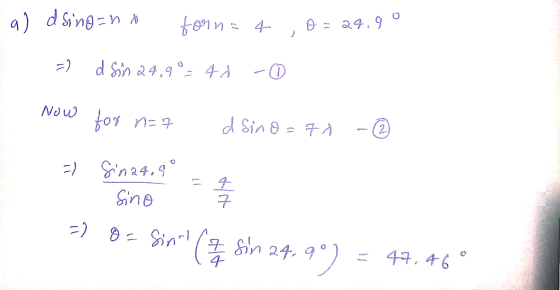
(a) If the fourth-order maximum for monochromatic light falling on a double slit is at an...
(a) If the third-order maximum for monochromatic light falling on a double slit is at an...
(a) If the third-order maximum for monochromatic light falling on a double slit is at an angle of 15.1°, at what angle (in degrees) is the sixth-order maximum? (b) What is the angle (in degrees) of the fourth minimum? (c) What is the highest-order maximum possible here? I got 31.4 by using dsin(θ1)/dsin(θ2)=3λ / 6λ foe part A which was correct. Please help me with part b and c and explain your steps.
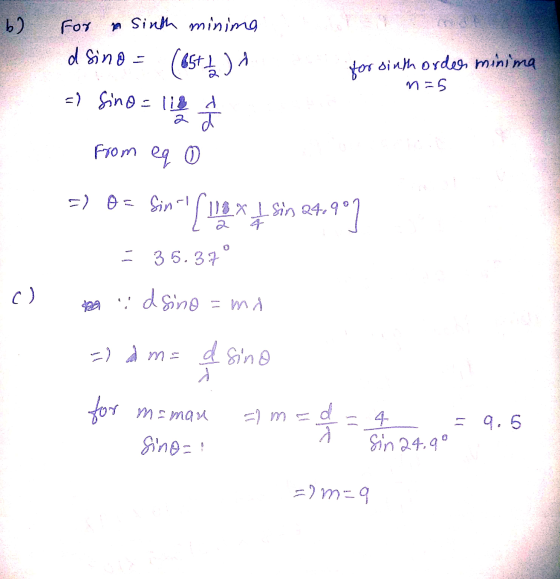
If the fourth-order maximum for pure-wavelength light falling on a double slit is at an angle...
If the fourth-order maximum for pure-wavelength light falling on a double slit is at an angle of 18.7°, at what angle (in degrees) is the sixth-order maximum? ° (b)What is the angle (in degrees) of the sixth minimum? ° (c)What is the highest-order maximum possible here?
(a If the fifth-order maximum for pure-wavelength light falling on a double slit is at an...
(a If the fifth-order maximum for pure-wavelength light falling on a double slit is at an angle of 41.8°, at what angle (in degrees) is the sixth-order maximum? ________ ° (b) What is the angle (in degrees) of the fourth minimum? ________ ° (c) What is the highest-order maximum possible here?
(a) If the fourth-order maximum for pure-wavelength light falling on a double slit is at an...
 (a) If the fourth-order maximum for pure-wavelength light falling on a double slit is at an angle of 20.4°, at what angle (in degrees) is the fifth-order maximum? (b) What is the angle (in degrees) of the third minimum? (c) What is the highest-order maximum possible here?
If the fourth-order maximum for pure-wavelength light falling on a double slit is at an angle...
If the fourth-order maximum for pure-wavelength light falling on a double slit is at an angle of 28.1°, at what angle (in degrees) is the seventh-order maximum?
If the first�order maximum for pure�wavelength light falling on a double slit is at an angle...
 If the first�order maximum for pure�wavelength light falling on
a double slit is at an angle of 10.1�, at what angle is the
second�order maximum?
(in deg) 20.5 deg
You are
correct.
Your receipt no. is 169-9313
What is the angle of the first minimum?
I would like to get help on the
2nd part?
If the first�½order maximum for pure�½wavelength light falling on a double slit is at an angle of 10.1�½, at what angle is the second�½order maximum?...
If the first�order maximum for pure�wavelength light falling on
a double slit is at an angle of 10.1�, at what angle is the
second�order maximum?
(in deg) 20.5 deg
You are
correct.
Your receipt no. is 169-9313
What is the angle of the first minimum?
I would like to get help on the
2nd part?
If the first�½order maximum for pure�½wavelength light falling on a double slit is at an angle of 10.1�½, at what angle is the second�½order maximum?...
1. In a double-slit experiment that uses monochromatic light, the angular separation between the central maximum...
1. In a double-slit experiment that uses monochromatic light, the angular separation between the central maximum and the fourth-order bright fringe is 0.3°. What is the wavelength of light if the distance between slits is 0.45 mm?
Sunlight is used in a double-slit interference experiment. The fourth-order maximum for a wavelength of 460...
Sunlight is used in a double-slit interference experiment. The fourth-order maximum for a wavelength of 460 nm occurs at an angle of θ = 90°. Thus, it is on the verge of being eliminated from the pattern because θ cannot exceed 90° in Eq. 35-14. (a) What least wavelength in the visible range (400 nm to 700 nm) are not present in the third-order maxima? To eliminate all of the visible light in the fourth-order maximum, (b) should the slit...
1.) Find the largest wavelength (in nm) of light falling on double slits separated by 5.50...
1.) Find the largest wavelength (in nm) of light falling on double slits separated by 5.50 µm for which there is a second-order maximum. ________ nm 2) (a)How wide in m is a single slit that produces its first minimum for 635-nm light at an angle of 18.0°? Answer: 0.00000205 m b) At what angle in degrees will the second minimum be? ______
In a double-slit experiment that uses monochromatic light, the angular separation between the central maximum and...
In a double-slit experiment that uses monochromatic light, the angular separation between the central maximum and the third-order bright fringe is 0.2°. What is the wavelength of light if the distance between slits is 0.25 mm?
 (a) If the fourth-order maximum for pure-wavelength light falling on a double slit is at an angle of 20.4°, at what angle (in degrees) is the fifth-order maximum? (b) What is the angle (in degrees) of the third minimum? (c) What is the highest-order maximum possible here?
Most questions answered within 3 hours.
-
Where is the error in this code sequence?
String s1 = "Hello";
String s2 = "ello";...
asked 10 months ago -
Financial data for Joel de Paris, Inc., for last year
follow:
Joel de Paris, Inc.
Balance...
asked 10 months ago -
Consider this reaction:
Al2(SO4)3 (aq)+ BaCl3
(aq) Al2Cl6 (aq)- +
3BaSO4(s) . What is the...
asked 10 months ago -
Suppose that Savneet is considering increasing her
recent random sample from 20 car rentals to 40...
asked 10 months ago -
Trucks arrive at an unloading terminal at an average rate of 120
per hour.
Trucks arrive...
asked 10 months ago -
Why are methanol and ethanol completely soluble in water while
octanol is not very little soluble....
asked 10 months ago -
A facilities manager at a university reads in a research report
that the mean amount of...
asked 10 months ago -
When the CuSO4 is rehydrated by adding water to the anhydrous
compound, is this an endothermic...
asked 10 months ago -
A ray of sunlight is passing from diamond into crown glass; the
angle of incidence is...
asked 10 months ago -
A block of mass 0.249 kg is placed on top of a light, vertical
spring of...
asked 10 months ago -
how do the kidneys compensate in the presences of acidosis
a) trigger hyperventilate
b) reserve acid...
asked 10 months ago -
Question 501 pts
The rental rate of capital to the firm increases. Which of the
following...
asked 10 months ago