
Homework Answers
ANSWER) Allelic ladder
EXPLANATION
Short tandem repeats (STR) is a tandem repeats of 1-6 basepair and is about 100 nucleotide long. It is also known microsatellite as well as simple sequence repeat (SSR). Allelic ladder consist of alleles which are known and are obtained through PCR(polymerase chain reaction). The alleles are of different loci and represent the Variation of STR marker that are present in the ladder.
Exclusion of other option
See the mutation and somatic mutations are the random change in nucleotide sequence which include insertion, deletion and substitution. The later one is mutation present in somatic cell. It is a major factor associated with genome profiling of an individual.
Chromosome: it is Highly condensed and compact structure of DNA present within cell nucleus.
Add Answer to:
Question 36 In STR, these are important for obtaining accurate genotype profiles: A. Mutations B. Somatic...
Question 43 Which of the following is a factor affecting genotype results in STR analysis: O...
 Question 43 Which of the following is a factor affecting genotype results in STR analysis: O A. Mutations at STR core repeat regions OB. Gene duplications O C. Point mutations OD. All of the above
QUESTION 7 What are the potential consequences of un-repaired DNA damage (i.e. mutations) (select all that...
 QUESTION 7 What are the potential consequences of un-repaired DNA damage (i.e. mutations) (select all that apply)? A. Somatic mutations lead to changes in fitness for the affected individual ONLY B. Germ line mutations lead to cancer or other disease in the affected individual ONLY OC. Somatic mutations lead to cancer or other disease in the affected individual ONLY D. Germ line mutations lead to generation of new alleles that are passed on to the progeny E. Germ line mutations...
So this question is asking for me to determine what genotype these individuals are based off...
 So this question is asking for me to determine what genotype
these individuals are based off the gel electrophoresis scan next
to it.
5. Observe the photograph of a stained gel containing the PMCT118 amplified results from 6 unknown people. a. Lanes 1, 4, 7 and 10 contain and allelic ladder that corresponds to a sample mixture containing all 32 alleles at the PMCT118 locus 1 2 3 4 5 6 7 8 9 10 (alleles 13, 20, 30 and...
So this question is asking for me to determine what genotype
these individuals are based off the gel electrophoresis scan next
to it.
5. Observe the photograph of a stained gel containing the PMCT118 amplified results from 6 unknown people. a. Lanes 1, 4, 7 and 10 contain and allelic ladder that corresponds to a sample mixture containing all 32 alleles at the PMCT118 locus 1 2 3 4 5 6 7 8 9 10 (alleles 13, 20, 30 and...
QUESTION 11 DMD is most commonly caused by: A. point mutations in introns B. frameshift mutation...
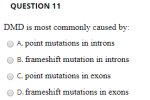 QUESTION 11 DMD is most commonly caused by: A. point mutations in introns B. frameshift mutation in introns C. point mutations in exons D. frameshift mutations in exons
QUESTION 2 Which of the following is a somatic sense? A. sight B. sound C. taste...
 QUESTION 2 Which of the following is a somatic sense? A. sight B. sound C. taste D.taste E. smell QUESTION 3 The semicircular canals A. contain cupula that respond to gravity B. have a base called a papilla. Callow a person to detect movement in all directions D. are parallel to each other
34. Compensatory mutations in genes for noncoding RNAs indicate that: A) these genes are not important...
34. Compensatory mutations in genes for noncoding RNAs indicate that: A) these genes are not important for the function of the organism. B) the secondary structure of the noncoding RNA is important for its function. C) the noncoding RNA is not undergoing accelerated evolution. D) All of the answers are correct. E) None of the answers is correct. 35. Which statement true about the formation of early organisms? A) The first organisms were anaerobic because the atmosphere was devoid of...
Question 5 (1 point) Describe this: Tt Question 5 options: A) homozygous phenotype B) heterozygous genotype...
Question 5 (1 point) Describe this: Tt Question 5 options: A) homozygous phenotype B) heterozygous genotype C) homozygous genotype D) heterozygous phenotype Question 6 (1 point) Which of these is a prenatal genetic test? Question 6 options: A) in vitro fertilization B) nuclear transplantation C) chorionic villi sampling D) DNA profiling Question 7 (1 point) All the offspring of a white hen and a black rooster are gray. The simplest explanation for this type of inheritance is: Question 7 options:...
Question 37 The length of most commonly used STR loci is: A. 100-500 bp B. 1000-5000...
 Question 37 The length of most commonly used STR loci is: A. 100-500 bp B. 1000-5000 bp C. 2-6 bp D. None of the above
1. Animals can teach us genetics. Match Codominance Show a dominant and recessive relationship _An allelic...
 1. Animals can teach us genetics. Match Codominance Show a dominant and recessive relationship _An allelic series A dominant homozygote is lethal Coat coloration is determined by 2 genes Shows variable expressivity A qualitative, or continuous, trait involving polygenes Females mosaics for X-linked heterozygous color genes A. Manx cat B. Coat coloration rabbits C. Labrador retriever dogs D. Piebald spotting in beagles E. A and B blood alleles F. A and O blood alleles G. Calico cat H. Height of...
20. Phenotypic plasticity A. is when an organism survives but not does not reproduce. B. only...
 20. Phenotypic plasticity A. is when an organism survives but not does not reproduce. B. only happens for animals, not plants C. is the altered phenotype of organism based on variation in genotype. D. none of the above 21. Commensalism is when A. for example, there is colonization by a gastrointestinal bacterial species that provides neither a benefit nor an ailment for the host B. there is an exaptation due to hybridization C. there is a mixture of chromosomes as...
 Question 43 Which of the following is a factor affecting genotype results in STR analysis: O A. Mutations at STR core repeat regions OB. Gene duplications O C. Point mutations OD. All of the above
 QUESTION 7 What are the potential consequences of un-repaired DNA damage (i.e. mutations) (select all that apply)? A. Somatic mutations lead to changes in fitness for the affected individual ONLY B. Germ line mutations lead to cancer or other disease in the affected individual ONLY OC. Somatic mutations lead to cancer or other disease in the affected individual ONLY D. Germ line mutations lead to generation of new alleles that are passed on to the progeny E. Germ line mutations...
 So this question is asking for me to determine what genotype
these individuals are based off the gel electrophoresis scan next
to it.
5. Observe the photograph of a stained gel containing the PMCT118 amplified results from 6 unknown people. a. Lanes 1, 4, 7 and 10 contain and allelic ladder that corresponds to a sample mixture containing all 32 alleles at the PMCT118 locus 1 2 3 4 5 6 7 8 9 10 (alleles 13, 20, 30 and...
So this question is asking for me to determine what genotype
these individuals are based off the gel electrophoresis scan next
to it.
5. Observe the photograph of a stained gel containing the PMCT118 amplified results from 6 unknown people. a. Lanes 1, 4, 7 and 10 contain and allelic ladder that corresponds to a sample mixture containing all 32 alleles at the PMCT118 locus 1 2 3 4 5 6 7 8 9 10 (alleles 13, 20, 30 and...
 QUESTION 11 DMD is most commonly caused by: A. point mutations in introns B. frameshift mutation in introns C. point mutations in exons D. frameshift mutations in exons
 QUESTION 2 Which of the following is a somatic sense? A. sight B. sound C. taste D.taste E. smell QUESTION 3 The semicircular canals A. contain cupula that respond to gravity B. have a base called a papilla. Callow a person to detect movement in all directions D. are parallel to each other
 Question 37 The length of most commonly used STR loci is: A. 100-500 bp B. 1000-5000 bp C. 2-6 bp D. None of the above
 1. Animals can teach us genetics. Match Codominance Show a dominant and recessive relationship _An allelic series A dominant homozygote is lethal Coat coloration is determined by 2 genes Shows variable expressivity A qualitative, or continuous, trait involving polygenes Females mosaics for X-linked heterozygous color genes A. Manx cat B. Coat coloration rabbits C. Labrador retriever dogs D. Piebald spotting in beagles E. A and B blood alleles F. A and O blood alleles G. Calico cat H. Height of...
 20. Phenotypic plasticity A. is when an organism survives but not does not reproduce. B. only happens for animals, not plants C. is the altered phenotype of organism based on variation in genotype. D. none of the above 21. Commensalism is when A. for example, there is colonization by a gastrointestinal bacterial species that provides neither a benefit nor an ailment for the host B. there is an exaptation due to hybridization C. there is a mixture of chromosomes as...
Most questions answered within 3 hours.
-
Where is the error in this code sequence?
String s1 = "Hello";
String s2 = "ello";...
asked 10 months ago -
Financial data for Joel de Paris, Inc., for last year
follow:
Joel de Paris, Inc.
Balance...
asked 10 months ago -
Consider this reaction:
Al2(SO4)3 (aq)+ BaCl3
(aq) Al2Cl6 (aq)- +
3BaSO4(s) . What is the...
asked 10 months ago -
Suppose that Savneet is considering increasing her
recent random sample from 20 car rentals to 40...
asked 10 months ago -
Trucks arrive at an unloading terminal at an average rate of 120
per hour.
Trucks arrive...
asked 10 months ago -
Why are methanol and ethanol completely soluble in water while
octanol is not very little soluble....
asked 10 months ago -
A facilities manager at a university reads in a research report
that the mean amount of...
asked 10 months ago -
When the CuSO4 is rehydrated by adding water to the anhydrous
compound, is this an endothermic...
asked 10 months ago -
A ray of sunlight is passing from diamond into crown glass; the
angle of incidence is...
asked 10 months ago -
A block of mass 0.249 kg is placed on top of a light, vertical
spring of...
asked 10 months ago -
how do the kidneys compensate in the presences of acidosis
a) trigger hyperventilate
b) reserve acid...
asked 10 months ago -
Question 501 pts
The rental rate of capital to the firm increases. Which of the
following...
asked 10 months ago