
Homework Answers
Request Answer!
We need at least 10 more requests to produce the answer.
0 / 10 have requested this problem solution
The more requests, the faster the answer.
Add Answer to:
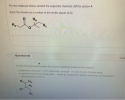
6. Four part problem, all about the molecule shown in part a.) a.) Name the following...
Apply the n+1 rule to assign the multiplicity (splitting) of each of the protons indicated by...
 Apply the n+1 rule to assign the multiplicity (splitting) of each of the protons indicated by an arrow. Possible answers include: singlet, doublet, triplet, quartet, quintet, sextet, septet, octet and nonet. A molecule with formula C_2H_gO gave the NMR peaks below. Draw its structure.^1H NMR: 2.6 ppm (quartet, 2 hydrogens) 2.1 ppm (singlet, 3 hydrogens) 1.1 ppm (triplet, 3 hydrogens)^13C NMR: 215 ppm, 36 ppm, 26 ppm, 8 ppm
can u pls answer all the questions 32. What is the expected splitting pattern for the...
 can u pls answer all the questions
32. What is the expected splitting pattern for the indicated hydrogen? d. quartet a. Singlet b. Doublet C. Triplet e. quintet 33. What apparent splitting pattern would NOT be found in the 'H NMR spectrum for the following molecule? a. singlet w ord. quintet e. multiplet b. triplet c. quartet 34. Which of the following molecules would have a quartet at 3.5 ppm? но он
can u pls answer all the questions
32. What is the expected splitting pattern for the indicated hydrogen? d. quartet a. Singlet b. Doublet C. Triplet e. quintet 33. What apparent splitting pattern would NOT be found in the 'H NMR spectrum for the following molecule? a. singlet w ord. quintet e. multiplet b. triplet c. quartet 34. Which of the following molecules would have a quartet at 3.5 ppm? но он
What types of splitting patterns would you expect in the proton NMR spectrum of the molecule...
 What types of splitting patterns would you expect in the proton NMR spectrum of the molecule shown below? Mark all that apply. singlet А doublet B triplet с quartet D sextet E ОА OB Ос Dם О Е D Question 9 4 pts Which compound corresponds to the 'H NMR spectrum below? (Integral values are indicated above/beside signals.) ОА Ос OE
18) How many signals would you expect to see in the 1H NMR spectrum of the...
 18) How many signals would you expect to see in the 1H NMR spectrum of the following compound? 18) NI CH3CH2CH2CCH3 A) 6 B) 4 C)2 D) 5 E) 3 3 19) What splitting pattern is observed in the 1H NMR spectrum for the indicated hydrogens? OCH CH3 19) - D) quartet E) septet A) singlet B) doublet C) triplet 20) Which of the following alcohols dehydrates most rapidly? 1 -OH IV. CH3- 20) CH3- II. CH3 OH Cox HO...
The signals in the 1H NMR spectrum of butanoic acid are labelled from A to D....
The signals in the 1H NMR spectrum of butanoic acid are labelled from A to D. Considering the spectrum, answer the questions below: [4 marks] Complete the table: Signal Chemical shift, δ (ppm) Splitting pattern (singlet, doublet, triplet, quartet, pentet, sixtet, septet, octet, nonet, multiplet) # of H neighbours Integration (# of protons) Circle or highlight the proton(s) that give rise to this signal A 11.60 CH3CH2CH2COOH B 2.35 CH3CH2CH2COOH C 1.68 CH3CH2CH2COOH D 0.98 CH3CH2CH2COOH [2 marks] Compare this...
Part 1: For each of the following structures, indicate the integration expected for the signal associated...
 Part 1: For each of the following structures, indicate the
integration expected for the signal associated with the indicated
hydrogen(s).
a)
i)
ii)
iii)
iv)
b)
i)
ii)
iii)
c)
i)
ii)
iii)
d)
i)
ii)
iii)
iv)
v)
vi)
e)
i)
ii)
iii)
iv)
f)
i)
ii)
iii)
iv)
v)
vi)
Part 2: For each of the following structures, indicate the
coupling (a.k.a, splitting) pattern expected for the signal
associated with the indicated hydrogen(s) by placing the
appropriate letter(s)...
Part 1: For each of the following structures, indicate the
integration expected for the signal associated with the indicated
hydrogen(s).
a)
i)
ii)
iii)
iv)
b)
i)
ii)
iii)
c)
i)
ii)
iii)
d)
i)
ii)
iii)
iv)
v)
vi)
e)
i)
ii)
iii)
iv)
f)
i)
ii)
iii)
iv)
v)
vi)
Part 2: For each of the following structures, indicate the
coupling (a.k.a, splitting) pattern expected for the signal
associated with the indicated hydrogen(s) by placing the
appropriate letter(s)...
both questions plz! For the molecule below, predict the expected chemical shift for proton A. Enter...
 both questions plz!
For the molecule below, predict the expected chemical shift for proton A. Enter the answer as a number to the tenths places (X.X) Question 10 3 pts For the molecule below. predict the expected splitting (multiplicity) for proton C. • determine using the m= N+1 relationship, where N = # vicinal H's (H's 3-bonds away) • report the answer as a single letter - singlet (s), doublet (d) triplet (1) quartet (9) quintet (quin) or multiplet (m)...
both questions plz!
For the molecule below, predict the expected chemical shift for proton A. Enter the answer as a number to the tenths places (X.X) Question 10 3 pts For the molecule below. predict the expected splitting (multiplicity) for proton C. • determine using the m= N+1 relationship, where N = # vicinal H's (H's 3-bonds away) • report the answer as a single letter - singlet (s), doublet (d) triplet (1) quartet (9) quintet (quin) or multiplet (m)...
Question 8 4 pts What types of splitting patterns would you expect in the proton NMR...
 Question 8 4 pts What types of splitting patterns would you expect in the proton NMR spectrum of the molecule shown below? Mark all that apply. es doublet singlet A triplet с quartet D sextet E B ОА OB Ос OD ОЕ Question 9 4 pts Which compound corresponds to the H NMR spectrum below? (Integral values are indicated above/beside signals.) 3 3 2 1 0 2 PPM FO 6 ho La А B с D E OB o D...
Begin by naming the molecule. What functional group could this alcohol be converted to using only...
 Begin by naming the molecule.
What functional group could this alcohol be converted to using
only one step?
How many signals would be seen in the 13C NMR
specturm of the alcohol above?
What splitting patterns would be seen in the 1H NMR
spectrum of the alcohol, assuming that the OH proton behaves like a
CH proton in terms of splitting? (single, double, triplet...)
НО,
Begin by naming the molecule.
What functional group could this alcohol be converted to using
only one step?
How many signals would be seen in the 13C NMR
specturm of the alcohol above?
What splitting patterns would be seen in the 1H NMR
spectrum of the alcohol, assuming that the OH proton behaves like a
CH proton in terms of splitting? (single, double, triplet...)
НО,
Organic Lab Technique Problem Set 1) How many different sets of equivalent protons are there in...
 Organic Lab Technique Problem Set 1) How many different sets of equivalent protons are there in the following compound? CI CH3CCH2C(CH3)3 CH3 5. Which or the spect A. three B. four C. five D. six 2) Which of the following gives the furthest downfield shift from TMS in its proton NMR spectrum? A. CC14 B. CHCl3 C. CH2C12 D. CH3CI 3) Which of the following has only a single peak in its proton NMR spectrum? I. (CH3)3CCI II. (CH3)2C=C(CH3)2 H,C...
 Apply the n+1 rule to assign the multiplicity (splitting) of each of the protons indicated by an arrow. Possible answers include: singlet, doublet, triplet, quartet, quintet, sextet, septet, octet and nonet. A molecule with formula C_2H_gO gave the NMR peaks below. Draw its structure.^1H NMR: 2.6 ppm (quartet, 2 hydrogens) 2.1 ppm (singlet, 3 hydrogens) 1.1 ppm (triplet, 3 hydrogens)^13C NMR: 215 ppm, 36 ppm, 26 ppm, 8 ppm
 can u pls answer all the questions
32. What is the expected splitting pattern for the indicated hydrogen? d. quartet a. Singlet b. Doublet C. Triplet e. quintet 33. What apparent splitting pattern would NOT be found in the 'H NMR spectrum for the following molecule? a. singlet w ord. quintet e. multiplet b. triplet c. quartet 34. Which of the following molecules would have a quartet at 3.5 ppm? но он
can u pls answer all the questions
32. What is the expected splitting pattern for the indicated hydrogen? d. quartet a. Singlet b. Doublet C. Triplet e. quintet 33. What apparent splitting pattern would NOT be found in the 'H NMR spectrum for the following molecule? a. singlet w ord. quintet e. multiplet b. triplet c. quartet 34. Which of the following molecules would have a quartet at 3.5 ppm? но он
 What types of splitting patterns would you expect in the proton NMR spectrum of the molecule shown below? Mark all that apply. singlet А doublet B triplet с quartet D sextet E ОА OB Ос Dם О Е D Question 9 4 pts Which compound corresponds to the 'H NMR spectrum below? (Integral values are indicated above/beside signals.) ОА Ос OE
 18) How many signals would you expect to see in the 1H NMR spectrum of the following compound? 18) NI CH3CH2CH2CCH3 A) 6 B) 4 C)2 D) 5 E) 3 3 19) What splitting pattern is observed in the 1H NMR spectrum for the indicated hydrogens? OCH CH3 19) - D) quartet E) septet A) singlet B) doublet C) triplet 20) Which of the following alcohols dehydrates most rapidly? 1 -OH IV. CH3- 20) CH3- II. CH3 OH Cox HO...
 Part 1: For each of the following structures, indicate the
integration expected for the signal associated with the indicated
hydrogen(s).
a)
i)
ii)
iii)
iv)
b)
i)
ii)
iii)
c)
i)
ii)
iii)
d)
i)
ii)
iii)
iv)
v)
vi)
e)
i)
ii)
iii)
iv)
f)
i)
ii)
iii)
iv)
v)
vi)
Part 2: For each of the following structures, indicate the
coupling (a.k.a, splitting) pattern expected for the signal
associated with the indicated hydrogen(s) by placing the
appropriate letter(s)...
Part 1: For each of the following structures, indicate the
integration expected for the signal associated with the indicated
hydrogen(s).
a)
i)
ii)
iii)
iv)
b)
i)
ii)
iii)
c)
i)
ii)
iii)
d)
i)
ii)
iii)
iv)
v)
vi)
e)
i)
ii)
iii)
iv)
f)
i)
ii)
iii)
iv)
v)
vi)
Part 2: For each of the following structures, indicate the
coupling (a.k.a, splitting) pattern expected for the signal
associated with the indicated hydrogen(s) by placing the
appropriate letter(s)...
 both questions plz!
For the molecule below, predict the expected chemical shift for proton A. Enter the answer as a number to the tenths places (X.X) Question 10 3 pts For the molecule below. predict the expected splitting (multiplicity) for proton C. • determine using the m= N+1 relationship, where N = # vicinal H's (H's 3-bonds away) • report the answer as a single letter - singlet (s), doublet (d) triplet (1) quartet (9) quintet (quin) or multiplet (m)...
both questions plz!
For the molecule below, predict the expected chemical shift for proton A. Enter the answer as a number to the tenths places (X.X) Question 10 3 pts For the molecule below. predict the expected splitting (multiplicity) for proton C. • determine using the m= N+1 relationship, where N = # vicinal H's (H's 3-bonds away) • report the answer as a single letter - singlet (s), doublet (d) triplet (1) quartet (9) quintet (quin) or multiplet (m)...
 Question 8 4 pts What types of splitting patterns would you expect in the proton NMR spectrum of the molecule shown below? Mark all that apply. es doublet singlet A triplet с quartet D sextet E B ОА OB Ос OD ОЕ Question 9 4 pts Which compound corresponds to the H NMR spectrum below? (Integral values are indicated above/beside signals.) 3 3 2 1 0 2 PPM FO 6 ho La А B с D E OB o D...
 Begin by naming the molecule.
What functional group could this alcohol be converted to using
only one step?
How many signals would be seen in the 13C NMR
specturm of the alcohol above?
What splitting patterns would be seen in the 1H NMR
spectrum of the alcohol, assuming that the OH proton behaves like a
CH proton in terms of splitting? (single, double, triplet...)
НО,
Begin by naming the molecule.
What functional group could this alcohol be converted to using
only one step?
How many signals would be seen in the 13C NMR
specturm of the alcohol above?
What splitting patterns would be seen in the 1H NMR
spectrum of the alcohol, assuming that the OH proton behaves like a
CH proton in terms of splitting? (single, double, triplet...)
НО,
 Organic Lab Technique Problem Set 1) How many different sets of equivalent protons are there in the following compound? CI CH3CCH2C(CH3)3 CH3 5. Which or the spect A. three B. four C. five D. six 2) Which of the following gives the furthest downfield shift from TMS in its proton NMR spectrum? A. CC14 B. CHCl3 C. CH2C12 D. CH3CI 3) Which of the following has only a single peak in its proton NMR spectrum? I. (CH3)3CCI II. (CH3)2C=C(CH3)2 H,C...
Most questions answered within 3 hours.
-
Where is the error in this code sequence?
String s1 = "Hello";
String s2 = "ello";...
asked 10 months ago -
Financial data for Joel de Paris, Inc., for last year
follow:
Joel de Paris, Inc.
Balance...
asked 10 months ago -
Consider this reaction:
Al2(SO4)3 (aq)+ BaCl3
(aq) Al2Cl6 (aq)- +
3BaSO4(s) . What is the...
asked 10 months ago -
Suppose that Savneet is considering increasing her
recent random sample from 20 car rentals to 40...
asked 10 months ago -
Trucks arrive at an unloading terminal at an average rate of 120
per hour.
Trucks arrive...
asked 10 months ago -
Why are methanol and ethanol completely soluble in water while
octanol is not very little soluble....
asked 10 months ago -
A facilities manager at a university reads in a research report
that the mean amount of...
asked 10 months ago -
When the CuSO4 is rehydrated by adding water to the anhydrous
compound, is this an endothermic...
asked 10 months ago -
A ray of sunlight is passing from diamond into crown glass; the
angle of incidence is...
asked 10 months ago -
A block of mass 0.249 kg is placed on top of a light, vertical
spring of...
asked 10 months ago -
how do the kidneys compensate in the presences of acidosis
a) trigger hyperventilate
b) reserve acid...
asked 10 months ago -
Question 501 pts
The rental rate of capital to the firm increases. Which of the
following...
asked 10 months ago