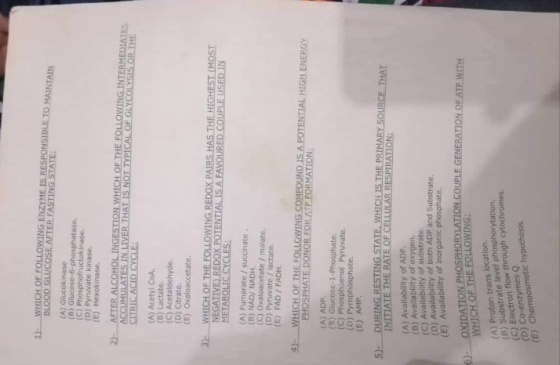
Biochemistry metabolisms..please help and answer these confimly i will be thankfull
Homework Answers
Request Answer!
We need at least 5 more requests to produce the answer.
5 / 10 have requested this problem solution
The more requests, the faster the answer.
Add Answer to:
Biochemistry metabolisms..please help and answer these confimly i will be thankfull
For biochemistry- Oxidative Phosphorylation please answer all 3 i really need help with these. thank you!!...
 For biochemistry- Oxidative Phosphorylation
please answer all 3 i really need help with these. thank you!!
10. For a given reduced/oxidized molecular pair (X /X), a negative reducing potential suggests that the x has a higher affinity for the electrons than x does X has a higher affinity for electrons than H2 does. X has a lower affinity for the electrons than x does X has a lower affinity for electrons than H2 does.
For biochemistry- Oxidative Phosphorylation
please answer all 3 i really need help with these. thank you!!
10. For a given reduced/oxidized molecular pair (X /X), a negative reducing potential suggests that the x has a higher affinity for the electrons than x does X has a higher affinity for electrons than H2 does. X has a lower affinity for the electrons than x does X has a lower affinity for electrons than H2 does.
This is a biochemistry question, please take the time to answer both questions and I will...
 This is a biochemistry question, please take the time to answer
both questions and I will like as soon as the answer is posted.
Thanks in advance!
QUESTION 7 From the graph below, identify the O2 binding curves for the following proteins. 100. a b % saturation 50 PO2 (torr) Hemoglobin A (HbA, P50 = 30 torr) - A mutated hemoglobin that has lost all cooperativity u HbA in presence of 8 mM BPG (elevated relative to normal [BPG] -...
This is a biochemistry question, please take the time to answer
both questions and I will like as soon as the answer is posted.
Thanks in advance!
QUESTION 7 From the graph below, identify the O2 binding curves for the following proteins. 100. a b % saturation 50 PO2 (torr) Hemoglobin A (HbA, P50 = 30 torr) - A mutated hemoglobin that has lost all cooperativity u HbA in presence of 8 mM BPG (elevated relative to normal [BPG] -...
This is a biochemistry question, please take the time to answer both questions and I will...
 This is a biochemistry question, please take the time to answer
both questions and I will like as soon as the answer is posted.
Thanks in advance!
QUESTION 9 Glycolysis is divided into two stages. Identify which of the following characteristics pertain to stage 1 or stage 2 of glycolysis. A. stage 1 - ATP is utilized B. stage 2 - ATP is synthesized - Six-carbon compounds are involved Only three-carbon compounds are involved - - NADH is produced QUESTION...
This is a biochemistry question, please take the time to answer
both questions and I will like as soon as the answer is posted.
Thanks in advance!
QUESTION 9 Glycolysis is divided into two stages. Identify which of the following characteristics pertain to stage 1 or stage 2 of glycolysis. A. stage 1 - ATP is utilized B. stage 2 - ATP is synthesized - Six-carbon compounds are involved Only three-carbon compounds are involved - - NADH is produced QUESTION...
This is a biochemistry question, please take the time to answer both questions and I will...
 This is a biochemistry question, please take the time to answer
both questions and I will like as soon as the answer is posted.
Thanks in advance!
QUESTION 7 Which of these molecules is NOT produced in glycolysis? Glucose-6-phosphate Fructose-6-phosphate water Inorganic phosphate ATP QUESTION 8 Glycolysis is connected to many other metabolic pathways, which can feed intermediates into glycolysis at different steps. Starting glycolysis at dihydroxyacetone phosphate will give a net yield (per DHAP molecule) of: 2 mol of...
This is a biochemistry question, please take the time to answer
both questions and I will like as soon as the answer is posted.
Thanks in advance!
QUESTION 7 Which of these molecules is NOT produced in glycolysis? Glucose-6-phosphate Fructose-6-phosphate water Inorganic phosphate ATP QUESTION 8 Glycolysis is connected to many other metabolic pathways, which can feed intermediates into glycolysis at different steps. Starting glycolysis at dihydroxyacetone phosphate will give a net yield (per DHAP molecule) of: 2 mol of...
This is a biochemistry question, please take the time to answer both questions and I will...
 This is a biochemistry question, please take the time to answer
both questions and I will like as soon as the answer is posted.
Thanks in advance!
QUESTION 5 Select all the statements that apply to enolase in glycolysis. Catalyzes a reversible reaction Is a regulated enzyme Catalyzes a dehydration Catalyzes a hydrolysis Forms a high-energy intermediate Catalyzes an oxidation Catalyzes a coupled reaction QUESTION 6 Select all the statements that apply to phosphofructokinase in glycolysis. Catalyzes the rate-limiting step...
This is a biochemistry question, please take the time to answer
both questions and I will like as soon as the answer is posted.
Thanks in advance!
QUESTION 5 Select all the statements that apply to enolase in glycolysis. Catalyzes a reversible reaction Is a regulated enzyme Catalyzes a dehydration Catalyzes a hydrolysis Forms a high-energy intermediate Catalyzes an oxidation Catalyzes a coupled reaction QUESTION 6 Select all the statements that apply to phosphofructokinase in glycolysis. Catalyzes the rate-limiting step...
biochemistry if you could please help me answer the following questions! EFT i 11) (6 pts)...
 biochemistry
if you could please help me answer the following questions!
EFT i 11) (6 pts) Which types of symmetry are possible for a protein with six (6) identical subunits? (Select all correct answers) a) cyclic C b) cyclic C3 c) dihedral D2 d) dihedral D e) octahedral o f) icosahedral ро, Yo₂ - pO₂+ Pso 12) (6 pts) What is the fractional saturation of oxygen binding to myoglobin when the partial pressure of oxygen is 1.5 torr and dissociation...
biochemistry
if you could please help me answer the following questions!
EFT i 11) (6 pts) Which types of symmetry are possible for a protein with six (6) identical subunits? (Select all correct answers) a) cyclic C b) cyclic C3 c) dihedral D2 d) dihedral D e) octahedral o f) icosahedral ро, Yo₂ - pO₂+ Pso 12) (6 pts) What is the fractional saturation of oxygen binding to myoglobin when the partial pressure of oxygen is 1.5 torr and dissociation...
Biochemistry: PLEASE EXPLAIN YOUR ANSWER
 Biochemistry: PLEASE EXPLAIN YOUR ANSWER
Help! I do not understand how to answer this biochemistry question! Which of the following binding...
Help! I do not understand how to answer this biochemistry question! Which of the following binding modes does a Walker A, P-loop ATP/GTP binding motif (AXXXXGKT) use to interact with ATP? A. phosphoryl transfer B. nucleotide transfer C. pyrophosphoryl transfer D. adenosyl transfer
Experimental Biochemistry pKa of Amino Acids.. ** PLEASE ANSWER IN CLER HAND WRITING PLEASE HELP AND ANSWER AS SOON AS P...
 Experimental Biochemistry pKa of Amino Acids.. ** PLEASE ANSWER
IN CLER HAND WRITING PLEASE HELP AND ANSWER AS SOON AS
POSSIBLE**
1- where the pKas are located (for pKa1, pKa2 and if
applicable, pKa3) for your unknown.
2-write their values on the correct parts of the graph. c)
mark where the buffering regions are.
3-Record the pKa values below, that you obtained from the
graphpKa1=_______ pKa2=__________ ; pKa3 (if
present)=_________
4-For pI value: Show the correct formula to use for...
Experimental Biochemistry pKa of Amino Acids.. ** PLEASE ANSWER
IN CLER HAND WRITING PLEASE HELP AND ANSWER AS SOON AS
POSSIBLE**
1- where the pKas are located (for pKa1, pKa2 and if
applicable, pKa3) for your unknown.
2-write their values on the correct parts of the graph. c)
mark where the buffering regions are.
3-Record the pKa values below, that you obtained from the
graphpKa1=_______ pKa2=__________ ; pKa3 (if
present)=_________
4-For pI value: Show the correct formula to use for...
This is Biochemistry. I need help with Q1 and Q2. Please be detailed. Thanks DISCUSSION HMW...
 This is Biochemistry. I need help with Q1 and Q2.
Please be detailed. Thanks
DISCUSSION HMW 2 Q1. Ad apted from: Keith J. Chappell, Martin J. Stoermer, David P. Fairlie, and Paul R. Young Insights Substrate Binding and Processing by West Nile Virus N$3 Protease through Combined Modeling. Protease Mutagenesis, and Kinetic St Mosquito borne flaviviruses include West Nile Virus (WNV) and Denge Viruses (Den1-4). One of the most important differences between the sequences of the proteins these two viruses...
This is Biochemistry. I need help with Q1 and Q2.
Please be detailed. Thanks
DISCUSSION HMW 2 Q1. Ad apted from: Keith J. Chappell, Martin J. Stoermer, David P. Fairlie, and Paul R. Young Insights Substrate Binding and Processing by West Nile Virus N$3 Protease through Combined Modeling. Protease Mutagenesis, and Kinetic St Mosquito borne flaviviruses include West Nile Virus (WNV) and Denge Viruses (Den1-4). One of the most important differences between the sequences of the proteins these two viruses...
 For biochemistry- Oxidative Phosphorylation
please answer all 3 i really need help with these. thank you!!
10. For a given reduced/oxidized molecular pair (X /X), a negative reducing potential suggests that the x has a higher affinity for the electrons than x does X has a higher affinity for electrons than H2 does. X has a lower affinity for the electrons than x does X has a lower affinity for electrons than H2 does.
For biochemistry- Oxidative Phosphorylation
please answer all 3 i really need help with these. thank you!!
10. For a given reduced/oxidized molecular pair (X /X), a negative reducing potential suggests that the x has a higher affinity for the electrons than x does X has a higher affinity for electrons than H2 does. X has a lower affinity for the electrons than x does X has a lower affinity for electrons than H2 does.
 This is a biochemistry question, please take the time to answer
both questions and I will like as soon as the answer is posted.
Thanks in advance!
QUESTION 7 From the graph below, identify the O2 binding curves for the following proteins. 100. a b % saturation 50 PO2 (torr) Hemoglobin A (HbA, P50 = 30 torr) - A mutated hemoglobin that has lost all cooperativity u HbA in presence of 8 mM BPG (elevated relative to normal [BPG] -...
This is a biochemistry question, please take the time to answer
both questions and I will like as soon as the answer is posted.
Thanks in advance!
QUESTION 7 From the graph below, identify the O2 binding curves for the following proteins. 100. a b % saturation 50 PO2 (torr) Hemoglobin A (HbA, P50 = 30 torr) - A mutated hemoglobin that has lost all cooperativity u HbA in presence of 8 mM BPG (elevated relative to normal [BPG] -...
 This is a biochemistry question, please take the time to answer
both questions and I will like as soon as the answer is posted.
Thanks in advance!
QUESTION 9 Glycolysis is divided into two stages. Identify which of the following characteristics pertain to stage 1 or stage 2 of glycolysis. A. stage 1 - ATP is utilized B. stage 2 - ATP is synthesized - Six-carbon compounds are involved Only three-carbon compounds are involved - - NADH is produced QUESTION...
This is a biochemistry question, please take the time to answer
both questions and I will like as soon as the answer is posted.
Thanks in advance!
QUESTION 9 Glycolysis is divided into two stages. Identify which of the following characteristics pertain to stage 1 or stage 2 of glycolysis. A. stage 1 - ATP is utilized B. stage 2 - ATP is synthesized - Six-carbon compounds are involved Only three-carbon compounds are involved - - NADH is produced QUESTION...
 This is a biochemistry question, please take the time to answer
both questions and I will like as soon as the answer is posted.
Thanks in advance!
QUESTION 7 Which of these molecules is NOT produced in glycolysis? Glucose-6-phosphate Fructose-6-phosphate water Inorganic phosphate ATP QUESTION 8 Glycolysis is connected to many other metabolic pathways, which can feed intermediates into glycolysis at different steps. Starting glycolysis at dihydroxyacetone phosphate will give a net yield (per DHAP molecule) of: 2 mol of...
This is a biochemistry question, please take the time to answer
both questions and I will like as soon as the answer is posted.
Thanks in advance!
QUESTION 7 Which of these molecules is NOT produced in glycolysis? Glucose-6-phosphate Fructose-6-phosphate water Inorganic phosphate ATP QUESTION 8 Glycolysis is connected to many other metabolic pathways, which can feed intermediates into glycolysis at different steps. Starting glycolysis at dihydroxyacetone phosphate will give a net yield (per DHAP molecule) of: 2 mol of...
 This is a biochemistry question, please take the time to answer
both questions and I will like as soon as the answer is posted.
Thanks in advance!
QUESTION 5 Select all the statements that apply to enolase in glycolysis. Catalyzes a reversible reaction Is a regulated enzyme Catalyzes a dehydration Catalyzes a hydrolysis Forms a high-energy intermediate Catalyzes an oxidation Catalyzes a coupled reaction QUESTION 6 Select all the statements that apply to phosphofructokinase in glycolysis. Catalyzes the rate-limiting step...
This is a biochemistry question, please take the time to answer
both questions and I will like as soon as the answer is posted.
Thanks in advance!
QUESTION 5 Select all the statements that apply to enolase in glycolysis. Catalyzes a reversible reaction Is a regulated enzyme Catalyzes a dehydration Catalyzes a hydrolysis Forms a high-energy intermediate Catalyzes an oxidation Catalyzes a coupled reaction QUESTION 6 Select all the statements that apply to phosphofructokinase in glycolysis. Catalyzes the rate-limiting step...
 biochemistry
if you could please help me answer the following questions!
EFT i 11) (6 pts) Which types of symmetry are possible for a protein with six (6) identical subunits? (Select all correct answers) a) cyclic C b) cyclic C3 c) dihedral D2 d) dihedral D e) octahedral o f) icosahedral ро, Yo₂ - pO₂+ Pso 12) (6 pts) What is the fractional saturation of oxygen binding to myoglobin when the partial pressure of oxygen is 1.5 torr and dissociation...
biochemistry
if you could please help me answer the following questions!
EFT i 11) (6 pts) Which types of symmetry are possible for a protein with six (6) identical subunits? (Select all correct answers) a) cyclic C b) cyclic C3 c) dihedral D2 d) dihedral D e) octahedral o f) icosahedral ро, Yo₂ - pO₂+ Pso 12) (6 pts) What is the fractional saturation of oxygen binding to myoglobin when the partial pressure of oxygen is 1.5 torr and dissociation...
 Biochemistry: PLEASE EXPLAIN YOUR ANSWER
 Experimental Biochemistry pKa of Amino Acids.. ** PLEASE ANSWER
IN CLER HAND WRITING PLEASE HELP AND ANSWER AS SOON AS
POSSIBLE**
1- where the pKas are located (for pKa1, pKa2 and if
applicable, pKa3) for your unknown.
2-write their values on the correct parts of the graph. c)
mark where the buffering regions are.
3-Record the pKa values below, that you obtained from the
graphpKa1=_______ pKa2=__________ ; pKa3 (if
present)=_________
4-For pI value: Show the correct formula to use for...
Experimental Biochemistry pKa of Amino Acids.. ** PLEASE ANSWER
IN CLER HAND WRITING PLEASE HELP AND ANSWER AS SOON AS
POSSIBLE**
1- where the pKas are located (for pKa1, pKa2 and if
applicable, pKa3) for your unknown.
2-write their values on the correct parts of the graph. c)
mark where the buffering regions are.
3-Record the pKa values below, that you obtained from the
graphpKa1=_______ pKa2=__________ ; pKa3 (if
present)=_________
4-For pI value: Show the correct formula to use for...
 This is Biochemistry. I need help with Q1 and Q2.
Please be detailed. Thanks
DISCUSSION HMW 2 Q1. Ad apted from: Keith J. Chappell, Martin J. Stoermer, David P. Fairlie, and Paul R. Young Insights Substrate Binding and Processing by West Nile Virus N$3 Protease through Combined Modeling. Protease Mutagenesis, and Kinetic St Mosquito borne flaviviruses include West Nile Virus (WNV) and Denge Viruses (Den1-4). One of the most important differences between the sequences of the proteins these two viruses...
This is Biochemistry. I need help with Q1 and Q2.
Please be detailed. Thanks
DISCUSSION HMW 2 Q1. Ad apted from: Keith J. Chappell, Martin J. Stoermer, David P. Fairlie, and Paul R. Young Insights Substrate Binding and Processing by West Nile Virus N$3 Protease through Combined Modeling. Protease Mutagenesis, and Kinetic St Mosquito borne flaviviruses include West Nile Virus (WNV) and Denge Viruses (Den1-4). One of the most important differences between the sequences of the proteins these two viruses...
Most questions answered within 3 hours.
-
Where is the error in this code sequence?
String s1 = "Hello";
String s2 = "ello";...
asked 10 months ago -
Financial data for Joel de Paris, Inc., for last year
follow:
Joel de Paris, Inc.
Balance...
asked 10 months ago -
Consider this reaction:
Al2(SO4)3 (aq)+ BaCl3
(aq) Al2Cl6 (aq)- +
3BaSO4(s) . What is the...
asked 10 months ago -
Suppose that Savneet is considering increasing her
recent random sample from 20 car rentals to 40...
asked 10 months ago -
Trucks arrive at an unloading terminal at an average rate of 120
per hour.
Trucks arrive...
asked 10 months ago -
Why are methanol and ethanol completely soluble in water while
octanol is not very little soluble....
asked 10 months ago -
A facilities manager at a university reads in a research report
that the mean amount of...
asked 10 months ago -
When the CuSO4 is rehydrated by adding water to the anhydrous
compound, is this an endothermic...
asked 10 months ago -
A ray of sunlight is passing from diamond into crown glass; the
angle of incidence is...
asked 10 months ago -
A block of mass 0.249 kg is placed on top of a light, vertical
spring of...
asked 10 months ago -
how do the kidneys compensate in the presences of acidosis
a) trigger hyperventilate
b) reserve acid...
asked 10 months ago -
Question 501 pts
The rental rate of capital to the firm increases. Which of the
following...
asked 10 months ago