
Homework Answers
Add Answer to:
An object is propelled upward at an initial velocity of 32 feet per second at a....
An object is propelled upward at an initial velocity of 32 feet per second at an...
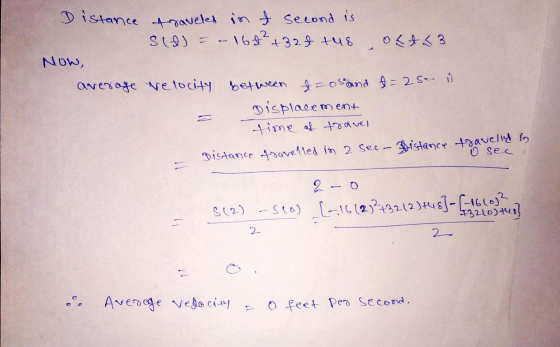
 An object is propelled upward at an initial velocity of 32 feet per second at an initial elevation of 48 feet above the ground. The free-fall model used to describe the motion is: s(t) = -1672 + 32t +48 for 03033 (t seconds from release of object). Reference: Drop the Ball Activity The average velocity between t = 2 sec and t = 3 sec A) -48 feet per second B) -24 feet per second C) 16 feet per second...
A ball is thrown vertically upward with an initial velocity of 48 feet per second.
 A ball is thrown vertically upward with an initial velocity of 48 feet per second. The distances (in feet) of the ball from the ground after t seconds is s=48-16t2. (a) At what time t will the ball strike the ground? (b) For what time t is the ball more than 32 feet above the ground?
If an object is propelled upwards from a height of 128 feet at an initial velocity...
If an object is propelled upwards from a height of 128 feet at an initial velocity of 112 feet per second, then its height h (in feet) after t seconds is given by the equation h(t) = -16t2 +112t +128 a) When does the object reach its maximum height? Determine answer analytically. b) What is the object's maximum height?
An object is thrown upward at a speed of 161 feet per second by a machine...
 An object is thrown upward at a speed of 161 feet per second by a machine from a height of 8 feet off the ground. The height h of the object after t seconds can be found using the equation h(t) = 16t2 + 161t + 8 When will the height be 67 feet? (Write both results, using a comma between). Round answers to the nearest hundredth. Select an answer Select an answer ict reach the ground? seconds 1 answer...
A ball is thrown vertically upward with an initial velocity of 96 feet per second
A ball is thrown vertically upward with an initial velocity of 96 feet per second. The distance s (in feet) of the ball from the ground after t seconds is s(t)=96t-16t^2a.) at what time will the ball strike the groundb.) for what time t is the ball more than 128 feet above the ground?c.) when will the ball reach its highest peak? how high is it above the ground?
An object is thrown upward at a speed of 194 feet per second by a machine...
An object is thrown upward at a speed of 194 feet per second by a machine from a height of 6 feet off the ground. The height hh of the object after tt seconds can be found using the equation h(t)=−16t2+194t+6h(t)=-16t2+194t+6 When will the height be 522 feet? (Write both results, using a comma between). Round answers to the nearest hundredth. When will the object reach the ground?
12. Use the fact that acceleration is - 32 feet per second per second as the...
 12. Use the fact that acceleration is - 32 feet per second per second as the acceleration due to gravity. A ball is thrown vertically upward from the ground with an initial velocity of 56 feet per second. For how many seconds will the ball be thrown upward? Recall v(t) = a(t)- dt and s(t) = f(t)-dt
If an object is thrown with a velocity of v feet per second at an angle...
If an object is thrown with a velocity of v feet per second at an angle of θ with the horizontal, then its flight can be modeled by, x = (v cos θ ) t and y = v (sin θ ) t - 16 t2 + h where t is in seconds and h is the object's initial height in feet above the ground. x is the horizontal position and y is the vertical position, and - 16 t2...
show work 4. Suppose a stone is launched vertically upward with initial velocity 32 ft/sec from...
 show work
4. Suppose a stone is launched vertically upward with initial velocity 32 ft/sec from a height of 48 ft above ground. After t seconds its height is given by s(t) = -16t2 + 32t + 48 At the time when the stone hits the ground it is moving with a speed of A. 32 ft/s B. 24 ft/s C. 64 ft/s D. 48 ft/s E. 96 ft/s
show work
4. Suppose a stone is launched vertically upward with initial velocity 32 ft/sec from a height of 48 ft above ground. After t seconds its height is given by s(t) = -16t2 + 32t + 48 At the time when the stone hits the ground it is moving with a speed of A. 32 ft/s B. 24 ft/s C. 64 ft/s D. 48 ft/s E. 96 ft/s
A model rocket is launches upward with an initial velocity of 160 feet per second
A model rocket is launches upward with an initial velocity of 160 feet per second. The height, in feet, of the rocket t seconds after the launch is given by h=-16t^2+160t. How many seconds after the launch will the rocket be 290 feet above the ground? Round to the nearest tenth of a second.
 An object is propelled upward at an initial velocity of 32 feet per second at an initial elevation of 48 feet above the ground. The free-fall model used to describe the motion is: s(t) = -1672 + 32t +48 for 03033 (t seconds from release of object). Reference: Drop the Ball Activity The average velocity between t = 2 sec and t = 3 sec A) -48 feet per second B) -24 feet per second C) 16 feet per second...
 An object is thrown upward at a speed of 161 feet per second by a machine from a height of 8 feet off the ground. The height h of the object after t seconds can be found using the equation h(t) = 16t2 + 161t + 8 When will the height be 67 feet? (Write both results, using a comma between). Round answers to the nearest hundredth. Select an answer Select an answer ict reach the ground? seconds 1 answer...
 12. Use the fact that acceleration is - 32 feet per second per second as the acceleration due to gravity. A ball is thrown vertically upward from the ground with an initial velocity of 56 feet per second. For how many seconds will the ball be thrown upward? Recall v(t) = a(t)- dt and s(t) = f(t)-dt
 show work
4. Suppose a stone is launched vertically upward with initial velocity 32 ft/sec from a height of 48 ft above ground. After t seconds its height is given by s(t) = -16t2 + 32t + 48 At the time when the stone hits the ground it is moving with a speed of A. 32 ft/s B. 24 ft/s C. 64 ft/s D. 48 ft/s E. 96 ft/s
show work
4. Suppose a stone is launched vertically upward with initial velocity 32 ft/sec from a height of 48 ft above ground. After t seconds its height is given by s(t) = -16t2 + 32t + 48 At the time when the stone hits the ground it is moving with a speed of A. 32 ft/s B. 24 ft/s C. 64 ft/s D. 48 ft/s E. 96 ft/s
Most questions answered within 3 hours.
-
Where is the error in this code sequence?
String s1 = "Hello";
String s2 = "ello";...
asked 10 months ago -
Financial data for Joel de Paris, Inc., for last year
follow:
Joel de Paris, Inc.
Balance...
asked 10 months ago -
Consider this reaction:
Al2(SO4)3 (aq)+ BaCl3
(aq) Al2Cl6 (aq)- +
3BaSO4(s) . What is the...
asked 10 months ago -
Suppose that Savneet is considering increasing her
recent random sample from 20 car rentals to 40...
asked 10 months ago -
Trucks arrive at an unloading terminal at an average rate of 120
per hour.
Trucks arrive...
asked 10 months ago -
Why are methanol and ethanol completely soluble in water while
octanol is not very little soluble....
asked 10 months ago -
A facilities manager at a university reads in a research report
that the mean amount of...
asked 10 months ago -
When the CuSO4 is rehydrated by adding water to the anhydrous
compound, is this an endothermic...
asked 10 months ago -
A ray of sunlight is passing from diamond into crown glass; the
angle of incidence is...
asked 10 months ago -
A block of mass 0.249 kg is placed on top of a light, vertical
spring of...
asked 10 months ago -
how do the kidneys compensate in the presences of acidosis
a) trigger hyperventilate
b) reserve acid...
asked 10 months ago -
Question 501 pts
The rental rate of capital to the firm increases. Which of the
following...
asked 10 months ago