
Homework Answers
Add Answer to:
Please show all work. Provide equations used for full credit. Please use correct significant figures and...
Please show all work. Provide equations used for full credit. Please use correct significant figures and...
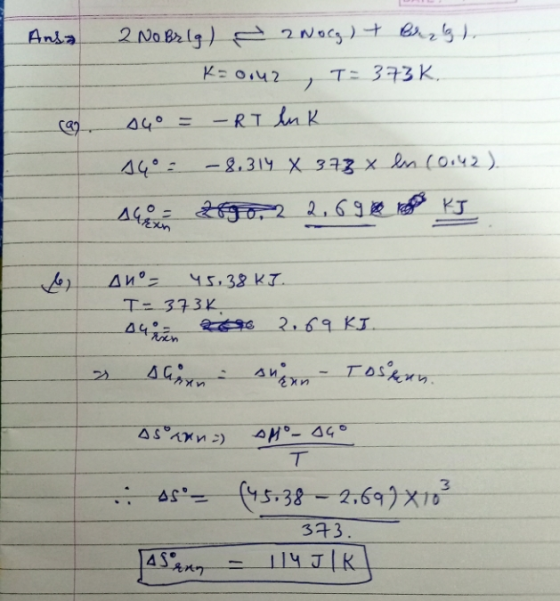
 Please show all work. Provide equations used for full credit. Please use correct significant figures and correct units in answers. The reaction, 2NOBr(g) + 2NO(g) + Br2(g) has an equilibrium constant, K = 0.42 at 373 K. a. Calculate AGºrxn at 373 K. b. Using the value of AHºrxn = 45.38 kJ and the AGºrxn calculated in part a, calculate the ASºrxn at 373 K. TT T Arial 3 (12pt) TEE >>>
Please show all work. Provide equations used for full credit. Please use correct significant figures and...
 Please show all work. Provide equations used for full credit. Please use correct significant figures and correct units in answers. The reaction, 2NOBr(g) + 2NO(g) + Br2(8) has an equilibrium constant, K = 0.42 at 373 K. a. Calculate Agºrxn at 373 K. b. Using the value of AHºrxn = 45.38 k) and the AGºrxn calculated in part a, calculate the ASºrxn at 373 K. Consider the reaction: 2NO(g) + C12(8) + 2NOCI(g) Given the following table of thermodynamic data,...
The reaction, 2NOBr(g) 2NO(g) + Br2(g) has an equilibrium constant, K = 0.42 at 373 K. a. Calculate...
The reaction, 2NOBr(g) 2NO(g) + Br2(g) has an equilibrium constant, K = 0.42 at 373 K. a. Calculate ΔGorxn at 373 K. b. Using the value of ΔHorxn = 45.38 kJ and the ΔGorxn calculated in part a, calculate the ΔSorxn at 373 K. Please show all work. Provide equations used for full credit. Please use correct significant figures and correct units in answers.
temp is : 298K QUESTION 9 Please show all work. For full credit provide equations used....
 temp is :
298K
QUESTION 9 Please show all work. For full credit provide equations used. Please use correct significant figures and correct units in answers. The equilibrium constant for the reaction, 2Fe3+ (aq) + Hg22+ (aq) = 2Fe2+ (aq) + 2Hg2+ is Kc = 9.1 x 10⁻⁶ @298K a. What is AGO at this temperature? b. If reactants and products in their standard state concentrations (1M) are mixed, in which direction does the reaction proceed? Provide a numerical justification...
temp is :
298K
QUESTION 9 Please show all work. For full credit provide equations used. Please use correct significant figures and correct units in answers. The equilibrium constant for the reaction, 2Fe3+ (aq) + Hg22+ (aq) = 2Fe2+ (aq) + 2Hg2+ is Kc = 9.1 x 10⁻⁶ @298K a. What is AGO at this temperature? b. If reactants and products in their standard state concentrations (1M) are mixed, in which direction does the reaction proceed? Provide a numerical justification...
SHOW ALL WORK. Include the correct significant figures and units for full points. Useful equations and...
 SHOW ALL WORK. Include the correct significant figures and units for full points. Useful equations and constants: heat lost/gained = (Volume) (Density)(AT)(specific heat capacity) (heat lost by hot water) - (heat gained by cold water) calorimeter constant = Density o - 1.00 g/mL Specific heat capacity (water) - 4.184 J/g °C AT cold 1. What is thermochemistry? (2 pts) 2. A student adds 5.00 mL of cold water to 5.00 mL of hot water in a test tube surrounded by...
Please answer with correct sig figs Use the data given to calculate the value of AGºrxn...
 Please answer with correct sig figs
Use the data given to calculate the value of AGºrxn for the reaction at 25 °C. 2 C(graphite) + H2(g) C2H2(g) C(graphite) H2(g) C2H2(g) Sº (J/mol · K) 5.74 130.68 201.0 (kJ/mol) 0 0 -226.8 Report answer to four significant figures.
Please answer with correct sig figs
Use the data given to calculate the value of AGºrxn for the reaction at 25 °C. 2 C(graphite) + H2(g) C2H2(g) C(graphite) H2(g) C2H2(g) Sº (J/mol · K) 5.74 130.68 201.0 (kJ/mol) 0 0 -226.8 Report answer to four significant figures.
Show all work to receive full credit. Express answers to the correct number of significant figures. Note: Complete...
 Show all work to receive full credit. Express answers to the correct number of significant figures. Note: Complete the table below by calculating the initial SCN and equilibrium Fe(SCN)2+ concentrations for each of the five standard solutions. In addition to the volume of KSCN indicated in the table below each solution contains 5.00 mL of Fe(NO,)a and sufficient 0.050 M HNO3 to produce a total volume of 25.00 mL of solution. 1. Fe3+ +SCN Fe(SCN)2+ 0.00200 M Molarity of KSCN...
Please write clearly and show all work, with correct units, for full credit. This completed quiz...
 Please write clearly and show all work, with correct units, for full credit. This completed quiz will be due by the start of class on Friday November 1, 2019. 1. Opts) A reaction flask contains an initial concentration of He=2.00 x 10 M and an initial concentration of 12 = 9.00 x 10M, at a high temperature where they remain in the gas phase. They react as follows: Hare +12 + 2HI Calculate K, if the equilibrium concentration of HI...
1.00 points 3 attempts left Check my work 2 Enter your answer in the provided box....
 1.00 points 3 attempts left Check my work 2 Enter your answer in the provided box. The rate constant for the second-order reaction: 2NOBr(g) → 2NO(g) + Br2(g) is 0.800-s) at 10°C. Starting with a concentration of 0.86 M, calculate the concentration of NOBr Report problem Hint Solution Guided Solution after 67 s. Be sure to report your answer to the correct number of significant figures. References eBook &Resources
Consider the reaction: 2NO(g) + Cl2(g) 2NOCl(g) Given the following table of thermodynamic data, Substance...
Consider the reaction: 2NO(g) + Cl2(g) 2NOCl(g) Given the following table of thermodynamic data, Substance ∆Hfo (kJ/mol) So (J/molK) NO (g) 90.3 210.7 Cl2 (g) 0 223.0 NOCl (g) 51.7 261.6 Calculate ∆Horxn and ∆Sorxn and determine the temperature at which the reaction switches from being spontaneous to being non-spontaneous. Please show all work. Provide equations used. Please use correct significant figures and correct units in answers.
 Please show all work. Provide equations used for full credit. Please use correct significant figures and correct units in answers. The reaction, 2NOBr(g) + 2NO(g) + Br2(g) has an equilibrium constant, K = 0.42 at 373 K. a. Calculate AGºrxn at 373 K. b. Using the value of AHºrxn = 45.38 kJ and the AGºrxn calculated in part a, calculate the ASºrxn at 373 K. TT T Arial 3 (12pt) TEE >>>
 Please show all work. Provide equations used for full credit. Please use correct significant figures and correct units in answers. The reaction, 2NOBr(g) + 2NO(g) + Br2(8) has an equilibrium constant, K = 0.42 at 373 K. a. Calculate Agºrxn at 373 K. b. Using the value of AHºrxn = 45.38 k) and the AGºrxn calculated in part a, calculate the ASºrxn at 373 K. Consider the reaction: 2NO(g) + C12(8) + 2NOCI(g) Given the following table of thermodynamic data,...
 temp is :
298K
QUESTION 9 Please show all work. For full credit provide equations used. Please use correct significant figures and correct units in answers. The equilibrium constant for the reaction, 2Fe3+ (aq) + Hg22+ (aq) = 2Fe2+ (aq) + 2Hg2+ is Kc = 9.1 x 10⁻⁶ @298K a. What is AGO at this temperature? b. If reactants and products in their standard state concentrations (1M) are mixed, in which direction does the reaction proceed? Provide a numerical justification...
temp is :
298K
QUESTION 9 Please show all work. For full credit provide equations used. Please use correct significant figures and correct units in answers. The equilibrium constant for the reaction, 2Fe3+ (aq) + Hg22+ (aq) = 2Fe2+ (aq) + 2Hg2+ is Kc = 9.1 x 10⁻⁶ @298K a. What is AGO at this temperature? b. If reactants and products in their standard state concentrations (1M) are mixed, in which direction does the reaction proceed? Provide a numerical justification...
 SHOW ALL WORK. Include the correct significant figures and units for full points. Useful equations and constants: heat lost/gained = (Volume) (Density)(AT)(specific heat capacity) (heat lost by hot water) - (heat gained by cold water) calorimeter constant = Density o - 1.00 g/mL Specific heat capacity (water) - 4.184 J/g °C AT cold 1. What is thermochemistry? (2 pts) 2. A student adds 5.00 mL of cold water to 5.00 mL of hot water in a test tube surrounded by...
 Please answer with correct sig figs
Use the data given to calculate the value of AGºrxn for the reaction at 25 °C. 2 C(graphite) + H2(g) C2H2(g) C(graphite) H2(g) C2H2(g) Sº (J/mol · K) 5.74 130.68 201.0 (kJ/mol) 0 0 -226.8 Report answer to four significant figures.
Please answer with correct sig figs
Use the data given to calculate the value of AGºrxn for the reaction at 25 °C. 2 C(graphite) + H2(g) C2H2(g) C(graphite) H2(g) C2H2(g) Sº (J/mol · K) 5.74 130.68 201.0 (kJ/mol) 0 0 -226.8 Report answer to four significant figures.
 Show all work to receive full credit. Express answers to the correct number of significant figures. Note: Complete the table below by calculating the initial SCN and equilibrium Fe(SCN)2+ concentrations for each of the five standard solutions. In addition to the volume of KSCN indicated in the table below each solution contains 5.00 mL of Fe(NO,)a and sufficient 0.050 M HNO3 to produce a total volume of 25.00 mL of solution. 1. Fe3+ +SCN Fe(SCN)2+ 0.00200 M Molarity of KSCN...
 Please write clearly and show all work, with correct units, for full credit. This completed quiz will be due by the start of class on Friday November 1, 2019. 1. Opts) A reaction flask contains an initial concentration of He=2.00 x 10 M and an initial concentration of 12 = 9.00 x 10M, at a high temperature where they remain in the gas phase. They react as follows: Hare +12 + 2HI Calculate K, if the equilibrium concentration of HI...
 1.00 points 3 attempts left Check my work 2 Enter your answer in the provided box. The rate constant for the second-order reaction: 2NOBr(g) → 2NO(g) + Br2(g) is 0.800-s) at 10°C. Starting with a concentration of 0.86 M, calculate the concentration of NOBr Report problem Hint Solution Guided Solution after 67 s. Be sure to report your answer to the correct number of significant figures. References eBook &Resources
Most questions answered within 3 hours.
-
Where is the error in this code sequence?
String s1 = "Hello";
String s2 = "ello";...
asked 10 months ago -
Financial data for Joel de Paris, Inc., for last year
follow:
Joel de Paris, Inc.
Balance...
asked 10 months ago -
Consider this reaction:
Al2(SO4)3 (aq)+ BaCl3
(aq) Al2Cl6 (aq)- +
3BaSO4(s) . What is the...
asked 10 months ago -
Suppose that Savneet is considering increasing her
recent random sample from 20 car rentals to 40...
asked 10 months ago -
Trucks arrive at an unloading terminal at an average rate of 120
per hour.
Trucks arrive...
asked 10 months ago -
Why are methanol and ethanol completely soluble in water while
octanol is not very little soluble....
asked 10 months ago -
A facilities manager at a university reads in a research report
that the mean amount of...
asked 10 months ago -
When the CuSO4 is rehydrated by adding water to the anhydrous
compound, is this an endothermic...
asked 10 months ago -
A ray of sunlight is passing from diamond into crown glass; the
angle of incidence is...
asked 10 months ago -
A block of mass 0.249 kg is placed on top of a light, vertical
spring of...
asked 10 months ago -
how do the kidneys compensate in the presences of acidosis
a) trigger hyperventilate
b) reserve acid...
asked 10 months ago -
Question 501 pts
The rental rate of capital to the firm increases. Which of the
following...
asked 10 months ago