
Homework Answers
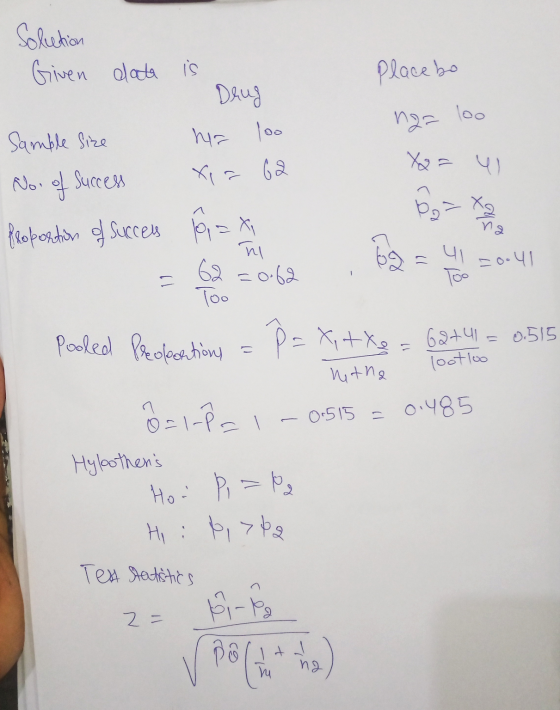
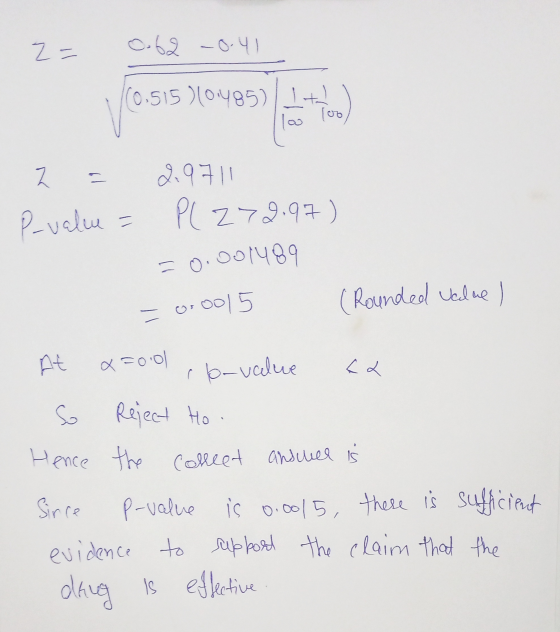
The solution to this problem is given by
Add Answer to:
Incorrect Question 3 0/1 pts Provide an appropriate response. To test the effectiveness of a new...
To test the effectiveness of a new drug designed to relieve pain, 200 patients were randomly...
To test the effectiveness of a new drug designed to relieve pain, 200 patients were randomly selected and divided into two equal groups. One group of 100 patients was given a pill containing the drug, while the other group of 100 was given a placebo. What can we conclude about the effectiveness of the drug if 62 of those actually taking the drug felt a beneficial effect, while 41 of the patients taking the placebo felt a beneficial effect? A)...
Incorrect Question 6 0/1 pts Provide an appropriate response. A pharmaceutical company wishes to test a...
 Incorrect Question 6 0/1 pts Provide an appropriate response. A pharmaceutical company wishes to test a new drug with the expectation of lowering cholesterol levels. Ten subjects are randomly selected and pretested. The results are listed below. The subjects were placed on the drug for a period of 6 months, after which their cholesterol levels were tested again. The results are listed below. (All units are milligrams per deciliter.) Test the company's claim that the drug lowers cholesterol levels. Use...
Quel He Rhino viruses typically cause common colds. In a test of the effectiveness of echinacea,...
 Quel He Rhino viruses typically cause common colds. In a test of the effectiveness of echinacea, 39 of the 46 subjects treated with echinacea developed rhinovirus infections. In a placebo group. 73 of the 90 subjects developed rhinovirus infections. Use a 0.01 significance level to test the claim that echinacea has an effect on rhinovirus infections. Complete parts (a) through (c) below. a. Test the claim using a hypothesis test. Consider the first sample to be the sample of subjects...
Rhino viruses typically cause common colds. In a test of the effectiveness of echinacea, 37 of...
Rhino viruses typically cause common colds. In a test of the effectiveness of echinacea, 37 of the 42 subjects treated with echinacea developed rhinovirus infections. In a placebo group, 84 of the 101 subjects developed rhinovirus infections. Use a 0.05 significance level to test the claim that echinacea has an effect on rhinovirus infections. Complete parts (a) through (c) below. a. Test the claim using a hypothesis test. Consider the first sample to be the sample of subjects treated with...
(1 point) Suppose a group of 900 smokers (who all wanted to give up smoking) were...
 (1 point) Suppose a group of 900 smokers (who all wanted to give up smoking) were randomly assigned to receive an antidepressant drug or a placebo for six weeks. Of the 434 patients who received the antidepressant drug, 111 were not smoking one year later. Of the 466 patients who received the placebo, 175 were not smoking one year later. Given the null hypothesis H: (Pdrug - Pplacebo) = 0 and the alternative hypothesis He : (Pdrug - Pplacebo) +...
HW 31 #1 Suppose a group of 900 smokers (who all wanted to give up smoking)...
HW 31 #1 Suppose a group of 900 smokers (who all wanted to give up smoking) were randomly assigned to receive an antidepressant drug or a placebo for six weeks. Of the 379 patients who received the antidepressant drug, 85 were not smoking one year later. Of the 521 patients who received the placebo, 151 were not smoking one year later. Given the null hypothesis H0:(pdrug−pplacebo)≠0 , conduct a test to see if taking an antidepressant drug can help smokers...
(1 point) Suppose a group of 800 smokers (who all wanted to give up smoking) were...
 (1 point) Suppose a group of 800 smokers (who all wanted to give up smoking) were randomly assigned to receive an antidepressant drug or a placebo for six weeks. Of the 561 patients who received the antidepressant drug, 49 were not smoking one year later. Of the 239 patients who received the placebo, 83 were not smoking one year later. Given the null hypothesis Ho : (Pdrug – Pplacebo) = 0 and the alternative hypothesis H.: (Pdrug - Pplacebo) +...
(1 point) Suppose a group of 1000 smokers (who all wanted to give up smoking) were...
 (1 point) Suppose a group of 1000 smokers (who all wanted to give up smoking) were randomly assigned to receive an antidepressant drug or a placebo for six weeks. Of the 165 patients who received the antidepressant drug, 27 were not smoking one year later. Of the 835 patients who received the placebo, 394 were not smoking one year later. Given the null hypothesis Ho : Ģang-Placebo )-0 and the alternative hypothesis Ha: (Pdrug Pplacebo) 0, conduct a test to...
1) Investigators want to determine the effectiveness of a new drug in lowering cholesterol. They conduct...
 1) Investigators want to determine the effectiveness of a new drug in lowering cholesterol. They conduct a small clinical trial in which patients were randomized to receive the new drug or placebo. The total cholesterol was measured after ten weeks on the assigned treatment. The table below shows the results. Sample Size (n) Mean Cholesterol SD New drug 30 198.8 26.7 Placebo 30 215.4 30.3 Is there sufficient evidence to conclude a difference in mean cholesterol for patients on the...
Suppose a group of 800 smokers (who all wanted to give up smoking) were randomly assigned...
Suppose a group of 800 smokers (who all wanted to give up smoking) were randomly assigned to receive an antidepressant drug or a placebo for six weeks. Of the 116 patients who received the antidepressant drug, 21 were not smoking one year later. Of the 684 patients who received the placebo, 39 were not smoking one year later. Given the null hypothesis H0:(pdrug−pplacebo)=0H0:(pdrug−pplacebo)=0 and the alternative hypothesis Ha:(pdrug−pplacebo)≠0Ha:(pdrug−pplacebo)≠0, conduct a test to see if taking an antidepressant drug can help...
 Incorrect Question 6 0/1 pts Provide an appropriate response. A pharmaceutical company wishes to test a new drug with the expectation of lowering cholesterol levels. Ten subjects are randomly selected and pretested. The results are listed below. The subjects were placed on the drug for a period of 6 months, after which their cholesterol levels were tested again. The results are listed below. (All units are milligrams per deciliter.) Test the company's claim that the drug lowers cholesterol levels. Use...
 Quel He Rhino viruses typically cause common colds. In a test of the effectiveness of echinacea, 39 of the 46 subjects treated with echinacea developed rhinovirus infections. In a placebo group. 73 of the 90 subjects developed rhinovirus infections. Use a 0.01 significance level to test the claim that echinacea has an effect on rhinovirus infections. Complete parts (a) through (c) below. a. Test the claim using a hypothesis test. Consider the first sample to be the sample of subjects...
 (1 point) Suppose a group of 900 smokers (who all wanted to give up smoking) were randomly assigned to receive an antidepressant drug or a placebo for six weeks. Of the 434 patients who received the antidepressant drug, 111 were not smoking one year later. Of the 466 patients who received the placebo, 175 were not smoking one year later. Given the null hypothesis H: (Pdrug - Pplacebo) = 0 and the alternative hypothesis He : (Pdrug - Pplacebo) +...
 (1 point) Suppose a group of 800 smokers (who all wanted to give up smoking) were randomly assigned to receive an antidepressant drug or a placebo for six weeks. Of the 561 patients who received the antidepressant drug, 49 were not smoking one year later. Of the 239 patients who received the placebo, 83 were not smoking one year later. Given the null hypothesis Ho : (Pdrug – Pplacebo) = 0 and the alternative hypothesis H.: (Pdrug - Pplacebo) +...
 (1 point) Suppose a group of 1000 smokers (who all wanted to give up smoking) were randomly assigned to receive an antidepressant drug or a placebo for six weeks. Of the 165 patients who received the antidepressant drug, 27 were not smoking one year later. Of the 835 patients who received the placebo, 394 were not smoking one year later. Given the null hypothesis Ho : Ģang-Placebo )-0 and the alternative hypothesis Ha: (Pdrug Pplacebo) 0, conduct a test to...
 1) Investigators want to determine the effectiveness of a new drug in lowering cholesterol. They conduct a small clinical trial in which patients were randomized to receive the new drug or placebo. The total cholesterol was measured after ten weeks on the assigned treatment. The table below shows the results. Sample Size (n) Mean Cholesterol SD New drug 30 198.8 26.7 Placebo 30 215.4 30.3 Is there sufficient evidence to conclude a difference in mean cholesterol for patients on the...
Most questions answered within 3 hours.
-
Where is the error in this code sequence?
String s1 = "Hello";
String s2 = "ello";...
asked 10 months ago -
Financial data for Joel de Paris, Inc., for last year
follow:
Joel de Paris, Inc.
Balance...
asked 10 months ago -
Consider this reaction:
Al2(SO4)3 (aq)+ BaCl3
(aq) Al2Cl6 (aq)- +
3BaSO4(s) . What is the...
asked 10 months ago -
Suppose that Savneet is considering increasing her
recent random sample from 20 car rentals to 40...
asked 10 months ago -
Trucks arrive at an unloading terminal at an average rate of 120
per hour.
Trucks arrive...
asked 10 months ago -
Why are methanol and ethanol completely soluble in water while
octanol is not very little soluble....
asked 10 months ago -
A facilities manager at a university reads in a research report
that the mean amount of...
asked 10 months ago -
When the CuSO4 is rehydrated by adding water to the anhydrous
compound, is this an endothermic...
asked 10 months ago -
A ray of sunlight is passing from diamond into crown glass; the
angle of incidence is...
asked 10 months ago -
A block of mass 0.249 kg is placed on top of a light, vertical
spring of...
asked 10 months ago -
how do the kidneys compensate in the presences of acidosis
a) trigger hyperventilate
b) reserve acid...
asked 10 months ago -
Question 501 pts
The rental rate of capital to the firm increases. Which of the
following...
asked 10 months ago