When separating Sand from Salt in a mixture during an experiment, why would you need to...
Homework Answers
Request Answer!
We need at least 10 more requests to produce the answer.
0 / 10 have requested this problem solution
The more requests, the faster the answer.
Add Answer to:
When separating Sand from Salt in a mixture during an experiment,
why would you need to...
Question # 9 (9 pt) In the lab you performed to determine the % of salt in a mixture of salt and sand. a. Which part of the procedure was performed with the aim of separating the salt from b. Whi...
 Question # 9 (9 pt) In the lab you performed to determine the % of salt in a mixture of salt and sand. a. Which part of the procedure was performed with the aim of separating the salt from b. Which part of the procedure was performed with the aim of collecting all of the salt c. Which part of the procedure was performed with the aim of finally getting a measure nothing but the salt? of salt and Choose...
experiment 4 report sheet and questions seperating a mixture, recrystallization EXPERIMENT 4 Report Sheet and Questions...
 experiment 4
report sheet and questions
seperating a mixture, recrystallization
EXPERIMENT 4 Report Sheet and Questions Separating a Mixture, Recrystallization Name Date What is your unknown number?_ 1. Original total mass of your sample: 2.502_ g Your sample is 0.6050 g sand,0.776 g acetanilide (crude), and 1.07 g salt. 3. Your sample is __% sand, % acetanilide, and __% salt. 2. Show calculations below. 4. What is the melting range of your purified acetanilide?
experiment 4
report sheet and questions
seperating a mixture, recrystallization
EXPERIMENT 4 Report Sheet and Questions Separating a Mixture, Recrystallization Name Date What is your unknown number?_ 1. Original total mass of your sample: 2.502_ g Your sample is 0.6050 g sand,0.776 g acetanilide (crude), and 1.07 g salt. 3. Your sample is __% sand, % acetanilide, and __% salt. 2. Show calculations below. 4. What is the melting range of your purified acetanilide?
need help 2 During the separation of a mixture of benzoic acid, salt, and sand, a student records the following res...
 need help
2 During the separation of a mixture of benzoic acid, salt, and sand, a student records the following results. (6 pts) A. Complete the following table: Trial Unknown mixture (a) 4.9648 g Filter paper for sand 0.8120 g 2.4115 g Filter paper dried sand Empty beaker for salt 126.5215 g Beaker +evaporated salt 129.0819 g Filter paper for benzoic acid 0.2755 g Filter paper+ dried benzoic acid 1.3780 g Mass Sand (b) Mass Salt (e) Mass Benzoic acid...
need help
2 During the separation of a mixture of benzoic acid, salt, and sand, a student records the following results. (6 pts) A. Complete the following table: Trial Unknown mixture (a) 4.9648 g Filter paper for sand 0.8120 g 2.4115 g Filter paper dried sand Empty beaker for salt 126.5215 g Beaker +evaporated salt 129.0819 g Filter paper for benzoic acid 0.2755 g Filter paper+ dried benzoic acid 1.3780 g Mass Sand (b) Mass Salt (e) Mass Benzoic acid...
Which of the following would not be helpful in separation a mixture of sand and salt?...
 Which of the following would not be helpful in separation a mixture of sand and salt? Select one: O Filter paper and funnel O Water O Glass cup O Magnet
Propose and experiment that would allow you to separate sand from water. And classify if a...
Propose and experiment that would allow you to separate sand from water. And classify if a Peanut butter sandwich homogeneous or heterogeneous mixture.
Separating a Mixture, Recrystallization, pre-lab assignment could you also explain why you chose that substance for...
 Separating a Mixture, Recrystallization, pre-lab
assignment
could you also explain why you chose that substance for the empty
spaces and question marks
EXPERIMENT 4 Pre-Lab Assignment Separating a Mixture, Recrystalliration Name Date 1. Complete the following flowchart which shows how to separate a mixture of sand, sodium chloride and acetanilide. Notice that after a separation process (a down arrow) the filtered solids are shown on the left and the filtrate (the liquid) is shown on the right. The terminal step...
Separating a Mixture, Recrystallization, pre-lab
assignment
could you also explain why you chose that substance for the empty
spaces and question marks
EXPERIMENT 4 Pre-Lab Assignment Separating a Mixture, Recrystalliration Name Date 1. Complete the following flowchart which shows how to separate a mixture of sand, sodium chloride and acetanilide. Notice that after a separation process (a down arrow) the filtered solids are shown on the left and the filtrate (the liquid) is shown on the right. The terminal step...
We did an experiment in class separating (and determining the % composition of) a mixture of...
We did an experiment in class separating (and determining the % composition of) a mixture of NaCl, NH4Cl, and SiO2 by subliming the NH4Cl, then adding water to dissolve the NaCl, separating that from the SiO2 by decanting, and then heating both of those to evaporate the water. They are asking whether these steps could be done in another order, such as adding water first to separate out the SiO2.
Post-lab Filtration experiment questions. 1. If your goal is to separate oil from sand, estimate how...
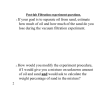 Post-lab Filtration experiment questions. 1. If your goal is to separate oil from sand, estimate how much of oil and how much of the sand do you lose during the vacuum filtration experiment. 2. How would you modify the experiment procedure, if I would give you a mixture on unknown amount of oil and sand and would ask to calculate the weight percentage of sand in the mixture?
1.describe how you would separate a mixture of acetanilide and sand 2.water is a convenient solvent...
1.describe how you would separate a mixture of acetanilide and sand 2.water is a convenient solvent for recrsytallizing what type of compound. 3. why is fluted filter paper usually used when doing the hot filtration during a recrystallization. 4.describe how seed crystal are used in recrystallization. 5.explain the adage " like dissolve lik
Let's assume you have a mixture of equal parts benzoic acid, sand and toluene that are...
Let's assume you have a mixture of equal parts benzoic acid, sand and toluene that are intimately mixed together (the crude material is a mixture of solid and liquid). Propose a procedure to separate these three components using any of the chemicals commonly available (you've used all of the "common" chemicals in the lab by now) in the organic chemistry teaching laboratories and observing the typical limitations with the instruments and techniques (such as not being able to distill or...
 Question # 9 (9 pt) In the lab you performed to determine the % of salt in a mixture of salt and sand. a. Which part of the procedure was performed with the aim of separating the salt from b. Which part of the procedure was performed with the aim of collecting all of the salt c. Which part of the procedure was performed with the aim of finally getting a measure nothing but the salt? of salt and Choose...
 experiment 4
report sheet and questions
seperating a mixture, recrystallization
EXPERIMENT 4 Report Sheet and Questions Separating a Mixture, Recrystallization Name Date What is your unknown number?_ 1. Original total mass of your sample: 2.502_ g Your sample is 0.6050 g sand,0.776 g acetanilide (crude), and 1.07 g salt. 3. Your sample is __% sand, % acetanilide, and __% salt. 2. Show calculations below. 4. What is the melting range of your purified acetanilide?
experiment 4
report sheet and questions
seperating a mixture, recrystallization
EXPERIMENT 4 Report Sheet and Questions Separating a Mixture, Recrystallization Name Date What is your unknown number?_ 1. Original total mass of your sample: 2.502_ g Your sample is 0.6050 g sand,0.776 g acetanilide (crude), and 1.07 g salt. 3. Your sample is __% sand, % acetanilide, and __% salt. 2. Show calculations below. 4. What is the melting range of your purified acetanilide?
 need help
2 During the separation of a mixture of benzoic acid, salt, and sand, a student records the following results. (6 pts) A. Complete the following table: Trial Unknown mixture (a) 4.9648 g Filter paper for sand 0.8120 g 2.4115 g Filter paper dried sand Empty beaker for salt 126.5215 g Beaker +evaporated salt 129.0819 g Filter paper for benzoic acid 0.2755 g Filter paper+ dried benzoic acid 1.3780 g Mass Sand (b) Mass Salt (e) Mass Benzoic acid...
need help
2 During the separation of a mixture of benzoic acid, salt, and sand, a student records the following results. (6 pts) A. Complete the following table: Trial Unknown mixture (a) 4.9648 g Filter paper for sand 0.8120 g 2.4115 g Filter paper dried sand Empty beaker for salt 126.5215 g Beaker +evaporated salt 129.0819 g Filter paper for benzoic acid 0.2755 g Filter paper+ dried benzoic acid 1.3780 g Mass Sand (b) Mass Salt (e) Mass Benzoic acid...
 Which of the following would not be helpful in separation a mixture of sand and salt? Select one: O Filter paper and funnel O Water O Glass cup O Magnet
 Separating a Mixture, Recrystallization, pre-lab
assignment
could you also explain why you chose that substance for the empty
spaces and question marks
EXPERIMENT 4 Pre-Lab Assignment Separating a Mixture, Recrystalliration Name Date 1. Complete the following flowchart which shows how to separate a mixture of sand, sodium chloride and acetanilide. Notice that after a separation process (a down arrow) the filtered solids are shown on the left and the filtrate (the liquid) is shown on the right. The terminal step...
Separating a Mixture, Recrystallization, pre-lab
assignment
could you also explain why you chose that substance for the empty
spaces and question marks
EXPERIMENT 4 Pre-Lab Assignment Separating a Mixture, Recrystalliration Name Date 1. Complete the following flowchart which shows how to separate a mixture of sand, sodium chloride and acetanilide. Notice that after a separation process (a down arrow) the filtered solids are shown on the left and the filtrate (the liquid) is shown on the right. The terminal step...
 Post-lab Filtration experiment questions. 1. If your goal is to separate oil from sand, estimate how much of oil and how much of the sand do you lose during the vacuum filtration experiment. 2. How would you modify the experiment procedure, if I would give you a mixture on unknown amount of oil and sand and would ask to calculate the weight percentage of sand in the mixture?
Most questions answered within 3 hours.
-
Where is the error in this code sequence?
String s1 = "Hello";
String s2 = "ello";...
asked 10 months ago -
Financial data for Joel de Paris, Inc., for last year
follow:
Joel de Paris, Inc.
Balance...
asked 10 months ago -
Consider this reaction:
Al2(SO4)3 (aq)+ BaCl3
(aq) Al2Cl6 (aq)- +
3BaSO4(s) . What is the...
asked 10 months ago -
Suppose that Savneet is considering increasing her
recent random sample from 20 car rentals to 40...
asked 10 months ago -
Trucks arrive at an unloading terminal at an average rate of 120
per hour.
Trucks arrive...
asked 10 months ago -
Why are methanol and ethanol completely soluble in water while
octanol is not very little soluble....
asked 10 months ago -
A facilities manager at a university reads in a research report
that the mean amount of...
asked 10 months ago -
When the CuSO4 is rehydrated by adding water to the anhydrous
compound, is this an endothermic...
asked 10 months ago -
A ray of sunlight is passing from diamond into crown glass; the
angle of incidence is...
asked 10 months ago -
A block of mass 0.249 kg is placed on top of a light, vertical
spring of...
asked 10 months ago -
how do the kidneys compensate in the presences of acidosis
a) trigger hyperventilate
b) reserve acid...
asked 10 months ago -
Question 501 pts
The rental rate of capital to the firm increases. Which of the
following...
asked 10 months ago