
Homework Answers
Add Answer to:
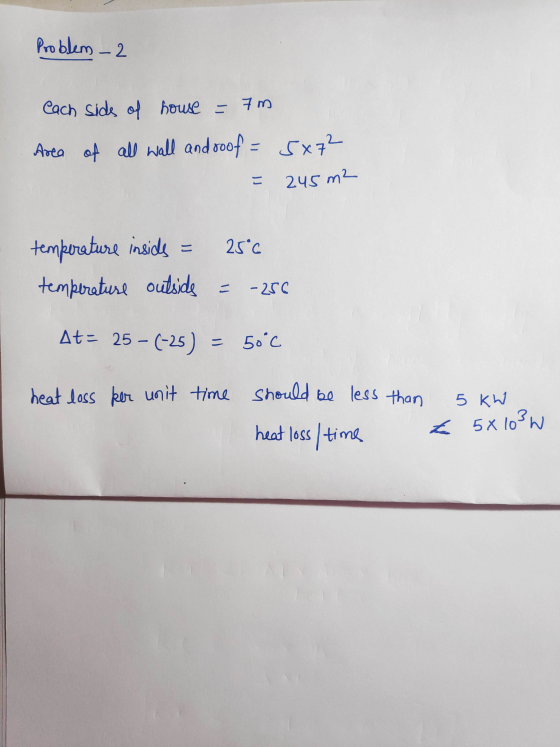
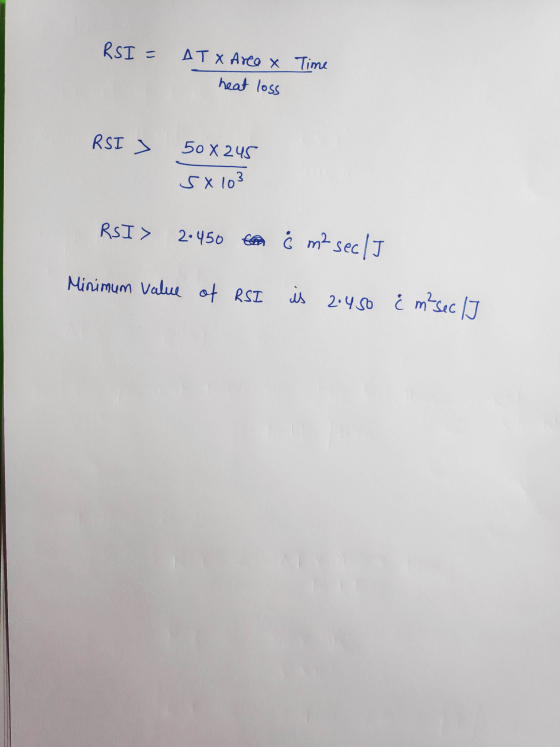
Problem 2 Consider a house that is approximated as a cube that is 7 m on...
In this problem you will estimate the heat lost by a typical house, assuming that the temperature inside is T(in) = 20 degrees celcius and the temperature outside is T(out) = 0 degrees celcius
In this problem you will estimate the heat lost by a typical house, assuming that the temperature inside is T(in) = 20 degrees celcius and the temperature outside is T(out) = 0 degrees celcius. The walls have fiberglass insulation, which dominates the heat conduction properties of the wall So we can consider the wall to have a thermal conductivity of k(wall) = 0.048 W/m/K . We will take the thickness of the walls and ceiling to be L(wall) = 12...
A heat pump is to be used to heat a house in winter and then reversed...
 A heat pump is to be used to heat a house in winter and then
reversed to cool the house in summer. The interior space is to be
maintained at 20oC. Heat transfer through walls and roof is
estimated to be χ = 0.525 kJ/sec per degree difference in
temperature between inside and outside. (6a) (8p) In winter if the
outside temperature is 5oC, what is the minimum power required to
drive the heat pump? (6b) (12p) For the same...
A heat pump is to be used to heat a house in winter and then
reversed to cool the house in summer. The interior space is to be
maintained at 20oC. Heat transfer through walls and roof is
estimated to be χ = 0.525 kJ/sec per degree difference in
temperature between inside and outside. (6a) (8p) In winter if the
outside temperature is 5oC, what is the minimum power required to
drive the heat pump? (6b) (12p) For the same...
7a) Consider a room in a house that has composite walls with an Rtt-1.5 m2K/W. The...
 7a) Consider a room in a house that has composite walls with an Rtt-1.5 m2K/W. The total cross sectional area of the walls is 35 m During winter, the temperature outside the room is Tout5°C. Inside the room, there is an electric heater that emits heat at a rate of 200 W The room is occupied by 2 people that emit heat at a rate 80 W each. What is the temperature inside the room (in °C)? Express your answer...
Consider a house that has a 10-m x 20-m base and a 4-m-high wall. All four...
 Consider a house that has a 10-m x 20-m base and a 4-m-high wall. All four walls of the house have an R-value of 2.31m2°C/W. The two 10-m x 4-m walls have no windows. The third wall has five windows made of 0.5-cm-thick glass (k = 0.78 W/m-K), 1.2m x 1.8min size. The fourth wall has the same size and number of windows, but they are double paned with a 1.5-cm-thick stagnant air space (k = 0.026 W/m-K) enclosed between...
In this problem, you will estimate the heat lost by a typical house, assuming that the...
In this problem, you will estimate the heat lost by a typical house, assuming that the temperature inside is Tin=20∘C and the temperature outside is Tout=0∘C. The walls and uppermost ceiling of a typical house are supported by 2×6 inch wooden beams (kwood=0.12W/(mK)) with fiberglass insulation (kins=0.04W/(mK)) in between. The thickness of the wall is Lwall=18cm allowing for interior and exterior covering. Assume that the house is a cube of length L=9.0m on a side. Approximate that the roof has...
Outside it is 11∘C (52∘F), and inside your house you maintain 23∘C (73∘F). By how many...
Outside it is 11∘C (52∘F), and inside your house you maintain 23∘C (73∘F). By how many percent could you reduce your heating bill if you reduced the inside temperature by 4∘C to 19∘C (66∘F)? Consider only heat loss by conduction through the walls and roof, and assume that your bill is proportional to your energy consumption.
An ideal heat pump is used to maintain the inside temperature of a house at Tin...
An ideal heat pump is used to maintain the inside temperature of a house at Tin = 20 ∘C when the outside temperature is Tout. Assume that when it is operating, the heat pump does work at a rate of 1700 W . Also assume that the house loses heat via conduction through its walls and other surfaces at a rate given by (650W/∘C)(Tin−Tout). For what outside temperature would the heat pump have to operate at all times in order...
On a cold winter day, the outside temperature is -20°C and the inside temperature is maintained...
On a cold winter day, the outside temperature is -20°C and the inside temperature is maintained at 20°C. There is a net heat flow to the outside through the walls, roof, etc., of 25 kW. What is the rate of increase of the entropy of the universe as a result of this heat flow?
9. Bilbo lives in a rectangular home, 10.0m (width) x 16.0m (length) x 10.0m (height), which...
 9. Bilbo lives in a rectangular home, 10.0m (width) x 16.0m (length) x 10.0m (height), which he maintains at a constant temperature of 23.0°C year round. Each of the outer walls, including the roof, has two sandwiched layers of uniform thickness: wood (2.0cm) and fiberglass insulation (14.5cm). Note: The thermal conductivities can found in the UsefulPhysicalQuantities file in D2L. Bilbo's House i. Determine the total surface area of Bilbo's house, excluding the floor. For simplicity, assume that the windows and...
A simple building with walls of unknown construction has been determined to have a super insulated...
A simple building with walls of unknown construction has been determined to have a super insulated roof, which allows essentially no heat transfer. You are to determine the heat transfer coefficient for the walls. The walls measure 1 foot thick, and the building is of rectangular shape 20 feet on the long side in 10 feet on the short side with ceilings 8 feet high. From the heating bills for the month of January, in which the average outside temperature...
 A heat pump is to be used to heat a house in winter and then
reversed to cool the house in summer. The interior space is to be
maintained at 20oC. Heat transfer through walls and roof is
estimated to be χ = 0.525 kJ/sec per degree difference in
temperature between inside and outside. (6a) (8p) In winter if the
outside temperature is 5oC, what is the minimum power required to
drive the heat pump? (6b) (12p) For the same...
A heat pump is to be used to heat a house in winter and then
reversed to cool the house in summer. The interior space is to be
maintained at 20oC. Heat transfer through walls and roof is
estimated to be χ = 0.525 kJ/sec per degree difference in
temperature between inside and outside. (6a) (8p) In winter if the
outside temperature is 5oC, what is the minimum power required to
drive the heat pump? (6b) (12p) For the same...
 7a) Consider a room in a house that has composite walls with an Rtt-1.5 m2K/W. The total cross sectional area of the walls is 35 m During winter, the temperature outside the room is Tout5°C. Inside the room, there is an electric heater that emits heat at a rate of 200 W The room is occupied by 2 people that emit heat at a rate 80 W each. What is the temperature inside the room (in °C)? Express your answer...
 Consider a house that has a 10-m x 20-m base and a 4-m-high wall. All four walls of the house have an R-value of 2.31m2°C/W. The two 10-m x 4-m walls have no windows. The third wall has five windows made of 0.5-cm-thick glass (k = 0.78 W/m-K), 1.2m x 1.8min size. The fourth wall has the same size and number of windows, but they are double paned with a 1.5-cm-thick stagnant air space (k = 0.026 W/m-K) enclosed between...
 9. Bilbo lives in a rectangular home, 10.0m (width) x 16.0m (length) x 10.0m (height), which he maintains at a constant temperature of 23.0°C year round. Each of the outer walls, including the roof, has two sandwiched layers of uniform thickness: wood (2.0cm) and fiberglass insulation (14.5cm). Note: The thermal conductivities can found in the UsefulPhysicalQuantities file in D2L. Bilbo's House i. Determine the total surface area of Bilbo's house, excluding the floor. For simplicity, assume that the windows and...
Most questions answered within 3 hours.
-
Where is the error in this code sequence?
String s1 = "Hello";
String s2 = "ello";...
asked 10 months ago -
Financial data for Joel de Paris, Inc., for last year
follow:
Joel de Paris, Inc.
Balance...
asked 10 months ago -
Consider this reaction:
Al2(SO4)3 (aq)+ BaCl3
(aq) Al2Cl6 (aq)- +
3BaSO4(s) . What is the...
asked 10 months ago -
Suppose that Savneet is considering increasing her
recent random sample from 20 car rentals to 40...
asked 10 months ago -
Trucks arrive at an unloading terminal at an average rate of 120
per hour.
Trucks arrive...
asked 10 months ago -
Why are methanol and ethanol completely soluble in water while
octanol is not very little soluble....
asked 10 months ago -
A facilities manager at a university reads in a research report
that the mean amount of...
asked 10 months ago -
When the CuSO4 is rehydrated by adding water to the anhydrous
compound, is this an endothermic...
asked 10 months ago -
A ray of sunlight is passing from diamond into crown glass; the
angle of incidence is...
asked 10 months ago -
A block of mass 0.249 kg is placed on top of a light, vertical
spring of...
asked 10 months ago -
how do the kidneys compensate in the presences of acidosis
a) trigger hyperventilate
b) reserve acid...
asked 10 months ago -
Question 501 pts
The rental rate of capital to the firm increases. Which of the
following...
asked 10 months ago