
Homework Answers
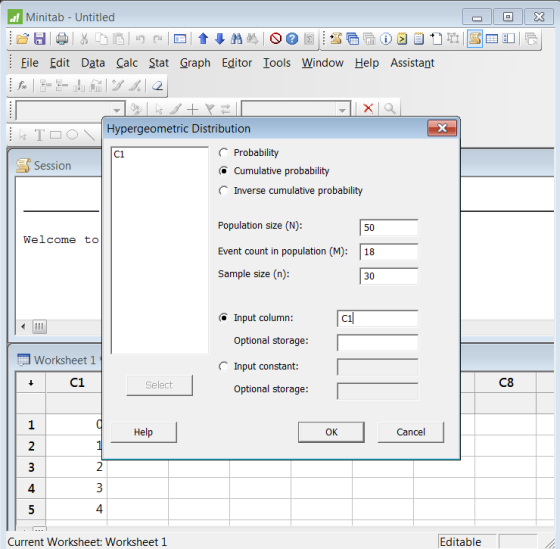
(a)Box A:
step 1:

Step 2:
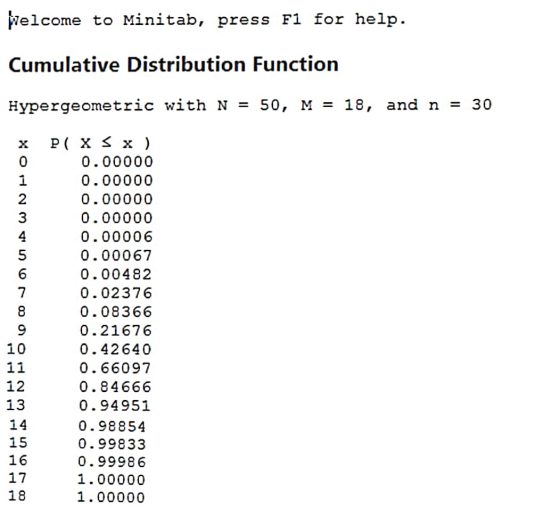
Obtained probabilities:

Add Answer to:
1. MINITAB QUESTION. Let X be a hypergeometric random variable with N= 50, M= 18, and...
not precalc- stat #2. Use the Minitab to simulate 10,000 rolls of two dice. Find the...
 not
precalc- stat
#2. Use the Minitab to simulate 10,000 rolls of two dice. Find the number of times that the sum of the two dice is exactly 7. Based on that result, use the relative frequency approach to estimate the probability of getting a 7 when two dice are rolled. Compare this probability to the true probability and also compare this probability to your estimated probability in #1 when you rolled the dice 1000 times. What do you think...
not
precalc- stat
#2. Use the Minitab to simulate 10,000 rolls of two dice. Find the number of times that the sum of the two dice is exactly 7. Based on that result, use the relative frequency approach to estimate the probability of getting a 7 when two dice are rolled. Compare this probability to the true probability and also compare this probability to your estimated probability in #1 when you rolled the dice 1000 times. What do you think...
A. Let X be a binomial random variable with n = 74 and p = .6....
A. Let X be a binomial random variable with n = 74 and p = .6. Use the normal approximation to the binomial to find: (i) P(X ≤ 50) (iii) P(40 ≤ X ≤ 50) (v) P(X = 43) (ii) P(X ≥ 40) (iv) P(42 ≤ X < 49) B. Each time a roulette wheel is spun, there are 38 possible outcomes, 18 red, 18 black, and two green. Suppose that you ALWAYS bet "black". (i) Suppose the roulette wheel...
Question 18, c d e 18. Medical: Hemoglobin Count Let x be a random variable that...
 Question 18, c d e
18. Medical: Hemoglobin Count Let x be a random variable that represents hemoglobin count (HC) in grams per 100 milliliters of whole blood. Then x has a distribution that is approximately normal, with a population mean of about 14 for healthy adult women (see reference in Problem 17). Suppose female patient has taken 10 laboratory od tests during the past year. The HC data sent to the patient's doctor are 2 that a 15 18...
Question 18, c d e
18. Medical: Hemoglobin Count Let x be a random variable that represents hemoglobin count (HC) in grams per 100 milliliters of whole blood. Then x has a distribution that is approximately normal, with a population mean of about 14 for healthy adult women (see reference in Problem 17). Suppose female patient has taken 10 laboratory od tests during the past year. The HC data sent to the patient's doctor are 2 that a 15 18...
Let x be the binomial random variable with n=10 and p = 9 a. Find P(x...
 Let x be the binomial random variable with n=10 and p = 9 a. Find P(x = 8) and create a cumulative probability table for the distribution. b. Find P( x is less than or equal to 7) and P(x is greater than 7) c. Find the mean, u, the standard deviation, o, and the variance. d. Does the Empirical rule work on this distribution for data that is within one, two or three standard deviations of the mean? Explain....
) 6. Let x be the binomial random variable with n = 10 and p =...
) 6. Let x be the binomial random variable with n = 10 and p = .9 (2) a. Find P(x = 8) (5) b. Create a cumulative probability table for the distribution. (2) c. Find P( x is less than or equal to 7) (2) d. Find P(x is greater than 7) e. Find the mean, μ. (1) f. Find the standard deviation, σ. (1) g. Find the variance. ...
Problem: Obtain a random sample size n of at least 30 on a random variable of...
 Problem:
Obtain a random sample size n of at least 30 on a
random variable of your choice. Plot the frequency histogram, and
compute the mean, standard deviation, and skew. Use the relative
frequency histogram to determine the interval probability,
cumulative probability, and exceedence probability of values of
your choice (choose any valuss of your choice) Use the handout, in
photos below, which contains precipitation data for College Station
to guide you.
Illustrative example:(Ref. exampl The values of annual precipitation,x...
Problem:
Obtain a random sample size n of at least 30 on a
random variable of your choice. Plot the frequency histogram, and
compute the mean, standard deviation, and skew. Use the relative
frequency histogram to determine the interval probability,
cumulative probability, and exceedence probability of values of
your choice (choose any valuss of your choice) Use the handout, in
photos below, which contains precipitation data for College Station
to guide you.
Illustrative example:(Ref. exampl The values of annual precipitation,x...
e Question Help Suppose a simple random sample of size n=150 is obtained from a population...
 e Question Help Suppose a simple random sample of size n=150 is obtained from a population whose size is N=25,000 and whose population proportion with a specified characteristic is p=0.2 Click here to view the standard normal distribution table (page 1). Click here to view the standard normal distribution table (page 2). H = 0.2 (Round to one decimal place as needed) Determine the standard deviation of the sampling distribution of p. (Round to six decimal places as needed) (b)...
Let X be a random variable with probability density function 2 (r > 1 0 otherwise....
 Let X be a random variable with probability density function 2 (r > 1 0 otherwise. (a) Compute F)-P(X ) (the cumulative distribution function) for 1. Note that F(x) 0 for 1 (b) Let u-F(z). Invert F(-) to obtain 2 marks [1 mark 3 marks) F-1 (u), (z as a function of Your function should have:- Input: n - Number of samples to be generated. . Output: x - (xi, x2,, n) A vector x of n values from the...
Save Homework: Homework Chapter 5 Score: 0 of 1 pt 5.2.43 46 of 55 (46 complete)...
 Save Homework: Homework Chapter 5 Score: 0 of 1 pt 5.2.43 46 of 55 (46 complete) HW Score: 72.74%, 40.01 of 55 pts is Question Help If we sample from a small finite population without replacement, the binomial distribution should not be used because the events are not independent. If sampling is done without replacement and the outcomes belong to one of two types, we can use the hypergeometric distribution. If a population has A objects of one type, while...
 not
precalc- stat
#2. Use the Minitab to simulate 10,000 rolls of two dice. Find the number of times that the sum of the two dice is exactly 7. Based on that result, use the relative frequency approach to estimate the probability of getting a 7 when two dice are rolled. Compare this probability to the true probability and also compare this probability to your estimated probability in #1 when you rolled the dice 1000 times. What do you think...
not
precalc- stat
#2. Use the Minitab to simulate 10,000 rolls of two dice. Find the number of times that the sum of the two dice is exactly 7. Based on that result, use the relative frequency approach to estimate the probability of getting a 7 when two dice are rolled. Compare this probability to the true probability and also compare this probability to your estimated probability in #1 when you rolled the dice 1000 times. What do you think...
 Question 18, c d e
18. Medical: Hemoglobin Count Let x be a random variable that represents hemoglobin count (HC) in grams per 100 milliliters of whole blood. Then x has a distribution that is approximately normal, with a population mean of about 14 for healthy adult women (see reference in Problem 17). Suppose female patient has taken 10 laboratory od tests during the past year. The HC data sent to the patient's doctor are 2 that a 15 18...
Question 18, c d e
18. Medical: Hemoglobin Count Let x be a random variable that represents hemoglobin count (HC) in grams per 100 milliliters of whole blood. Then x has a distribution that is approximately normal, with a population mean of about 14 for healthy adult women (see reference in Problem 17). Suppose female patient has taken 10 laboratory od tests during the past year. The HC data sent to the patient's doctor are 2 that a 15 18...
 Let x be the binomial random variable with n=10 and p = 9 a. Find P(x = 8) and create a cumulative probability table for the distribution. b. Find P( x is less than or equal to 7) and P(x is greater than 7) c. Find the mean, u, the standard deviation, o, and the variance. d. Does the Empirical rule work on this distribution for data that is within one, two or three standard deviations of the mean? Explain....
 Problem:
Obtain a random sample size n of at least 30 on a
random variable of your choice. Plot the frequency histogram, and
compute the mean, standard deviation, and skew. Use the relative
frequency histogram to determine the interval probability,
cumulative probability, and exceedence probability of values of
your choice (choose any valuss of your choice) Use the handout, in
photos below, which contains precipitation data for College Station
to guide you.
Illustrative example:(Ref. exampl The values of annual precipitation,x...
Problem:
Obtain a random sample size n of at least 30 on a
random variable of your choice. Plot the frequency histogram, and
compute the mean, standard deviation, and skew. Use the relative
frequency histogram to determine the interval probability,
cumulative probability, and exceedence probability of values of
your choice (choose any valuss of your choice) Use the handout, in
photos below, which contains precipitation data for College Station
to guide you.
Illustrative example:(Ref. exampl The values of annual precipitation,x...
 e Question Help Suppose a simple random sample of size n=150 is obtained from a population whose size is N=25,000 and whose population proportion with a specified characteristic is p=0.2 Click here to view the standard normal distribution table (page 1). Click here to view the standard normal distribution table (page 2). H = 0.2 (Round to one decimal place as needed) Determine the standard deviation of the sampling distribution of p. (Round to six decimal places as needed) (b)...
 Let X be a random variable with probability density function 2 (r > 1 0 otherwise. (a) Compute F)-P(X ) (the cumulative distribution function) for 1. Note that F(x) 0 for 1 (b) Let u-F(z). Invert F(-) to obtain 2 marks [1 mark 3 marks) F-1 (u), (z as a function of Your function should have:- Input: n - Number of samples to be generated. . Output: x - (xi, x2,, n) A vector x of n values from the...
 Save Homework: Homework Chapter 5 Score: 0 of 1 pt 5.2.43 46 of 55 (46 complete) HW Score: 72.74%, 40.01 of 55 pts is Question Help If we sample from a small finite population without replacement, the binomial distribution should not be used because the events are not independent. If sampling is done without replacement and the outcomes belong to one of two types, we can use the hypergeometric distribution. If a population has A objects of one type, while...
Most questions answered within 3 hours.
-
Where is the error in this code sequence?
String s1 = "Hello";
String s2 = "ello";...
asked 10 months ago -
Financial data for Joel de Paris, Inc., for last year
follow:
Joel de Paris, Inc.
Balance...
asked 10 months ago -
Consider this reaction:
Al2(SO4)3 (aq)+ BaCl3
(aq) Al2Cl6 (aq)- +
3BaSO4(s) . What is the...
asked 10 months ago -
Suppose that Savneet is considering increasing her
recent random sample from 20 car rentals to 40...
asked 10 months ago -
Trucks arrive at an unloading terminal at an average rate of 120
per hour.
Trucks arrive...
asked 10 months ago -
Why are methanol and ethanol completely soluble in water while
octanol is not very little soluble....
asked 10 months ago -
A facilities manager at a university reads in a research report
that the mean amount of...
asked 10 months ago -
When the CuSO4 is rehydrated by adding water to the anhydrous
compound, is this an endothermic...
asked 10 months ago -
A ray of sunlight is passing from diamond into crown glass; the
angle of incidence is...
asked 10 months ago -
A block of mass 0.249 kg is placed on top of a light, vertical
spring of...
asked 10 months ago -
how do the kidneys compensate in the presences of acidosis
a) trigger hyperventilate
b) reserve acid...
asked 10 months ago -
Question 501 pts
The rental rate of capital to the firm increases. Which of the
following...
asked 10 months ago