
Homework Answers
Add Answer to:
7. Using the values in the appendix at the end of your textbook, calculate the value...
Please explain the correct answer to both questions. Thank you! Incorrect Question 19 0/1 pts The...
 Please explain the correct
answer to both questions. Thank you!
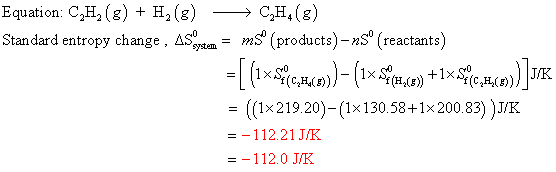
Incorrect Question 19 0/1 pts The value of A Sº for the catalytic hydrogenation of acetylene to ethene, C2H2(g) + H2(g) →C2H4 (g) is_ J/K.mol. Use the following thermodynamic quantities for selected substances at 298.15 K (25°C). Substance AHºf (kJ/mol) AG°f (kJ/mol) S (J/K-mol) 2.84 Carbon C(s, diamond) 1.88 C(s, graphite) 0 C2H2(g) 226.7 C2H4 (g) 52.30 C2H6 (g) -84.68 CO(g) -110.5 CO2 (g) -393.5 209.2 68.11 -32.89 -137.2 -394.4...
Please explain the correct
answer to both questions. Thank you!
Incorrect Question 19 0/1 pts The value of A Sº for the catalytic hydrogenation of acetylene to ethene, C2H2(g) + H2(g) →C2H4 (g) is_ J/K.mol. Use the following thermodynamic quantities for selected substances at 298.15 K (25°C). Substance AHºf (kJ/mol) AG°f (kJ/mol) S (J/K-mol) 2.84 Carbon C(s, diamond) 1.88 C(s, graphite) 0 C2H2(g) 226.7 C2H4 (g) 52.30 C2H6 (g) -84.68 CO(g) -110.5 CO2 (g) -393.5 209.2 68.11 -32.89 -137.2 -394.4...
Using values from Appendix C of your textbook, calculate the value of Kea at 298 K...
 Using values from Appendix C of your textbook, calculate the value of Kea at 298 K for each of the following reactions: (a) 2 SO3(g) 2 SO2(g) O2(g) Кeg (b) 2 NO(g) N2(g)02(g) Кeg (c) 2 NH3(g) N2(g) +3 H2(g) Кeg
Using values from Appendix C of your textbook, calculate the value of Keq at 298 K...
 Using values from Appendix C of your textbook, calculate the
value of Keq at 298 K for each of the following
reactions:
Using values from Appendix C of your textbook, calculate the value of Keg at 298 K for each of the following reactions: (a) Fe3O4(s) + 4 CO(g) = 3 Fe(s) + 4 CO2(g) Keq = (b) Fe2O3(s) + 6 HCI(g) = 2 FeCl3(s) + 3 H2O(g) Keq = D . (c) 4 NH3(g) + O2(g) = 2 N2H4(9)...
Using values from Appendix C of your textbook, calculate the
value of Keq at 298 K for each of the following
reactions:
Using values from Appendix C of your textbook, calculate the value of Keg at 298 K for each of the following reactions: (a) Fe3O4(s) + 4 CO(g) = 3 Fe(s) + 4 CO2(g) Keq = (b) Fe2O3(s) + 6 HCI(g) = 2 FeCl3(s) + 3 H2O(g) Keq = D . (c) 4 NH3(g) + O2(g) = 2 N2H4(9)...
Using values from Appendix C of your textbook, calculate the value of Keq at 298 K...
 Using values from Appendix C of your textbook, calculate the
value of Keq at 298 K for each of the following
reactions:
(a) 4 NH3(g) + O2(g) 2 N2H4(g) + 2
H2O(l)
Keq = .
(b) CH4(g) + 4 Cl2(g) CCl4(l) + 4 HCl(g)
Keq = .
(c) 6 C(graphite) + 6 H2O(l)
C6H12O6(s)
Keq = .
Using values from Appendix C of your textbook, calculate the
value of Keq at 298 K for each of the following
reactions:
(a) 4 NH3(g) + O2(g) 2 N2H4(g) + 2
H2O(l)
Keq = .
(b) CH4(g) + 4 Cl2(g) CCl4(l) + 4 HCl(g)
Keq = .
(c) 6 C(graphite) + 6 H2O(l)
C6H12O6(s)
Keq = .
4. (14 pts) Using the values in the table below reported at 25°C, determine the table below reported at 25°C, deter...
 4. (14 pts) Using the values in the table below reported at 25°C, determine the table below reported at 25°C, determine AH at 400°C for the hydrogenation of acetylene to ethane, C2H2(g) + 2 H2(g) → CzHed) Assume that Cp.m is independent of temperature for all species in the reaction. mol AN mol 296.13 $1.68 CH, CH, H
Using Appendix 2 in your textbook, what is the value for the standard change in Gibbs...
Using Appendix 2 in your textbook, what is the value for the standard change in Gibbs free energy (in kJ) at 25oC of the reaction: C2H4(g) + H2(g) --> C2H6(g)?
QUESTION 5 Consider the formation of solid silver chloride from aqueous silver and chloride ions. Given...
 QUESTION 5
Consider the formation of solid silver chloride from aqueous
silver and chloride ions.
Given the following table of thermodynamic data at 298 K:
The value of K for the reaction at 25 °C is ________.
a)
1.8 × 10⁴
b)
3.7 × 10¹⁰
c)
1.9 × 10⁻¹⁰
d)
810
e)
5.3 × 10⁹
QUESTION 6
Consider the reaction:
NH 3 (g) + HCl (g) → NH 4Cl (s)
Given the following table of thermodynamic data,
...
QUESTION 5
Consider the formation of solid silver chloride from aqueous
silver and chloride ions.
Given the following table of thermodynamic data at 298 K:
The value of K for the reaction at 25 °C is ________.
a)
1.8 × 10⁴
b)
3.7 × 10¹⁰
c)
1.9 × 10⁻¹⁰
d)
810
e)
5.3 × 10⁹
QUESTION 6
Consider the reaction:
NH 3 (g) + HCl (g) → NH 4Cl (s)
Given the following table of thermodynamic data,
...
Using values of Kb in Appendix C in the textbook, calculate values of Ka for each...
Using values of Kb in Appendix C in the textbook, calculate values of Ka for each of the following ions: Part A Propylammonium ion, C3H7NH3+ Express your answer using two significant figures. Part B Hydroxylammonium ion, NH3OH+ Express your answer using two significant figures. Part C Anilinium ion, C6H5NH3+ Express your answer using two significant figures. Part D Pyridinium ion, C5H5NH+ Express your answer using two significant figures.
Using values from Appendix C in the textbook, calculate the standard enthalpy change for each of...
Using values from Appendix C in the textbook, calculate the standard enthalpy change for each of the following reactions. Link to Appendix C: https://media.pearsoncmg.com/ph/esm/esm_brown_chemistry_14/appendices/appendix-c.pdf 1. 2SO2(g)+O2(g)→2SO3(g) 2. Mg(OH)2(s)→MgO(s)+H2O(l) 3. N2O4(g)+4H2(g)→N2(g)+4H2O(g)N2O4(g)+4H2(g)→N2(g)+4H2O(g) 4. SiCl4(l)+2H2O(l)→SiO2(s)+4HCl(g)
Using heat of formation values from Appendix C of the textbook, calculate the standard enthalpy change...
Using heat of formation values from Appendix C of the textbook, calculate the standard enthalpy change for the following reaction: 2 C3H8 (g) + 9 O2 (g) ----> 2 CO2 (g) + 8 H2O (l) + 4 CO2 (g) Enthalpies of formation values C3H8 (g) = -103.85 kJ/ mol , O2 (g) = 0 , CO (g) = -110.5 kJ/ mol , H20 (l) = -285.83 kJ/ mol , CO2 (g) = -393.5 kJ/ mol
 Please explain the correct
answer to both questions. Thank you!
Incorrect Question 19 0/1 pts The value of A Sº for the catalytic hydrogenation of acetylene to ethene, C2H2(g) + H2(g) →C2H4 (g) is_ J/K.mol. Use the following thermodynamic quantities for selected substances at 298.15 K (25°C). Substance AHºf (kJ/mol) AG°f (kJ/mol) S (J/K-mol) 2.84 Carbon C(s, diamond) 1.88 C(s, graphite) 0 C2H2(g) 226.7 C2H4 (g) 52.30 C2H6 (g) -84.68 CO(g) -110.5 CO2 (g) -393.5 209.2 68.11 -32.89 -137.2 -394.4...
Please explain the correct
answer to both questions. Thank you!
Incorrect Question 19 0/1 pts The value of A Sº for the catalytic hydrogenation of acetylene to ethene, C2H2(g) + H2(g) →C2H4 (g) is_ J/K.mol. Use the following thermodynamic quantities for selected substances at 298.15 K (25°C). Substance AHºf (kJ/mol) AG°f (kJ/mol) S (J/K-mol) 2.84 Carbon C(s, diamond) 1.88 C(s, graphite) 0 C2H2(g) 226.7 C2H4 (g) 52.30 C2H6 (g) -84.68 CO(g) -110.5 CO2 (g) -393.5 209.2 68.11 -32.89 -137.2 -394.4...
 Using values from Appendix C of your textbook, calculate the value of Kea at 298 K for each of the following reactions: (a) 2 SO3(g) 2 SO2(g) O2(g) Кeg (b) 2 NO(g) N2(g)02(g) Кeg (c) 2 NH3(g) N2(g) +3 H2(g) Кeg
 Using values from Appendix C of your textbook, calculate the
value of Keq at 298 K for each of the following
reactions:
Using values from Appendix C of your textbook, calculate the value of Keg at 298 K for each of the following reactions: (a) Fe3O4(s) + 4 CO(g) = 3 Fe(s) + 4 CO2(g) Keq = (b) Fe2O3(s) + 6 HCI(g) = 2 FeCl3(s) + 3 H2O(g) Keq = D . (c) 4 NH3(g) + O2(g) = 2 N2H4(9)...
Using values from Appendix C of your textbook, calculate the
value of Keq at 298 K for each of the following
reactions:
Using values from Appendix C of your textbook, calculate the value of Keg at 298 K for each of the following reactions: (a) Fe3O4(s) + 4 CO(g) = 3 Fe(s) + 4 CO2(g) Keq = (b) Fe2O3(s) + 6 HCI(g) = 2 FeCl3(s) + 3 H2O(g) Keq = D . (c) 4 NH3(g) + O2(g) = 2 N2H4(9)...
 Using values from Appendix C of your textbook, calculate the
value of Keq at 298 K for each of the following
reactions:
(a) 4 NH3(g) + O2(g) 2 N2H4(g) + 2
H2O(l)
Keq = .
(b) CH4(g) + 4 Cl2(g) CCl4(l) + 4 HCl(g)
Keq = .
(c) 6 C(graphite) + 6 H2O(l)
C6H12O6(s)
Keq = .
Using values from Appendix C of your textbook, calculate the
value of Keq at 298 K for each of the following
reactions:
(a) 4 NH3(g) + O2(g) 2 N2H4(g) + 2
H2O(l)
Keq = .
(b) CH4(g) + 4 Cl2(g) CCl4(l) + 4 HCl(g)
Keq = .
(c) 6 C(graphite) + 6 H2O(l)
C6H12O6(s)
Keq = .
 4. (14 pts) Using the values in the table below reported at 25°C, determine the table below reported at 25°C, determine AH at 400°C for the hydrogenation of acetylene to ethane, C2H2(g) + 2 H2(g) → CzHed) Assume that Cp.m is independent of temperature for all species in the reaction. mol AN mol 296.13 $1.68 CH, CH, H
 QUESTION 5
Consider the formation of solid silver chloride from aqueous
silver and chloride ions.
Given the following table of thermodynamic data at 298 K:
The value of K for the reaction at 25 °C is ________.
a)
1.8 × 10⁴
b)
3.7 × 10¹⁰
c)
1.9 × 10⁻¹⁰
d)
810
e)
5.3 × 10⁹
QUESTION 6
Consider the reaction:
NH 3 (g) + HCl (g) → NH 4Cl (s)
Given the following table of thermodynamic data,
...
QUESTION 5
Consider the formation of solid silver chloride from aqueous
silver and chloride ions.
Given the following table of thermodynamic data at 298 K:
The value of K for the reaction at 25 °C is ________.
a)
1.8 × 10⁴
b)
3.7 × 10¹⁰
c)
1.9 × 10⁻¹⁰
d)
810
e)
5.3 × 10⁹
QUESTION 6
Consider the reaction:
NH 3 (g) + HCl (g) → NH 4Cl (s)
Given the following table of thermodynamic data,
...
Most questions answered within 3 hours.
-
Where is the error in this code sequence?
String s1 = "Hello";
String s2 = "ello";...
asked 10 months ago -
Financial data for Joel de Paris, Inc., for last year
follow:
Joel de Paris, Inc.
Balance...
asked 10 months ago -
Consider this reaction:
Al2(SO4)3 (aq)+ BaCl3
(aq) Al2Cl6 (aq)- +
3BaSO4(s) . What is the...
asked 10 months ago -
Suppose that Savneet is considering increasing her
recent random sample from 20 car rentals to 40...
asked 10 months ago -
Trucks arrive at an unloading terminal at an average rate of 120
per hour.
Trucks arrive...
asked 10 months ago -
Why are methanol and ethanol completely soluble in water while
octanol is not very little soluble....
asked 10 months ago -
A facilities manager at a university reads in a research report
that the mean amount of...
asked 10 months ago -
When the CuSO4 is rehydrated by adding water to the anhydrous
compound, is this an endothermic...
asked 10 months ago -
A ray of sunlight is passing from diamond into crown glass; the
angle of incidence is...
asked 10 months ago -
A block of mass 0.249 kg is placed on top of a light, vertical
spring of...
asked 10 months ago -
how do the kidneys compensate in the presences of acidosis
a) trigger hyperventilate
b) reserve acid...
asked 10 months ago -
Question 501 pts
The rental rate of capital to the firm increases. Which of the
following...
asked 10 months ago