
Homework Answers
Request Answer!
We need at least 10 more requests to produce the answer.
0 / 10 have requested this problem solution
The more requests, the faster the answer.
Add Answer to:
Problem 4: A signal x(t) is given mathematically as follows: x(t) = 4.5+ 3.8cos(27 74t -...
An analog signal is given as below x(t) = 10sin 4rtt The signal is sampled by...
 An analog signal is given as below x(t) = 10sin 4rtt The signal is sampled by two different frequencies f, = 1Hz, f, = 10Hz respectively, and the output are yı, Yz. (i) Sketch signal x(t) in the time domain. (3 marks) (ii) Sketch frequency spectrum of x(t). (3 marks) (iii) After sampling, the continuous signal is converted to a discrete signal. Draw the two discrete signals Yı, Y2: (4 marks) (iv) Discuss whether f1, f, can successfully sample the...
Problem (3) a) A periodic square wave signal x(t) is shown below, it is required to answer the below questions: x(t) 1. What is the period and the duration of such a signal? 2. Determine the fund...
 Problem (3) a) A periodic square wave signal x(t) is shown below, it is required to answer the below questions: x(t) 1. What is the period and the duration of such a signal? 2. Determine the fundamental frequency. 3. Calculate the Trigonometric Fourier Series and sketch the amplitude spectrum and phase spectrum of the signal x(t) for the first 5 harmonics. b) Find the Continuous Time Fourier Series (CTFS) and Continuous Time Fourier Transform (CTFT) of the following periodic signals...
(a) Determine the period, amplitude, and frequency of a signal given by, v(t) (120nt). Plot this ...
 (a) Determine the period, amplitude, and frequency of a signal given by, v(t) (120nt). Plot this signal both in the time-domain and frequency domain. (b) For the following square wave v(t), determine if it is a periodic signal, and if yes, what 10 V sin 4. [61 are its amplitude, period T and fundamental frequency f? Why do we need to convert this signal into sine/cosine wave for transmission? 2 o-oims (c) () According to Fourier Theorem, the above signal...
Given an energy signal x(t) = (t-5T)e-t-T) , where T-0.1 compute its energy spectrum density in...
 Given an energy signal x(t) = (t-5T)e-t-T) , where T-0.1 compute its energy spectrum density in Matlab 1. use two different methods to a. Get its spectrum using Fourier transformation, follovfed by the squaring its amplitude. Plot its Fourier transformation and its energy spectrum density. Get its autocorrelation function, followed by its Fourier transformation. Plot its autocorrelation function and its energy spectrum density. b. 2. In a multipath channel, the received signal y (t) x(t) 0.15x(t -6T) +0.09x(t 10.5T), plot...
Problem 2 (Spectrum of a rectangular signal): In this problem, the amplitude spectrum of the signal 1 or Ot 2 ms x(t)- 0 otherwise is to be analysed (b) Numerical calculation of the spectrum: (i) Us...
 Problem 2 (Spectrum of a rectangular signal): In this problem, the amplitude spectrum of the signal 1 or Ot 2 ms x(t)- 0 otherwise is to be analysed (b) Numerical calculation of the spectrum: (i) Use Matlab to generate and plot a vector containing the sample values of the rectangular signal defined in (2) sampled at f 8kHz. Choose the number N of sample values so that it is a power of 2 and that the signal duration is at...
Please explain the answer, thank you An analog signal is given as below x(t) 10sin 4Tt...
 Please explain the answer, thank you
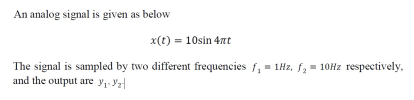
An analog signal is given as below x(t) 10sin 4Tt The signal is sampled by two different frequencies f and the output are y1, y2 10HZ respectively 1Hz, f2 Discuss whether f,, f2 aliasing effect. Explain your answer can successfully sample the analog signal x(t) without
Please explain the answer, thank you
An analog signal is given as below x(t) 10sin 4Tt The signal is sampled by two different frequencies f and the output are y1, y2 10HZ respectively 1Hz, f2 Discuss whether f,, f2 aliasing effect. Explain your answer can successfully sample the analog signal x(t) without
Please answer in MATLAB, thank you! 2. Calculate the energy of time domain signal x (t) and z (t) for the range of 0SIS...
 Please answer in MATLAB, thank you!
2. Calculate the energy of time domain signal x (t) and z (t) for the range of 0SIS2.5 Also calculate the energy of these signals in frequency domain using Parseval's theorem. Plot Energy (X) and Energy (Z) as a function of frequency f in a 2xl subplot (Energy vs frequency plot is know as energy spectrum of a signal).
2. Calculate the energy of time domain signal x (t) and z (t) for the...
Please answer in MATLAB, thank you!
2. Calculate the energy of time domain signal x (t) and z (t) for the range of 0SIS2.5 Also calculate the energy of these signals in frequency domain using Parseval's theorem. Plot Energy (X) and Energy (Z) as a function of frequency f in a 2xl subplot (Energy vs frequency plot is know as energy spectrum of a signal).
2. Calculate the energy of time domain signal x (t) and z (t) for the...
Program from problem 1: (Using MATLAB) % Sampling frequency and sampling period fs = 10000; ts...
 Program from problem 1: (Using MATLAB)
% Sampling frequency and sampling period
fs = 10000;
ts = 1/fs;
% Number of samples, assume 1000 samples
l = 1000;
t = 0:1:l-1;
t = t.*ts; % Convert the sample index into time for generation and
plotting of signal
% Frequency and amplitude of the sensor
f1 = 110;
a1 = 1.0;
% Frequency and amplitude of the power grid noise
f2 = 60;
a2 = 0.7;
% Generating the sinusoidal waves...
Program from problem 1: (Using MATLAB)
% Sampling frequency and sampling period
fs = 10000;
ts = 1/fs;
% Number of samples, assume 1000 samples
l = 1000;
t = 0:1:l-1;
t = t.*ts; % Convert the sample index into time for generation and
plotting of signal
% Frequency and amplitude of the sensor
f1 = 110;
a1 = 1.0;
% Frequency and amplitude of the power grid noise
f2 = 60;
a2 = 0.7;
% Generating the sinusoidal waves...
Problem 2: A sinusoidal signal w(t) = 10cos(200nt) is sampled using a periodic impulse function s(t)...
 Problem 2: A sinusoidal signal w(t) = 10cos(200nt) is sampled using a periodic impulse function s(t) = Ek=-08(t - kt), where the sampling period Tg = 1ms. a) Sketch the signal w(t) and its corresponding impulse-sampled function ws(t) = w(t)s(t) b) What is the sampling frequency fs of this signal? c) Write an expression for the spectrum W (f) and the spectrum of the sampled signal Ws(f). Sketch W, (f) and specify the coordinates of its frequency components.
Problem 1 Consider the sinusoidal signal x(t) shown below. 10 8 4 2 4 6 8...
 Problem 1 Consider the sinusoidal signal x(t) shown below. 10 8 4 2 4 6 8 -10 0.2 0.4 0.6 0.8 t (seconds) (i) What is the amplitude of this signal? ii) What is the period of this signal (in seconds)? (iii) What is the frequency of this signal (in Hertz)? (iv) Write an equation for this signal.
 An analog signal is given as below x(t) = 10sin 4rtt The signal is sampled by two different frequencies f, = 1Hz, f, = 10Hz respectively, and the output are yı, Yz. (i) Sketch signal x(t) in the time domain. (3 marks) (ii) Sketch frequency spectrum of x(t). (3 marks) (iii) After sampling, the continuous signal is converted to a discrete signal. Draw the two discrete signals Yı, Y2: (4 marks) (iv) Discuss whether f1, f, can successfully sample the...
 Problem (3) a) A periodic square wave signal x(t) is shown below, it is required to answer the below questions: x(t) 1. What is the period and the duration of such a signal? 2. Determine the fundamental frequency. 3. Calculate the Trigonometric Fourier Series and sketch the amplitude spectrum and phase spectrum of the signal x(t) for the first 5 harmonics. b) Find the Continuous Time Fourier Series (CTFS) and Continuous Time Fourier Transform (CTFT) of the following periodic signals...
 (a) Determine the period, amplitude, and frequency of a signal given by, v(t) (120nt). Plot this signal both in the time-domain and frequency domain. (b) For the following square wave v(t), determine if it is a periodic signal, and if yes, what 10 V sin 4. [61 are its amplitude, period T and fundamental frequency f? Why do we need to convert this signal into sine/cosine wave for transmission? 2 o-oims (c) () According to Fourier Theorem, the above signal...
 Given an energy signal x(t) = (t-5T)e-t-T) , where T-0.1 compute its energy spectrum density in Matlab 1. use two different methods to a. Get its spectrum using Fourier transformation, follovfed by the squaring its amplitude. Plot its Fourier transformation and its energy spectrum density. Get its autocorrelation function, followed by its Fourier transformation. Plot its autocorrelation function and its energy spectrum density. b. 2. In a multipath channel, the received signal y (t) x(t) 0.15x(t -6T) +0.09x(t 10.5T), plot...
 Problem 2 (Spectrum of a rectangular signal): In this problem, the amplitude spectrum of the signal 1 or Ot 2 ms x(t)- 0 otherwise is to be analysed (b) Numerical calculation of the spectrum: (i) Use Matlab to generate and plot a vector containing the sample values of the rectangular signal defined in (2) sampled at f 8kHz. Choose the number N of sample values so that it is a power of 2 and that the signal duration is at...
 Please explain the answer, thank you
An analog signal is given as below x(t) 10sin 4Tt The signal is sampled by two different frequencies f and the output are y1, y2 10HZ respectively 1Hz, f2 Discuss whether f,, f2 aliasing effect. Explain your answer can successfully sample the analog signal x(t) without
Please explain the answer, thank you
An analog signal is given as below x(t) 10sin 4Tt The signal is sampled by two different frequencies f and the output are y1, y2 10HZ respectively 1Hz, f2 Discuss whether f,, f2 aliasing effect. Explain your answer can successfully sample the analog signal x(t) without
 Please answer in MATLAB, thank you!
2. Calculate the energy of time domain signal x (t) and z (t) for the range of 0SIS2.5 Also calculate the energy of these signals in frequency domain using Parseval's theorem. Plot Energy (X) and Energy (Z) as a function of frequency f in a 2xl subplot (Energy vs frequency plot is know as energy spectrum of a signal).
2. Calculate the energy of time domain signal x (t) and z (t) for the...
Please answer in MATLAB, thank you!
2. Calculate the energy of time domain signal x (t) and z (t) for the range of 0SIS2.5 Also calculate the energy of these signals in frequency domain using Parseval's theorem. Plot Energy (X) and Energy (Z) as a function of frequency f in a 2xl subplot (Energy vs frequency plot is know as energy spectrum of a signal).
2. Calculate the energy of time domain signal x (t) and z (t) for the...
 Program from problem 1: (Using MATLAB)
% Sampling frequency and sampling period
fs = 10000;
ts = 1/fs;
% Number of samples, assume 1000 samples
l = 1000;
t = 0:1:l-1;
t = t.*ts; % Convert the sample index into time for generation and
plotting of signal
% Frequency and amplitude of the sensor
f1 = 110;
a1 = 1.0;
% Frequency and amplitude of the power grid noise
f2 = 60;
a2 = 0.7;
% Generating the sinusoidal waves...
Program from problem 1: (Using MATLAB)
% Sampling frequency and sampling period
fs = 10000;
ts = 1/fs;
% Number of samples, assume 1000 samples
l = 1000;
t = 0:1:l-1;
t = t.*ts; % Convert the sample index into time for generation and
plotting of signal
% Frequency and amplitude of the sensor
f1 = 110;
a1 = 1.0;
% Frequency and amplitude of the power grid noise
f2 = 60;
a2 = 0.7;
% Generating the sinusoidal waves...
 Problem 2: A sinusoidal signal w(t) = 10cos(200nt) is sampled using a periodic impulse function s(t) = Ek=-08(t - kt), where the sampling period Tg = 1ms. a) Sketch the signal w(t) and its corresponding impulse-sampled function ws(t) = w(t)s(t) b) What is the sampling frequency fs of this signal? c) Write an expression for the spectrum W (f) and the spectrum of the sampled signal Ws(f). Sketch W, (f) and specify the coordinates of its frequency components.
 Problem 1 Consider the sinusoidal signal x(t) shown below. 10 8 4 2 4 6 8 -10 0.2 0.4 0.6 0.8 t (seconds) (i) What is the amplitude of this signal? ii) What is the period of this signal (in seconds)? (iii) What is the frequency of this signal (in Hertz)? (iv) Write an equation for this signal.
Most questions answered within 3 hours.
-
Where is the error in this code sequence?
String s1 = "Hello";
String s2 = "ello";...
asked 10 months ago -
Financial data for Joel de Paris, Inc., for last year
follow:
Joel de Paris, Inc.
Balance...
asked 10 months ago -
Consider this reaction:
Al2(SO4)3 (aq)+ BaCl3
(aq) Al2Cl6 (aq)- +
3BaSO4(s) . What is the...
asked 10 months ago -
Suppose that Savneet is considering increasing her
recent random sample from 20 car rentals to 40...
asked 10 months ago -
Trucks arrive at an unloading terminal at an average rate of 120
per hour.
Trucks arrive...
asked 10 months ago -
Why are methanol and ethanol completely soluble in water while
octanol is not very little soluble....
asked 10 months ago -
A facilities manager at a university reads in a research report
that the mean amount of...
asked 10 months ago -
When the CuSO4 is rehydrated by adding water to the anhydrous
compound, is this an endothermic...
asked 10 months ago -
A ray of sunlight is passing from diamond into crown glass; the
angle of incidence is...
asked 10 months ago -
A block of mass 0.249 kg is placed on top of a light, vertical
spring of...
asked 10 months ago -
how do the kidneys compensate in the presences of acidosis
a) trigger hyperventilate
b) reserve acid...
asked 10 months ago -
Question 501 pts
The rental rate of capital to the firm increases. Which of the
following...
asked 10 months ago