The following code on a 32 bit machine: int x= 0xAABBCCDD; print("%02x",(int) (* ((char *)(& x))&0xFF))...
The following code on a 32 bit machine:
int x= 0xAABBCCDD;
print("%02x",(int) (* ((char *)(& x))&0xFF))
will print out a ___________________ if the machine is big-end-in.
Homework Answers
Answer:
will print out a ________AA___________ if the
machine is big-end-in.
Explanation: 0x AABBCCDD will be stored as
DD CC BB AA In the memory As Big Endian and when we do . & FF,
Then last two bytes will be be the answer
Thanks, PLEASE UPVOTE
Add Answer to:
The following code on a 32 bit machine:
int x= 0xAABBCCDD;
print("%02x",(int) (* ((char *)(& x))&0xFF))...
Given the structure definition in a 32-bit environment: struct contact { char name[22] char gender; int...
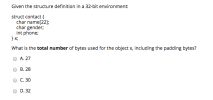 Given the structure definition in a 32-bit environment: struct contact { char name[22] char gender; int phone; X, What is the total number of bytes used for the object x, including the padding bytes? O A. 27 O B. 28 O C. 30 O D. 32
We are running programs on a machine where values of type int have a 32-bit two’s-complement...
We are running programs on a machine where values of type int have a 32-bit two’s-complement representation. Values of type float use the 32-bit IEEE format, and values of type double use the 64-bit IEEE format. We generate arbitrary integer values x, y, and z, and convert them to values of type double as follows: /* Create some arbitrary values */ int x = random(); int y = random(); int z = random(); /* Convert to double */ double dx...
int xyz( char[] X, char[] Y, int m, int n ) { int L[][] = new...
 int xyz( char[] X, char[] Y, int m, int n ) { int L[][] = new int[m+1] [n+1]; for (int i=0; i<=m; i++){ for (int j=0; j<=n; j++){ if (i == 0 Ilj == 0) L[i][j] = 0; else if (x[i-1] == Y[j-1]) L[i][j] = L[i-1][j-1] + 1; else L[i][j] max(L[i-1][j], L[i][j-1]); مه } ...//more code follows Given the code fragment above, select the best descriptive phrase from the list below. Bottom-up. Recursive. Top-down.
Consider the following code: int i = 0x56789a; char c = (char) i; int j =...
Consider the following code: int i = 0x56789a; char c = (char) i; int j = c; What is the hex value of c? (0x9a) What is the hex value of j? (0xffffff9a) I know the answer but I don't know how to get to that answer. Can someone explain this to me, please? Thanks!
Write a program that allows the user to enter an unsigned integer (the maximum value of...
Write a program that allows the user to enter an unsigned integer (the maximum value of an unsigned 4-byte int is 232 = 4,294,967,296) and reverses its format (from little to big endian, or vice versa). Print out the user-entered number in hexadecimal and binary, reverse the endianness, and print the reverse in hexadecimal and binary. Integers in most machine architectures are represented in little endian format: the least significant byte is stored in the smallest address; for instance, the...
int editDist(char * firstString, char * secString, int table) { //Code to make a edit distance...
int editDist(char * firstString, char * secString, int table) { //Code to make a edit distance table }
Using Microsoft Visual Studio. 1) Complete the following C++ program by adding more line of code...
Using Microsoft Visual Studio. 1) Complete the following C++ program by adding more line of code for 8-bit signed array, 16-bit unsigned array, 16-bit signed array, 32-bit signed array and 32-bit signed array. 2) Fill in all the blanks in Table 1 using your completed code, following the hints provided within the table. 3) Fill in all the blanks in Table 2 using your completed code, following the hints provided within the table. C++ Program #include <stdio.h> #include <iostream> int...
What does the following code fragment print? char c[20] = "ABC"; cout << sizeof(c[2]) << endl;...
What does the following code fragment print? char c[20] = "ABC"; cout << sizeof(c[2]) << endl; 2. What does the following code fragment print? char c[20] = "ABC"; c[3] = 'x'; cout << c << endl; 3. What does the following code fragment print? char c[20] = "ABC"; c[3] = 'x'; strcat(c, "ZZ"); cout << c << endl;
What number does each line of code print out? Briefly explain why. printf("%u\n",(unsigned char)(-2)); printf("%d\n",(unsigned char)(-2));...
What number does each line of code print out? Briefly explain why. printf("%u\n",(unsigned char)(-2)); printf("%d\n",(unsigned char)(-2)); printf("%u\n",(uint16_t)(-2)); printf("%d\n",(uint16_t)(-2)); printf("%u\n",(unsigned int)(-2)); printf("%d\n",(unsigned int)(-2));
Homework Part 1 Write a C program that declares and initializes a double, an int, and a char. You...
 Homework Part 1 Write a C program that declares and initializes a double, an int, and a char. You can initialize the variables to any legal value of your choosing. Next, declare and initialize a pointer variable to each of the variables Using printf), output the following: The address of each of the first three variables. Use the "Ox%x" format specifier to print the addresses in hexadecimal notation The value of each variable. They should equal the value you gave...
 Given the structure definition in a 32-bit environment: struct contact { char name[22] char gender; int phone; X, What is the total number of bytes used for the object x, including the padding bytes? O A. 27 O B. 28 O C. 30 O D. 32
 int xyz( char[] X, char[] Y, int m, int n ) { int L[][] = new int[m+1] [n+1]; for (int i=0; i<=m; i++){ for (int j=0; j<=n; j++){ if (i == 0 Ilj == 0) L[i][j] = 0; else if (x[i-1] == Y[j-1]) L[i][j] = L[i-1][j-1] + 1; else L[i][j] max(L[i-1][j], L[i][j-1]); مه } ...//more code follows Given the code fragment above, select the best descriptive phrase from the list below. Bottom-up. Recursive. Top-down.
 Homework Part 1 Write a C program that declares and initializes a double, an int, and a char. You can initialize the variables to any legal value of your choosing. Next, declare and initialize a pointer variable to each of the variables Using printf), output the following: The address of each of the first three variables. Use the "Ox%x" format specifier to print the addresses in hexadecimal notation The value of each variable. They should equal the value you gave...
Most questions answered within 3 hours.
-
Where is the error in this code sequence?
String s1 = "Hello";
String s2 = "ello";...
asked 10 months ago -
Financial data for Joel de Paris, Inc., for last year
follow:
Joel de Paris, Inc.
Balance...
asked 10 months ago -
Consider this reaction:
Al2(SO4)3 (aq)+ BaCl3
(aq) Al2Cl6 (aq)- +
3BaSO4(s) . What is the...
asked 10 months ago -
Suppose that Savneet is considering increasing her
recent random sample from 20 car rentals to 40...
asked 10 months ago -
Trucks arrive at an unloading terminal at an average rate of 120
per hour.
Trucks arrive...
asked 10 months ago -
Why are methanol and ethanol completely soluble in water while
octanol is not very little soluble....
asked 10 months ago -
A facilities manager at a university reads in a research report
that the mean amount of...
asked 10 months ago -
When the CuSO4 is rehydrated by adding water to the anhydrous
compound, is this an endothermic...
asked 10 months ago -
A ray of sunlight is passing from diamond into crown glass; the
angle of incidence is...
asked 10 months ago -
A block of mass 0.249 kg is placed on top of a light, vertical
spring of...
asked 10 months ago -
how do the kidneys compensate in the presences of acidosis
a) trigger hyperventilate
b) reserve acid...
asked 10 months ago -
Question 501 pts
The rental rate of capital to the firm increases. Which of the
following...
asked 10 months ago