
Homework Answers
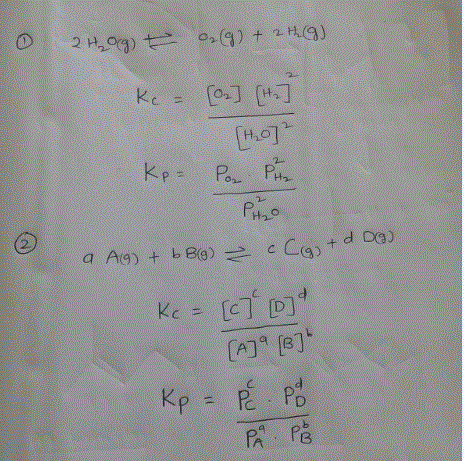
Rate constant of the reaction is given by
Rate constant = [Concentration of each product] /[Concentration of each reactant[gaseous] in the reaction].
Both reactant and product must be in gaseous state
Add Answer to:
Write the equilibrium constant expressions K_c and K_p for the reaction below. Please use square brackets...
Write the reaction rate expressions for the reaction below in terms of the disappearance of the...
Write the reaction rate expressions for the reaction below in terms of the disappearance of the reactants and the appearance of products. Give the expressions for the disappearance of the reactants first, in the order written in the chemical equation. Then write the expressions for the appearance of the products in the order written in the chemical equation. Write the expressions in order of appearance in the equation in the form. ± 1 X × Δ[Α] Δt where ± is...
Write the equilibrium-constant, K_p, expression for the reaction A(g) + 2B(l) 4C(g) + D(g) in terms...
 Write the equilibrium-constant, K_p, expression for the reaction A(g) + 2B(l) 4C(g) + D(g) in terms of P_A. P_B, P_C. and P_D as needed You should not include the standard pressure, P degree, in the expression
Write the equilibrium constant expression for the following reaction. Remember to use brackets, [ ], for...
Write the equilibrium constant expression for the following reaction. Remember to use brackets, [ ], for concentrations and use exponents where needed, but do not show physical states in your answer. C(s) + H2O(g) ⇌ CO(g) + H2(g) Keq = ANSWER
Write a valid equilibrium constant expression for the following reaction. Remember to use brackets, for concentrations,...
 Write a valid equilibrium constant expression for the following reaction. Remember to use brackets, for concentrations, and use exponents where needed. Click in the answer box to activate the palette. N3O4(g) ? 2NO2(g) INO2 q_1 [N2][04] Keq
Part A The equilibrium constant, K. of a reaction at a particular temperature is determined by...
 Part A The equilibrium constant, K. of a reaction at a particular temperature is determined by the concentrations or pressures of the reactants and products at equilibrium, For a gaseous reaction with the general form aA +B=cC+ DD the K, and Ky expressions are given by CDI K= A "B" (PE) K- Phosgene (carbonyl chloride). COClz, is an extremely toxic gas that is used in manufacturing certain dyes and plastics. Phosgene can be produced by reacting carbon monoxide and chlorine...
Which of the following expressions is the correct equilibrium-constant expression for the reaction below? 200(g) =...
 Which of the following expressions is the correct equilibrium-constant expression for the reaction below? 200(g) = CO2(g) + C(s) A. [CO][C]/[CO] B. K [CO] C. [CO] / [CO2) D. [CO]/[CO] E. 2[CO] /[CO][C] In which of the following reactions would increasing pressure at constant temperature not change the concentrations of reactants and products, based on Le Châtelier's principle? ООООО A. 2N, () + 0,02N,0 () B. N.O. (g) 2NO, (g) C. N2(g) + 3H2(g)2NH3 (9) D. N2 (9) + 202...
An decrease in temperature increases the reaction rate because temperature affects the equilibrium constant of the...
 An decrease in temperature increases the reaction rate because temperature affects the equilibrium constant of the reaction a smaller fraction of the collisions have the correct orientation of molecules. the activation energy of the reaction will decrease. less collisions will have enough energy to exceed the activation energy. the activation energy of the reaction will increase. The equilibrium constant, K_p, for the reaction H_2(g) + I_2(g) doubleheadarrow 2HI(g) is 10.0 at 450 degree C. A rigid cylinder at that temperature...
Deriving concentrations from data The equilibrium constant, K, of a reaction at a particular temperature is...
 Deriving concentrations from data The equilibrium constant, K, of a reaction at a particular temperature is detemined by the concentrations or pressures of the reactants and products at equilibrium. In Part A, you were given the equilibrium pressures, which could be plugged directly into the formula for K. In Part B however, you will be given initial concentrations and only one equilibrium concentration. You must use this data to find all three equilibrium concentrations before you can apply the formula...
The equilibrium constant, Kp, is 4.51 x 10⁻³⁵ at 450c for the reaction expressed below. N2...
The equilibrium constant, Kp, is 4.51 x 10⁻³⁵ at 450c for the reaction expressed below. N2 (g) + 3H2 (g) equilibrium arrows 2 NH3 (g) a. Write the equilibrium expression for, Kp, for the reaction. b. Supposed you start out with only reactants in a rigid container. The initial partial pressure of N2 (g) is 1 atm and that of H2 is 1.4 atm. What ate the partial pressure of each species when the system reaches equilibrium? Can you explain...
Write the dissociation reaction and the corresponding Ka equilibrium expression for each of the following acids...
Write the dissociation reaction and the corresponding Ka equilibrium expression for each of the following acids in water. (For the dissociation reaction, include states-of-matter under the given conditions in your answer. Use the lowest possible whole number coefficients. Concentration equilibrium expressions take the general form: Kc = [C]c / [A]a . [B]b. Subscripts and superscripts that include letters must be enclosed in braces {}.) (a) HC7H13O2(aq) dissociation reaction: equilibrium expression: (b) Cr(H2O)63+ dissociation reaction: equilibrium expression: (c) C3H7NH3+ dissociation reaction: equilibrium expression:
 Write the equilibrium-constant, K_p, expression for the reaction A(g) + 2B(l) 4C(g) + D(g) in terms of P_A. P_B, P_C. and P_D as needed You should not include the standard pressure, P degree, in the expression
 Write a valid equilibrium constant expression for the following reaction. Remember to use brackets, for concentrations, and use exponents where needed. Click in the answer box to activate the palette. N3O4(g) ? 2NO2(g) INO2 q_1 [N2][04] Keq
 Part A The equilibrium constant, K. of a reaction at a particular temperature is determined by the concentrations or pressures of the reactants and products at equilibrium, For a gaseous reaction with the general form aA +B=cC+ DD the K, and Ky expressions are given by CDI K= A "B" (PE) K- Phosgene (carbonyl chloride). COClz, is an extremely toxic gas that is used in manufacturing certain dyes and plastics. Phosgene can be produced by reacting carbon monoxide and chlorine...
 Which of the following expressions is the correct equilibrium-constant expression for the reaction below? 200(g) = CO2(g) + C(s) A. [CO][C]/[CO] B. K [CO] C. [CO] / [CO2) D. [CO]/[CO] E. 2[CO] /[CO][C] In which of the following reactions would increasing pressure at constant temperature not change the concentrations of reactants and products, based on Le Châtelier's principle? ООООО A. 2N, () + 0,02N,0 () B. N.O. (g) 2NO, (g) C. N2(g) + 3H2(g)2NH3 (9) D. N2 (9) + 202...
 An decrease in temperature increases the reaction rate because temperature affects the equilibrium constant of the reaction a smaller fraction of the collisions have the correct orientation of molecules. the activation energy of the reaction will decrease. less collisions will have enough energy to exceed the activation energy. the activation energy of the reaction will increase. The equilibrium constant, K_p, for the reaction H_2(g) + I_2(g) doubleheadarrow 2HI(g) is 10.0 at 450 degree C. A rigid cylinder at that temperature...
 Deriving concentrations from data The equilibrium constant, K, of a reaction at a particular temperature is detemined by the concentrations or pressures of the reactants and products at equilibrium. In Part A, you were given the equilibrium pressures, which could be plugged directly into the formula for K. In Part B however, you will be given initial concentrations and only one equilibrium concentration. You must use this data to find all three equilibrium concentrations before you can apply the formula...
Most questions answered within 3 hours.
-
Where is the error in this code sequence?
String s1 = "Hello";
String s2 = "ello";...
asked 10 months ago -
Financial data for Joel de Paris, Inc., for last year
follow:
Joel de Paris, Inc.
Balance...
asked 10 months ago -
Consider this reaction:
Al2(SO4)3 (aq)+ BaCl3
(aq) Al2Cl6 (aq)- +
3BaSO4(s) . What is the...
asked 10 months ago -
Suppose that Savneet is considering increasing her
recent random sample from 20 car rentals to 40...
asked 10 months ago -
Trucks arrive at an unloading terminal at an average rate of 120
per hour.
Trucks arrive...
asked 10 months ago -
Why are methanol and ethanol completely soluble in water while
octanol is not very little soluble....
asked 10 months ago -
A facilities manager at a university reads in a research report
that the mean amount of...
asked 10 months ago -
When the CuSO4 is rehydrated by adding water to the anhydrous
compound, is this an endothermic...
asked 10 months ago -
A ray of sunlight is passing from diamond into crown glass; the
angle of incidence is...
asked 10 months ago -
A block of mass 0.249 kg is placed on top of a light, vertical
spring of...
asked 10 months ago -
how do the kidneys compensate in the presences of acidosis
a) trigger hyperventilate
b) reserve acid...
asked 10 months ago -
Question 501 pts
The rental rate of capital to the firm increases. Which of the
following...
asked 10 months ago