
Homework Answers
Add Answer to:
there is no wire between the capacitor plates
Prnlherm t l dhr opaci ne rd dE/dt-exp(ut)...
Problem 5: If the capacitor plates in the figure have radius R and the electric field...
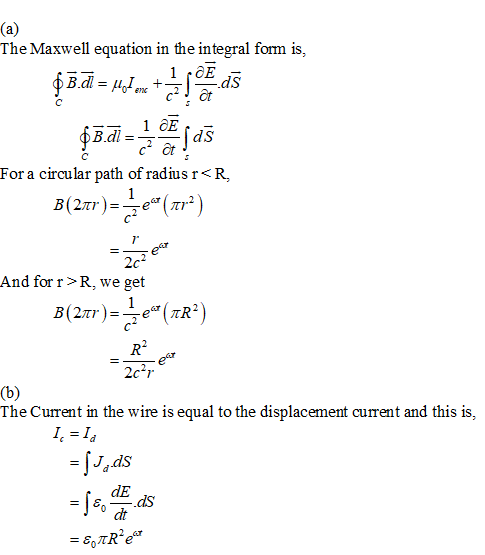
 Problem 5: If the capacitor plates in the figure have radius R and the electric field is increasing at a rate dE/dt = exp(wt). a) Find an expression for the induced magnetic field for r < R. Do the same for r > R. d) What is the current in the wire? As charge flows onto plates, ... ...E field between plates increases. Field lines of induced B field are circles.
Suppose that, instead of forming a complete ring, the two ends of the wire are connected to the electrodes of a parallel-plate capacitor. The capacitor plates are circular with radius 1.0 cm and sepa...
 Suppose that, instead of forming a complete ring, the two ends of the wire are connected to the electrodes of a parallel-plate capacitor. The capacitor plates are circular with radius 1.0 cm and separation 1.0 mm. Again, the magnetic field strength is initially B 0.750 T and subsequently decreases in time at the constant rate -0.035 T/s (a) Sketch a charge diagram illustrating the final charge distribution on the capacitor plates When this final distribution is obtained, what is the...
As a parallel-plate capacitor with circular plates 22 cm in diameter is being charged, the current...
As a parallel-plate capacitor with circular plates 22 cm in diameter is being charged, the current density of the displacement current in the region between the plates is uniform and has a magnitude of 16 A/m2. (a) Calculate the magnitude B of the magnetic field at a distance r = 45 mm from the axis of symmetry of this region. (b) Calculate dE/dt in this region.
As a parallel-plate capacitor with circular plates 27 cm in diameter is being charged, the current...
As a parallel-plate capacitor with circular plates 27 cm in diameter is being charged, the current density of the displacement current in the region between the plates is uniform and has a magnitude of 23 A/m2. (a) Calculate the magnitude B of the magnetic field at a distance r = 80 mm from the axis of symmetry of this region. (b) Calculate dE/dt in this region.
5. A 10-cm diameter parallel plate capacitor has a 1.00 mm spacing (see the figure). A...
 5. A 10-cm diameter parallel plate capacitor has a 1.00 mm spacing (see the figure). A continues current I is being used to charge this capacitor, and this current causes the electric field between the plates to change at a rate of 5.0 x 10 volt/m s. R=5 mm a. Find the magnetic field (magnitude and direction) at a point 2.0 mm radially from the center of the wire leading out of the capacitor (see the figure). (10 pts.) b....
2. (15 points) Consider a capacitor with plates of area A separated by a distance d...
 2. (15 points) Consider a capacitor with plates of area A separated by a distance d being fed current by infinitely long wires connected to each plate. If the electric field as a function of time inside the capacitor is E(t) = Eocos(wt), find: a) The magnetic field magnitude & direction) at any distance r from the wire (far away from the capacitor). b) The charge on the capacitor as a function of t (the capacitance of a parallel plate...
In the figure (Figure 1) the capacitor plates have area 31.00 cm2 and are separated by...
 In the figure (Figure 1) the capacitor plates have area 31.00
cm2 and are separated by a distance of 2.00 mm (the figure is not
drawn to scale). The plates are in vacuum. A sinusoidal potential
difference with a maximum value of 740 V and a frequency of 60 Hz
is applied across the plates; that isV(t)=( 740 V
)sin[2?(60Hz)t]. The
current iC(t) which charges or
discharges the capacitor is also sinusoidal. In the figure, the
current is shown at...
In the figure (Figure 1) the capacitor plates have area 31.00
cm2 and are separated by a distance of 2.00 mm (the figure is not
drawn to scale). The plates are in vacuum. A sinusoidal potential
difference with a maximum value of 740 V and a frequency of 60 Hz
is applied across the plates; that isV(t)=( 740 V
)sin[2?(60Hz)t]. The
current iC(t) which charges or
discharges the capacitor is also sinusoidal. In the figure, the
current is shown at...
3. a) The distance between two plates in a plate-like capacitor is d. It is con-...
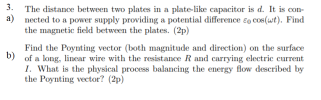 3. a) The distance between two plates in a plate-like capacitor is d. It is con- nected to a power supply providing a potential difference Eo coswt). Find the magnetic field between the plates. (2p) b) Find the Poynting vector (both magnitude and direction on the surface of a long, linear wire with the resistance R and carrying electric current I. What is the physical process balancing the energy flow described by the Poynting vector? (2p)
V sin(wt) is maintained across a parallel-plate capacitor with capacitance C consisting of two circular parallel...
 V sin(wt) is maintained across a parallel-plate capacitor with capacitance C consisting of two circular parallel plates. A thin wire with resistance R connects the centers of the two plates, allowing charge to leak between plates while they are charging. A potential difference V(t) (a) Obtain an expression for the leakage current I(t) in the thin wire. (Use the following as necessary: R, V, t and .) Ire(t)= Use this result to obtain an expression for the current I(t in...
12. The B-field through a one-turn loop of wire E1.0r having a radius of 10 cm...
 12. The B-field through a one-turn loop of wire E1.0r having a radius of 10 cm and a total resistance of 10 changes with time as shown in the graph at the right. Plot a. the EMF induced in the loop as a function 20.5 of time. b. the rate at which heat is dissipated in the t (s) loop as a function of time. 13. A rectangular loop of wire having sides L and L/3 and resistance R lies...
 Problem 5: If the capacitor plates in the figure have radius R and the electric field is increasing at a rate dE/dt = exp(wt). a) Find an expression for the induced magnetic field for r < R. Do the same for r > R. d) What is the current in the wire? As charge flows onto plates, ... ...E field between plates increases. Field lines of induced B field are circles.
 Suppose that, instead of forming a complete ring, the two ends of the wire are connected to the electrodes of a parallel-plate capacitor. The capacitor plates are circular with radius 1.0 cm and separation 1.0 mm. Again, the magnetic field strength is initially B 0.750 T and subsequently decreases in time at the constant rate -0.035 T/s (a) Sketch a charge diagram illustrating the final charge distribution on the capacitor plates When this final distribution is obtained, what is the...
 5. A 10-cm diameter parallel plate capacitor has a 1.00 mm spacing (see the figure). A continues current I is being used to charge this capacitor, and this current causes the electric field between the plates to change at a rate of 5.0 x 10 volt/m s. R=5 mm a. Find the magnetic field (magnitude and direction) at a point 2.0 mm radially from the center of the wire leading out of the capacitor (see the figure). (10 pts.) b....
 2. (15 points) Consider a capacitor with plates of area A separated by a distance d being fed current by infinitely long wires connected to each plate. If the electric field as a function of time inside the capacitor is E(t) = Eocos(wt), find: a) The magnetic field magnitude & direction) at any distance r from the wire (far away from the capacitor). b) The charge on the capacitor as a function of t (the capacitance of a parallel plate...
 In the figure (Figure 1) the capacitor plates have area 31.00
cm2 and are separated by a distance of 2.00 mm (the figure is not
drawn to scale). The plates are in vacuum. A sinusoidal potential
difference with a maximum value of 740 V and a frequency of 60 Hz
is applied across the plates; that isV(t)=( 740 V
)sin[2?(60Hz)t]. The
current iC(t) which charges or
discharges the capacitor is also sinusoidal. In the figure, the
current is shown at...
In the figure (Figure 1) the capacitor plates have area 31.00
cm2 and are separated by a distance of 2.00 mm (the figure is not
drawn to scale). The plates are in vacuum. A sinusoidal potential
difference with a maximum value of 740 V and a frequency of 60 Hz
is applied across the plates; that isV(t)=( 740 V
)sin[2?(60Hz)t]. The
current iC(t) which charges or
discharges the capacitor is also sinusoidal. In the figure, the
current is shown at...
 3. a) The distance between two plates in a plate-like capacitor is d. It is con- nected to a power supply providing a potential difference Eo coswt). Find the magnetic field between the plates. (2p) b) Find the Poynting vector (both magnitude and direction on the surface of a long, linear wire with the resistance R and carrying electric current I. What is the physical process balancing the energy flow described by the Poynting vector? (2p)
 V sin(wt) is maintained across a parallel-plate capacitor with capacitance C consisting of two circular parallel plates. A thin wire with resistance R connects the centers of the two plates, allowing charge to leak between plates while they are charging. A potential difference V(t) (a) Obtain an expression for the leakage current I(t) in the thin wire. (Use the following as necessary: R, V, t and .) Ire(t)= Use this result to obtain an expression for the current I(t in...
 12. The B-field through a one-turn loop of wire E1.0r having a radius of 10 cm and a total resistance of 10 changes with time as shown in the graph at the right. Plot a. the EMF induced in the loop as a function 20.5 of time. b. the rate at which heat is dissipated in the t (s) loop as a function of time. 13. A rectangular loop of wire having sides L and L/3 and resistance R lies...
Most questions answered within 3 hours.
-
Where is the error in this code sequence?
String s1 = "Hello";
String s2 = "ello";...
asked 10 months ago -
Financial data for Joel de Paris, Inc., for last year
follow:
Joel de Paris, Inc.
Balance...
asked 10 months ago -
Consider this reaction:
Al2(SO4)3 (aq)+ BaCl3
(aq) Al2Cl6 (aq)- +
3BaSO4(s) . What is the...
asked 10 months ago -
Suppose that Savneet is considering increasing her
recent random sample from 20 car rentals to 40...
asked 10 months ago -
Trucks arrive at an unloading terminal at an average rate of 120
per hour.
Trucks arrive...
asked 10 months ago -
Why are methanol and ethanol completely soluble in water while
octanol is not very little soluble....
asked 10 months ago -
A facilities manager at a university reads in a research report
that the mean amount of...
asked 10 months ago -
When the CuSO4 is rehydrated by adding water to the anhydrous
compound, is this an endothermic...
asked 10 months ago -
A ray of sunlight is passing from diamond into crown glass; the
angle of incidence is...
asked 10 months ago -
A block of mass 0.249 kg is placed on top of a light, vertical
spring of...
asked 10 months ago -
how do the kidneys compensate in the presences of acidosis
a) trigger hyperventilate
b) reserve acid...
asked 10 months ago -
Question 501 pts
The rental rate of capital to the firm increases. Which of the
following...
asked 10 months ago