
Homework Answers
Add Answer to:
0 Figure 2: The potential barrier setup for Problem 4 4. (10 points) "Burrowing a hole...
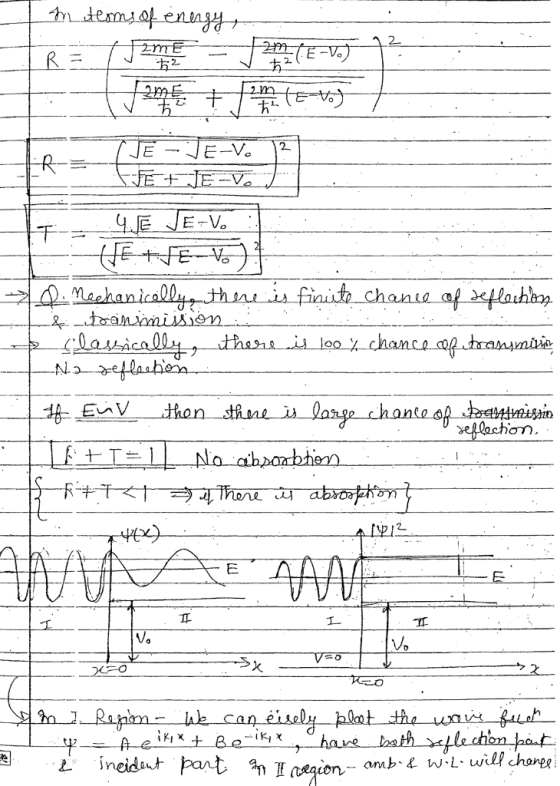
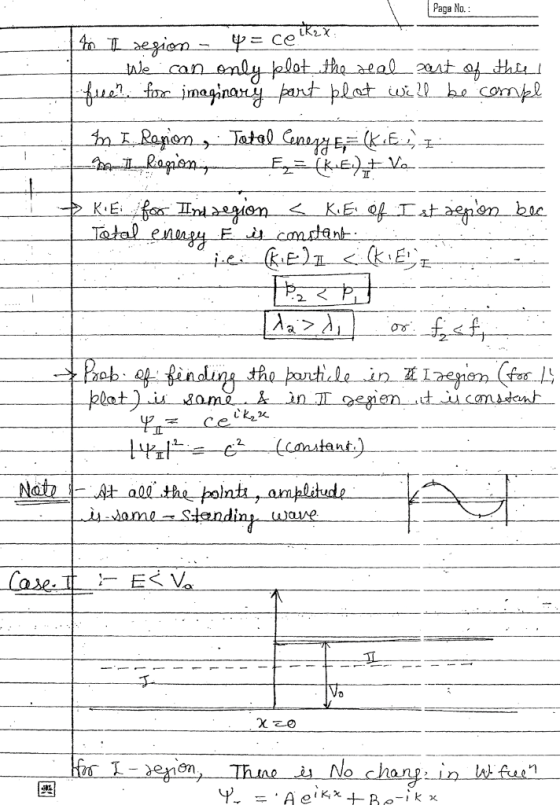
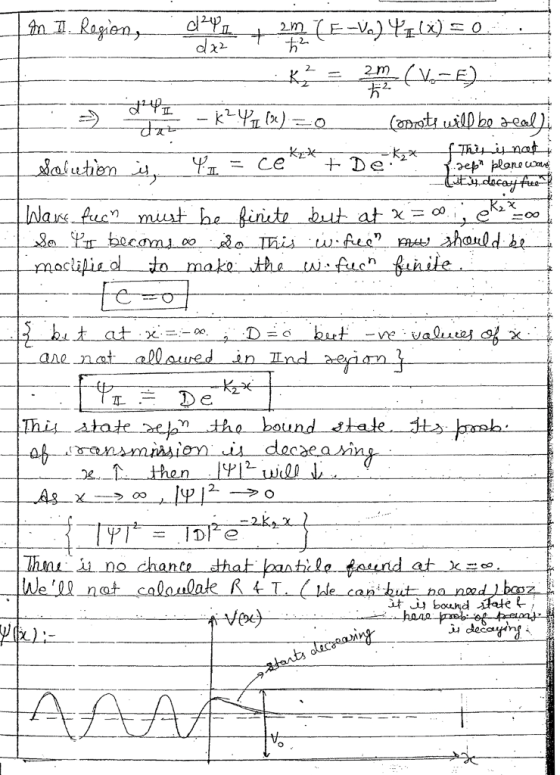
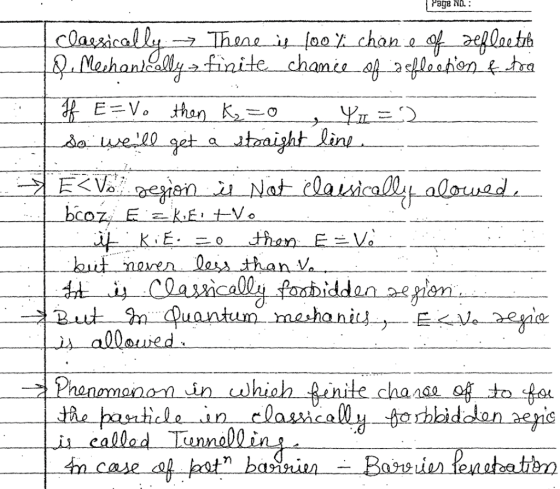
(III) Quantum Tunneling Consider an electron in 1D in presence of a potential barrier of width...
 (III) Quantum Tunneling Consider an electron in 1D in presence of a potential barrier of width L represented by a step function ſo I<0 or 1>L V U. r>0 and 2<L The total wavefunction is subject to the time-independent Schrödinger equation = EV (2) 2m ar2 +V where E is the energy of the quantum particle in question and m is the mass of the quantum particle. A The total wavefunction of a free particle that enters the barrier from...
mechani mie The potential energy barrier shown below is a simplified model of thec electrons in...
 mechani mie The potential energy barrier shown below is a simplified model of thec electrons in metals. The metal workfunction (Ew), the minimum energy required to remove an electron from the metal, is given by Ew-,-E where 1s the height of the potential energy barrier and E is the energy of the electrons near the surface of the metal. The potential energy barrier is = 5 eV V(x) V=0 (a) The wavefunction of an electron on the surface (x< 0)...
5. Consider a square potential barrier in figure below: V(x) 0 x <0 a) Assume that...
 5. Consider a square potential barrier in figure below: V(x) 0 x <0 a) Assume that incident particles of energy E> v are coming from-X. Find the stationary states (the equations for region . 2 and 3 and the main equation for the all regions). Apply the matching limit conditions in the figure. Explain and find all the constants used in the equations in terms of the parameters provided and Planck's constant -(6) Find the transmission and reflection coefficients. -(4)
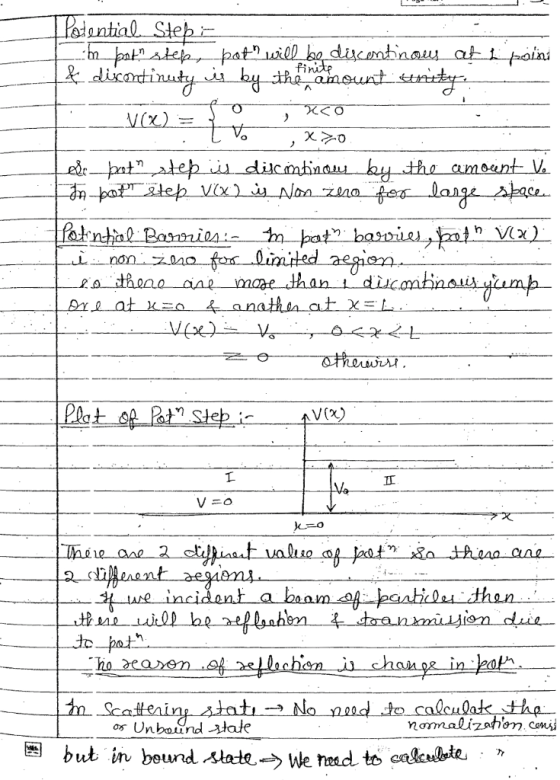
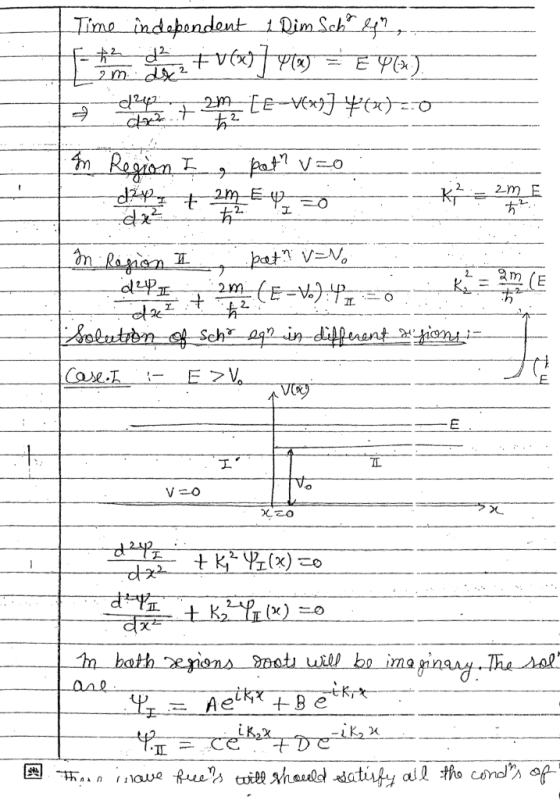
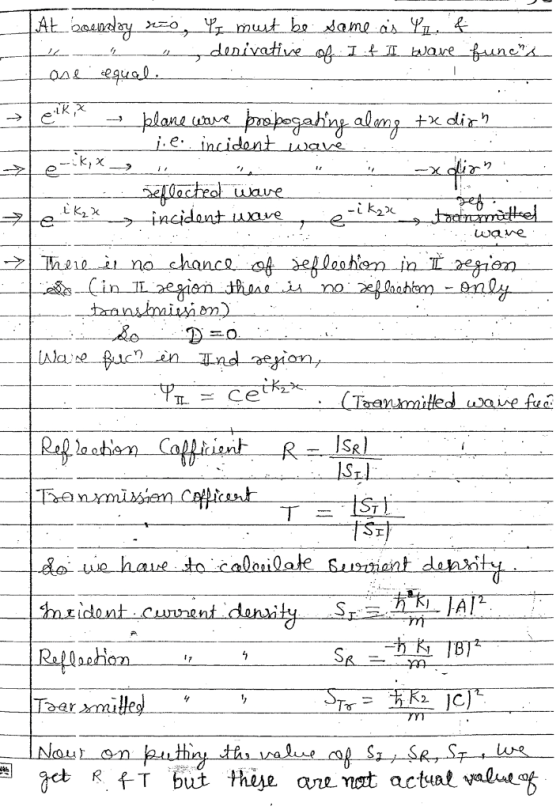
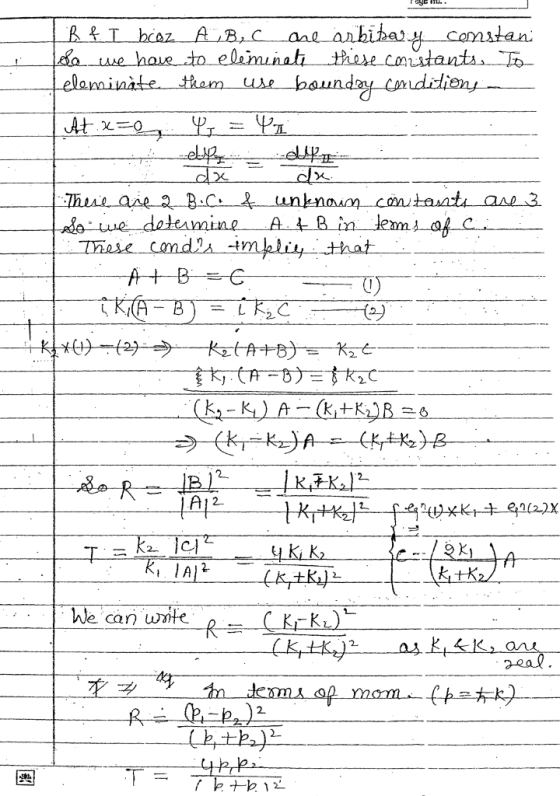
toward a Problem 4 (30 points): Consider a current of particles of energy E moving from...
 toward a Problem 4 (30 points): Consider a current of particles of energy E moving from x = - potential step as shown in the figure. x > 0 V(x) = {v. x<0 TE Where E > V a) (8 points) Derive the general solution of Schrödinger equation for x < 0 and for x > 0 b) (14 points) Apply the boundary conditions and calculate the transmission and the reflection coefficients. c) (8 points) What is the value of...
The interaction potential between 2 particles that generates the desired effect of particles coming together, sticking,...
 The interaction potential between 2 particles that generates the desired effect of particles coming together, sticking, and bouncing off if knocked with sufficient energy is given by the Lennard-Jones (LJ) interaction potential. This potential as a function of distance r between any 2 particles is: U(n) = 4e (9)"-09)) (1) Consider a solution of gold nanoparticles of diameter o = 2 nm. Take e 1 eV. Note that 1 eV = 1.6 x 10⁻¹⁹ Joules. 2. At what distance between...
(15 points) Encounter with a semi-infinite potential "well" In this problem we will investigate one situation involving a a semi-infinite one-dimensional po- tential well (Figure 1) U=0 regio...
 (15 points) Encounter with a semi-infinite potential "well" In this problem we will investigate one situation involving a a semi-infinite one-dimensional po- tential well (Figure 1) U=0 region 1 region 2 region 3 Figure 1: Semi-infinite potential for Problem 3 This potential is piecewise defined as follows where Uo is some positive value of energy. The three intervals in x have been labeled region 1,2 and 3 in Figure 1 Consider a particle of mass m f 0 moving in...
Consider a potential well defined as U(x) = for x < 0, U(x) = 0 for 0 < x < L, and U(x) = U0 > 0 for x > L (see the following figure).
 Consider a potential well defined as \(U(x)=\infty\) for \(x<0, U(x)=0\)for \(0<x<L,\)and \(U(x)=U_{0}>0\) for \(x>L\) (see the following figure). Consider a particle with mass \(m\) and kinetic energy \(E<U_{0}\)that is trapped in the well. (a) The boundary condition at the infinite wall ( \(x=\)0) is \(\psi(x)=0\). What must the form of the function \(\psi(x)\) for \(0<x<L\)be in order to satisfy both the Schrödinger equation and this boundary condition? (b) The wave function must remain finite as \(x \rightarrow \infty\). What must...
Question 2 A metal-semiconductor junction has barrier potential height of 1.265 V. The semiconductor is uniformly...
 Question 2 A metal-semiconductor junction has barrier potential height of 1.265 V. The semiconductor is uniformly doped with 1015 cm-3 Phosphorus and the other parameters are as listed below. a) Derive the electric field distribution, E as a function distance, x at thermal equilibrium. The metal-semiconductor interface is defined as x=0. State the boundary condition used. b) Derive the potential distribution, V as a function of distance, x under thermal equilibrium. Determine the potentials at the metal-semiconductor interface (x=0) and...
Lcarning Goal: Submit My Answers Glve Up To understand the qualities of the finite square-well potential...
 Lcarning Goal: Submit My Answers Glve Up To understand the qualities of the finite square-well potential and how to connect solutions to the Schrödinger equation from different regions. Correct The case of a particle in an infinite potential well, also known as the particle in a box, is one of the simplest in quantum mechanics. The closely related finite potential well is substantially more complicated to solve, but it also shows more of the qualities that are characteristic of quantum...
4. Anharmonic potential (15 points) The adjacent figure shows the experimentally determined potential energy curve of the electronic ground state of"Br2, with a few of the vibrational levels. The...
 4. Anharmonic potential (15 points) The adjacent figure shows the experimentally determined potential energy curve of the electronic ground state of"Br2, with a few of the vibrational levels. The vibrational transitions are reasonably well described by a harmonic oscillator model, but much more accurately by including a small anharmonic correction term: En/hcVe(n 1/2) - vexe(n + 1/2)2. From fits to experimental data, the values of the constants are 325.32 cm and exe 1.08 cm .5 10 15 (a) Calculate the...
 (III) Quantum Tunneling Consider an electron in 1D in presence of a potential barrier of width L represented by a step function ſo I<0 or 1>L V U. r>0 and 2<L The total wavefunction is subject to the time-independent Schrödinger equation = EV (2) 2m ar2 +V where E is the energy of the quantum particle in question and m is the mass of the quantum particle. A The total wavefunction of a free particle that enters the barrier from...
 mechani mie The potential energy barrier shown below is a simplified model of thec electrons in metals. The metal workfunction (Ew), the minimum energy required to remove an electron from the metal, is given by Ew-,-E where 1s the height of the potential energy barrier and E is the energy of the electrons near the surface of the metal. The potential energy barrier is = 5 eV V(x) V=0 (a) The wavefunction of an electron on the surface (x< 0)...
 5. Consider a square potential barrier in figure below: V(x) 0 x <0 a) Assume that incident particles of energy E> v are coming from-X. Find the stationary states (the equations for region . 2 and 3 and the main equation for the all regions). Apply the matching limit conditions in the figure. Explain and find all the constants used in the equations in terms of the parameters provided and Planck's constant -(6) Find the transmission and reflection coefficients. -(4)
 toward a Problem 4 (30 points): Consider a current of particles of energy E moving from x = - potential step as shown in the figure. x > 0 V(x) = {v. x<0 TE Where E > V a) (8 points) Derive the general solution of Schrödinger equation for x < 0 and for x > 0 b) (14 points) Apply the boundary conditions and calculate the transmission and the reflection coefficients. c) (8 points) What is the value of...
 The interaction potential between 2 particles that generates the desired effect of particles coming together, sticking, and bouncing off if knocked with sufficient energy is given by the Lennard-Jones (LJ) interaction potential. This potential as a function of distance r between any 2 particles is: U(n) = 4e (9)"-09)) (1) Consider a solution of gold nanoparticles of diameter o = 2 nm. Take e 1 eV. Note that 1 eV = 1.6 x 10⁻¹⁹ Joules. 2. At what distance between...
 (15 points) Encounter with a semi-infinite potential "well" In this problem we will investigate one situation involving a a semi-infinite one-dimensional po- tential well (Figure 1) U=0 region 1 region 2 region 3 Figure 1: Semi-infinite potential for Problem 3 This potential is piecewise defined as follows where Uo is some positive value of energy. The three intervals in x have been labeled region 1,2 and 3 in Figure 1 Consider a particle of mass m f 0 moving in...
 Question 2 A metal-semiconductor junction has barrier potential height of 1.265 V. The semiconductor is uniformly doped with 1015 cm-3 Phosphorus and the other parameters are as listed below. a) Derive the electric field distribution, E as a function distance, x at thermal equilibrium. The metal-semiconductor interface is defined as x=0. State the boundary condition used. b) Derive the potential distribution, V as a function of distance, x under thermal equilibrium. Determine the potentials at the metal-semiconductor interface (x=0) and...
 Lcarning Goal: Submit My Answers Glve Up To understand the qualities of the finite square-well potential and how to connect solutions to the Schrödinger equation from different regions. Correct The case of a particle in an infinite potential well, also known as the particle in a box, is one of the simplest in quantum mechanics. The closely related finite potential well is substantially more complicated to solve, but it also shows more of the qualities that are characteristic of quantum...
 4. Anharmonic potential (15 points) The adjacent figure shows the experimentally determined potential energy curve of the electronic ground state of"Br2, with a few of the vibrational levels. The vibrational transitions are reasonably well described by a harmonic oscillator model, but much more accurately by including a small anharmonic correction term: En/hcVe(n 1/2) - vexe(n + 1/2)2. From fits to experimental data, the values of the constants are 325.32 cm and exe 1.08 cm .5 10 15 (a) Calculate the...
Most questions answered within 3 hours.
-
Where is the error in this code sequence?
String s1 = "Hello";
String s2 = "ello";...
asked 10 months ago -
Financial data for Joel de Paris, Inc., for last year
follow:
Joel de Paris, Inc.
Balance...
asked 10 months ago -
Consider this reaction:
Al2(SO4)3 (aq)+ BaCl3
(aq) Al2Cl6 (aq)- +
3BaSO4(s) . What is the...
asked 10 months ago -
Suppose that Savneet is considering increasing her
recent random sample from 20 car rentals to 40...
asked 10 months ago -
Trucks arrive at an unloading terminal at an average rate of 120
per hour.
Trucks arrive...
asked 10 months ago -
Why are methanol and ethanol completely soluble in water while
octanol is not very little soluble....
asked 10 months ago -
A facilities manager at a university reads in a research report
that the mean amount of...
asked 10 months ago -
When the CuSO4 is rehydrated by adding water to the anhydrous
compound, is this an endothermic...
asked 10 months ago -
A ray of sunlight is passing from diamond into crown glass; the
angle of incidence is...
asked 10 months ago -
A block of mass 0.249 kg is placed on top of a light, vertical
spring of...
asked 10 months ago -
how do the kidneys compensate in the presences of acidosis
a) trigger hyperventilate
b) reserve acid...
asked 10 months ago -
Question 501 pts
The rental rate of capital to the firm increases. Which of the
following...
asked 10 months ago